00080000/dsh-project-memory
Persistent project memory for DeepSeek Harness(dsh) agents. Indexes documents (PDF / Markdown / txt) and code symbols into a per-workspace store, refreshes them automatically, and recalls them with source citations — documents are cross-linked to the code symbols they reference.
catalog 简介 / catalog descriptioncatalog description:Read-time project memory plugin for DeepSeek Harness (dsh)
项目介绍Project Overview
这是 DSH 代理的持久项目记忆插件:将 PDF/Markdown/txt 文档与代码符号索引到工作区存储,自动刷新并按 BM25 检索带来源引用,文档与符号交叉链接。适合会话压缩后快速恢复项目上下文、复用经验笔记。注意默认懒索引,未被读取的文件不会入库。
A persistent project-memory plugin for DSH agents. It indexes PDF/Markdown/txt documents and code symbols into a per-workspace store, refreshes them automatically, and retrieves entries via BM25 with path:line citations, cross-linking docs to referenced symbols. Use it to reorient after compaction and reuse experience notes. Caveat: lazy indexing is default, so files never read are not indexed.
请帮我了解并安装插件:【dsh-project-memory】【https://github.com/00080000/dsh-project-memory】把上面这条消息直接发给当前会话里的 DSH,让它帮你了解并安装。安装命令不一定准确,发给 DSH 更稳。Send this message to DSH in your current session. CLI install commands may not be accurate across systems — DSH will figure it out for you.
或使用命令行安装(适合开发者)Or use CLI install (for developers)
命令行安装CLI Install
dsh plugin --profile web add @yolk_vat-y/dsh-project-memory -w把 00080000/dsh-project-memory 加入你的 DSH 配置(web profile)即可启用。
READMEREADME
dsh-project-memory



Persistent project memory for DeepSeek Harness(dsh) agents. Indexes documents (PDF / Markdown / txt) and code symbols into a per-workspace store, refreshes them automatically, and recalls them with source citations — documents are cross-linked to the code symbols they reference.
The plugin keeps a compact project index on disk, with every entry pointing to a concrete file and line — the agent can reorient quickly instead of re-reading the whole project.
Features
- Document indexing — PDF, Markdown, and plain text files are chunked and summarized by the LLM; each entry carries a
path:linecitation back to the source. - Code symbol table — function, class, and method names are extracted by a dependency-free source scanner (string/comment masking, multi-line signature joining, indentation-aware Python, class-method context), without LLM token usage.
- Automatic refresh — a background poll (
watch_repo) detects new or changed files by content hash and re-indexes only those. - Read-time indexing — files are indexed the moment the model actually reads them (
fs/observed), so the index is a byproduct of normal work, not a separate upfront scan. Files that are never read are never indexed. The project root is detected by markers (.git,package.json, …), a README plus source directories, or the file's own directory as a last resort. - Doc ↔ code cross-linking — when a document mentions a symbol, the match is recorded as a
reference; querying a symbol also surfaces the documents that describe it. - BM25 retrieval — ranked search over documents, symbols, and experience notes, with optional LLM query expansion to handle vocabulary mismatch.
- Experience notes — problems → solutions; similar problems supersede instead of duplicating, and notes are returned only when a search matches. The note store is bounded: capacity scales with project size (clamped to 100–2000), and the oldest notes are pruned when the limit is exceeded.
- Minimal dependencies — pure JavaScript; the only runtime dependency is
pdfjs-dist(PDF text extraction), no native builds required.
How it works
The design follows four principles:
- Volatility — context is ephemeral; it is lost when a session is compacted.
- Persistence — the index is stored on disk and survives compaction and new sessions.
- Compactness — only summaries are stored; the index runs around 0.5% the size of the source it covers (8.8 MB of source → 49 KB of index in the example project), so retrieval replaces re-reading the full file.
- Verifiability — hits carry a
path:linecitation where applicable, so the agent can confirm details against the source.
Building the index does not require an upfront scan: files are indexed as the model reads them, so the index grows to cover exactly what has been worked with. Re-reading a file that has not changed is a no-op (content hash), so the index stays fresh with minimal ongoing overhead.
The store is per-project and follows the codebase: changed files are re-extracted by content hash, deleted files are removed. Experience notes are retrieval-only, so accumulation does not affect context.
Installation
Tested against dsh 0.1.0-rc.7 through 0.1.1-rc.2. Newer rc lines are expected to work — the plugin only touches stable surfaces (defineTool, llm.stream, Schema) — but they are not individually verified. The host provides @deepseek-ai/cordis ^4.0.1 and @deepseek-ai/schemastery ^3.18.1, declared via peerDependencies.
cd dsh-project-memory
dsh plugin --profile web add . -w
The -w (workspace-root) flag is required: the profile directory is a pnpm workspace root, and pnpm rejects add there without it. From any other directory, the path form works the same: dsh plugin --profile web add /path/to/dsh-project-memory -w.
The plugin is also published on npm as a scoped package:
dsh plugin --profile web add @yolk_vat-y/dsh-project-memory -w
A prebuilt tarball is published with each release, installable without a build step:
dsh plugin --profile web add /path/to/dsh-project-memory-0.1.6.tgz
Each indexed project has its own store at <root>/.dsh-project-memory/. Add it to .gitignore if it should not be committed.
Usage
The tools below are invoked by the agent, not typed by the user. In the chat, just ask naturally — e.g. "index this project" or "what does the auth module do?" — or simply keep working, and the agent calls the matching tool automatically. By default (lazyIndexing) files are indexed the moment the model reads them, so memory fills in while you work. watch_repo keeps explicitly-watched roots fresh in the background; index_repo forces a full backfill of a project (unchanged files are skipped).
| Tool | Purpose |
|---|---|
index_doc file_path |
Index one document (PDF/MD/txt): chunk → LLM summary → store with path:line. Unchanged files are skipped. |
index_repo root |
Index a whole project: docs get LLM summaries, code files get a zero-token symbol table. Incremental, cleans up deleted files, cross-links docs to symbols. |
watch_repo root |
Enable automatic refresh: a background poll detects new/changed files (mtime + content hash) and re-indexes only those. Watched roots persist across plugin restarts. |
memory_stats root |
Show what the store contains: totals (files / entries / experience notes), last index time, and the per-file list sorted by recency. |
query_memory query |
BM25 search over docs + symbols + experience, optionally query-expanded by the LLM. Returns ranked hits with relative scores, sources, and doc→symbol references. |
remember problem solution |
Save an experience note. Similar problems supersede instead of duplicating. |
forget id_or_query |
Delete stale experience notes. |
Design
.dsh-project-memory/
  format.json      layout marker (v2, sharded)
  shards/          one self-describing JSON per indexed source file
                   ({ relPath, record, entries }) — writes touch only dirty shards
  experience.json  problem → solution notes (retrieval-only)
  watch.json       watched roots
Stores created before v0.2.0 (single entries.json / index.json) migrate automatically and idempotently on first load. Within one dsh process, all tool calls share a single in-memory store per project, so hot-path indexing writes only the shard that changed.
- Incremental — content hash per file; only changed files are re-extracted.
- Cross-linking — after indexing, doc summaries are matched against symbol names; matches are attached to the doc entry as
referencesand surfaced byquery_memory. - Query expansion — when
llmQueryExpansionis on,query_memoryasksctx.llmto rewrite the query into several variants (synonyms, EN/CN, identifier guesses) and merges BM25 scores across variants; when off, queries never touch the LLM. Cross-language recall (a Chinese question hitting English content) comes from index time instead: doc keywords are required to cover the document's own language AND English, and doc↔symbol links surface English symbol names from Chinese hits. - Consistency — the fact layer follows the codebase (hash re-extract / remove-on-delete); the experience layer is retrieval-only with supersede and
forget. Store writes are serialized per memory directory; the lock is in-process, so avoid running multiple dsh instances against the same project store concurrently.
Design tradeoffs
These are deliberate scope choices.
- In-process locking — store writes are serialized per memory directory within one dsh process; two dsh instances sharing a project store is last-writer-wins. A cross-process lock would need a resident daemon, which conflicts with the pure-JS, no-background-service positioning, so multi-instance writes are explicitly unsupported.
- Watch poll holds the lock — while the watcher re-indexes changed docs (LLM summarization),
remember/forgetqueue behind it. Polling (mtime + content hash) instead offs.watchevents keeps behavior consistent across platforms; overlapping polls serialize on the same lock: safe, but they can pile up on very large diffs. Tune viawatchInterval. - Corrupt files are quarantined — a store JSON that fails to parse falls back to empty for that file and is rebuilt on the next write; the broken file is renamed to
*.corruptwith an error logged, but its data cannot be recovered. Auto-repairing partial writes would need a write-ahead journal or an embedded database — out of proportion when quarantining one bad file costs nothing. - Absolute source paths — entries cite absolute paths; moving a project invalidates citations until the next re-index.
forgetby query is eager — keyword deletion matches at ≥0.5 token overlap and may remove several notes at once; prefer deleting by id for precision.- Cross-language recall depends on index time — with
llmQueryExpansionoff, a Chinese-only query reaches English content through bilingual keywords captured when docs are indexed, plus doc↔symbol links; queries stay LLM-free. Stores indexed before v0.1.1 gain bilingual keywords as files change, or immediately viaindex_repowithreindex: true.
Configuration
| Key | Default | Meaning |
|---|---|---|
memoryDir |
.dsh-project-memory |
store directory inside each indexed root |
chunkChars |
3000 | max chars per document chunk |
maxChunksPerFile |
40 | max chunks per document |
maxFileSizeMb |
50 | skip documents (incl. PDF) and code files larger than this (MB) |
maxOutputChars |
8000 | cap for query_memory result text (chars) |
maxPdfPages |
1000 | PDF page cap when pages are not otherwise limited |
llmQueryExpansion |
false | expand queries via ctx.llm before BM25 (off by default to save tokens) |
expansionCount |
6 | max expansion variants |
lazyIndexing |
true | index files the moment the model reads them (fs/observed) |
autoIndexOnFirstUse |
false | full scan of the current working directory on plugin load (opt-in) |
watch |
true | enable the background refresh |
watchInterval |
15 | poll interval (seconds) |
Toggling features
The two most relevant switches are lazyIndexing (index a file the moment the model reads it; default on) and autoIndexOnFirstUse (full scan of the current working directory on plugin load; default off). Lazily indexed project roots are automatically registered with the watcher, so changed files stay fresh without an explicit watch_repo.
Settings live in the plugin's config object. To change them, add an override entry to your profile's cordis.patch.yml — for the web profile that is ~/.dsh/profiles/web/cordis.patch.yml:
- id: project-memory
  config:
    lazyIndexing: true          # on: index files as the model reads them (default)
    autoIndexOnFirstUse: false  # off: no upfront full scan (default)
    llmQueryExpansion: false    # off: do not spend tokens on LLM query expansion (default)
    watch: true                 # on: background refresh for watched roots (default)
    watchInterval: 15           # poll interval in seconds
Only list the keys you want to change; the rest fall back to the plugin defaults. Verify the result with dsh --profile web --dump-config.
For a one-off run without editing the profile, pass the override as a CLI patch overlay:
dsh web --patch ./config.yml
where config.yml contains the same override block.
Development (for contributors)
These commands are for maintaining the plugin code — regular users do not need them. Installing the plugin only requires the command in Installation.
npm install
npm test          # chunker / symbols / store / tools / BM25 / links / watch / lazy / config / dump / concurrency / restore / size limit
License
MIT
相关推荐Related
-
 nexu-io/open-design
🎨 Best DeepSeek Harness Design Plugin. The open-source Claude Design alternative. 🖥️ Local-first desktop app. 🖼️ Your…
nexu-io/open-design
🎨 Best DeepSeek Harness Design Plugin. The open-source Claude Design alternative. 🖥️ Local-first desktop app. 🖼️ Your…
-
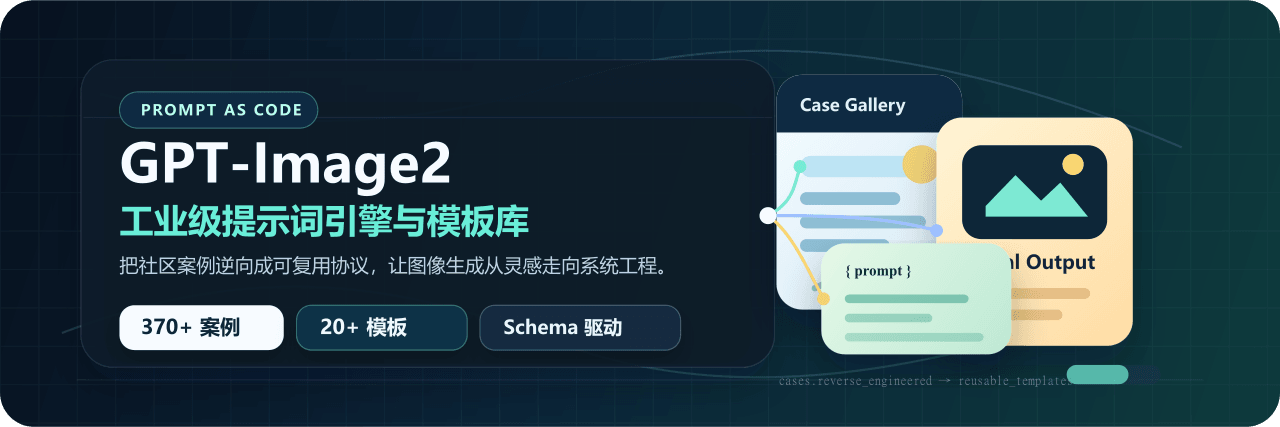 freestylefly/awesome-gpt-image-2
Prompt as Code | GPT-Image2 工业级提示词引擎与模板库,530+ 个案例逆向工程,20+ 套工业级模板,并提炼出Skills,持续更新中
freestylefly/awesome-gpt-image-2
Prompt as Code | GPT-Image2 工业级提示词引擎与模板库,530+ 个案例逆向工程,20+ 套工业级模板,并提炼出Skills,持续更新中
-
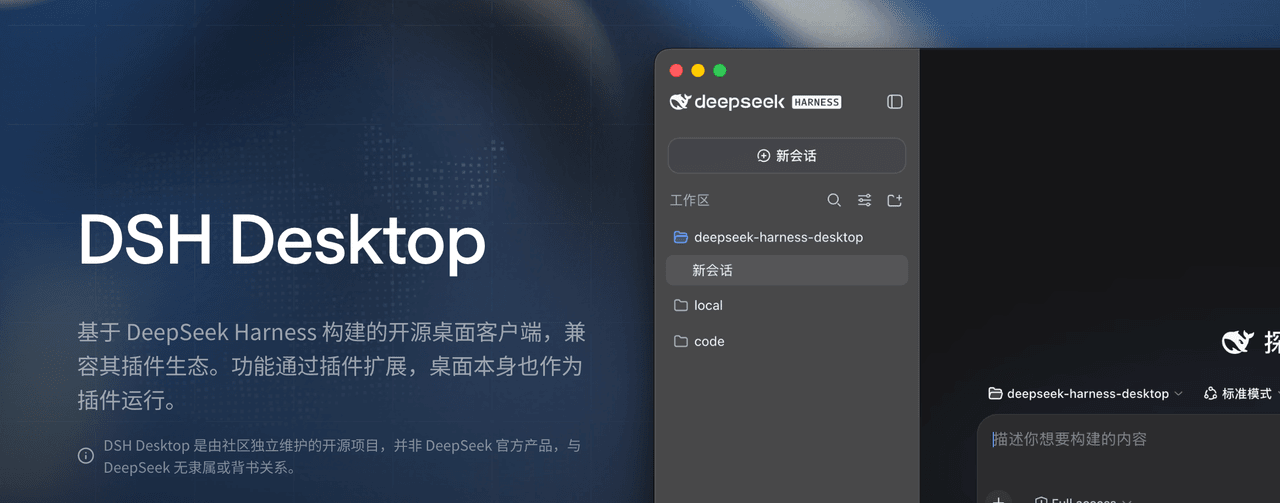 anywhere-labs/dsh-desktop
为 DeepSeek Harness (DSH) 插件生态打造的现代化桌面端解决方案。万物皆「插件」,桌面本身也是「插件」。
anywhere-labs/dsh-desktop
为 DeepSeek Harness (DSH) 插件生态打造的现代化桌面端解决方案。万物皆「插件」,桌面本身也是「插件」。
- Nagi-ovo/voyager Enhancement suite for Gemini, AI Studio, Claude & ChatGPT — plus a prompt manager for any web UI, DeepSeek Harness inclu…
-
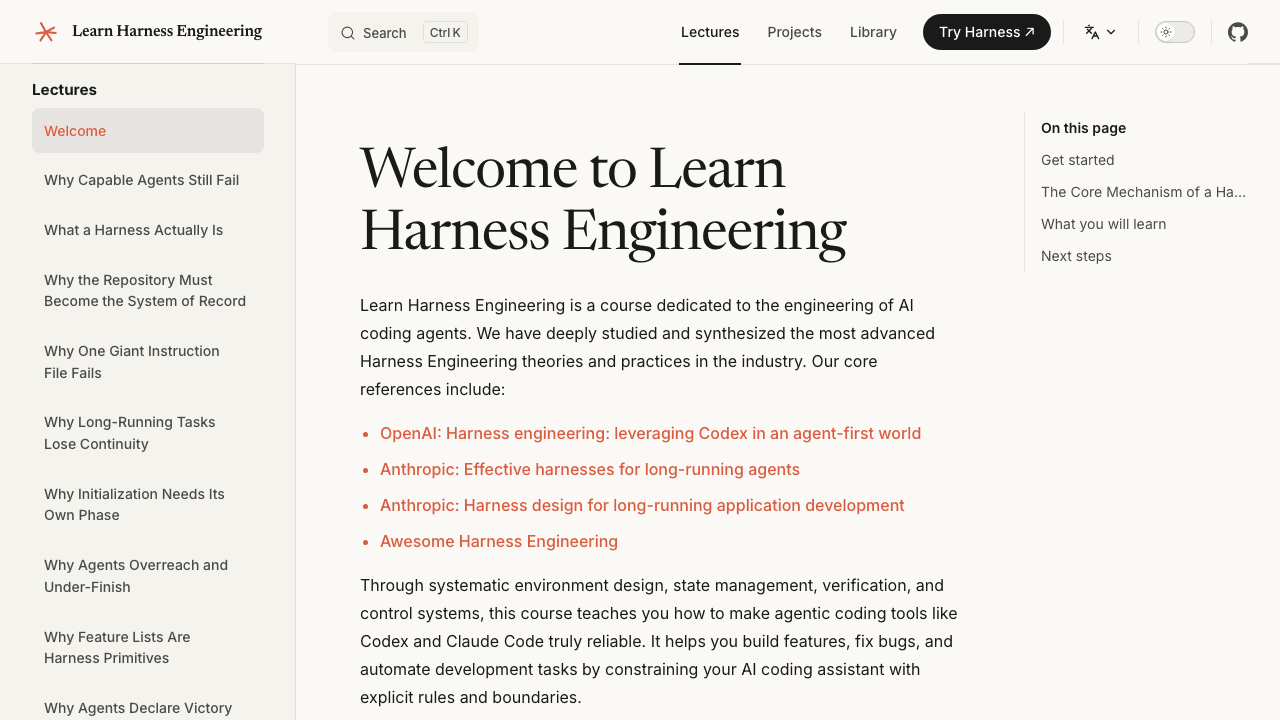 walkinglabs/learn-harness-engineering
Harness engineering beginner tutorial, from 0 to 1
walkinglabs/learn-harness-engineering
Harness engineering beginner tutorial, from 0 to 1
-
 awesome-dsh-plugin/awesome-dsh-plugin
A curated list of plugins for DeepSeek Harness (dsh) · DeepSeek Harness 插件精选列表
awesome-dsh-plugin/awesome-dsh-plugin
A curated list of plugins for DeepSeek Harness (dsh) · DeepSeek Harness 插件精选列表
-
 MemTensor/MemOS
Self-evolving memory OS for LLM & AI Agents: ultra-persistent memory, hybrid-retrieval, and cross-task skill reuse, with…
MemTensor/MemOS
Self-evolving memory OS for LLM & AI Agents: ultra-persistent memory, hybrid-retrieval, and cross-task skill reuse, with…
- yjh051108/dsh-routing-suite dsh-routing-suite — injector + router-standard kit: install the runtime injector first, then the task-aware reasoning-mo…