aaronlei/dsh-web-search-diy
A web search provider plugin for the DeepSeek Harness (DSH) that backs the built-in websearch tool with multiple search backends, returning structured citation sources. A single mode switch selects the protocol:
catalog descriptioncatalog 简介 / catalog description:DeepSeek Harness(DSH)网页搜索提供方插件:把内置 web_search 工具接到 OpenAI 兼容 Responses API 及其原生 web_search 工具上。
Project Overview项目介绍
This is a custom web search plugin for DeepSeek Harness (DSH). It supports multiple search backend protocols, lets you replace the default search provider and configure your own gateway, model and credentials. Use it when you need real-time web search for LLM queries. You need to bring your own API key from your selected search platform.
这是DeepSeek Harness(DSH)的自定义网页搜索插件,支持多种搜索后端协议,可替换默认搜索提供商,允许用户自定义搜索网关端点、模型和凭据。需要联网搜索实时信息时使用,注意需自备对应平台的API密钥。
请帮我了解并安装插件:【dsh-web-search-diy】【https://github.com/aaronlei/dsh-web-search-diy】Send this message to DSH in your current session. CLI install commands may not be accurate across systems — DSH will figure it out for you.把上面这条消息直接发给当前会话里的 DSH,让它帮你了解并安装。安装命令不一定准确,发给 DSH 更稳。
Or use CLI install (for developers)或使用命令行安装(适合开发者)
CLI Install命令行安装
dsh plugin --profile web add dsh-web-search-diy把 aaronlei/dsh-web-search-diy 加入你的 DSH 配置(web profile)即可启用。
READMEREADME
dsh-web-search-diy

A web search provider plugin for the DeepSeek Harness (DSH) that backs
the built-in web_search tool with multiple search backends, returning
structured citation sources. A single mode switch selects the protocol:
mode |
Protocol | Backend |
|---|---|---|
responses (default) |
OpenAI-compatible Responses API + web_search tool |
Qwen Token Plan (default example), OpenAI, any compatible gateway |
zhipu-web-search |
Zhipu Web Search API (basic retrieval, POST /web_search) |
Zhipu open platform; raw structured results, no model turn |
zhipu-chat-search |
Zhipu Web Search in Chat (answer augmentation, /chat/completions + web_search tool) |
Zhipu open platform; retrieval fused into a grounded answer |
In responses mode, endpoint, model, and key reference are yours to swap —
the only requirement is a model that actually exposes the web_search tool on
its gateway.
- Default model:
deepseek-v4-flash-0731 - Default endpoint:
https://token-plan.cn-beijing.maas.aliyuncs.com/compatible-mode/v1 - Default key reference:
QWEN_TOKEN_PLAN_CN_API_KEY
In zhipu-* modes: default endpoint https://open.bigmodel.cn/api/paas/v4,
default key reference ZHIPU_API_KEY, and zhipu-chat-search defaults its
model to glm-5.3-flash (with thinking effort low, ~3.5s live-verified —
the free-tier glm-4.7-flash is frequently rate-limited with HTTP 429 and is
not the default). See the
Zhipu web search docs.
Why
The shipped DSH search provider (deepseek-official) calls DeepSeek's own
Anthropic-compatible endpoint — it cannot be pointed at other gateways, and
switching per deployment is hard. This plugin is a first-class DSH plugin:
it registers a ctx.web search provider and overrides the shared
searchProvider to it, exactly like the ecosystem's other provider plugins.
Search and conversation models stay fully decoupled — use it with any chat LLM.
Why Responses API? Many OpenAI-compatible gateways only trigger their built-in web search through the Responses API (
/responses) with an explicittools: [{type: "web_search"}]declaration — Chat Completions search flags are silently ignored there. This plugin speaks the Responses protocol and parses the structuredweb_search_callblocks'action.sourcesinto seam-standard citation sources.
Install
Published on npm:
dsh plugin --profile web add dsh-web-search-diy
The bundle patch then (no manual cordis.patch.yml edits needed):
- inserts the
web-search-diyloader entry - overrides the shared
webrow'ssearchProvidertodiy-searchand restatesfetchProvider: http(a patch replaces the whole row config) - disables the shipped DeepSeek-official search (
web-search-deepseek)
For local development, install the checkout as a linked package (the same way other local plugins are linked):
dsh plugin --profile web add link:./dsh-web-search-diy
(replace ./dsh-web-search-diy with the actual path to your local checkout)
Note for local linked installs: the plugin declares its
@deepseek-ai/*hooks aspeerDependencies(mirrored indevDependencies). A linked package resolves its ownnode_modulesfirst, so runpnpm installinside the plugin directory once; the harness install supplies the runtime peers.
Configuration
The provider resolves options with precedence: UI-managed file
($DSH_HOME/dsh-web-search-diy.json, written by the Settings card) >
settings section / entry config > package defaults.
| Key | Default | Meaning |
|---|---|---|
mode |
responses |
Protocol mode: responses / zhipu-web-search / zhipu-chat-search |
apiKey |
— | Literal API key; overrides apiKeyEnv when set |
apiKeyEnv |
per mode (see above) | Credential reference resolved per search via ctx.credentials |
baseURL |
per mode (see above) | API base; /responses, /web_search, or /chat/completions is appended per mode |
model |
per mode (see above) | Model served by the endpoint; zhipu-web-search has no model turn and ignores this key |
maxOutputTokens |
1024 |
Output cap for one search turn (max_output_tokens in responses, max_tokens in zhipu-chat-search) |
searchEngine |
search_std |
Zhipu engine: search_std / search_pro / search_pro_sogou / search_pro_quark (Zhipu modes only) |
count |
10 |
Zhipu result count (1-50); a request-supplied maxResults cap takes precedence (Zhipu modes only) |
searchRecencyFilter |
noLimit |
Zhipu recency window: noLimit / oneDay / oneWeek / oneMonth / oneYear (Zhipu modes only) |
contentSize |
medium |
Zhipu snippet size: medium / high (Zhipu modes only) |
searchDomainFilter |
— | Zhipu domain allowlist, e.g. www.example.com (Zhipu modes only) |
searchIntent |
false |
Zhipu intent recognition; off searches directly (Zhipu zhipu-web-search only) |
searchPrompt |
— | Zhipu chat search prompt; blank uses the official default (zhipu-chat-search only) |
reasoningEffort |
low |
Thinking effort (reasoning_effort) for the chat turn: low / high / max; low keeps thinking-only models like GLM-5.3-Flash fast (zhipu-chat-search only) |
responsesReasoningEffort |
— (unset) | OpenAI-standard reasoning.effort for the responses turn: low / high; unset sends no reasoning parameter and follows the model's own mode — keep it unset if the gateway rejects unknown parameters (responses mode only) |
apiKeyEnv/baseURL/modelleft empty inherit the current mode's default. Values fossilized into a section by the old schema defaults (the Qwen endpoint/model/reference) yield to the zhipu defaults when you switch to a zhipu mode; explicitly customized values are always honored.
Settings card
The configuration card lives under Settings → Plugins → Plugin configuration → Custom web search, in the same form as the shipped Shell / Agent loop cards: edits stage locally (an "unsaved" badge appears in the header) and only Save writes, while Discard reverts to the stored values. Saving takes effect immediately — no restart. Card copy follows Settings → Language (zh / en). The API key input is write-only: leave it blank to keep the stored key.
How it works
you ──> chat LLM
            │ decides it needs live info
            ▼
     web_search tool (model-agnostic)
            │ ctx.web seam ──> diy-search provider
            ▼
     ├─ responses:        POST {baseURL}/responses   tools: [{ type: "web_search" }]
     ├─ zhipu-web-search: POST {baseURL}/web_search  (raw retrieval, no model turn)
     └─ zhipu-chat-search:POST {baseURL}/chat/completions  tools: [{ type: "web_search", web_search: {...} }]
            │
            ▼
     chat LLM answers grounded in the results
- responses: each search is one Responses API call (a full model turn).
Results return as deduped
sources[](url + optional title fromurl_citationannotations) plus the model's groundedcontent. A response without anyweb_search_callblock fails loudly withWEB_PROVIDER_ERROR— never a prose-scraping fallback. - zhipu-web-search:
search_result[]maps directly into dedupedsources[](url + title), and a digest of the top title-plus-snippet entries becomes thecontentoverview. An empty result set is a valid outcome and returns emptysources[]rather than an error. - zhipu-chat-search:
choices[0].message.contentis the grounded answer (content); the tool'ssearch_result: truedeclaration makes the endpoint attach source details, which are parsed defensively from the message-level or root-levelweb_searchfield intosources[]. A grounded answer without source details is still a usable result.
Credential
Store the key through the web Models page / credentials service (the
default reference is per mode: QWEN_TOKEN_PLAN_CN_API_KEY in responses
mode, ZHIPU_API_KEY in the zhipu modes), or export it in the launching
environment. The provider resolves it per search; no key is retained on the
provider.
License
MIT — see LICENSE. Copyright (c) 2026 aaronlei.
Related相关推荐
-
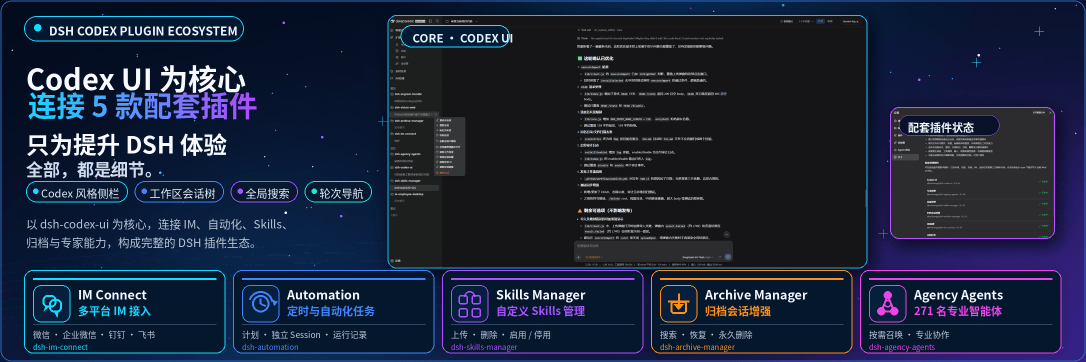 MichengAI/dsh-codex-ui
DSH Codex UI — 为 DeepSeek Harness Web 提供 Codex 风格侧栏、工作区会话树、全局搜索和轮次导航 · A Codex-style sidebar, workspace session tree, gl…
MichengAI/dsh-codex-ui
DSH Codex UI — 为 DeepSeek Harness Web 提供 Codex 风格侧栏、工作区会话树、全局搜索和轮次导航 · A Codex-style sidebar, workspace session tree, gl…
-
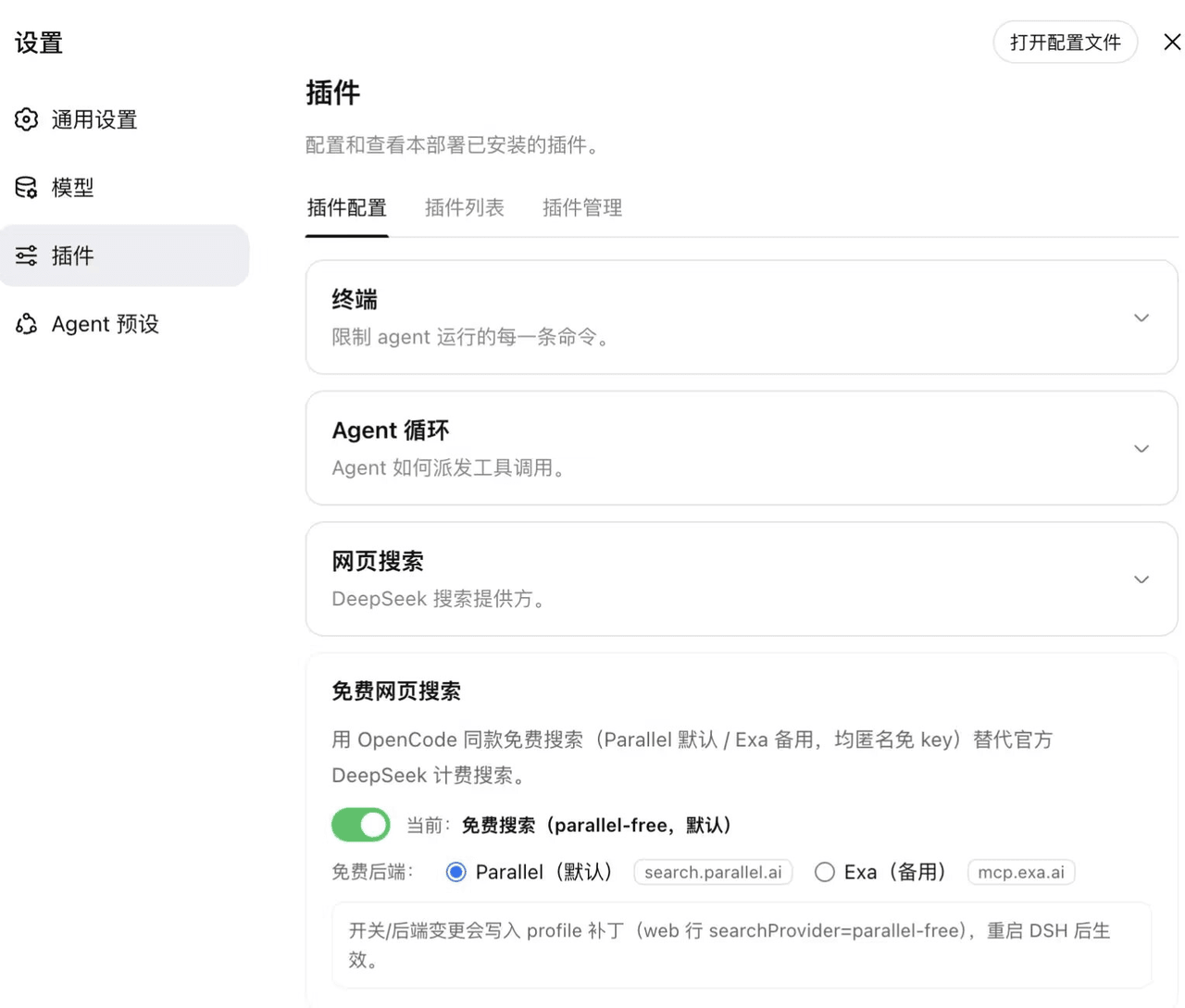 sheep-programmer/dsh-web-search-free
DSH 插件:免费网页搜索,双免费后端(Parallel 默认 + Exa 备用,均匿名免 key)+ 设置开关 + MCP server 双传输(stdio + HTTP/SSE 双端口),兼容 Claude Code / Codex |…
sheep-programmer/dsh-web-search-free
DSH 插件:免费网页搜索,双免费后端(Parallel 默认 + Exa 备用,均匿名免 key)+ 设置开关 + MCP server 双传输(stdio + HTTP/SSE 双端口),兼容 Claude Code / Codex |…
- Letter2025/dsh-tool-search Tool search & slimming for DeepSeek Harness: Hermes-style progressive disclosure — search, describe, and call long-tail …
-
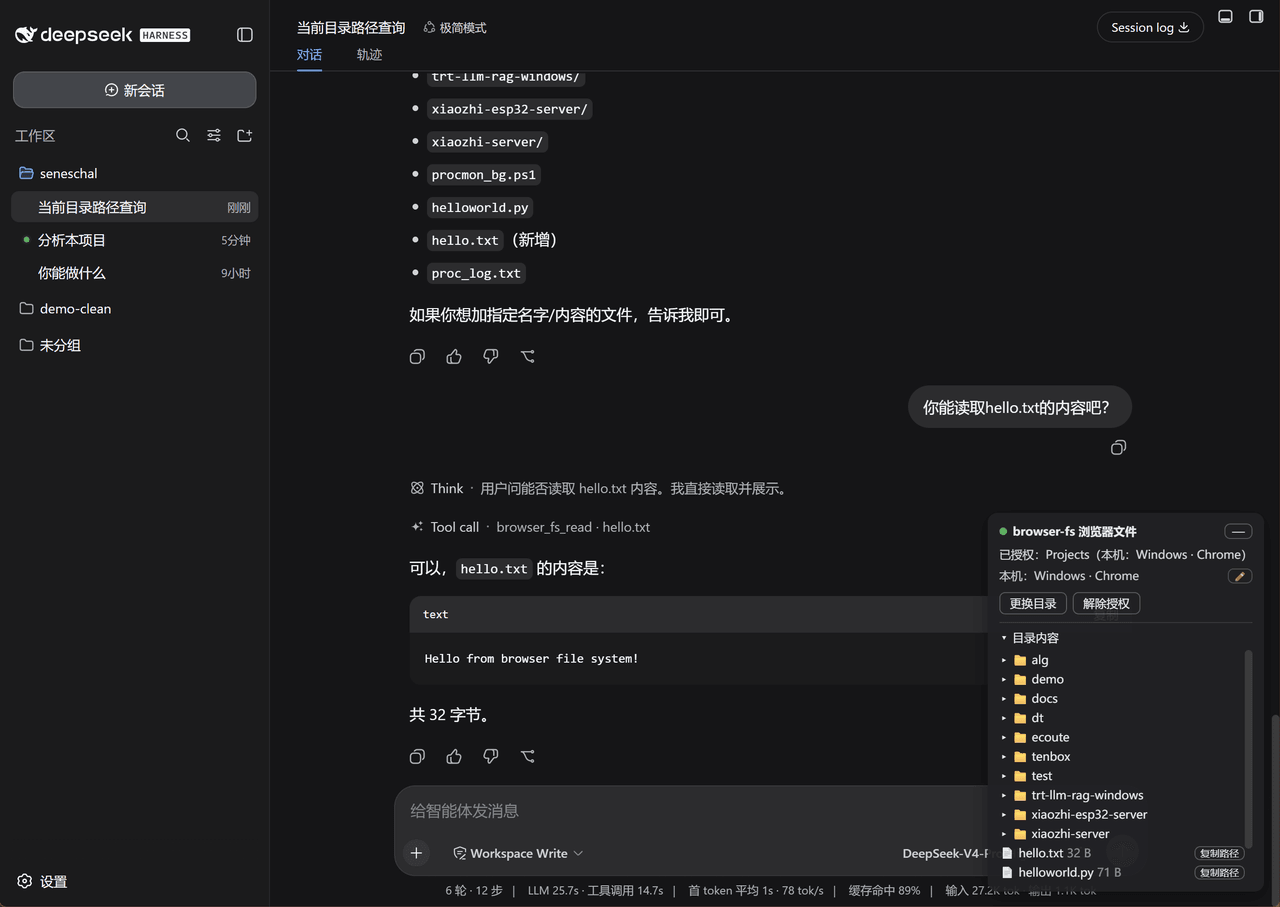 whitefirer/dsh-browser-fs
dsh(DeepSeek Harness)插件:让 agent 读写浏览器所在机器的本地文件——File System Access 授权 + WS 中继,含非安全上下文兼容模式
whitefirer/dsh-browser-fs
dsh(DeepSeek Harness)插件:让 agent 读写浏览器所在机器的本地文件——File System Access 授权 + WS 中继,含非安全上下文兼容模式
- a1141171521/dsh-thinking-effort dsh 工作区可添加多文件夹/第三方厂商模型可开启推理等级插件
- Zachary7456/dsh-voice-mic DeepSeek Harness (dsh) 语音输入插件:麦克风按钮/快捷键录音,实时转写回填输入框。三种识别引擎:浏览器 Web Speech、本地 SenseVoice/Paraformer 离线后端(一键部署)、OpenAI 兼容云…
-
 Hilbert-beinghappy/seektty
面向 DeepSeek Harness 的 Claude Code 风格终端界面,支持 Windows、macOS 与 Linux,兼容透明终端、VS Code 主题和自定义配色。
Hilbert-beinghappy/seektty
面向 DeepSeek Harness 的 Claude Code 风格终端界面,支持 Windows、macOS 与 Linux,兼容透明终端、VS Code 主题和自定义配色。
-
 weijiafu14/pi2dsh
Bridge the Pi and DeepSeek Harness ecosystems: one Pi Host ABI runs unmodified Pi extensions as native DSH plugins. 打通 P…
weijiafu14/pi2dsh
Bridge the Pi and DeepSeek Harness ecosystems: one Pi Host ABI runs unmodified Pi extensions as native DSH plugins. 打通 P…