AngelosZou/dsh-pdf-reader
Project Overview项目介绍
DSH PDF Reader is a DeepSeek Harness plugin for content-aware PDF reading by vision models, built on PyMuPDF. It reads a PDF the way its content demands: text-heavy pages are extracted as text, while figure, table, formula-heavy, or two-column pages are rendered as high-DPI region crops so vector figures and table structure are never lost to the per-image token ceiling. Use it for any paper or report with mixed layouts, especially two-column PDFs with vector figures or structured tables; start with pdf_scan to profile the document, then loop preview → content → refine with pdf_read_page and pdf_render_region. Caveat: region detection is heuristic and may over-flag, so critical tables or formulas may still need a targeted pdf_render_region.
DSH PDF 阅读器是基于 PyMuPDF 的插件,可让视觉模型按页面内容读取 PDF:纯文本页用提取,图表、表格、公式或双栏页用高 DPI 区域裁剪,避免小字、矢量图与表格结构因每图 token 上限而丢失。使用方式:先 pdf_scan 看全文档分布,再 pdf_read_page 取预览、文本与自动裁好的高分辨率 PNG 路径(缓存在 .dsh-pdf-reader),最后用 pdf_render_region 按坐标精修。需 Node ≥ 20 与 Python 3 + pymupdf;缺依赖时工具返回明确的安装提示,不直接报错。区域检测为启发式,会偏多识别为图/表,公式识别对堆叠分式也可能不完美,此时建议直接对目标坐标精修。
请帮我了解并安装插件:【dsh-pdf-reader】【https://github.com/AngelosZou/dsh-pdf-reader】Send this message to DSH in your current session. CLI install commands may not be accurate across systems — DSH will figure it out for you.把上面这条消息直接发给当前会话里的 DSH,让它帮你了解并安装。安装命令不一定准确,发给 DSH 更稳。
Or use CLI install (for developers)或使用命令行安装(适合开发者)
CLI Install命令行安装
dsh plugin --profile web add dsh-pdf-reader把 AngelosZou/dsh-pdf-reader 加入你的 DSH 配置(web profile)即可启用。
READMEREADME
dsh-pdf-reader
DeepSeek Harness plugin for content-aware PDF reading by vision models.
The plugin reads a PDF the way its content demands: text-heavy pages are extracted as text, while figures, tables, formula-heavy or two-column pages are rendered as high-DPI region crops fed to the vision model — so a paper's vector figures and structured tables are never lost to the per-image token ceiling.
Backed by PyMuPDF. When Python or a dependency is missing, the tools return a clear, actionable warning (with the exact install command) for the agent to resolve, instead of failing hard.
Install
dsh plugin --profile web add dsh-pdf-reader
Requires a Python interpreter with pymupdf.
After installing Python, you can install the
dsh-python-env plugin in DeepSeek
Harness so the agent handles the dependency automatically — it will create a
project venv and install pymupdf itself, with no manual steps:
dsh plugin --profile web add dsh-python-env
To set it up by hand instead:
python -m venv .venv
.venv\Scripts\python.exe -m pip install pymupdf
Tools
| Tool | What it does |
|---|---|
pdf_scan |
Per-page content profile — columns, figures (vector regions), raster images, tables, text characters, hasGraphics, formulaRisk, hasTextLayer. Use first to decide how each page should be read. |
pdf_read_page |
Read one page. mode=mixed is the one-shot: a low-res fullPage preview + the page text + every auto-detected figure/table region as high-DPI PNGs (paths, cached in .dsh-pdf-reader). mode=auto/text/render force a single path. |
pdf_render_region |
Targeted high-res render of a [x0,y0,x1,y1] region at budget-filling DPI (or an explicit dpi), returning its path for read_image. |
Recommended workflow
The tools are built around a preview → content → refine loop so large PDFs stay cheap and no layout is lost to flattening:
- Preview (whole page, low-res). Call
pdf_read_page --mode mixedfor a page. It returns a low-resfullPagerender (the whole layout — formulas, table gridlines, figure placement, two-column order) plus the page's text. Look at the preview to see what is on the page before spending high-res budget on it. - Content (auto, cached). The same
mixedcall auto-detects every figure and table region and renders each as a high-DPI PNG. All PNGs are written to<cwd>/.dsh-pdf-readerand returned only as paths — heavy/long content lives in the cache, never inlined into your context. Feed the paths toread_image. - Refine (on demand). If a specific area is still too small, or was not
auto-cropped (an uncropped formula, a crowded table cell, a sub-figure), zoom it
with
pdf_render_regionon the exact[x0,y0,x1,y1]you read off thefullPagepreview.
Start any document with pdf_scan (whole-document overview) to plan which pages
are text-only vs figure/table/formula-rich, then apply the loop per page.
Why this design
A two-column paper's figures are usually vector (only page rasterization can see them), tables lose structure under text extraction, and formulas garble in some text layers. Meanwhile DeepSeek caps each image at ~800×800-equivalent / 384 tokens — so reading a whole two-column page at that budget makes each column ~350px and loses small text, sub/superscripts and figure detail. The fix:
- Text pages → extraction (cheap, precise, preserves prose + inline math that PyMuPDF decodes well).
- Figure/table/math pages → render the region and scale it to fill the
~640k-pixel budget via
dpi = 72 × sqrt(640000 / region_pt_area). Content is complete (nothing legible is lost inside the budget) and token-optimal (rendered AT the budget, not beyond it).
Region detection is heuristic (not a perfect classifier) and deliberately biased
toward rendering — vector clusters from get_drawings(), raster rects from
get_image_rects(), the same clustering for tables, and math from fonts + a LaTeX
producer. It over-flags (a ruled table or a logo may be treated as a figure) rather
than under-flagging, because rendering is cheap and safe.
When dependencies are missing
Each tool resolves a Python interpreter in priority order — the activated venv
($VIRTUAL_ENV) first, then PATH python/python3/py, then the project
.venv/venv/env — probes it for pymupdf (and optionally pymupdf4llm), and
picks the first one that can import it. If none can, it returns a warning naming
what is missing and how to fix it, so the agent can install the dependency,
switch interpreters, or fall back.
Limitations
page.find_tables()false-positives on plot grids and diagrams, so tables are primarily read by rendering (the reliable path); Markdown tables frompymupdf4llmare a best-effort extra.- Formula detection is heuristic (fonts + LaTeX producer). PyMuPDF decodes inline
math well, but stacked fractions can still be imperfect — use
pdf_render_regionon an equation when exact structure is needed. - A whole page renders to only ~83 DPI-equivalent at the budget; the tools never do that for a two-column page — they crop regions instead, and body text uses extraction.
- Large PDFs are parsed into memory.
Requirements
- Node ≥ 20,
@deepseek-ai/cordis^4,@deepseek-ai/dsh-tools(peer deps, provided by the harness). - Python 3 +
pymupdf(optionalpymupdf4llm).
License
MIT
Related相关推荐
-
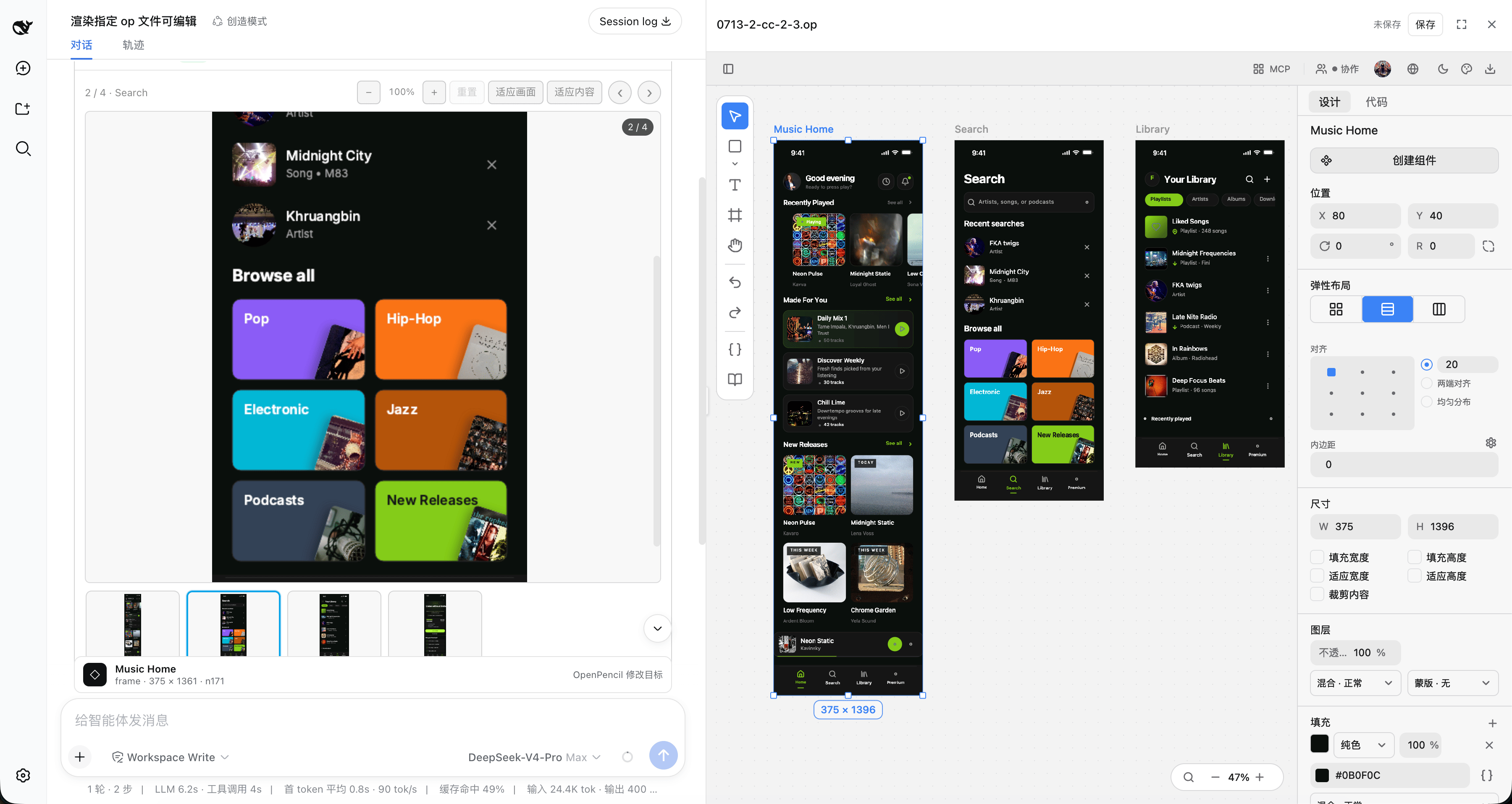 ZSeven-W/dsh-openpencil
The DeepSeek Harness plugin for OpenPencil — preview, inspect, and edit real .op documents inside a conversation.
ZSeven-W/dsh-openpencil
The DeepSeek Harness plugin for OpenPencil — preview, inspect, and edit real .op documents inside a conversation.
-
 HanaAyane/dsh-reasoning-effort
DSH适用的Codex风格的思考强度滑块,以及大肥鱼跑步滑块。Codex-style model and reasoning-effort slider for DeepSeek Harness
HanaAyane/dsh-reasoning-effort
DSH适用的Codex风格的思考强度滑块,以及大肥鱼跑步滑块。Codex-style model and reasoning-effort slider for DeepSeek Harness
- FylarOpen/dsh-fylar-office-editor Office document preview, editing, and DOCX generation for DeepSeek Harness, powered by Fylar Office SDK.
-
 HuanLinOTO/dsh-plugin-better-sidebar-plugin-office
为 better-sidebar 提供 Office 三件套预览(.docx/.xlsx/.pptx),独立 bundle 瘦身主体 | Provides Office-suite preview (.docx/.xlsx/.pptx) f…
HuanLinOTO/dsh-plugin-better-sidebar-plugin-office
为 better-sidebar 提供 Office 三件套预览(.docx/.xlsx/.pptx),独立 bundle 瘦身主体 | Provides Office-suite preview (.docx/.xlsx/.pptx) f…
- Andiii208/dsh-ultramath UltraMath 数学建模竞赛多 Agent 求解 DSH 插件: 5 角色预设 + 33 篇模型库 + 论文模板/审稿脚本随包 + 进度可视化
-
 omdsh-dev/dsh-office
办公三件套!Office document tools for DeepSeek Harness (dsh): generate, read, and edit spreadsheets (.xlsx), PDFs, and present…
omdsh-dev/dsh-office
办公三件套!Office document tools for DeepSeek Harness (dsh): generate, read, and edit spreadsheets (.xlsx), PDFs, and present…
-
 dingyi222666/dsh-focus-chat
为 Deepseek Harness 提供新的「聚焦会话」精简会话视图,更轻松易于阅读,只关注最终产出结果。
dingyi222666/dsh-focus-chat
为 Deepseek Harness 提供新的「聚焦会话」精简会话视图,更轻松易于阅读,只关注最终产出结果。
-
 609476965/dsh-LorebookMD
DSH lorebook-driven fiction writer plugin: import Tavern/SillyTavern character cards & world books, save local Markdown …
609476965/dsh-LorebookMD
DSH lorebook-driven fiction writer plugin: import Tavern/SillyTavern character cards & world books, save local Markdown …