bobjia/dsh-context-milvus
claude-context-milvus like plugin for Deepseek Harness (DSH)
Project Overview项目介绍
This is an open-source plugin for DeepSeek Harness (DSH), built on Milvus vector database. It provides a full semantic code search pipeline with indexing and search. Use it on large codebases to improve DSH agent performance by cutting token usage and context pollution. It requires a running Milvus instance to work.
这是DeepSeek Harness基于Milvus的开源插件,提供完整的语义代码搜索索引与查询管线,支持代码索引、语义搜索、调用链追踪等功能。适用于大型代码库,可减少token消耗和上下文污染,提升DSH代理效率。注意需要预先部署可用的Milvus实例。
请帮我了解并安装插件:【dsh-context-milvus】【https://github.com/bobjia/dsh-context-milvus】Send this message to DSH in your current session. CLI install commands may not be accurate across systems — DSH will figure it out for you.把上面这条消息直接发给当前会话里的 DSH,让它帮你了解并安装。安装命令不一定准确,发给 DSH 更稳。
Or use CLI install (for developers)或使用命令行安装(适合开发者)
CLI Install命令行安装
dsh plugin --profile web add dsh-context-milvus把 bobjia/dsh-context-milvus 加入你的 DSH 配置(web profile)即可启用。
READMEREADME
dsh-context-milvus


English | 简体中文
A DSH plugin that provides semantic code search over a Milvus vector database, with a complete index ↔ search pipeline.
dsh-context-milvus = equips your DSH Agent with a dedicated codebase semantic search engine. Milvus handles high-speed vector retrieval, transforming "needle-in-a-haystack grep" into precise recall of relevant code snippets — reducing tokens, minimizing tool calls, and improving coding agent quality on large repositories.
Why dsh-context-milvus?
dsh-context-milvus is an open-source code semantic search plugin for DeepSeek Harness (DSH) coding agents, built on Milvus as the vector database and registered as a Cordis Plugin. Its core purpose: solve the high token consumption, excessive tool calls, context pollution, and poor large-codebase comprehension that plague native DSH Agent grep workflows.
Native DSH Agent workflow: encounter a problem → repeatedly
search_code(grep) →readfiles → search again, flooding the prompt with irrelevant text, exploding tool calls, increasing token costs, and making it easy to miss dependencies in large repositories.
Solving the key pain points of native grep search
| Native grep workflow pain point | dsh-context-milvus solution |
|---|---|
| Literal string matching only — semantically related but differently named code is missed | Vector semantic search — matches by code meaning, not just keywords |
| Multiple tool call rounds, reading many irrelevant files, token explosion | Returns only truly relevant code snippets, split by AST at function/class boundaries for precision |
| Flooding context with grep output and irrelevant source code, causing context pollution and degraded model reasoning | Milvus pre-built index, Agent gets concise effective context in one tool call without search noise in the prompt |
| Thousands of files in large repos, Agent traversal is extremely inefficient | Milvus vector DB enables fast retrieval over millions of code blocks, supports incremental index updates without full repo rescanning |
| Can only search already-open or known-path files | After full-repo indexing, can semantically search any code location regardless of file path knowledge |
Features
search_code— Semantic code search: natural language query, returns matching code snippetsindex_code— Index codebase: AST parsing + chunking → Embedding → Milvus storageindex_status— View index status: file count, last index time, hash statisticsfind_callers— Code relationship analysis (impact analysis): find all references to a symbol, with cross-file import resolutiontrace_call_chain— Call chain tracing: BFS expansion from entry symbol (impact/dependency analysis), with cross-file resolution disambiguation- Hybrid search — BM25 keyword + vector semantic dual-path retrieval, RRF fusion,
hybridModetoggle - Chunk overlap — AST chunks include surrounding context lines (
chunkContextLines, default 2) for better recall - Query expansion — expands natural-language queries with code synonyms before embedding (
queryExpansion, default on) - Two-stage reranking — retrieves a topK×3 pool then applies proportional term-overlap & name-match boosts, keeping the Milvus score primary (
rerankEnabled, default on) - Ignore pattern system — Three-layer gitignore-style ignore rules (default + codebase + global)
- Incremental indexing — Merkle SHA-256 hash tracking, processes only changed files
- Workspace isolation — Independent Merkle state files per workspace, no interference
- ADR decision memory system — Records design rationale behind code changes (Architecture Decision Records), supports semantic search, CRUD, constraint injection, and consistency checking
- Code relationship analysis — Extracts symbol references from AST during indexing (
references, language-specific syntax nodes), supports cross-file exact matching - Cross-file import resolution (V2) — Scans import/export statements using tree-sitter AST during indexing, builds a persistent bidirectional Import Map, enabling
find_callers/trace_call_chainto perform precise cross-file symbol matching (same-name disambiguation, cross-module tracing) - Native telemetry (opt-in) —
search_code/index_code/index_statuswrite one JSONL line per execution (disabled by default, no source code captured), with an analysis script for descriptive stats + Bootstrap CI + correlation
Codex CLI support
The retrieval engine behind this plugin is published separately as dsh-context-milvus-core, so the same code also runs as a stdio MCP server for OpenAI Codex CLI (and any other MCP client) from the codex-context-milvus package. It exposes the five retrieval tools — search_code, index_code, index_status, find_callers, trace_call_chain — and shares the same Milvus collection and per-workspace index state as the DSH plugin. Start it with ADR_ENABLED=true and the 8 ADR decision-memory tools are registered as well; the four that write to disk stay gated behind CONTEXT_MILVUS_ADR_WRITE.
Shortest setup:
codex mcp add context-milvus -- npx -y codex-context-milvus mcp
See packages/codex/README.md for the init wizard, the environment variable reference, the error-code table, and current limitations (ADR tools are off by default, no runtime config hot-reload).
Offline / air-gapped install
An offline machine cannot resolve the ~230-package production closure, so the payload has to be built on a connected one. Seed a scratch install with the package as its only production dependency, then carry either the npm cache or the whole node_modules:
mkdir ctxmilvus-offline && cd ctxmilvus-offline
npm init -y
npm pkg set dependencies.codex-context-milvus=0.2.0
npm install --omit=dev --cache ./npm-cache

tar czf ctxmilvus-offline.tgz npm-cache package.json package-lock.json   # method A
tar czf ctxmilvus-tree.tgz node_modules                                  # method B
On the target, method A installs with npm ci --omit=dev --offline --cache ./npm-cache (--offline makes npm fail on a missing tarball instead of reaching for a network that is not there), while method B only needs the tree extracted and the binary invoked directly. Two traps: the generated config.toml starts the server with npx -y, which is a registry call on every Codex launch, so point command/args at the local bin/mcp.js; and the tree-sitter* prebuilds for linux/darwin/win32 × x64/arm64 come inside the tarballs, so one bundle is cross-platform — any other triple needs a compiler. The full recipe, including the prebuild-pruning trick and the exact TOML, is in packages/codex/README.md → Offline install.
Effectiveness Evaluation
A reproducible statistical evaluation suite (see scripts/eval/) quantifies how dsh-context-milvus improves retrieval quality and end-to-end agent efficiency. It covers offline retrieval quality, end-to-end agent evaluation, and native telemetry — using nonparametric statistics (Wilcoxon, Bootstrap CI, Cliff's Δ) with a unified file-level relevance standard. Run instructions and full reports live in scripts/eval/*/output/report.md.
Offline retrieval quality — 21 annotated queries × 19-file multi-language corpus
Three retrieval strategies compared: G (grep keyword), R (naive RAG: sliding-window + pure vector), P (plugin: AST chunking + BM25 hybrid + RRF + chunk overlap + query expansion + two-stage reranking).
| Metric | G (grep) | R (naive RAG) | P (plugin) |
|---|---|---|---|
| recall@10 | 0.9524 | 1.0000 | 0.9524 |
| MRR | 0.6754 | 0.9524 | 0.8452 |
| nDCG@10 | 0.7446 | 0.9610 | 0.8725 |
| hit@1 | 0.4762 | 0.9048 | 0.7619 |
| precision@10 (file-level) | 0.4203 | 0.1095 | 0.2730 |
| precision@10 (chunk-level) | — | — | 0.3619 |
Note on precision@10: Two metrics are reported. File-level precision@10 de-duplicates results by file path (each file counted once), measuring how many unique relevant files appear in the top-K. Chunk-level precision@10 counts each result independently, matching the classic IR definition: "of the 10 entries the Agent sees, how many are from relevant files?" The chunk-level metric is higher because the Agent benefits from multiple chunks of the same relevant file clustering in the top results.
Key findings:
- Two-stage reranking lifts hit@1 by 6.7% (from 0.714 to 0.762 vs P0 baseline): proportional term-overlap (+30%) and name-matching (+15%) boosts improve first-hit accuracy. The gap to naive RAG (0.905) narrowed from 0.14 to 0.14.
- Chunk-level precision@10 = 0.362: the Agent sees ~3.6 relevant entries per 10 results. This is bounded by the corpus (each query has only 1-2 relevant files, each producing few chunks) — the ceiling is determined by the number of chunks per relevant file, not search quality.
- AST chunking + query expansion + chunk overlap drive precision: P vs R precision@10 +0.1635 (p=0.00013, Cliff's Δ=0.868 — large effect). Function/class-boundary chunks with surrounding context lines are far more focused than fixed sliding windows.
- Semantic search beats keyword grep on ranking: P vs G MRR +0.1698 (p=0.108), nDCG@10 +0.1280 (p=0.100) — relevant files rank higher, with near-significant p-values.
- grep precision is high but recall is brittle: G has the best precision@10 (0.4203) but the worst hit@1 (0.4762) — keyword-only search misses semantically-related code (e.g. "retry with exponential backoff" never matches
withRetry).
End-to-end agent evaluation — 8 tasks × 3 runs × 3 strategies
| Group | Average pass rate | Token consumption |
|---|---|---|
| G (grep) | 37.5% | baseline |
| R (naive RAG) | 50.0% | −928 vs G |
| P (plugin) | 62.5% | −2109 vs G |
Key findings:
- Highest task pass rate: P 62.5% vs G 37.5% vs R 50.0%.
- Significant token reduction: P vs G Δmean −2109 tokens/task (95% CI [−2325, −1864]), Wilcoxon p=0.014, significant after Holm correction, Cliff's Δ=−1.0. P also beats R by −928 tokens/task (p=0.014).
Native telemetry (opt-in)
search_code / index_code / index_status record execution metrics (query, result count, top score, duration, files/chunks indexed, etc.) as one JSONL line per call — disabled by default (telemetryEnabled: false), no source code content captured. Run node scripts/eval/telemetry/run.mjs to generate a descriptive statistics + Bootstrap CI + correlation report from ~/.milvus-index/telemetry.jsonl.
What role does Milvus play, and why Milvus?
- Stores AST-chunked code vectors: dsh-context-milvus uses tree-sitter AST to split code at function/class/method boundaries, generates embeddings, and stores them in Milvus — avoiding cutting a function in half.
- High-performance vector search: Encodes the query and performs vector similarity search with low latency, suitable for real-time Agent tool calls.
Note: BM25 keyword fusion is already implemented — Milvus native BM25 full-text search + vector semantic dual-path retrieval, RRF fusion (
hybridModeenabled by default). - Supports self-hosted Milvus / Zilliz Cloud, two deployment options; teams can control data; supports incremental indexing after code changes without full rebuild.
- Specifically adapted for code RAG: Supports path-scoped filtering (
search_codepathparameter), allowing directory-limited searches — ideal for codebase scenarios.
DSH plugin architecture advantages
It is not a standalone MCP service, but a DSH plugin (Cordis Plugin) embedded directly into the DSH Agent process:
- Zero network overhead: Plugin and Agent share the same process, tool calls don't go through HTTP, latency far below MCP
- Naturally shares DSH resource configuration: Reuses DSH's config management, environment variable injection, and logging system — no additional configuration needed
- DSH Web GUI integration: Visual configuration through Settings → Plugins interface, no YAML hand-editing
- DSH ecosystem compatibility: Shares the tool registry with other DSH plugins (bash, agent-loop, web-search, etc.), Agents can freely combine them
Core Workflow
Registered DSH tools
| Tool | Function | Key Parameters |
|---|---|---|
search_code |
Semantic code search | query (natural language), topK (result count), path (search scope) |
index_code |
Index codebase | mode (full/incremental), path (target path) |
index_status |
View index status | path (view per-workspace status) |
search_adr |
Semantic ADR search | query (natural language), status, topK |
search_adr_by_file |
Find ADRs by file path | file_path (code file path), status |
create_adr |
Create new ADR | title (required), requirement, change_type |
update_adr |
Update existing ADR | adr_id (required), content, status |
list_adrs |
List ADR records | status, change_type, limit |
load_constraints |
Load active ADR constraints | adr_ids, format |
check_adr_consistency |
Check ADR-code consistency | file_path, fix |
find_callers |
Find all references to a symbol for impact analysis, supports cross-file import resolution | symbol (required), direction, maxResults, sourceFile, resolve |
trace_call_chain |
BFS call chain tracing from entry symbol (impact/dependency analysis), supports import resolution disambiguation | entry (required), direction, maxDepth, maxResults, resolve |
Workflow
- Run
index_code: Parse the project, split code blocks via tree-sitter AST → call Embedding API to generate vectors → store in Milvus collection. - Agent encounters a coding problem, calls
search_codefor hybrid search (vector semantic + BM25 keyword, RRF fusion). - Milvus returns the most relevant code snippets, injected into the Agent's context.
- Agent debugs, refactors, or develops based on precise context — no more frantic grep file reading.
- After code changes, run
index_code mode=incrementalto incrementally re-index only changed files. - Check index status anytime with
index_status(indexed files, total code blocks, last index time). - Before modifying code, use
find_callersfor impact analysis: see which places reference the symbol to avoid missing cascading effects. For same-name symbols across files, use thesourceFileparameter to disambiguate by definition file. - Understand call chains with
trace_call_chain: BFS expansion from entry function,direction=backwardtraces callers,direction=forwardtraces downstream dependencies.resolve: falsefalls back to V1 name-matching mode. - Cross-file reference analysis:
find_callersandtrace_call_chainenable import resolution by default (resolve: true). The Import Map built during indexing automatically mapsimport { X } from './foo'tofoo.ts's exports, eliminating same-name ambiguity and supporting cross-module call chain tracing. Falls back to V1 name matching when the import map is not built.
ADR decision memory workflow
The ADR decision memory system records the "why" behind code changes (design decisions, trade-offs, constraints), enabling the Agent to not only read code but understand its evolution:
Note: ADR functionality is disabled by default. To enable it, set
adrEnabled: truein the DSH config panel (Settings → Plugins → dsh-context-milvus).
- Before modifying code with ADR coverage, use
search_adr_by_fileto check if the file has decision records, avoiding violation of existing decisions. - When making design decisions, use
create_adrto record the context, alternatives, and rationale, and useupdate_adrto maintain code_anchors linking to code locations. - When needing to understand constraints, use
load_constraintsto load active ADR constraints into the context. - After creating or updating ADRs, use
check_adr_consistencyto verify ADR-code consistency, withfixfor auto-repair. - Use
search_adrfor semantic search of historical decisions, understanding "why this was done this way."
Spec Document Fusion
When the brainstorming skill produces specification documents, they can be linked to the codebase through the following steps:
- Write spec documents: brainstorming output saved to
docs/superpowers/specs/YYYY-MM-DD-<topic>-design.md - Generate anchors: Call
index_specsto automatically detect code references in the document and generate frontmatter + code_anchors - Index:
index_codeautomatically scansdocs/superpowers/specs/anddocs/superpowers/plans/directories - Discover:
search_adrreturns both ADR and spec document results (withdocTypeannotation)
Configuration
| Field | Default | Description |
|---|---|---|
specRoot |
docs/superpowers/specs |
Spec document directory (relative to indexRoot) |
planRoot |
docs/superpowers/plans |
Implementation plan directory (relative to indexRoot) |
Spec document fusion follows the adrEnabled toggle — no additional configuration needed.
Prerequisites
1. Install Ollama (Embedding service)
# macOS
brew install ollama

# Linux
curl -fsSL https://ollama.com/install.sh | sh

# Start Ollama service
ollama serve
Or use any OpenAI-compatible Embedding API service (OpenAI, Alibaba Cloud Bailian, etc.) by configuring
embeddingEndpointandembeddingApiKey.
2. Install Embedding model
# Pull nomic-embed-text model (default)
ollama pull nomic-embed-text

# Or other supported Embedding models:
ollama pull bge-m3
ollama pull mxbai-embed-large
3. Install Milvus (vector database)
Docker (recommended):
# Pull and start Milvus standalone
docker run -d --name milvus \
  -p 19530:19530 \
  -p 9091:9091 \
  milvusdb/milvus:latest

# Verify connection
docker ps | grep milvus
Milvus cluster mode (Docker Compose):
# Download docker-compose file
wget https://github.com/milvus-io/milvus/releases/latest/download/milvus-standalone-docker-compose.yml -O docker-compose.yml

# Start
docker compose up -d
Or use Zilliz Cloud managed service — no self-hosting required.
Verify installation
# Verify Ollama
curl http://localhost:11434/api/tags

# Verify Milvus
docker run -it --rm \
  -e MILVUS_URL=localhost:19530 \
  milvusdb/milvus-sdk-node:latest \
  node -e "const {MilvusClient} = require('@zilliz/milvus2-sdk-node'); \
  new MilvusClient({address:'localhost:19530'}).listCollections().then(r=>console.log(r))"
Install to DSH
Method 1: From npm (recommended)
The plugin is published to the npm registry. Install directly via DSH CLI:
dsh plugin --profile web add dsh-context-milvus
The npm package includes pre-built
dist/output — no build step required during installation, avoiding theERR_PNPM_GIT_DEP_PREPARE_NOT_ALLOWEDerror.
Method 2: From local tarball (offline / local development)
Build and package as a tarball, then install directly:
# 1. Build
npm run build

# 2. Package as tarball
pnpm pack

# 3. Install to profile
dsh plugin --profile web add ./dsh-context-milvus-0.1.3.tgz
pnpm packproduces a tarball containing the compileddist/output — no build step required during installation, so pnpm won't raiseERR_PNPM_GIT_DEP_PREPARE_NOT_ALLOWED.
Method 3: From Git (requires additional configuration)
dsh plugin --profile web add git+https://github.com/bobjia/dsh-context-milvus.git
dist/output is not committed to git. The plugin uses thepreparescript to automatically runtscduring installation.pnpm 10 limitation: pnpm 10 blocks execution of build scripts by default. If you see:
ERR_PNPM_GIT_DEP_PREPARE_NOT_ALLOWED
The git-hosted package "dsh-context-milvus@0.1.2" needs to execute build scripts
but is not in the "onlyBuiltDependencies" allowlist.
Add to your profile's
pnpm-workspace.yaml:# ~/.dsh/profiles/<profile-name>/pnpm-workspace.yaml onlyBuiltDependencies: - dsh-context-milvusThen re-run the install command. Or run
pnpm approve-buildsand selectdsh-context-milvus.To avoid this authorization, use Method 1 (npm) or Method 2 (tarball).
Configure the plugin
After installation, edit cordis.patch.yml under your profile:
# ~/.dsh/profiles/<profile-name>/cordis.patch.yml
- id: dsh-context-milvus
  config:
    milvusAddress: localhost:19530
    milvusCollection: code_embeddings
    milvusDim: 768
    embeddingEndpoint: http://localhost:11434/api/embed
    embeddingModel: nomic-embed-text
    indexRoot: /path/to/your/code
    indexExtensions: .ts,.tsx,.js,.py,.java,.go,.rs,.cpp,.cs,.scala,.php
    hybridMode: true
    bm25RrfK: 60
Restart DSH after configuration.
Build from source (local development)
If using a local development version:
1. Install dependencies
cd /mnt/home/bobjia/workspace/dsh-context-milvus
npm install --legacy-peer-deps
2. Create symlinks for @deepseek-ai packages
# Link DSH runtime packages (npm install may break these links)
ln -sf /mnt/home/bobjia/.npm-global/lib/node_modules/@deepseek-ai/dsh/node_modules/@deepseek-ai/cordis \
  node_modules/@deepseek-ai/cordis
ln -sf /mnt/home/bobjia/.npm-global/lib/node_modules/@deepseek-ai/dsh/node_modules/@deepseek-ai/dsh-tools \
  node_modules/@deepseek-ai/dsh-tools
ln -sf /mnt/home/bobjia/.npm-global/lib/node_modules/@deepseek-ai/dsh/node_modules/@deepseek-ai/schemastery \
  node_modules/@deepseek-ai/schemastery
3. Register with DSH
# Install as local dependency
dsh plugin --profile web add file:/mnt/home/bobjia/workspace/dsh-context-milvus
dsh plugin addautomatically adds the plugin todsh.profile.bundles— no need to manually editpackage.json.
4. Configure plugin
Edit ~/.dsh/profiles/<profile-name>/cordis.patch.yml (same as above) and restart DSH.
Configuration System
Priority (highest → lowest)
- Cordis Config (set via
cordis.patch.ymlor DSH Web GUI) - Environment variables (fallback)
- Defaults (e.g.,
localhost:19530)
Configuration fields
| Field | Environment Variable | Type | Default | Description |
|---|---|---|---|---|
milvusAddress |
MILVUS_ADDRESS |
string | localhost:19530 |
Milvus server address |
milvusToken |
MILVUS_TOKEN |
string (secret) | empty | Milvus auth token |
milvusCollection |
MILVUS_COLLECTION |
string | code_embeddings |
Collection name |
milvusDim |
MILVUS_EMBEDDING_DIM |
number | 768 |
Vector dimension |
embeddingEndpoint |
EMBEDDING_ENDPOINT |
string | http://localhost:11434/api/embed |
Embedding API URL |
embeddingApiKey |
EMBEDDING_API_KEY |
string (secret) | empty | Embedding API key |
embeddingModel |
EMBEDDING_MODEL |
string | nomic-embed-text |
Embedding model name |
indexRoot |
INDEX_ROOT |
string | process.cwd() |
Code repository root path |
indexExtensions |
INDEX_EXTENSIONS |
string | all supported extensions | File extensions to index (comma-separated) |
hybridMode |
HYBRID_MODE |
boolean | true |
Enable hybrid search (BM25 full-text + vector semantic, RRF fusion) |
bm25RrfK |
BM25_RRF_K |
number | 60 |
RRF fusion parameter k |
indexIgnoreDirs |
INDEX_IGNORE_DIRS |
string | dist, build, target, vendor, ... | Directories to skip during scan |
ignorePatterns |
IGNORE_PATTERNS |
string (textarea) | empty | Custom gitignore-style ignore rules |
merkleFilePath |
MERKLE_FILE_PATH |
string | ~/.milvus-index/merkle-{name}-{hash}.json |
Merkle state file path |
Tool Reference
search_code
Semantic code search. Automatically invoked when the user asks about code functionality, logic, or needs to find code by natural language.
Parameters:
| Parameter | Type | Required | Default | Description |
|---|---|---|---|---|
query |
string | yes | — | Natural language query |
topK |
number | no | 5 | Maximum results to return |
path |
string | no | (configured root) | Path scope for search |
Return format:
[
  {
    "filePath": "src/auth/login.ts",
    "content": "export async function loginUser(credentials) { ... }",
    "score": 0.92,
    "language": "typescript",
    "chunkType": "function_declaration",
    "name": "loginUser",
    "startLine": 42,
    "endLine": 68
  }
]
index_code
Index the codebase. Supports two modes:
full— Full index of all filesincremental— Incremental index (only changed files, based on Merkle hash)
Parameters:
| Parameter | Type | Required | Default | Description |
|---|---|---|---|---|
mode |
string | no | incremental |
Index mode: full or incremental |
path |
string | no | (configured root) | Path to index |
index_status
View index status, including file count, total code blocks, last index time, etc.
find_callers
Find all references to a symbol (function/variable/class) in the codebase, for impact analysis. V2 adds cross-file import resolution: use sourceFile to disambiguate same-name symbols across files.
Parameters:
| Parameter | Type | Required | Default | Description |
|---|---|---|---|---|
symbol |
string | yes | — | Symbol name to find (function, variable, class) |
direction |
string | no | backward |
backward=who references me (impact); forward=who I reference (dependency) |
maxResults |
number | no | 20 | Maximum results |
sourceFile |
string | no | — | Definition file path (explicit disambiguation: only return callers that import from this file) |
resolve |
boolean | no | true |
Whether to enable import resolution (false falls back to V1 name-matching) |
Return format:
{
  "chunks": [
    {
      "filePath": "src/auth/login.ts",
      "content": "export async function loginUser(credentials) { ... }",
      "startLine": 42,
      "endLine": 68,
      "chunkType": "function_declaration",
      "name": "loginUser",
      "resolution": {
        "status": "resolved",
        "targetFile": "src/auth/session.ts",
        "exportedAs": "loginUser"
      }
    }
  ]
}
resolutionfield:statusisresolved(resolved to a cross-file import),local(defined in the same file), orunresolved(fallback to V1 name-matching). Only present when import resolution is enabled and the Import Map is built.
trace_call_chain
Starting from the entry symbol, BFS-traverses the call chain along reference relationships. direction=backward for impact analysis (find who calls the entry), direction=forward for dependency analysis (what the entry calls). Uses a visited set to prevent cycles. V2 supports import resolution disambiguation (resolve: true by default), using filePath:symbol composite keys for cross-file call chain tracing.
Parameters:
| Parameter | Type | Required | Default | Description |
|---|---|---|---|---|
entry |
string | yes | — | Entry symbol name |
direction |
string | no | backward |
Traversal direction |
maxDepth |
number | no | 3 | Maximum recursion depth |
maxResults |
number | no | 10 | Maximum results per level |
resolve |
boolean | no | true |
Whether to enable import resolution (false falls back to V1) |
Return format:
{
  "chain": [
    {
      "depth": 0,
      "symbol": "main",
      "filePath": "src/index.ts",
      "startLine": 1,
      "endLine": 5,
      "callers": ["runApp"]
    },
    {
      "depth": 1,
      "symbol": "runApp",
      "filePath": "src/app.ts",
      "startLine": 10,
      "endLine": 20,
      "callers": ["initConfig"]
    }
  ]
}
Code Chunking
| Language | Extensions | Chunking method | Covered AST node types |
|---|---|---|---|
| TypeScript | .ts, .tsx, .mts, .cts | tree-sitter | function_declaration, method_definition, class_declaration, interface_declaration, enum_declaration, type_alias_declaration, arrow_function, generator_function, getter, setter |
| JavaScript | .js, .jsx, .mjs, .cjs | tree-sitter | function_declaration, method_definition, class_declaration, arrow_function, generator_function, getter, setter |
| Python | .py | tree-sitter + regex fallback | function_definition, class_definition, async_function_definition, decorated_definition |
| Java | .java | tree-sitter + regex fallback | class_declaration, interface_declaration, enum_declaration, method_declaration, constructor_declaration, record_declaration |
| Go | .go | tree-sitter + regex fallback | function_declaration, method_declaration, type_declaration, type_spec |
| Rust | .rs | tree-sitter + regex fallback | function_item, impl_item, trait_item, struct_item, enum_item, macro_definition |
| C++ | .cpp, .cxx, .cc, .hpp, .h, .hh | tree-sitter + regex fallback | function_definition, class_specifier, namespace_definition, struct_specifier, enum_specifier |
| C# | .cs | tree-sitter + regex fallback | method_declaration, class_declaration, interface_declaration, struct_declaration, enum_declaration |
| Scala | .scala | tree-sitter + regex fallback | class_definition, function_definition, trait_definition, object_definition, constructor_definition |
| PHP | .php | regex fallback | function_definition, class_declaration, interface_declaration, trait_declaration, enum_declaration |
All languages except PHP (regex-only) use tree-sitter AST parsing as the primary method. Python, Java, Go, Rust, C++, C#, and Scala automatically fall back to regex when tree-sitter parsing fails; TypeScript / JavaScript have no regex fallback — if tree-sitter parsing fails, the file is skipped (no index entry).
Ignore Pattern System (IgnoreMatcher)
Three-layer gitignore-style file ignore rules, ensuring only the code files that need analysis are indexed:
Three rule layers
- Built-in defaults: Automatically excludes
node_modules/,dist/,build/,.git/,__pycache__/,*.log,*.min.js, and 30+ common build artifacts and dependency directories - Codebase ignore files: Automatically reads
.gitignore,.ignore,.xxxignore, etc. from the codebase root - Global ignore file: Reads
~/.context/.contextignore(user-level global rules)
Automatic hidden path protection
Automatically ignores path segments starting with . (e.g., .git/, .vscode/, .env), preventing hidden directories and files from being indexed.
Backward compatibility
The indexIgnoreDirs config (comma-separated directory names) is automatically converted to gitignore-style patterns (e.g., dist → **/dist/**), maintaining compatibility with older versions.
Incremental Indexing & Workspace Isolation
Incremental Indexing (Merkle hash tracking)
- Uses SHA-256 hash tracking for each file's content changes
- Only re-indexes new or modified files; skips unchanged files
- Deleted files are automatically removed from Milvus
- State is persisted to a local JSON file
Workspace Isolation
- Different workspaces use independent Merkle state files
- State file paths are generated based on the workspace path's SHA-256 hash
- Indexing different workspaces does not interfere with each other
- The
pathparameter in tool calls specifies the workspace, automatically using the corresponding state file
When to Use (and When Not To)
✅ Suitable Scenarios
- Codebases from tens of thousands to millions of lines, using DSH Agent for refactoring, bug localization, or cross-file reading
- Want to reduce token overhead and minimize Agent grep tool loops
- Need an open-source, self-hostable solution, avoiding closed-source indexing services
- Already using the DSH framework and want to enhance Agent code comprehension
- Need incremental indexing — code changes frequently but don't want full rebuilds every time
❌ Not Suitable / Caveats
- Requires an embedding API (OpenAI / Ollama, etc.), code snippets are sent to the embedding service during indexing; for high-privacy requirements, use Ollama local embeddings
- Adds Milvus / Zilliz Cloud as a dependency, increasing operational complexity; small codebases (a few hundred files) may not see significant benefit
- It is a retrieval augmentation tool, not a replacement for the model's context window — it filters high-quality context to solve "signal overload," not to infinitely expand the window
- Requires DSH environment (v0.6+), cannot run independently of DSH
Comparison: DIY Code RAG vs dsh-context-milvus
If you build your own code RAG for DSH Agent: you'd need to handle AST chunking, vector search tuning, incremental sync, DSH tool wrapping, result ranking, and ignore file systems. dsh-context-milvus packages all of this engineering into a plug-and-play solution, specifically tuned for code scenarios.
| Dimension | DIY Code RAG | dsh-context-milvus |
|---|---|---|
| AST Chunking | Integrate tree-sitter yourself, configure per language | Built-in 10-language tree-sitter chunking, auto fallback to regex |
| Semantic Search | Call embedding service and tune parameters yourself | Built-in vector semantic search, plug-and-play (BM25 keyword fusion) |
| Incremental Indexing | Implement file hash comparison and state management yourself | Built-in Merkle file state tracking, SHA-256, incremental updates |
| Workspace Isolation | Handle multi-workspace state conflicts yourself | Automatic path-hash-based isolation, no interference |
| Ignore Files | Implement .gitignore parsing yourself | Built-in three-layer ignore rule system (default + codebase + global) |
| DSH Tool Wrapping | Wrap DSH tools yourself (defineTool) | 13 native DSH tools (5 code tools + 8 ADR tools), one-click registration, formatted output |
| Configuration UI | Build yourself or hand-write YAML | DSH Web GUI visual configuration, 13 config fields |
| Config Sources | Single source | Three-source merge (Cordis Config > env vars > defaults) |
| Index Status | Build yourself | Built-in index_status tool, real-time index status |
DSH Web Configuration
After installation, go to the DSH Web interface (http://127.0.0.1:3080) Settings → Plugins to see dsh-context-milvus and its configuration form, supporting:
- Text inputs (standard fields)
- Password inputs (secret fields like
milvusToken,embeddingApiKey) - Number inputs (number fields like
milvusDim) - Toggles (boolean fields like
hybridMode) - Field descriptions / help text
Architecture
┌──────────────────────────────────────────┐  ┌──────────────────────────────────────┐
│      DSH Agent / Web UI (13 tools)       │  │   OpenAI Codex CLI / any MCP client  │
│  search_code │ index_code │ index_status │  │        (5 tools, MCP stdio)          │
│  find_callers │ trace_call_chain         │  │  search_code │ index_code │ ...      │
│  8 × ADR tools (decision memory)         │  │   ADR tools need ADR_ENABLED         │
└────────────────────┬─────────────────────┘  └───────────────────┬──────────────────┘
                     │                                            │
       packages/dsh (Cordis adapter)              packages/codex (MCP adapter + CLI)
       tools.ts / adr-tools.ts /                   server.ts / handlers.ts /
       constraint-injector.ts                      init-wizard.ts / doctor.ts
                     │                                            │
                     └────────────────────┬───────────────────────┘
                                          ▼
                    packages/core — dsh-context-milvus-core (framework-agnostic)
   ┌──────────────────────────────────────────────────────────────────────────────┐
   │  chunker (AST+regex) → embedding → milvus-service        merkle (SHA-256 Δ)  │
   │  code-relations (BFS findCallers/traceChain)             import-resolver     │
   │  query-expansion → reranker                              ignore-matcher (3层) │
   │  telemetry (JSONL, opt-in)                               logger port         │
   │  ADR engine: frontmatter/chunker/anchors/service/indexer/bundle              │
   └──────────────────────────────────────────────────────────────────────────────┘
                                          │
                          ┌───────────────┴───────────────┐
                     ┌──────────┐                   ┌──────────┐
                     │  Milvus  │                   │Embedding │
                     │(vector DB)│                  │   API    │
                     └──────────┘                   └──────────┘
Both adapters depend on the core package; they never depend on each other. The core boundary is machine-enforced: it may not import @deepseek-ai/*, @modelcontextprotocol/* or zod, and may not call console.* directly (logging goes through the injected Logger).
Module dependency graph
Core (packages/core/src/, imported by adapters only through the index.ts barrel):
index.ts (barrel)
  ├── config.ts     — Config resolution (adapter config > env vars > defaults)
  │     └── DEFAULT_IGNORE_PATTERNS — Built-in gitignore-style ignore rules
  ├── milvus-service.ts — Milvus vector DB client wrapper (CRUD, search, ADR collection)
  │     ├── embedding.ts — OpenAI-compatible Embedding API client
  │     ├── query-expansion.ts / reranker.ts — retrieval quality stages
  │     └── logger.ts — Logger port (consoleLogger / silentLogger)
  ├── merkle.ts     — SHA-256 hash tracker (incremental indexing, persisted to JSON)
  ├── code-relations.ts — Code relationship analysis engine (BFS call chain + dedup)
  │     └── import-resolver.ts — Cross-file Import Map (tree-sitter AST import/export scan)
  ├── ignore-matcher.ts — gitignore-style pattern matching (file exclusion)
  └── indexer.ts    — Indexing pipeline orchestration
        └── chunker.ts — tree-sitter AST chunking + regex fallback (references extraction + language import/export config)
DSH adapter (packages/dsh/src/plugins/dsh-context-milvus/):
index.ts        — Cordis entry: bootstrap, settings panel, register 13 tools
tools.ts        — DSH tool definitions, formatting, workspace-aware tracker creation
adr-frontmatter.ts — YAML frontmatter parsing
adr-chunker.ts     — Markdown section chunking
adr-anchor-index.ts / adr-anchor-generator.ts — code_anchors index + generation
adr-service.ts     — ADR CRUD + state management
adr-indexer.ts     — ADR indexing pipeline
adr-tools.ts       — 8 ADR tools
constraint-injector.ts — System prompt injection + re-injection
Codex adapter (packages/codex/src/): workspace-resolver.ts → context.ts (stderr logger) → workspace-services.ts (per-root cache) → handlers.ts (5 tools) → server.ts (MCP wiring) + result-format.ts / schemas.ts, plus init-wizard.ts and doctor.ts for the CLI.
Testing
# Run all tests (single root Jest project across the three packages)
npm test

# Test coverage
npm run test:coverage

# Single test file — Jest must run under --experimental-vm-modules here,
# so plain `npx jest <file>` fails with "Cannot use import statement outside a module"
node --experimental-vm-modules node_modules/.bin/jest packages/core/test/dsh-context-remdb.spec.ts

# Code relationship analysis tests
node --experimental-vm-modules node_modules/.bin/jest packages/core/test/code-relations.spec.ts

# Cross-file Import Resolution tests
node --experimental-vm-modules node_modules/.bin/jest packages/core/test/import-resolver.spec.ts

# core boundary guard + DSH contract freeze
node --experimental-vm-modules node_modules/.bin/jest packages/core/test/core-boundary.spec.ts
node --experimental-vm-modules node_modules/.bin/jest packages/dsh/test/public-surface.spec.ts

# ADR module tests
node --experimental-vm-modules node_modules/.bin/jest packages/dsh/test/adr-frontmatter.spec.ts
node --experimental-vm-modules node_modules/.bin/jest packages/dsh/test/adr-chunker.spec.ts
node --experimental-vm-modules node_modules/.bin/jest packages/dsh/test/adr-anchor-index.spec.ts
node --experimental-vm-modules node_modules/.bin/jest packages/dsh/test/adr-service.spec.ts
node --experimental-vm-modules node_modules/.bin/jest packages/dsh/test/adr-indexer.spec.ts
node --experimental-vm-modules node_modules/.bin/jest packages/dsh/test/adr-tools.spec.ts
node --experimental-vm-modules node_modules/.bin/jest packages/dsh/test/constraint-injector.spec.ts

# MCP server smoke test (spawns the built bin over real stdio — build first)
npm run build && node --experimental-vm-modules node_modules/.bin/jest packages/codex/test/mcp-smoke.spec.ts
Development
# Install (see the note below about the peer conflict)
npm install --legacy-peer-deps

# Build all packages in order: core → dsh → codex
npm run build

# Type check all packages (builds core first, since adapters resolve its .d.ts)
npm run typecheck

# Run tests (verbose)
node --experimental-vm-modules node_modules/.bin/jest --no-cache --verbose
@deepseek-ai/dsh-llm and @deepseek-ai/dsh-settings require incompatible @deepseek-ai/dsh-brand versions, so npm needs --legacy-peer-deps (or npm ci --legacy-peer-deps). This predates the workspace split and is unrelated to it.
Dependencies
Core (packages/core → dsh-context-milvus-core):
- @zilliz/milvus2-sdk-node — Milvus Node.js SDK
ignore— gitignore-style pattern matchingtree-sitter— AST parsing enginetree-sitter-typescript— TypeScript/JSX grammartree-sitter-python— Python grammartree-sitter-java— Java grammartree-sitter-go— Go grammartree-sitter-rust— Rust grammartree-sitter-cpp— C++ grammartree-sitter-c-sharp— C# grammartree-sitter-scala— Scala grammar
DSH adapter (packages/dsh), all provided by the DSH runtime:
@deepseek-ai/cordis— DSH framework@deepseek-ai/dsh-tools— DSH tool registration API@deepseek-ai/schemastery— Config schema definition@deepseek-ai/dsh-settings— settings panel (installSection)@deepseek-ai/dsh-llm— agent access used by constraint re-injection
Codex adapter (packages/codex):
@modelcontextprotocol/sdk— MCP server + stdio transportzod— MCP tool input schemas (kept out of core on purpose)
License
MIT
Related相关推荐
-
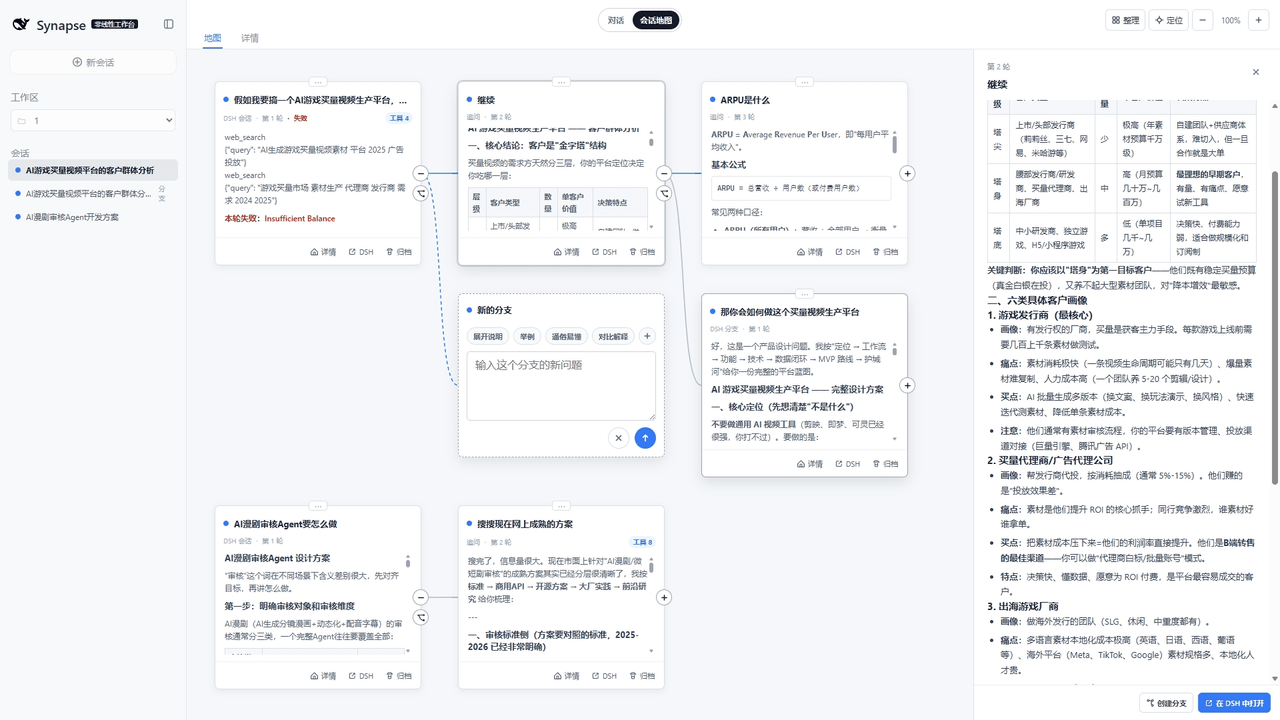 liangmianya/dsh-synapse
A visual, non-linear conversation workspace plugin for DeepSeek Harness ; A canvas-based session explorer and branching …
liangmianya/dsh-synapse
A visual, non-linear conversation workspace plugin for DeepSeek Harness ; A canvas-based session explorer and branching …
-
 alaliqing/claude-paper
📖 Cross-agent research paper toolkit for Claude Code, Codex, OpenCode, and DeepSeek Harness—quick summaries, deep study…
alaliqing/claude-paper
📖 Cross-agent research paper toolkit for Claude Code, Codex, OpenCode, and DeepSeek Harness—quick summaries, deep study…
-
 omdsh-dev/dsh-annotation
DSH Web 选中批注插件:选文字→批注→回车随消息发送;气泡隐藏批注块(零闪烁);回复按 Annotation N 逐条对照(可悬浮芯片)。官方 bundle,零核心改动
omdsh-dev/dsh-annotation
DSH Web 选中批注插件:选文字→批注→回车随消息发送;气泡隐藏批注块(零闪烁);回复按 Annotation N 逐条对照(可悬浮芯片)。官方 bundle,零核心改动
-
 Anionex/dsh-turn-rewind
deepseek harness对话和代码状态回退插件 | DSH — rewind conversation and workspace state, powered by a persistent Change Ledger
Anionex/dsh-turn-rewind
deepseek harness对话和代码状态回退插件 | DSH — rewind conversation and workspace state, powered by a persistent Change Ledger
-
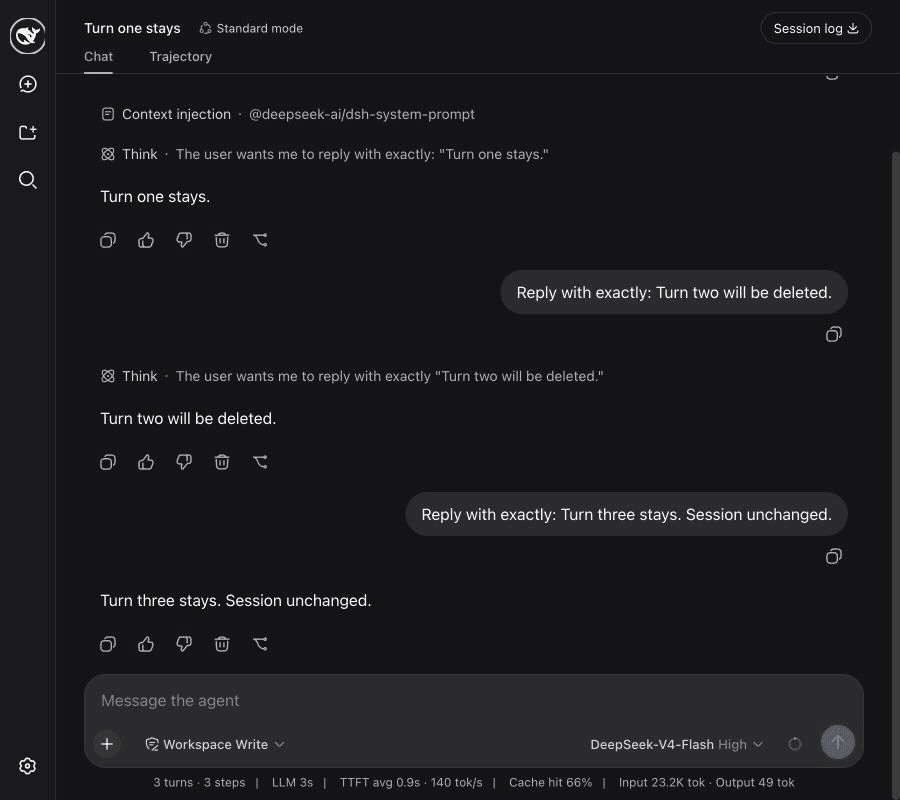 hanshenmesen/dsh-turn-delete
Delete one complete turn from a DeepSeek Harness session without deleting the session
hanshenmesen/dsh-turn-delete
Delete one complete turn from a DeepSeek Harness session without deleting the session
-
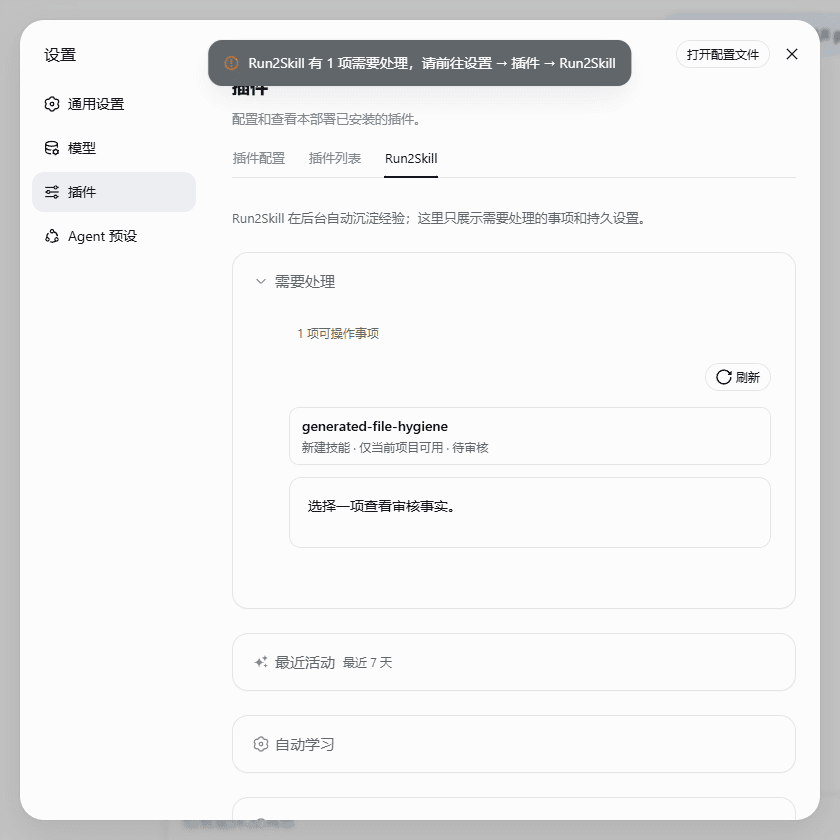 qkycir-123/dsh-run2skill
Automatically turn successful DeepSeek Harness sessions into reusable, reviewable Agent Skills.
qkycir-123/dsh-run2skill
Automatically turn successful DeepSeek Harness sessions into reusable, reviewable Agent Skills.
-
 Tyan66666/billion-context-dsh
Model-driven context management (Active Context Pruning / ACP) for the DeepSeek Harness — the model decides when and wha…
Tyan66666/billion-context-dsh
Model-driven context management (Active Context Pruning / ACP) for the DeepSeek Harness — the model decides when and wha…
-
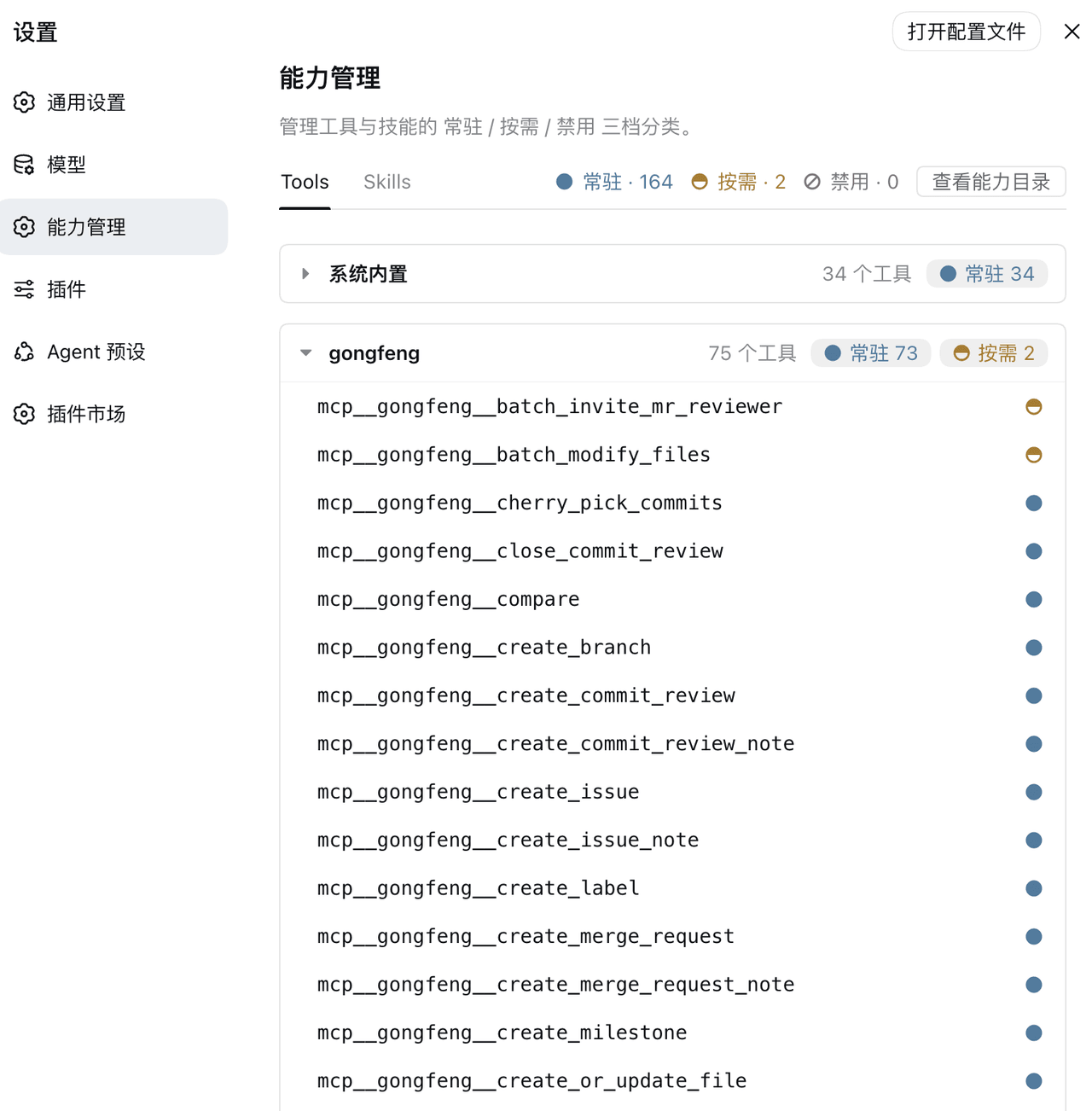 PKUfudawei/dsh-capability-menu
Unified capability menu for DeepSeek Harness: manage exposure level (context footprint) and execution mode of MCP tools …
PKUfudawei/dsh-capability-menu
Unified capability menu for DeepSeek Harness: manage exposure level (context footprint) and execution mode of MCP tools …