CaiZongyuan/dsh-ag-ui
AG-UI protocol gateway plugin for DeepSeek Harness
项目介绍Project Overview
dsh-ag-ui 是社区 DSH Host 插件,通过 AG-UI 协议暴露 DSH Agent,提供带认证的 HTTP/SSE 网关、线程绑定、文本与工具事件流式传输、浏览器自有工具,以及工具结果返回后续接同一轮对话;另有嵌入适配器。适合在可信 BFF 后把 DSH Agent 接入 AG-UI 前端。注意:线程、运行和共享状态为进程本地,重启后不恢复;部分 AG-UI 能力尚未适配。
dsh-ag-ui is a community DSH Host plugin that exposes DSH Agents over the AG-UI protocol. It provides an authenticated HTTP/SSE gateway, thread-to-agent bindings, streamed text and tool events, browser-owned tools, and continuation after tool results, plus an embedding adapter. Use it behind a trusted BFF to connect DSH Agents to AG-UI clients. Caveat: threads, runs, and shared state are process-local and not restored after restart; some AG-UI features are not adapted.
请帮我了解并安装插件:【dsh-ag-ui】【https://github.com/CaiZongyuan/dsh-ag-ui】把上面这条消息直接发给当前会话里的 DSH,让它帮你了解并安装。安装命令不一定准确,发给 DSH 更稳。Send this message to DSH in your current session. CLI install commands may not be accurate across systems — DSH will figure it out for you.
或使用命令行安装(适合开发者)Or use CLI install (for developers)
命令行安装CLI Install
dsh plugin --profile web add dsh-ag-ui把 CaiZongyuan/dsh-ag-ui 加入你的 DSH 配置(web profile)即可启用。
READMEREADME
dsh-ag-ui
English | 简体中文



A community DeepSeek Harness Host plugin that exposes DSH Agents through the AG-UI protocol. It provides an authenticated HTTP/SSE Gateway, AG-UI thread-to-DSH Agent bindings, streamed text and Tool events, browser-owned Tools, and continuation of the same DSH turn after a browser Tool result returns. The same projection core is also available in an embedding form: the separate dsh-ag-ui-adapter package spawns a private loopback micro-host behind an AG-UI AbstractAgent.
This is a community project. It is not an official DeepSeek or AG-UI package.
Features
- Standard Cordis
Serviceplugin exposed asctx.agUi - Installable DSH Profile Bundle through
dsh plugin add - Floored AG-UI protocol range (
~0.0.58) - Authenticated BFF-to-Gateway requests with trusted tenant and user headers
- Process-local
(tenantId, userId, threadId)bindings to DSH Agents - AG-UI text streaming and backend Tool result projection
- Agent-scoped browser Tools supplied by
RunAgentInput.tools - Frontend Tool Promise parking and ToolMessage continuation across HTTP runs
- Bidirectional shared state through
RunAgentInput.state,ag_ui_update_state, andSTATE_SNAPSHOT - Presenter cards for backend Tool calls as versioned
dsh:tool:viewCUSTOM events, live and on cold replay - React renderers for every card kind in the separate
dsh-ag-ui-cardspackage, with component tests against recorded gateway events - An embedding adapter in the separate
dsh-ag-ui-adapterpackage that spawns a loopback DSH micro-host and serves it as an AG-UIAbstractAgent - A keyless Dojo-compatible example for five standard AG-UI features
- Run and message idempotency
- Bounded requests, context, Tool schemas, event buffers, threads, and run ledgers
- Complete Cordis disposal of routes, Agents, Tools, timers, and pending calls
Requirements
- Node.js
^22.19.0or>=24.0.0 - A DSH Profile containing the standard Host services
- A registered DSH model provider and model
- An authenticated Backend-for-Frontend that keeps the Gateway secret away from browsers
Installation
Install the bundle into a DSH Profile:
dsh plugin --profile web add dsh-ag-ui
For the GitHub checkout before an npm release:
dsh plugin --profile web add github:CaiZongyuan/dsh-ag-ui
The bundle stays dormant until all required environment variables are present. This prevents an installation from breaking a Profile before the deployment chooses a model route and secret.
export DSH_AG_UI_PROVIDER='openai'
export DSH_AG_UI_MODEL='gpt-5.6-sol'
export DSH_AG_UI_SHARED_SECRET="$(openssl rand -hex 32)"
export DSH_AG_UI_PATH='/ag-ui' # optional

dsh --profile web
The bundle inserts one Host-plane ag-ui row that loads the Gateway service. The package also exports dsh-ag-ui/invariant; compositions that provide a process-global invariants service may load that optional companion explicitly. The default web Profile does not provide that service, so the installable bundle does not mount the companion automatically.
Profile configuration
Environment variables are the shortest setup path. A Profile can instead override the bundle row in its own cordis.patch.yml:
- id: ag-ui
  disabled: false
  config:
    provider: openai
    model: gpt-5.6-sol
    sharedSecret: !!js process.env.DSH_AG_UI_SHARED_SECRET
    path: /ag-ui
    maxThreads: 100
    frontendToolTimeoutMs: 300000
A later Profile patch replaces the bundle row's complete config; include every value that deployment needs.
Configuration
provider, model, and sharedSecret are required. sharedSecret must contain at least 16 UTF-8 bytes.
| Field | Default | Purpose |
|---|---|---|
path |
/ag-ui |
Exact Host HTTP route |
provider |
required | Registered DSH model provider route |
model |
required | Model ID owned by the provider |
agentPreset |
none | Deployment-default agent preset id composed into every thread |
tenantPresets |
{} |
Per-tenant preset ids taking precedence over agentPreset |
sharedSecret |
required | Bearer secret shared only with the trusted BFF |
tenantHeader |
x-dsh-tenant-id |
Trusted tenant identity header |
userHeader |
x-dsh-user-id |
Trusted user identity header |
allowNonLoopback |
false |
Permit a non-loopback Host bind explicitly |
maxRequestBytes |
262144 |
Maximum request body bytes |
maxIdentityBytes |
256 |
Maximum bytes per protocol or identity ID |
maxMessages |
256 |
Maximum message count per request |
maxMessageBytes |
524288 |
Maximum combined message JSON bytes |
maxContexts |
32 |
Maximum context entry count |
maxContextBytes |
131072 |
Maximum combined context JSON bytes |
maxTools |
32 |
Maximum browser Tool count |
maxToolBytes |
131072 |
Maximum browser Tool JSON bytes |
maxToolSchemaDepth |
16 |
Maximum browser Tool schema depth |
maxForwardedPropsBytes |
65536 |
Maximum forwardedProps JSON bytes |
maxStateBytes |
65536 |
Maximum state JSON bytes |
maxThreads |
100 |
Maximum process-local live threads |
threadIdleMs |
1800000 |
Idle thread lifetime |
frontendToolTimeoutMs |
300000 |
Maximum browser Tool result wait |
maxRunEvents |
4096 |
Maximum events retained per run |
maxRunEventBytes |
2097152 |
Maximum retained event bytes per run |
maxRunsPerThread |
32 |
Maximum retained run ledger entries per thread |
agentPreset composes each thread's agent from the host's agent-presets roster (mount the roster plugin before this Gateway); an unresolvable id fails Gateway activation loudly, a per-tenant entry overrides the deployment default for that tenant's threads, and a resumed thread keeps the composition its own durable session recorded. Without agentPreset, threads keep the host composition unchanged.
maxRunEvents must retain at least the mandatory opening and terminal events. maxRunEventBytes bounds the complete retained Run record, including RUN_STARTED and its terminal event, and must be large enough for the configured maximum identity length. A non-loopback DSH WebServer requires allowNonLoopback: true. Prefer a loopback Gateway behind a same-host authenticated BFF.
Architecture
One projection core, two supported shapes. The core is the dsh-ag-ui Host service: it binds AG-UI threads to DSH Agents and translates runs, events, tools, shared state, and presenter cards in both directions. Everything around it is packaging.
Deployment form — BFF Gateway            Embedding form — dsh-ag-ui-adapter

Browser                                   Node.js application
  -> authenticated application BFF         -> DshAgent (an AG-UI AbstractAgent)
       bearer secret and trusted                spawns a private micro-host child:
       identity headers                         - loopback webserver, ephemeral port
  -> POST /ag-ui on the Host                    - the same published dsh-ag-ui
  -> dsh-ag-ui Host Service                       gateway row, per-process secret
  -> DSH Agent / Session / Tool runtime         - the application's spine and
  -> model provider and backend Tools              model plugin rows
                                             -> run() over loopback HTTP to the
                                                same gateway service
The deployment form fronts a shared Host with an authenticated BFF for browser clients. The embedding form (dsh-ag-ui-adapter) composes a throwaway Host per application process — nothing is spawned before the first run, and the child never outlives the process. Both shapes speak the same protocol to the same projection core, so run semantics, browser Tools, shared state, presenter cards, idempotency, and disposal behave identically.
In both forms the gateway binding key is the exact (tenantId, userId, threadId) tuple supplied through trusted identity headers.
Trust posture
- The gateway listens on the Host webserver. Keep that webserver loopback and behind a same-host authenticated BFF; a non-loopback bind requires the explicit
allowNonLoopbacksetting and is almost always a mistake. - The bearer secret authenticates one service-to-service hop — the BFF (or, in the embedding form, the adapter process) to the gateway. It is not end-user authentication: the gateway never sees a user credential and by itself grants nothing user-scoped.
- End-user identity travels in the trusted
tenantHeader/userHeaderheaders. Whoever holds the secret can assert any identity, so the secret holder must itself be trustworthy — in the deployment form, authenticating the user before injecting those headers is the BFF's whole job; in the embedding form the adapter process is the trusted principal. - Browser-supplied identity, permission, patient ID, resource ID,
context,state,forwardedProps, Tool schemas, and IDs inside messages are untrusted wire input and never grant backend authority. - Backend Tools can derive the authenticated thread identity from the Agent:
const identity = ctx.agUi.identityFor(exec.agent)
if (identity === undefined) {
  throw new Error('This Tool requires an authenticated AG-UI thread.')
}

const { principal, threadId } = identity
The application should map this tuple to its server-owned resource authorization state.
BFF proxy
The browser must not call the private Gateway directly. A BFF should authenticate the user, authorize the application resource, retain the browser request body exactly, and inject trusted identity headers.
app.post('/api/agent', async (c) => {
  const user = await authenticateApplicationRequest(c.req.raw)
  const body = new Uint8Array(await c.req.raw.arrayBuffer())

  const upstream = await fetch('http://127.0.0.1:3080/ag-ui', {
    method: 'POST',
    headers: {
      authorization: `Bearer ${process.env.DSH_AG_UI_SHARED_SECRET}`,
      'content-type': 'application/json',
      'x-dsh-tenant-id': user.tenantId,
      'x-dsh-user-id': user.userId,
    },
    body,
  })

  return new Response(upstream.body, {
    status: upstream.status,
    headers: upstream.headers,
  })
})
The BFF owns login, sessions, CSRF protection, tenant policy, resource authorization, audit, and rate limits. Do not treat the Gateway bearer secret as end-user authentication.
Proxying Host service-plugin remotes
The AG-UI gateway is one Host-plane service with an HTTP remote; other DSH service plugins can mount routes on the same loopback webserver. The same rule covers every one of them: the browser never reaches the Host directly. Expose each remote through the application backend under an application-owned route, with the authenticate → authorize → forward shape above and the credentials that service expects. The Host port itself stays loopback and unadvertised to clients.
Browser client
Install the official client in the frontend application. Any release in the supported protocol range (>=0.0.58 <0.1.0) works; the gateway never requires an exact client pin:
pnpm add @ag-ui/client
Send page-specific browser Tools and current context on every run:
import { HttpAgent, randomUUID } from '@ag-ui/client'

const agent = new HttpAgent({
  url: '/api/agent',
  threadId: 'application-thread-123',
})

agent.addMessage({
  id: randomUUID(),
  role: 'user',
  content: 'Review the current draft.',
})

await agent.runAgent({
  runId: randomUUID(),
  tools: browserTools,
  context: [{
    description: 'Current page state',
    value: JSON.stringify(readPageSnapshot()),
  }],
  forwardedProps: {},
})
If the model calls a browser-owned Tool, the current HTTP run finishes successfully while the DSH Tool Promise remains pending. The browser executes the Tool, appends one standard AG-UI ToolMessage with the same toolCallId, and starts another run. The Gateway resolves the original Promise and continues the same DSH turn.
Do not send ordinary browser Tool results through AG-UI resume[]; that field is reserved for explicit interrupt/HITL flows.
Shared state
Activate shared state by setting a non-empty initial value before the first run:
agent.setState({
  recipe: {
    title: 'Draft',
    ingredients: [],
  },
})
The Gateway injects the accepted state into the DSH Session, registers the reserved ag_ui_update_state Tool in the exact Agent scope, and emits STATE_SNAPSHOT. The official client replaces agent.state when each snapshot arrives.
The state Tool accepts:
{
  "state_updates": {
    "recipe": {
      "title": "Pasta Primavera"
    }
  }
}
Updates use a shallow top-level merge: omitted top-level keys remain, while supplied nested values replace the previous nested value. The Gateway measures the complete merged state against maxStateBytes. It commits a model update and emits its snapshot only after DSH appends the durable tool/result; equal updates retain the Tool result but emit no redundant changed-state snapshot.
Initial activation ignores the default empty state sent by clients that do not use shared state. After activation, later empty objects, arrays, or null are valid complete baselines. Omitting state retains the current thread state.
Shared state is model/UI collaboration data. It never grants backend authority and should not replace an application's durable database state. STATE_DELTA is not implemented yet.
Dojo-compatible example
The package ships the framework-free BFF plugin as dsh-ag-ui/dojo-host. The keyless scripted model, launcher, and five-feature suite remain source-checkout fixtures. See examples/dojo/README.md for commands, routes, upstream Dojo compatibility, real-model configuration, and security limitations.
The upstream Dojo integration registry is static and has no deepseek-harness entry yet, so local upstream testing temporarily reuses the Claude Agent SDK TypeScript menu entry purely as a URL/path alias. The alias disappears once the upstream integration PR registering a DeepSeek Harness entry is accepted; no Claude runtime, model, or credential is involved.
The recording below shows the shared-state feature on the upstream Dojo demo viewer against this repository's keyless fixture. Both chat turns flow through the gateway: the first reads the shared state, the second emits STATE_SNAPSHOT events that rewrite the recipe form. Playback is sped up 3x and carries English captions.
If the inline player does not render on this host, download docs/demo/dojo-shared-state.mp4 (captions: docs/demo/dojo-shared-state.vtt).
Embedded adapter
The separate dsh-ag-ui-adapter package is the embedded counterpart of this deployment-form Gateway. A DshAgent (AbstractAgent subclass) spawns a DSH micro-host child — a Cordis overlay composing the loopback webserver on an ephemeral port, this Gateway with a per-process generated secret, and the caller's agent-spine and model rows — and passes run() through loopback HTTP using the official client primitives, adding no protocol translation code. The host starts lazily on the first run, can idle-shut-down, and never outlives the embedding process. See its README for usage, plugin row resolution, environment fallback, lifecycle, and the trust posture of the embedded shape.
HTTP and run semantics
- Requests must be
POST application/jsonand match AG-UIRunAgentInput. - A normal run accepts one new text user message.
- A continuation accepts one or more new frontend ToolMessages for one pending DSH turn.
- One DSH turn can cross multiple AG-UI HTTP runs.
- Each run emits one
RUN_STARTEDand exactly oneRUN_FINISHEDorRUN_ERROR. runIdis an exact-request idempotency key. Completed identical requests replay retained events without driving DSH again.- One thread can have only one active HTTP run.
- An active shared-state run emits its synchronization snapshot before model events.
- V1 allows one frontend Tool call per DSH step.
Client-provided Tools
Browser Tool names must match:
[A-Za-z_][A-Za-z0-9_-]{0,63}
This conservative subset follows common model-provider function-name limits; AG-UI itself does not require this exact regular expression. The name ag_ui_update_state is reserved for protocol shared state. Browser Tool parameters must use the object-rooted JSON Schema subset enforced by DSH Tools. The Gateway rejects collisions with inherited or global Tools and registers each accepted definition only in the exact Agent's Tool scope.
Backend Tool results are emitted as TOOL_CALL_RESULT. Frontend Tool results are not echoed on the AG-UI wire because the browser already added the ToolMessage; DSH still records the real durable tool/result.
Tool view cards
Every backend Tool call carries its DSH render-intent card next to the standard tool events, as a CUSTOM event named dsh:tool:view:
{
  "version": 1,
  "callId": "call-42",
  "toolName": "read_file",
  "phase": "call",
  "card": { "card": "generic", "title": "Reading src/index.ts", "kind": "read" }
}
- The Gateway resolves the Tool definition in the Agent scope that executed the call, then evaluates its
presentCall(pending state, emitted afterTOOL_CALL_END) andpresentResult(completed state, emitted afterTOOL_CALL_RESULT) intents. Both are pure functions of the arguments and the durable result, including the presentation metadata the Tool'soutput.presentationMetaprojected into its session log. - A Tool without intents, a returning intent, or a throwing intent soft-falls to the generic card:
{ "card": "generic", "title": "<toolName>", "rawInput": <args> }for the pending state and{ "card": "generic" }(keep the pending title, render the raw result) for the completed state. - The card vocabulary is DSH's provider-neutral
ToolCallView/ToolResultViewunion (generic,terminal,diff,search,read,webcards), so a UI renders cards without special-casing Tool names. - The reserved
ag_ui_update_stateTool and client-provided frontend Tools are excluded: the state Tool projects throughSTATE_SNAPSHOT, and the client already knows how to present its own Tools. - At each run start, the Gateway re-derives the settled cards of the whole transcript from the durable session log — the same evaluator and inputs as the live path — and emits them right after
MESSAGES_SNAPSHOT, so a client that missed the live stream renders identical cards. A cold read only re-derives cards for Tools that still resolve in the thread's scope, so a crash-materialized frontend Tool call after a restart stays cardless. Cards count against the per-run event budget.
The separate dsh-ag-ui-cards React package renders every card kind from these envelopes with no DSH runtime dependency, and documents the event-wiring recipe. Its component tests render events recorded from this Gateway, and the recording scenario stays guarded by this package's test suite.
Lifecycle
All effects belong to the Cordis plugin fiber. Route removal, idle expiry, timeout, and plugin disposal unregister browser Tools, reject pending calls, cancel active work, dispose Agent handles, and wait for quiescence.
An unexpected HTTP disconnect cancels the Gateway-owned DSH turn. HttpAgent does not implement partial SSE reconnect. A frontend Tool handoff is an intentional completed run and does not cancel the parked turn.
Compatibility
| Component | Supported version |
|---|---|
| AG-UI core/client/encoder | >=0.0.58 <0.1.0 (~0.0.58; tested with 0.0.58) |
| Node.js | ^22.19.0 or >=24.0.0 |
| DeepSeek Harness | Developer preview packages listed in peerDependencies |
DSH is in developer preview and can introduce breaking changes. This package uses exact DSH peer versions until those APIs stabilize.
Model Experience
Injected AG-UI context
What the model sees
Each non-empty RunAgentInput.context becomes one user-role snapshot containing ordered ## <description> sections. The source is { kind: "plugin", plugin: "ag-ui", form: "snapshot", sections }.
Token effect
Conditional and retained. Every accepted normal or continuation run appends its bounded context snapshot to the DSH Session and later model history.
KV cache effect
Append-only context preserves earlier reusable history. Changed current context adds a new suffix; provider cache availability is outside this package.
Shared application state
What the model sees
Once activated, the complete bounded state appears in a Current Shared State section and the reserved ag_ui_update_state Tool joins the Agent schema. A successful state update returns the complete merged state as a durable DSH Tool result.
Token effect
Conditional and retained. Every accepted run with active shared state appends the full state baseline. A model update additionally appends one Tool call/result pair containing the complete merged state.
KV cache effect
An unchanged earlier history remains reusable, but each current state baseline and changed Tool result adds a suffix. Large or frequently changing state reduces cache reuse and increases retained Session tokens.
Client-provided capabilities
What the model sees
The current Agent-scoped browser Tool definitions join the ordinary DSH Tool schema list. Their names, descriptions, and validated parameter schemas come from the authenticated client request; execution remains browser-owned.
Token effect
Conditional and replacing. The visible Tool schema list is sent on every model request and changes when the page advertises a different capability set.
KV cache effect
An unchanged Tool set preserves the Tool-schema prefix. Adding, removing, or changing a Tool may invalidate provider reuse from that portion onward.
Known limitations
- Thread, run, and shared state is process-local.
- Host restart does not call
agents.resume(), recover a parked browser Tool, or restore shared state without a new client baseline. - Only text user input, assistant text, and string Tool results are adapted.
- One frontend Tool call is allowed per DSH step.
- Partial SSE reconnect is not supported.
STATE_DELTA, AG-UI interrupt/HITLresume[], multimodal messages, reasoning events, and activity events are not adapted yet.- Shared-state updates use shallow top-level merge and do not provide versions, deep merge, or conflict resolution.
Development
git clone https://github.com/CaiZongyuan/dsh-ag-ui.git
cd dsh-ag-ui
corepack enable
pnpm install
pnpm -r --workspace-root check
The repository is a pnpm workspace: the root package is the Gateway, and packages/ holds the dsh-ag-ui-cards React card renderers and the dsh-ag-ui-adapter embedding adapter. pnpm -r --workspace-root check runs lint, strict TypeScript checking, per-file coverage, runtime/type builds, and publint in every workspace project. The Dojo fixture is intentionally source-checkout-only and is not included in the npm tarball.
See CONTRIBUTING.md for contribution and release requirements.
License
MIT. Portions are adapted from DeepSeek Harness; see NOTICE.
相关推荐Related
-
 ruvnet/ruflo
🌊 The original agent meta-harness. Deploy intelligent multi-player swarms, coordinate autonomous workflows, and build c…
ruvnet/ruflo
🌊 The original agent meta-harness. Deploy intelligent multi-player swarms, coordinate autonomous workflows, and build c…
-
 amruthpillai/reactive-resume
A one-of-a-kind resume builder that keeps your privacy in mind. Completely secure, customizable, portable, open-source a…
amruthpillai/reactive-resume
A one-of-a-kind resume builder that keeps your privacy in mind. Completely secure, customizable, portable, open-source a…
-
 volcengine/OpenViking
Self-evolving Context Database for AI Agents. Unify Agent Memory, Knowledge RAG and Skills.
volcengine/OpenViking
Self-evolving Context Database for AI Agents. Unify Agent Memory, Knowledge RAG and Skills.
-
 Molunerfinn/PicGo
:rocket: The Ultimate Image Uploader for Efficient Creators. Supports Obsidian, Typora, VS Code etc. and 60+ image hosti…
Molunerfinn/PicGo
:rocket: The Ultimate Image Uploader for Efficient Creators. Supports Obsidian, Typora, VS Code etc. and 60+ image hosti…
-
 titanwings/colleague-skill
将冰冷的离别化为温暖的 Skill,欢迎加入数字生命1.0!Transforming cold farewells into warm skills? It's giving rebirth era. Welcome to Digital …
titanwings/colleague-skill
将冰冷的离别化为温暖的 Skill,欢迎加入数字生命1.0!Transforming cold farewells into warm skills? It's giving rebirth era. Welcome to Digital …
-
 nocobase/nocobase
NocoBase is an open-source AI + no-code platform for building business systems fast. Instead of generating everything fr…
nocobase/nocobase
NocoBase is an open-source AI + no-code platform for building business systems fast. Instead of generating everything fr…
-
 Tencent/WeKnora
Open-source LLM knowledge platform: turn raw documents into a queryable RAG, an autonomous reasoning agent, and a self-m…
Tencent/WeKnora
Open-source LLM knowledge platform: turn raw documents into a queryable RAG, an autonomous reasoning agent, and a self-m…
-
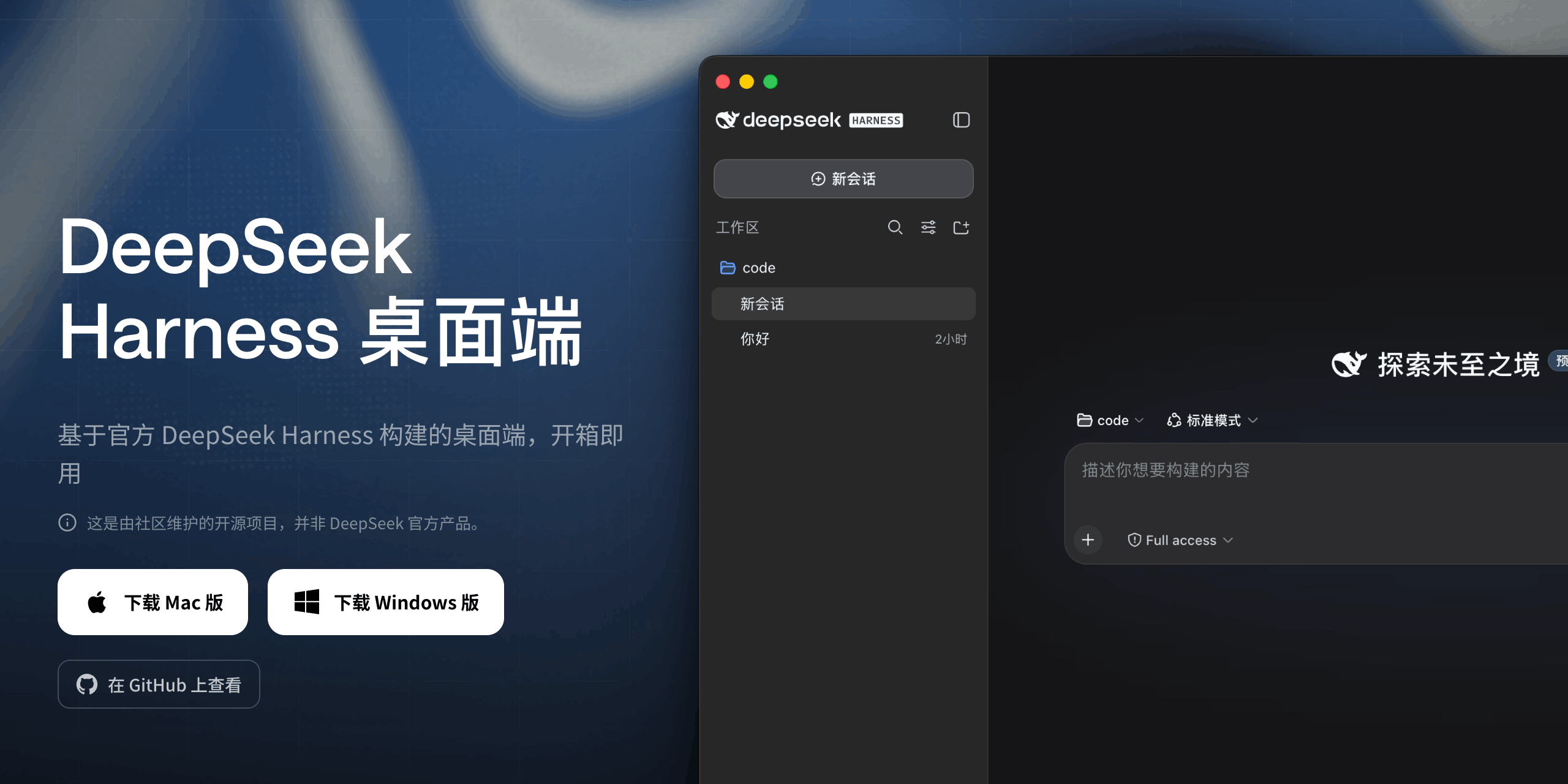 anywhere-labs/deepseek-harness-desktop
为 DeepSeek Harness (DSH) 插件生态打造的现代化桌面端解决方案。万物皆「插件」,桌面本身也是「插件」。
anywhere-labs/deepseek-harness-desktop
为 DeepSeek Harness (DSH) 插件生态打造的现代化桌面端解决方案。万物皆「插件」,桌面本身也是「插件」。