chenyinrusi/dsh-repo-health
Read-only repository health scanners for DeepSeek Harness and any repo: definition drift, unwired-module reachability, prompt bloat, evidence-gate calibration, registration completeness. CLI + MCP server.
项目介绍Project Overview
repo-health 是只读仓库健康扫描器,提供 CLI 与 MCP 服务器,检测定义漂移、未接线模块、提示膨胀、证据门校准和注册完整性。适合在测试、类型检查或 lint 之外发现静默腐化,并可用基线做检查。注意:drift 仅扫描 Python,reach 不识别动态导入,日志类扫描需符合指定 JSONL 结构。
repo-health is a read-only repository health scanner, available as a CLI and MCP server. It detects definition drift, unreachable modules, prompt-segment bloat, evidence-gate calibration, and missing extension registrations. Use it to catch silent codebase decay that tests, type checkers, and linters miss, with baselines for CI checks. Caveat: drift scans Python only, reach cannot see dynamic imports, and log scanners require specific JSONL schemas.
请帮我了解并安装插件:【dsh-repo-health】【https://github.com/chenyinrusi/dsh-repo-health】把上面这条消息直接发给当前会话里的 DSH,让它帮你了解并安装。安装命令不一定准确,发给 DSH 更稳。Send this message to DSH in your current session. CLI install commands may not be accurate across systems — DSH will figure it out for you.
或使用命令行安装(适合开发者)Or use CLI install (for developers)
命令行安装CLI Install
dsh plugin --profile web add github:chenyinrusi/dsh-repo-health把 chenyinrusi/dsh-repo-health 加入你的 DSH 配置(web profile)即可启用。
READMEREADME
repo-health
Read-only repository health scanners: definition drift, unwired-module reachability, prompt bloat, evidence-gate calibration, and registration completeness — as a CLI and an MCP server.
A codebase rots silently. The most damaging defects are the ones no test, type checker, or linter catches:
- a concept defined in two places where only one copy gets updated (drift),
- a module written but never wired up (unreachable),
- a fixed-injected prompt segment quietly eating the context (bloat),
- an extension point that exists but is never registered (registration).
repo-health is five read-only scanners that watch for exactly these. It is the extracted, generalized core of the quality-guard tooling behind a large production agent system, repackaged so any repository can run it.
Install
pip install "dsh-repo-health"        # CLI
pip install "dsh-repo-health[mcp]"   # + MCP server
Requires Python 3.11+ (the registration scanner uses tomllib; the others run on 3.10+).
Quick start
repo-health drift --root /path/to/repo           # definition drift report
repo-health reach --root /path/to/repo           # unwired-module report
repo-health prompt-bloat --root /path/to/repo    # prompt segment shares
repo-health evidence --path logs/evidence_gate.jsonl
repo-health registration --root /path/to/repo --config registration.toml
repo-health all --root /path/to/repo             # run every scanner
Every scanner also ships a --selftest that verifies the tool itself against a
synthetic fixture before it is trusted to judge your code — the predecessor of
these scanners shipped versions that produced pretty-but-wrong numbers, and
only known-answer fixtures caught them.
The five scanners
drift — multi-source definition drift
Detects the same name defined in more than one place with overlapping member structure, and flags it when one copy changes but the other does not.
- A class (guarded): same name and structure overlap ≥ 0.5 — watched for drift.
- B class (not guarded): same name, disjoint structure — a name collision, confusing but not a data hazard.
- Sync changes pass. If someone diligently updates both copies, that is correct behavior; a guard that punishes it gets disabled.
repo-health drift --root .                      # report
repo-health drift --root . --write-baseline     # freeze a baseline
repo-health drift --root . --check              # exit 1 on drift / new pairs
reach — unwired-module reachability
Builds the import graph and BFS-searches from startup entrypoints
(__main__.py, if __name__ == "__main__" guards, main.py, launch scripts).
Modules that cannot be reached are "wired but dead".
Its baseline carries auditable reasons: every unreachable module needs a
structured {verdict, anchor} entry, validated deterministically (V1–V7) so a
single wrong reason can never permanently hide code from every mechanism.
repo-health reach --root .                      # report
repo-health reach --root . --write-baseline     # freeze
repo-health reach --root . --check              # exit 1 on new unwired modules
repo-health reach --root . --audit-reasons      # validate baseline reasons
prompt-bloat — prompt segment share baseline
Reads prompt-inspection JSONL logs ({segments: [{name, pct, kind}]}) and
watches the median share per segment, not the absolute size (absolute size
varies naturally with task complexity; share reflects structural bloat).
repo-health prompt-bloat --root . --check --json
evidence — evidence-gate decision log calibration
Summarizes a decision log ({passed, suggested_action, tool, issues} JSONL) to
answer "is the gate calibrated yet?" — insufficient samples or a
false-positive-prone tool block any conclusion.
registration — config-driven registration completeness
Declares your architecture's extension points in a TOML config and verifies
every defined item appears in its registry. See
config/registration.example.toml for an
annotated example covering agent roles, checkers, API routers, sidebar pages,
and LLM providers.
MCP server (DeepSeek Harness & any MCP client)
pip install "dsh-repo-health[mcp]"
python -m repo_health.mcp_server
Exposes the scanners as read-only MCP tools (drift_scan, reach_scan,
reach_reason_audit, prompt_bloat, evidence_calibration, registration).
Register it in DeepSeek Harness's MCP settings (or any MCP client) to let an
agent diagnose its own repository. Large repositories may exceed MCP's default
tool timeout — pass narrower root values or raise the client timeout.
Methodology (why this is not "yet another linter")
The scanners share a discipline learned the hard way:
- Watch events, not states. "Duplicated" is a state; "one side changed and the other didn't" is the event that actually corrupts data.
- Guard must not punish correct behavior. Sync updates pass; else the guard gets disabled within a week.
- Never freeze a baseline from insufficient samples. A median from three records is not a fact — a baseline frozen from it is false confidence.
- Reasons must be checkable. Free-text baseline justifications are how
code permanently hides from every mechanism; make them
{verdict, anchor}. - Self-test the scanner before it judges anything. Known-answer fixtures are the only thing that caught the predecessor's wrong-but-plausible output.
Known limitations
driftscans Python only (.pyunder the configured package dirs).reachis module-granular: a reachable module whose functions are never called is not reported; dynamic imports (importlib, plugin loaders) are invisible and belong in the baseline.evidenceandprompt-bloatconsume a specific JSONL schema; adapt your logger to emit it (examples in the docstrings).
License
MIT © 2026 Chen (Jarry) Pan
相关推荐Related
-
 nexu-io/open-design
🎨 Best DeepSeek Harness Design Plugin. The open-source Claude Design alternative. 🖥️ Local-first desktop app. 🖼️ Your…
nexu-io/open-design
🎨 Best DeepSeek Harness Design Plugin. The open-source Claude Design alternative. 🖥️ Local-first desktop app. 🖼️ Your…
-
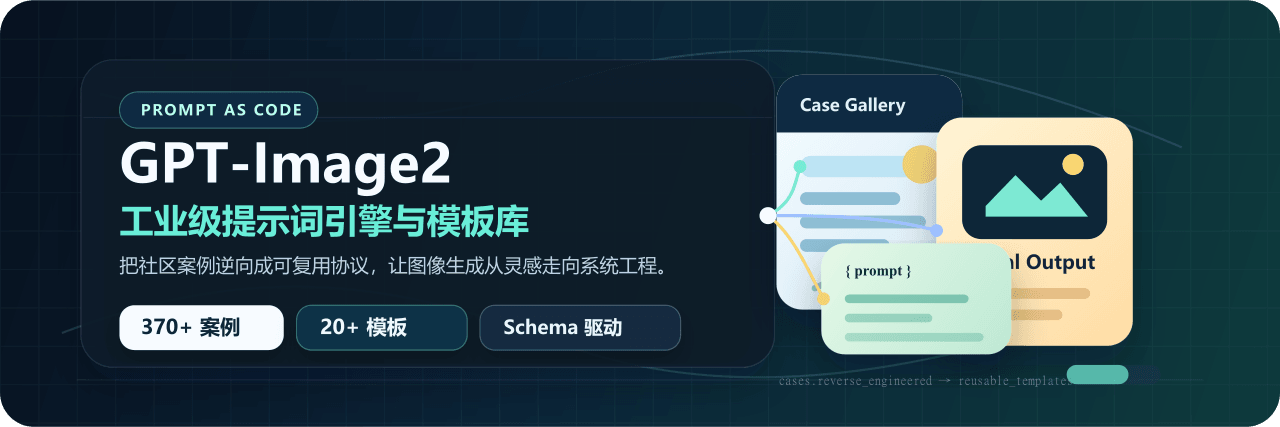 freestylefly/awesome-gpt-image-2
Prompt as Code | GPT-Image2 工业级提示词引擎与模板库,530+ 个案例逆向工程,20+ 套工业级模板,并提炼出Skills,持续更新中
freestylefly/awesome-gpt-image-2
Prompt as Code | GPT-Image2 工业级提示词引擎与模板库,530+ 个案例逆向工程,20+ 套工业级模板,并提炼出Skills,持续更新中
-
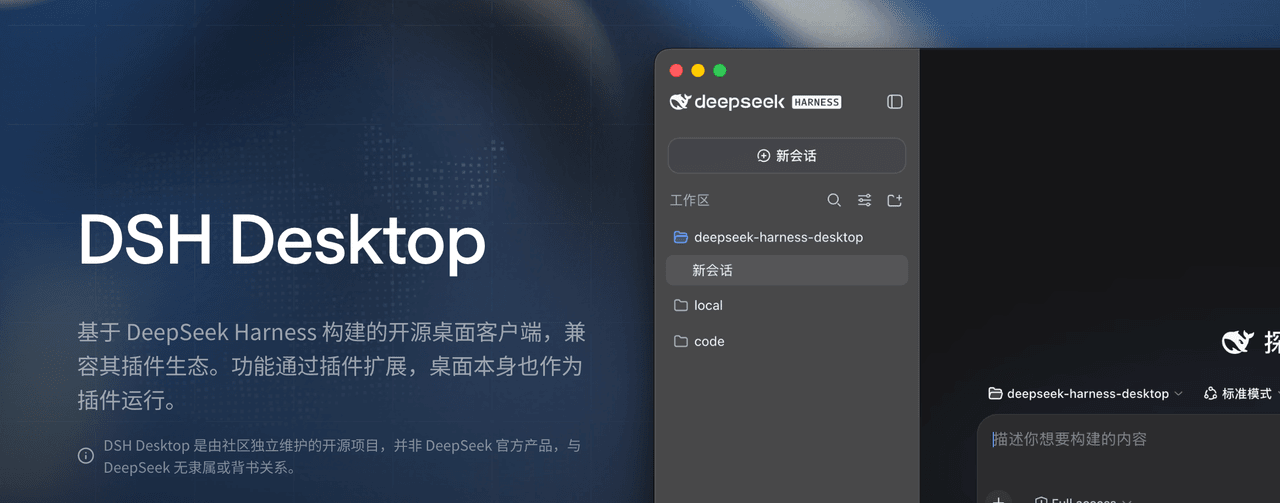 anywhere-labs/dsh-desktop
为 DeepSeek Harness (DSH) 插件生态打造的现代化桌面端解决方案。万物皆「插件」,桌面本身也是「插件」。
anywhere-labs/dsh-desktop
为 DeepSeek Harness (DSH) 插件生态打造的现代化桌面端解决方案。万物皆「插件」,桌面本身也是「插件」。
- Nagi-ovo/voyager Enhancement suite for Gemini, AI Studio, Claude & ChatGPT — plus a prompt manager for any web UI, DeepSeek Harness inclu…
-
 walkinglabs/learn-harness-engineering
Harness engineering beginner tutorial, from 0 to 1
walkinglabs/learn-harness-engineering
Harness engineering beginner tutorial, from 0 to 1
-
 awesome-dsh-plugin/awesome-dsh-plugin
A curated list of plugins for DeepSeek Harness (dsh) · DeepSeek Harness 插件精选列表
awesome-dsh-plugin/awesome-dsh-plugin
A curated list of plugins for DeepSeek Harness (dsh) · DeepSeek Harness 插件精选列表
-
 MemTensor/MemOS
Self-evolving memory OS for LLM & AI Agents: ultra-persistent memory, hybrid-retrieval, and cross-task skill reuse, with…
MemTensor/MemOS
Self-evolving memory OS for LLM & AI Agents: ultra-persistent memory, hybrid-retrieval, and cross-task skill reuse, with…
- yjh051108/dsh-routing-suite dsh-routing-suite — injector + router-standard kit: install the runtime injector first, then the task-aware reasoning-mo…