Co-Engram/Co-Engram
自我进化团队记忆
Project Overview项目介绍
Co-Engram is a self-evolving team memory system designed for AI agents and cross-functional development teams. It models memory after how the human brain works, strengthening frequently used engrams, weakening ones that have failed, and automatically consolidating and verifying memory over time. All memory entries are stored as individual Markdown files with YAML frontmatter in Git, which keeps content diffs clean and works with existing version control workflows. It supports three major agent platforms out of the box: Claude Code via MCP, OpenClaw via plugin SDK, and DeepSeek Harness via native Cordis plugin.
Co-Engram is built for teams that work with AI coding agents and want to accumulate reusable knowledge across projects and team members. It eliminates broken references from renaming or moving files thanks to its stable unique persistent IDs for every engram. Connections between memories are stored as independent files, so deduplication and pruning of stale connections only requires simple file operations. New users can get a working Co-Engram setup in Claude Code in four quick commands, with a zero-install npx alternative available if you don’t want a global npm install.
Co-Engram is released under the permissive MIT open source license, so it is free to use, modify, and distribute for both personal and commercial projects. The core @co-engram/core package has zero host dependencies, so you can embed it into any custom agent or tool you are building regardless of your stack. It includes optional command line tools to check for memory anomalies, show merge statistics, and install a git post-merge hook that automatically runs consistency checks after every pull. Contributions to the project are welcome, with documented contribution guidelines and a public roadmap for upcoming features.
Co-Engram 是一个面向AI智能体和开发团队的自进化记忆系统,灵感来源于大脑的记忆运作模式,会自动强化常用记忆、弱化失效记忆、自动整理维护记忆内容。核心是与平台无关的TypeScript实现,所有记忆都以带YAML前置信息的纯Markdown文件存储在Git中,方便协作和版本管理,原生支持Claude Code、OpenClaw和DeepSeek Harness多个平台。
这个工具适合需要共享和沉淀团队开发知识的AI开发团队,特别适配多AI智能体协作开发场景。典型工作流是:开发者先初始化一个独立的Git仓库作为记忆存储库,接着配置Co-Engram指向该存储仓库,之后每次生成可复用的决策或知识都会自动整理沉淀到记忆库,需要开发时就能快速检索调用可用的历史记忆。
Co-Engram采用MIT许可证开源,完全免费可商用,核心库没有额外宿主依赖,可以嵌入到任意自定义AI代理项目中使用。首次使用可以通过三条命令快速在Claude Code中部署,也支持零安装的npx方式运行,还提供git post-merge钩子自动检查记忆一致性。
请帮我安装这个 DSH 插件。安装前先完成【兼容性检查 + 安全性检查】,检查通过再动手。

插件:Co-Engram(Co-Engram/Co-Engram)
仓库:https://github.com/Co-Engram/Co-Engram
本站详情页:https://www.yhbd.top/plugins/co-engram-co-engram/
本站登记:类型 plugin · 归类 原生 DSH 插件 · 许可证 MIT · ⭐ 10 · 最近提交 2026-08-22 · 主语言 TypeScript · 未检测到 DSH 插件清单

按下面顺序执行,每步先把结论告诉我,再进入下一步:

【1 兼容性检查】
① 我这边:DSH 版本、Node 版本、操作系统、当前 profile(web / desktop)。
② 读它的 README、package.json、插件 manifest,列出它要求的 DSH 版本 / Node 版本 / 操作系统 / 外部依赖 / 需要另外先装的运行时。
③ 逐条比对,结论只写「满足 / 不满足 / 未知」三种;不满足的给出可行替代方案。
④ 检查是否和我已装的插件冲突:命令名重复、skill / tool 重名、端口占用、重复注册的 MCP server。

【2 安全性检查】
① 仓库可信度:和上面「本站登记」是否一致;star / fork 数、创建时间、最近提交,是否归档或长期停更。
② 安装脚本:逐行看 package.json 的 preinstall / install / postinstall,以及 install.sh、setup.ps1 之类脚本。出现 curl|bash、下载后直接执行、混淆代码、访问与插件功能无关的域名,立刻停下来告诉我,不要继续装。
③ 依赖:列出新增依赖,标出无人维护、或与知名包拼写近似的可疑包(typosquatting)。
④ 权限与副作用:它会读写哪些目录、访问哪些域名、需要哪些 DSH 权限(filesystem / network / shell / clipboard 等),以及怎么卸载和回滚。
⑤ 如果它要求 sudo / 管理员权限,或权限明显超出功能所需,先停下来问我。

【3 安装】
上面两步没有「不满足」和「高危项」时才执行;用官方推荐方式安装,不要自行提权。

【4 汇报】
用表格输出:检查项 / 结论 / 依据 / 是否需要我决策。拿不准的一律写「未知」并说明要我怎么确认——不要猜,也不要替我决定。
Send this message to DSH in your current session: it verifies compatibility and security first (answering met / not met / unknown item by item) and only installs once everything checks out — it will stop and ask you if it finds a high-risk item. The box scrolls; the copy is the full prompt. CLI install commands may not be accurate across systems, so DSH is the safer route.把上面这条消息直接发给当前会话里的 DSH:它会先核对兼容性与安全性(逐条给「满足 / 不满足 / 未知」),确认没问题再安装,有高危项会停下来问你。框内可滚动,复制到的是完整提示词;安装命令不一定准确,发给 DSH 更稳。
- 10 stars - an early-stage project星标 10,属于早期项目
- No DSH plugin manifest detected - it may only carry the dsh-plugin topic, so the install method must be confirmed on the spot未检测到 DSH 插件清单:可能只是打了 dsh-plugin 话题,安装方式要现场确认
DSH walks through these 9 checksDSH 会逐条核对这 9 项
Compatibility兼容性
- DSH, Node, OS and profile requirementsDSH 版本 / Node 版本 / 操作系统 / profile 是否满足要求
- External dependencies and runtimes (Electron / Python / Docker, ...)外部依赖与运行时(Electron / Python / Docker 等)是否齐备
- Conflicts with installed plugins: command names, skill / tool names, ports, duplicate MCP registration与已装插件是否冲突:命令名、skill / tool 重名、端口占用、重复 MCP 注册
Security安全性
- Repo matches the facts registered here; archived or abandoned?仓库是否与页面登记一致,是否归档或长期停更
- Safety of preinstall / install / postinstall and install.sh / setup.ps1preinstall / install / postinstall 与 install.sh、setup.ps1 是否安全
- curl|bash, download-then-execute, obfuscation, unrelated domains → stop immediatelycurl|bash、下载即执行、混淆代码、无关域名 → 立刻停止
- Typosquatting or unmaintained packages among the new dependencies新增依赖里有没有 typosquatting 或无人维护的包
- Requested permissions vs. what the feature actually needs申请了哪些权限、是否超出功能所需(filesystem / network / shell / clipboard)
- Any sudo / admin requirement, plus uninstall and rollback是否要求 sudo / 管理员权限,以及卸载与回滚方式
Anything uncertain must be marked unknown with a note on how to confirm it. This site's signal screen is a static snapshot, not a security audit.拿不准的必须标「未知」并说明要我怎么确认。本站的信号筛查是静态快照,不能替代安全审计。
Or use CLI install (for developers)或使用命令行安装(适合开发者)
CLI Install命令行安装
dsh plugin --profile web add @co-engram/dsh把 Co-Engram/Co-Engram 加入你的 DSH 配置(web profile)即可启用。
READMEREADME

Co-Engram: Self-evolving Team Memory


Memories that behave like a brain — they strengthen with use, fade when wrong, and verify themselves. Plain Markdown in Git, for AI agents and teams.
English | 中文
Co-Engram is a self-evolving memory system for AI agents and teams. Unlike traditional vector stores that only retrieve, Co-Engram models memory after the brain: engrams strengthen with use, weaken when they fail, consolidate during sleep, and verify themselves through metacognition.
Works with Claude Code (via MCP), OpenClaw (via plugin SDK), and DeepSeek Harness (via native Cordis plugin), with a host-agnostic TypeScript core you can embed anywhere.
Why Co-Engram
| Differentiator | What it means |
|---|---|
| Stable IDs + single-file layout | Every memory is one Markdown file with YAML frontmatter. The engram has a ULID that never changes, so renames, moves, and rewrites don't break references — while content diffs stay clean in Git. |
| Per-edge synapses | Connections between memories live as independent files keyed by a deterministic hash of (from, to, kind). No duplicate edges, trivial dedupe, and pruning a stale edge is a single file delete. |
| Self-maintaining | A maintenance engine runs light (RPE-based reinforcement), deep (consolidation + decay), and rem (metacognition upgrade/refute) stages automatically — no manual tagging required. |
| Two-layer proposal filter | Implicit memory proposals pass through a rule-based prefilter (Layer 1, zero-cost) plus a necessity evaluator (Layer 2 — rule-based by default, optional LLM) — mechanical repetition gets rejected, only genuinely reusable decisions become candidates. |
| Host-agnostic core | @co-engram/core has zero host dependencies. Same memory, same tools, whether you use Claude Code, OpenClaw, DeepSeek Harness, or your own agent. |
Showing the opening section of the README — the full document lives in the repository以上为 README 开头摘要,完整文档在仓库内 · View the full README on GitHub →在 GitHub 查看完整 README →
Related相关推荐
-
 ruvnet/ruflo
🌊 The original agent harness. Deploy intelligent multi-player swarms, coordinate autonomous workflows, and build conver…
ruvnet/ruflo
🌊 The original agent harness. Deploy intelligent multi-player swarms, coordinate autonomous workflows, and build conver…
-
 Tencent/WeKnora
Open-source LLM knowledge platform: turn raw documents into a queryable RAG, an autonomous reasoning agent, and a self-m…
Tencent/WeKnora
Open-source LLM knowledge platform: turn raw documents into a queryable RAG, an autonomous reasoning agent, and a self-m…
-
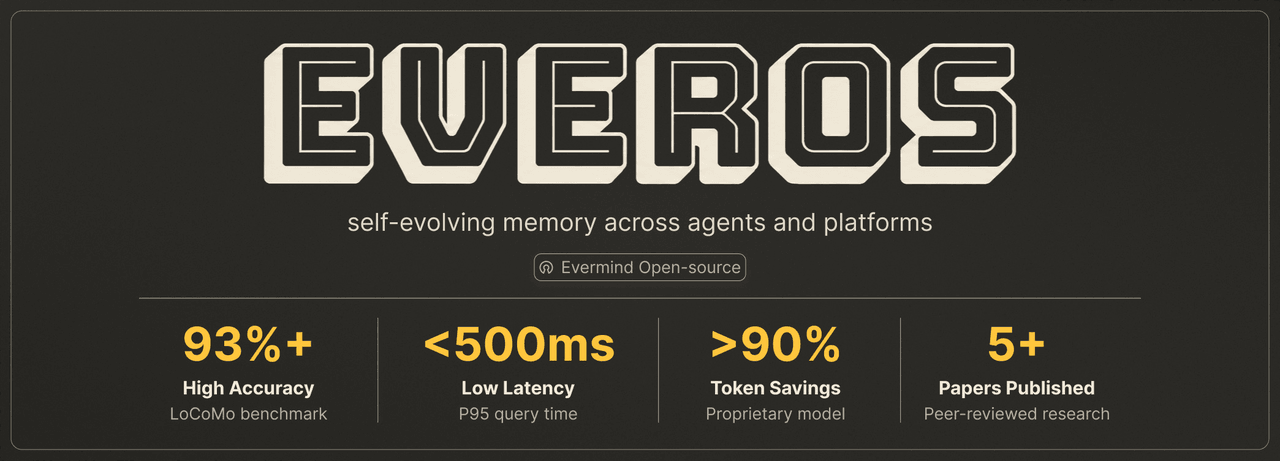 EverMind-AI/EverOS
One portable memory layer for every AI agent: local-first, Markdown-native, user-owned, and self-evolving across apps, t…
EverMind-AI/EverOS
One portable memory layer for every AI agent: local-first, Markdown-native, user-owned, and self-evolving across apps, t…
-
 MemTensor/MemOS
Self-evolving memory OS for LLM & AI Agents: ultra-persistent memory, hybrid-retrieval, and cross-task skill reuse, with…
MemTensor/MemOS
Self-evolving memory OS for LLM & AI Agents: ultra-persistent memory, hybrid-retrieval, and cross-task skill reuse, with…
-
 plastic-labs/honcho
Memory library for building stateful agents
plastic-labs/honcho
Memory library for building stateful agents
-
 agentscope-ai/ReMe
ReMe: Memory Management Kit for Agents - Remember Me, Refine Me.
agentscope-ai/ReMe
ReMe: Memory Management Kit for Agents - Remember Me, Refine Me.
-
 zilliztech/memsearch
A persistent, unified memory layer for all your AI agents (e.g. Claude Code, Codex, DSH), backed by Markdown and Milvus.
zilliztech/memsearch
A persistent, unified memory layer for all your AI agents (e.g. Claude Code, Codex, DSH), backed by Markdown and Milvus.
-
 vshulcz/deja-vu
The most accurate, cheapest and fastest memory for coding agents: searchable session history from Claude Code, Codex, Cu…
vshulcz/deja-vu
The most accurate, cheapest and fastest memory for coding agents: searchable session history from Claude Code, Codex, Cu…