
dsh-market/dsh-market
DeepSeek Harness 内置插件市场 — 浏览、搜索、一键安装 · DSH 可视化插件市场
项目介绍Project Overview
dsh-market 是 DeepSeek Harness 内置的插件市场,在设置中即可浏览、搜索并一键安装社区插件与主题。核心能力涵盖分类筛选、截图预览、热启用/禁用、备份与还原(含 WebDAV 自动备份)、更新检查等。适合需要集中管理插件、主题及跨机同步配置的用户。注意:需 dsh web 0.1.0-rc.6 或更高版本,否则市场会禁用自身。
dsh-market is the built-in plugin marketplace for DeepSeek Harness, letting users browse, search, and one-click install community plugins and themes from Settings. It offers category filters, screenshot previews, hot enable/disable, backup and restore (with WebDAV auto-backup), per-plugin update checks, and live theme switching. Use it to centrally manage plugins, themes, and synced profiles across machines. Note: requires dsh web 0.1.0-rc.6 or newer; older hosts disable the market silently.
请帮我了解并安装插件:【dsh-market】【https://github.com/dsh-market/dsh-market】把上面这条消息直接发给当前会话里的 DSH,让它帮你了解并安装。安装命令不一定准确,发给 DSH 更稳。Send this message to DSH in your current session. CLI install commands may not be accurate across systems — DSH will figure it out for you.
或使用命令行安装(适合开发者)Or use CLI install (for developers)
命令行安装CLI Install
dsh plugin --profile web add dshmarket把 dsh-market/dsh-market 加入你的 DSH 配置(web profile)即可启用。
READMEREADME

dsh-market
English | 中文


The plugin market inside DeepSeek Harness. Open Settings → Plugin Market → browse, search, one-click install.
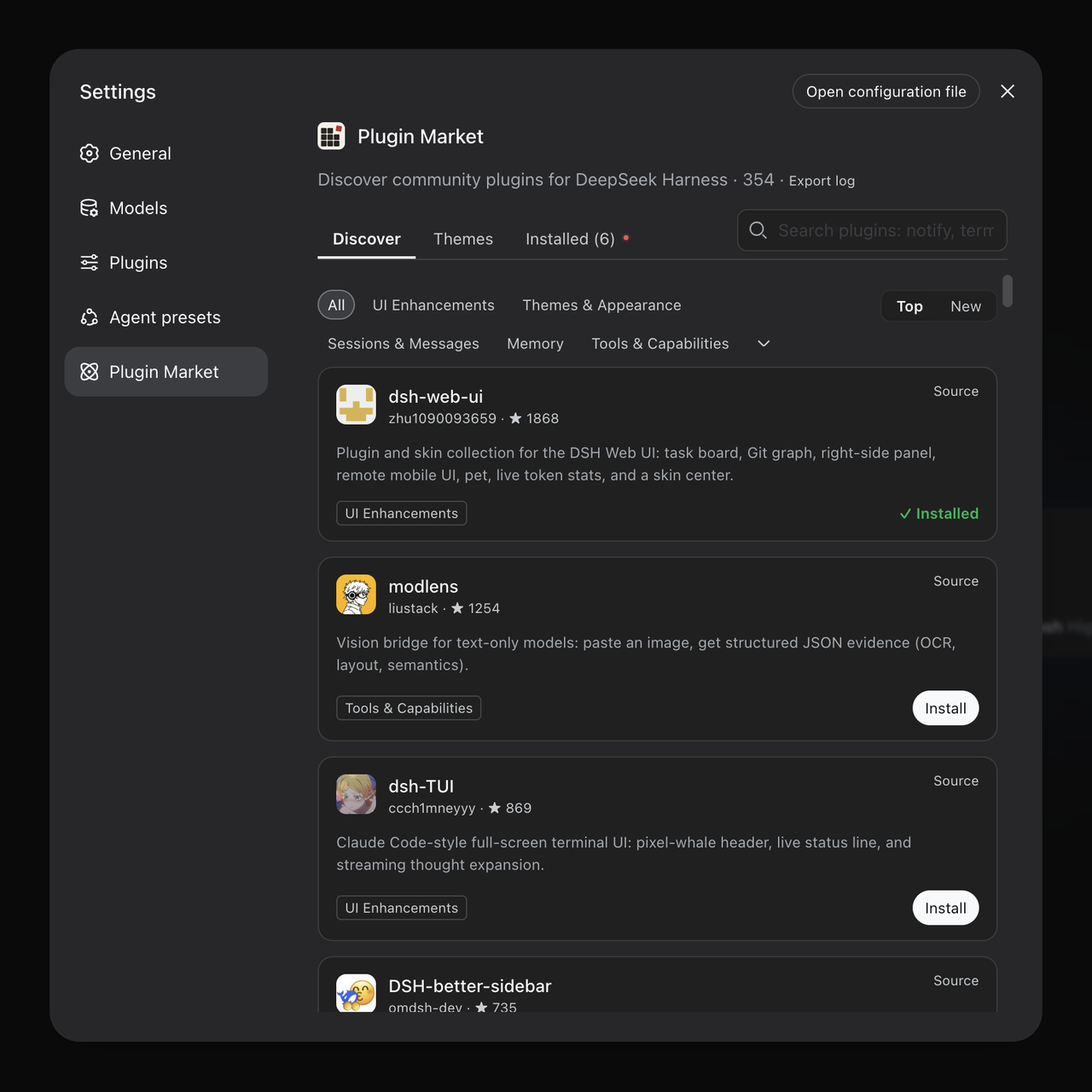
One-click themes: install, switch live, no restart.
Install
dsh plugin --profile web add dshmarket
Restart dsh web, then open Settings → Plugin Market.
Requires dsh web 0.1.0-rc.6 or newer. On an older host the market
disables itself and says so in the browser console rather than rendering
against primitives that are not there — if the Plugin Market entry never
appears, that is usually why. Worth checking when a desktop build bundles
its own dsh: it may be older than the one npm would give you (#139).
What you get
Browse & search the full community catalog (1550+ plugins, growing daily) — category filters, star counts, top/new sorting, bilingual descriptions that follow your UI language
Screenshots — AppStore-style screenshots, auto-carousel when there's more than one, click to preview full-size: author-curated shots show right on the card (zero extra requests); plugins without curated shots fall back to automatic README extraction once you open the install dialog. Images load from GitHub hosting only
Themes — a dedicated tab for community themes and skins: install → active immediately, switch with one click (themes are mutually exclusive, your choice survives restarts), uninstall to revert
One-click install — confirm the source, watch live progress; most plugins go live after a page refresh, no restart
Backup & restore — export your profile's plugin list and configuration as readable JSON, import it on another machine, store it on WebDAV with daily auto-backup, or sync through a private GitHub Gist; restores merge (plugins installed after the backup are kept), validate before writing, and roll back on failure
Updates — per-plugin update checks (npm version or pinned commit vs HEAD), one-click update, or update everything at once; the market updates itself the same way
Uninstall — two-step confirm; plugins installed this session are removed live
Hot disable / enable — toggles write
- id: …+disabled: true|falseinto the profile'scordis.patch.yml(the official patch layer, mechanism ported from dsh-plugin-hub): DSH's HMR re-composes within ~1s, no restart, and the loader re-applies the choice on every boot; hand-edited patch rows show as badges, host-infrastructure plugins are protected from toggling, and a malformed patch file is never made worseRestart when needed — changes that cannot hot-load show a one-click restart beside the pending-change banner; the action is restricted to same-origin loopback requests
Zero jargon — if a component is missing (pnpm), the market detects it and offers a one-click automatic setup
Log export — one click produces a sanitized plain-text log for bug reports (home paths and credential shapes are masked; nothing is ever sent anywhere). The market's version sits next to the page heading, so a screenshot of a problem already carries it
Settings card — on dsh 0.1.0-rc.7 and newer the market manages itself from Settings → Plugins → Plugin configuration, next to every other plugin: see the running version, pick a release channel (stable, or beta to try builds still being verified — the market only, never your other plugins; a third dev channel appears once developer mode is switched on, and carries builds published straight off a branch), update, or remove the market — with an opt-in cleanup that also drops the disable rows it wrote, so plugins it switched off start running again rather than staying off with no UI left to switch them back on
Diagnostics — the plugin load order and conflict surface, one page: bundle stack with official/community badges, duplicate loader entries, dependency version mismatches, multi-version core packages, overrides and invalid config entries. Plain-language terms, problem blocks highlighted, everything collapsible
Load order — drag community bundles into the order you want, or take the suggested one derived from the plugins' own before/after rules. Nothing is written until a trial composition passes, and the panel tells you what the new order would change (overrides, invalid or duplicate entries) before you apply it
AI fix — one click copies a diagnostics-driven fix prompt (errors/warnings/order conflicts + conservative scope instructions) to the clipboard; you paste it into a new conversation and decide whether to send. The prompt first asks the agent to detect whether it is itself the harness running this profile — if so it hard-forbids mutating the live composition, upgrading/restarting the harness or core packages, or reinstalling deps, and instead has it write an idempotent
applyscript plus arollbackscript, have you run them in an external terminal, and paste the output back
Speed
Installs prefer repo-verified npm packages, then author-supplied prebuilt GitHub Release tarballs, before falling back to full-repo GitHub source downloads. Prebuilt installs are typically seconds and do not need local build scripts; source-only plugins depend on your connection to GitHub.
Security
Installs are restricted to sources listed in the curated awesome-dsh-plugin registry — anything else is rejected
Build scripts stay blocked by default (pnpm ≥10); allowing one is your explicit per-package choice
Terminal/CLI-surface plugins are flagged before you install them into the web profile
The install endpoint accepts same-origin POST only; the market never phones home
Backups can contain credentials from your profile config — the UI warns before export and upload; WebDAV sync is https-only, refuses private-network targets, and never stores your password in the browser
The restart endpoint additionally requires a direct loopback client (forwarded requests are rejected) and relaunches the exact DSH entry, arguments, environment, and working directory
One-click restart launches a detached replacement. When this host is systemd's own service process the button is hidden automatically — the market would otherwise kill the takeover process along with the unit's cgroup and the service would not come back. The pending-change notice stays visible and says so. Detection requires both a systemd marker AND being the unit's main process, because
INVOCATION_IDis inherited by every descendant of a unit (an ordinary terminal included) and hiding the button for those would be the worse bug. pm2 and launchd are not detected, so those deployments need the explicit setting below. Either flip Allow restart off in Settings → Plugins → Plugin configuration, or write it into the profile patch — where it has to sit underconfig:, because the loader passes only that sub-object to a plugin and a top-levelallowRestart:is silently ignored (#227 by @Fantasymax):- id: dsh-market name: dshmarket config: allowRestart: false # NOT at the top level beside `name:`GET /dsh-market/statusreports"restart": falseonce it has taken effect.For terminal-attached launches, the detached replacement keeps running after the original terminal closes
Listing ≠ endorsement: plugins are third-party code, install sources you trust
Submit your plugin
This repo is the market app, not the catalog. The plugin list comes from the curated awesome-dsh-plugin registry — to get your plugin listed in the market, open a PR there (one entry in the list; the site and this market pick it up automatically, usually within a day). Please don't PR plugin entries against this repo.
Roadmap & feedback
- Bugs go in issues — attaching the market's "Export log" makes diagnosis roughly ten times faster
- Feature ideas go on the Roadmap. Issues are kept for things that are broken, so a proposal filed as an issue gets moved there and closed; the discussion stays where you wrote it either way
- Every roadmap item welcomes community PRs — say so on the item before starting, so two people don't build it twice
Data source
Fetched live on every open from awesome-dsh-plugin.com/plugins.json — curated entries, npm mapping, and star counts refreshed daily by CI, with no stale cache behind it. A failure reports the actual reason and elapsed time, with a Retry button.
There is deliberately no bundled snapshot to fall back on: for a catalog that grows daily, a stale answer is not a degraded one but a wrong one — a plugin published this morning would read as "does not exist".
If that host is unreachable from your network, point the market at a mirror instead. Set DSHM_REGISTRY_URL in the environment dsh runs in, to anything serving the same plugins.json shape:
DSHM_REGISTRY_URL=https://your-mirror.example/plugins.json dsh web
Friends
DSH Desktop (dataelement)
dsh-desktop — a desktop app for DeepSeek Harness: run and manage a local Harness without installing Node.js yourself. Ships with this plugin market preset as the default. dshdesktop.com
DeepSeek Harness Desktop (hairyf)
deepseek-harness-desktop — a native desktop app for DeepSeek Harness built with Tauri (Rust + Web): one-click local install and launch with no Node.js setup required. On first run it offers to install this plugin market as a recommended preset.
DeepSeek Harness Desktop (anywhere-labs)
deepseek-harness-desktop — an Electron desktop app for DeepSeek Harness built around the idea that everything is a plugin, including the desktop itself: profile switching, a bundled Node and pnpm, and a recoverable install path that snapshots the profile before a change. dshdesktop.cn
DSH App
dsh-app — a DeepSeek Harness desktop client built on Tauri 2 rather than Electron, so it ships a much smaller binary and uses the system webview. AGPL-3.0.
DSH Get
DSH Get — a searchable web directory for discovering DeepSeek Harness plugins: category filters, bilingual descriptions, install commands and per-plugin detail pages. Its normalized catalog snapshot is public at bobby-sheng/dshget-data.
modlens
modlens — the first vision plugin for DeepSeek Harness: bolts visual understanding onto text-only models like DeepSeek and GLM. Paste an image, get structured JSON evidence back — OCR, layout, semantics. Available right in this market:
dsh plugin --profile web add @liustack/modlens
License
MIT · dshmarket.com
相关推荐Related
-
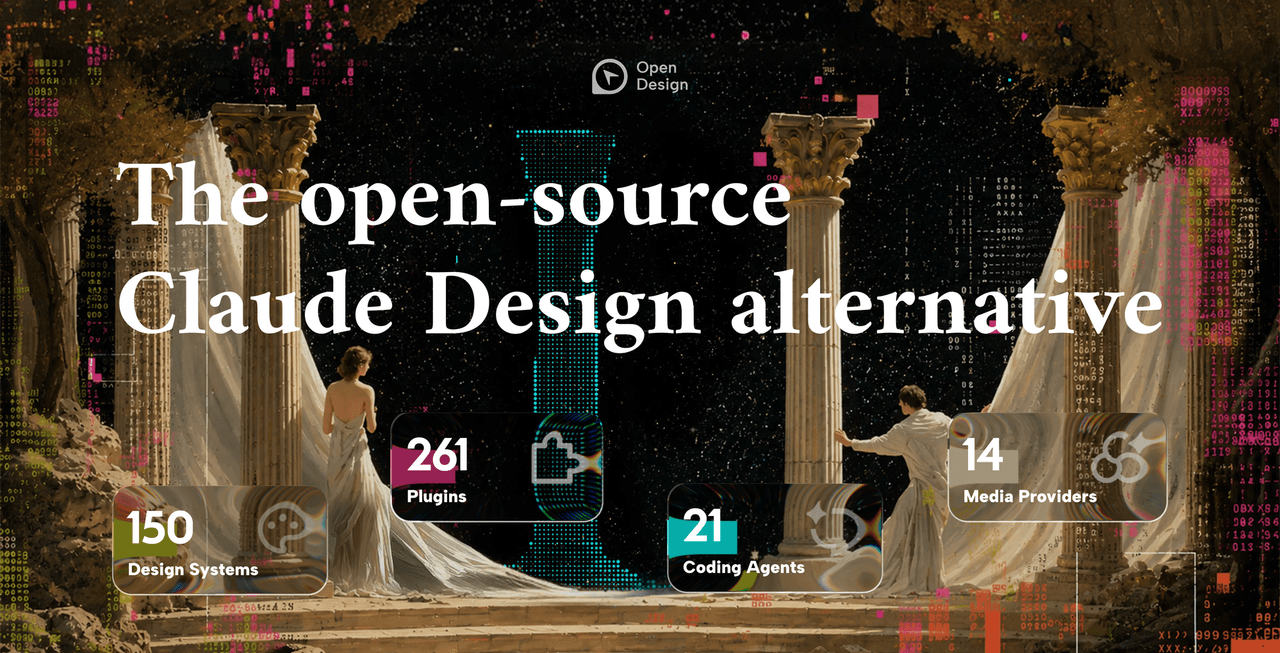 nexu-io/open-design
🎨 Best DeepSeek Harness Design Plugin. The open-source Claude Design alternative. 🖥️ Local-first desktop app. 🖼️ Your…
nexu-io/open-design
🎨 Best DeepSeek Harness Design Plugin. The open-source Claude Design alternative. 🖥️ Local-first desktop app. 🖼️ Your…
-
 ruvnet/ruflo
🌊 The original agent meta-harness. Deploy intelligent multi-player swarms, coordinate autonomous workflows, and build c…
ruvnet/ruflo
🌊 The original agent meta-harness. Deploy intelligent multi-player swarms, coordinate autonomous workflows, and build c…
-
 amruthpillai/reactive-resume
A one-of-a-kind resume builder that keeps your privacy in mind. Completely secure, customizable, portable, open-source a…
amruthpillai/reactive-resume
A one-of-a-kind resume builder that keeps your privacy in mind. Completely secure, customizable, portable, open-source a…
-
 esengine/DeepSeek-Reasonix
DeepSeek-native AI coding agent for your terminal. Engineered around prefix-cache stability — leave it running.
esengine/DeepSeek-Reasonix
DeepSeek-native AI coding agent for your terminal. Engineered around prefix-cache stability — leave it running.
-
 volcengine/OpenViking
Self-evolving Context Database for AI Agents. Unify Agent Memory, Knowledge RAG and Skills.
volcengine/OpenViking
Self-evolving Context Database for AI Agents. Unify Agent Memory, Knowledge RAG and Skills.
-
 Molunerfinn/PicGo
:rocket: The Ultimate Image Uploader for Efficient Creators. Supports Obsidian, Typora, VS Code etc. and 60+ image hosti…
Molunerfinn/PicGo
:rocket: The Ultimate Image Uploader for Efficient Creators. Supports Obsidian, Typora, VS Code etc. and 60+ image hosti…
-
 titanwings/distilly
Distilly — Distill how they think into reusable Skills for any Agent or Bot. Formerly Colleague Skill(原同事 Skill).
titanwings/distilly
Distilly — Distill how they think into reusable Skills for any Agent or Bot. Formerly Colleague Skill(原同事 Skill).
-
 titanwings/colleague-skill