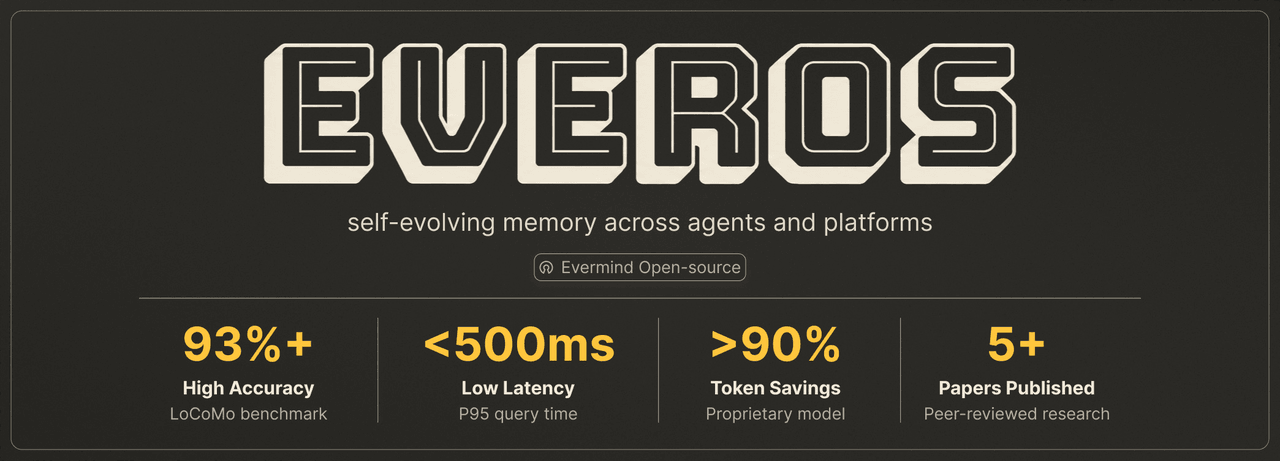
EverMind-AI/EverOS
EverOS is a Python library and local-first memory runtime for agents and makers. It gives one portable memory layer across coding assistants, apps, devices, and workflows from day one. It stores conversations, files, and agent trajectories as readable Markdown, then syncs local SQLite and LanceDB indexes
catalog 简介 / catalog descriptioncatalog description:One portable memory layer for every AI agent: local-first, Markdown-native, user-owned, and self-evolving across apps, tools, and workflows.
项目介绍Project Overview
EverOS 是面向智能体的本地优先 Python 记忆运行时,把会话、文件与轨迹存为可读 Markdown,并通过本地 SQLite 与 LanceDB 索引同步检索。核心能力是跨编码助手、应用与设备提供可移植、可直接编辑的记忆层,配合正交检索与离线反思实现自演化复用。适合构建需要长期、跨会话记忆的智能体工作流。需注意:仅支持 Python 3.12+,且默认依赖 OpenRouter API 密钥。
EverOS is a local-first Python memory runtime for agents that stores conversations, files, and trajectories as readable Markdown, synced via local SQLite and LanceDB indexes. Its core capability is a portable, directly editable memory layer spanning coding assistants, apps, and devices, with orthogonal retrieval and offline reflection for self-evolving reuse. Use it when building agents needing durable, cross-session memory. Caveat: requires Python 3.12+ and an OpenRouter API key.
请帮我了解并安装插件:【EverOS】【https://github.com/EverMind-AI/EverOS】把上面这条消息直接发给当前会话里的 DSH,让它帮你了解并安装。安装命令不一定准确,发给 DSH 更稳。Send this message to DSH in your current session. CLI install commands may not be accurate across systems — DSH will figure it out for you.
或使用命令行安装(适合开发者)Or use CLI install (for developers)
命令行安装CLI Install
dsh plugin --profile web add github:EverMind-AI/EverOS把 EverMind-AI/EverOS 加入你的 DSH 配置(web profile)即可启用。
READMEREADME




Why Ever OS
EverOS is a Python library and local-first memory runtime for agents and makers. It gives one portable memory layer across coding assistants, apps, devices, and workflows from day one. It stores conversations, files, and agent trajectories as readable Markdown, then syncs local SQLite and LanceDB indexes for fast retrieval and self-evolving reuse.
| Title | EverOS | Other Agent Memory Libraries |
|---|---|---|
| Markdown source of truth | ✅ Canonical .md files that are readable, editable, diffable, and Git-versioned |
❌ Usually API, vector, graph, dashboard, or database state |
| Direct file editing | ✅ Edit .md files; cascade watcher syncs |
❌ Usually SDK, API, dashboard, or backend update paths |
| Local three-part stack | ✅ Markdown + SQLite + LanceDB; no MongoDB, Elasticsearch, or Redis required | ❌ Often depends on managed services, vector DBs, graph DBs, or server stacks |
| User + agent tracks | ✅ User episodes/profile and agent cases/skills are separate first-class surfaces |
❌ Usually centered on chat history, profiles, entities, facts, or retrieval records |
| Orthogonal retrieval | ✅ Search by user_id, agent_id, app_id, project_id, and session_id |
❌ Usually app, namespace, tenant, thread, or graph scoped |
| Knowledge Wiki | ✅ Editable, source-backed Markdown knowledge pages with taxonomy, CRUD APIs, and topic search | ❌ Usually separate from memory, trapped in a dashboard, or not tied back to source files |
| Reflection | ✅ Offline memory evolution that merges episode clusters and refines profiles and skills between sessions | ❌ Usually retrieval-only memory with little background consolidation or long-horizon improvement |
Quick Start
One OpenRouter API key is enough to start EverOS, write durable memories, and retrieve them with keyword search.
Prerequisites
- Python 3.12+
- One OpenRouter API key
1. Install
uv pip install everos
# or: pip install everos
2. Try the standalone demo — no key required
No API key or server setup required—run one command to quickly experience how EverOS stores and recalls memory:
# If you installed EverOS as a package:
everos demo

# If you cloned or forked this repository and have not activated .venv:
uv run everos demo
Enter something EverOS should remember, then ask a related question to watch the memory move through ingest -> extract -> index -> recall.
https://github.com/user-attachments/assets/98cb8e1e-2ca8-4504-b0a6-0b9a040a0a5c
3. Initialize and add your OpenRouter key
everos init
This creates ~/.everos/everos.toml and ~/.everos/ome.toml. Open
~/.everos/everos.toml; the generated model and OpenRouter URL are already
correct, so replace only the empty api_key:
[llm]
model = "openai/gpt-4.1-mini"
api_key = "<OPENROUTER_API_KEY>"
base_url = "https://openrouter.ai/api/v1"
This is the smallest Tier 1 setup: memory add, flush, Markdown persistence, cascade indexing, and keyword search.
Use everos init --root <path> if you want a different memory root. Pass the
same --root <path> to subsequent commands.
4. Start EverOS
everos server start
Keep the server running, then open a second terminal and check it:
curl http://127.0.0.1:8000/health
Look for "status":"ok". With this one-key setup, capabilities.llm is
true; embedding and rerank remain false until you configure them.
5. Add and retrieve your first memory
[!NOTE] Business endpoints live under
/api/v2. The older/api/v1prefix still resolves to the same handlers so existing integrations keep working, but it is a legacy alias that may be removed in a future major release — write new code against/api/v2.
Add a tiny conversation:
TS=$(($(date +%s)*1000))

curl -X POST http://127.0.0.1:8000/api/v2/memory/add \
  -H 'Content-Type: application/json' \
  -d "{
    \"session_id\": \"demo-001\",
    \"app_id\": \"default\",
    \"project_id\": \"default\",
    \"messages\": [
      {\"sender_id\": \"alice\", \"role\": \"user\", \"timestamp\": $TS, \"content\": \"I love climbing in Yosemite every spring.\"},
      {\"sender_id\": \"alice\", \"role\": \"user\", \"timestamp\": $((TS+10000)), \"content\": \"My favorite coffee shop is Blue Bottle in SOMA.\"}
    ]
  }"
Flush the memory at the end of the session:
curl -X POST http://127.0.0.1:8000/api/v2/memory/flush \
  -H 'Content-Type: application/json' \
  -d '{"session_id":"demo-001","app_id":"default","project_id":"default"}'
Search it back:
curl -X POST http://127.0.0.1:8000/api/v2/memory/search \
  -H 'Content-Type: application/json' \
  -d '{
    "user_id": "alice",
    "app_id": "default",
    "project_id": "default",
    "query": "Where do I like to climb?",
    "method": "keyword",
    "top_k": 5
  }'
You should see the Yosemite memory in the response. Keep
"method": "keyword" in this one-key setup because the API defaults to hybrid
search, which requires an embedding provider.
[!TIP] First memory unlocked. You just gave EverOS a fact, flushed it into durable Markdown-backed memory, and searched it back through the local index. That is the core loop. Want to see the source of truth? Open
~/.everosand inspect the generated Markdown files.
For annotated responses and the Markdown files EverOS creates, see QUICKSTART.md.
What works with one key?
The OpenRouter one-key setup is EverOS Tier 1. It supports server startup, memory add and flush, durable Markdown storage, cascade indexing, and keyword search. Add optional providers only when you need the features below:
| Configuration | Adds |
|---|---|
[llm] only |
Core memory flow and keyword search |
Add [embedding] |
Vector/user hybrid search, reflection, and skill extraction |
Add [rerank] too |
Agentic search, default agent hybrid search, and Knowledge Wiki |
Add [multimodal] and parser extra |
Image, PDF, audio, and office-file ingestion |
Missing optional capabilities are reported by /health and return a clear
HTTP 422 if you request a feature that needs them.
[!NOTE]
everos demo --liveis different from the standalone demo in step 2: it connects to a running server and uses the real add/flush/search flow. It uses hybrid search, so add an embedding provider before you run it.
Optional: Ingest Multimodal Files
To ingest non-text content (image / pdf / audio / office documents)
through /api/v2/memory/add content items, install the optional
extra:
uv pip install 'everos[multimodal]' # or: pip install 'everos[multimodal]'
This pulls in everalgo-parser (with the [svg] bundle for SVG support via
cairosvg). Configure the [multimodal] section in everos.toml; its default
model is google/gemini-3-flash-preview via OpenRouter.
Office document support requires LibreOffice as a system dependency.
The parser shells out to soffice (LibreOffice's headless renderer) to
convert .doc / .docx / .ppt / .pptx / .xls / .xlsx to PDF
before feeding the result into the multimodal LLM. Without LibreOffice,
office uploads return HTTP 415 with a clear error message; PDF / image
/ audio / HTML / email parsing is unaffected.
Install on the host before serving office documents:
brew install --cask libreoffice              # macOS
sudo apt-get install -y libreoffice          # Debian / Ubuntu
For Contributors
git clone https://github.com/EverMind-AI/EverOS.git
cd EverOS
uv sync                              # creates ./.venv and installs deps
uv run everos demo --plain           # try the local educational demo; no API keys needed
uv run everos init                   # add one OpenRouter key to ~/.everos/everos.toml

uv run everos --help
make test
Use Cases
Now that you have had your first successful EverOS moment, explore what people are building with persistent memory across agents, apps, and community integrations.
Use cases show what persistent memory makes possible in real products and workflows. Some examples are packaged in this repository; others point to external demos or integrations you can study and adapt.
Reunite - Find With EverOSParents describe what they remember. Children describe what they recall. Reunite uses semantic memory to surface the connections. |
Hive OrchestratorBrowser-native hive-mind for CLI coding agents - Claude Code, Codex, Gemini, and OpenCode collaborate as real PTY processes via a team protocol. |
AI Coding Assistants With EverOSUniversal long-term memory layer for AI coding assistants, powered by EverOS. |
AI Data TechnicianAn agentic AI system that learns from scientist interaction to inspect, analyze, and classify high-dimensional time series data - with persistent memory that improves across sessions. |
Rokid AI Assistant With EverOSConnect to EverOS within Rokid Glasses enabling long-term memory for all of your smart activities. Coming soon |
Creative Assistant With MemoryCreative assistant with long-term memory, so your creative context stays available across sessions. Coming soon |

|
|
Earth Online Memory GameEarth Online is a memory-aware productivity game that turns everyday planning into a living quest log. |
Multi-Agent Orchestration PlatformGolutra presents a multi-agent workforce for engineering teams, extending the IDE model from a single assistant to coordinated agents. |
Your Personal Tasting UniverseRecord, visualize, and explore your tasting journey through an immersive 3D star map. |
EverOS Open HerBuild AI that feels. Open-source persona engine - personality emerges from neural drives, not prompts. Inspired by Her. |
Browser Agent For Personal MemoryRuminer brings persistent memory to a browser agent so it can carry personal context across web tasks. |
EverMem Sync With EverOSOne command to connect any AI coding CLI to EverMemOS long-term memory. |
|
|
|
MCO - Orchestrate AI Coding AgentsMCO equips your primary agent with an agent team that can work together to solve complex tasks. |
Study Buddy With Self-Evolving MemoryStudy proactively with an agent that has self-evolving memory. |
Alzheimer's Memory AssistantEmpowering individuals with advanced memory support and daily assistance. |
Memory-Driven Multi-Agent NPC ExperienceAn iOS sci-fi mystery game where players explore and uncover the truth. |
Mobi CompanionAn iOS app where users create, nurture, and live with a personalized AI companion called Mobi. |
AI Wearable With MemoryA context-native AI wearable that listens to everyday life and converts conversations into memory. |
|
|
|
Legacy OpenClaw Agent MemoryArchived pre-1.0.0 plugin reference. New integrations should use the current EverOS API. |
Live2D Character With MemoryAdd long-term memory to a real-time Live2D character, powered by TEN Framework. |
Computer-Use With MemoryRun screenshot-based analysis with computer-use and store the results in memory. |
Game Of Thrones MemoriesA demonstration of AI memory infrastructure through an interactive Q&A experience with A Game of Thrones. |
Claude Code PluginPersistent memory for Claude Code. Automatically saves and recalls context from past coding sessions. |
Memory Graph VisualizationExplore stored entities and relationships in a graph interface. Frontend demo; backend integration is in progress. |
Documentation
- docs/everos-demo.md — Demo scope and TUI source layout
- docs/how-memory-works.md — Markdown, SQLite, LanceDB, and recall flow
- docs/use-cases.md — Full use-case gallery and integration examples
- docs/engineering.md — Contributor engineering reference: build, test, CI, conventions
- docs/migration-to-1.0.0.md — Legacy API migration notes
- CHANGELOG.md — Release notes
- CONTRIBUTING.md — How to contribute
EverMind Ecosystem
EverMind connects memory research, production-ready products, and practical integrations into one open-source ecosystem.
| Products | |
|---|---|
| EverOS | A local-first, Markdown-native long-term memory runtime for agents and users. |
| Raven | A memory-first, self-improving agent harness with proactivity, context control, and skill evolution. |
| EverMe (CLI) | A CLI and agent plugin suite for cross-device, cross-agent personal memory. |
| Research & Evaluation | |
| SkillCorpus | Curated, retrieval-ready agent skill corpora with retrieval and evaluation tooling. |
| EverAlgo | Stateless extraction, ranking, parsing, and memory operators that power EverOS. |
| HyperMem | Hypergraph-based hierarchical memory for coarse-to-fine long-term conversation retrieval. |
| MSA | Memory Sparse Attention for scalable latent memory and 100M-token contexts. |
| EverMemBench | Evaluation of factual recall, applied reasoning, and personalized generalization in memory systems. |
| EvoAgentBench | Longitudinal evaluation of agent self-evolution, transfer efficiency, error avoidance, and skill use. |
| Integrations | |
| OpenClaw | OpenClaw plugin for automatic recall, capture, and session-memory lifecycle management. |
| Hermes Agent | Hermes plugin for persistent memory across Hermes sessions. |
| DeepSeek Harness | DSH plugin for memory-aware DeepSeek Harness agents. |
| Dify | Self-hosted and cloud tools for explicit memory search and storage in workflows and agents. |
Together, these projects form EverMind's research-to-runtime stack: methods and benchmarks become reusable memory infrastructure, products, and agent integrations.
Contributing
Contributions are welcome across the whole repository: memory methods, benchmark coverage, use-case examples, documentation, and bug fixes. Browse Issues to find a good entry point, then open a PR when you are ready.
[!TIP]
Welcome all kinds of contributions 🎉
Help make EverOS better. Code, documentation, benchmark reports, use-case write-ups, and integration examples are all valuable. Share your projects on social media to inspire others.
Connect with one of the EverOS maintainers @elliotchen200 on 𝕏 or @cyfyifanchen on GitHub for project updates, discussions, and collaboration opportunities.
Code Contributors
License
Apache License 2.0 — see NOTICE for third-party attributions.
Citation
If you use EverOS in research, see CITATION.md.
相关推荐Related
-
 nexu-io/open-design
🎨 Best DeepSeek Harness Design Plugin. The open-source Claude Design alternative. 🖥️ Local-first desktop app. 🖼️ Your…
nexu-io/open-design
🎨 Best DeepSeek Harness Design Plugin. The open-source Claude Design alternative. 🖥️ Local-first desktop app. 🖼️ Your…
-
 ruvnet/ruflo
🌊 The original agent meta-harness. Deploy intelligent multi-player swarms, coordinate autonomous workflows, and build c…
ruvnet/ruflo
🌊 The original agent meta-harness. Deploy intelligent multi-player swarms, coordinate autonomous workflows, and build c…
-
 amruthpillai/reactive-resume
A one-of-a-kind resume builder that keeps your privacy in mind. Completely secure, customizable, portable, open-source a…
amruthpillai/reactive-resume
A one-of-a-kind resume builder that keeps your privacy in mind. Completely secure, customizable, portable, open-source a…
-
 esengine/DeepSeek-Reasonix
DeepSeek-native AI coding agent for your terminal. Engineered around prefix-cache stability — leave it running.
esengine/DeepSeek-Reasonix
DeepSeek-native AI coding agent for your terminal. Engineered around prefix-cache stability — leave it running.
-
 volcengine/OpenViking
Self-evolving Context Database for AI Agents. Unify Agent Memory, Knowledge RAG and Skills.
volcengine/OpenViking
Self-evolving Context Database for AI Agents. Unify Agent Memory, Knowledge RAG and Skills.
-
 Molunerfinn/PicGo
:rocket: The Ultimate Image Uploader for Efficient Creators. Supports Obsidian, Typora, VS Code etc. and 60+ image hosti…
Molunerfinn/PicGo
:rocket: The Ultimate Image Uploader for Efficient Creators. Supports Obsidian, Typora, VS Code etc. and 60+ image hosti…
-
 titanwings/distilly
Distilly — Distill how they think into reusable Skills for any Agent or Bot. Formerly Colleague Skill(原同事 Skill).
titanwings/distilly
Distilly — Distill how they think into reusable Skills for any Agent or Bot. Formerly Colleague Skill(原同事 Skill).
-
 titanwings/colleague-skill