GMH13552/dsh-timer-scheduler
简单的dsh定时任务插件 支持定时列表任务、ui显示,对于长期任务有益
项目介绍Project Overview
DSH 定时调度插件,为 Agent 提供延时唤醒能力。核心:三个 host 端工具(schedule_reminder、list_reminders、cancel_reminder),到期后通过 agent.followup() 自动触发新一轮回话;客户端头部下拉菜单实时显示倒计时,主题感知、空时自动隐藏;待办持久化至 $DSH_HOME/timer-reminders.json,重启后自动重新挂载。适用:让 Agent 自主复查后台任务、远端作业等"稍后再看"场景。安装需将其加入 Web 配线包中;若预设采用严格工具过滤(如 anchored-standard),需在 residentTools 中显式保留三个工具名。冷启动恢复依赖 session 持久化,进程离线时到期的提醒会在启动时立即触发而非跳过。
DSH timer-scheduler plugin that lets agents self-wake at a future time. Core: three host-side tools (schedule_reminder, list_reminders, cancel_reminder) that arm a one-shot timer and, on fire, deliver a plugin-sourced follow-up via agent.followup(); pending reminders are persisted to $DSH_HOME/timer-reminders.json and re-armed on restart. A client-side header dropdown shows per-reminder notes with live countdowns, theme-aware, hidden when empty. Use it when you want an agent to autonomously check on background jobs or remote tasks without a human prompt. Caveat: cold resume needs session persistence configured, and a failed resume is logged and skipped rather than retried.
请帮我了解并安装插件:【dsh-timer-scheduler】【https://github.com/GMH13552/dsh-timer-scheduler】把上面这条消息直接发给当前会话里的 DSH,让它帮你了解并安装。安装命令不一定准确,发给 DSH 更稳。Send this message to DSH in your current session. CLI install commands may not be accurate across systems — DSH will figure it out for you.
或使用命令行安装(适合开发者)Or use CLI install (for developers)
命令行安装CLI Install
dsh plugin --profile web add github:GMH13552/dsh-timer-scheduler把 GMH13552/dsh-timer-scheduler 加入你的 DSH 配置(web profile)即可启用。
READMEREADME
dsh-timer-scheduler-ui
A DeepSeek Harness (DSH) plugin: an agent self-scheduler that wakes the agent at a future time to autonomously check on background jobs, remote tasks, or anything that needs a "come back later" look — without a human having to prompt it — plus a header reminder menu in the web UI.
Features
schedule_reminder— schedule a one-shot reminder, relative (delay_seconds) or absolute (at: ISO 8601 /HH:MM[:SS]).list_reminders— list pending reminders.cancel_reminder— cancel a reminder by id.- Auto-wake — on fire, the agent is woken through
agent.followup()with a new turn; it acts and reports on its own, no human wake-up needed. - Persistence — pending reminders are serialized to
$DSH_HOME/timer-reminders.jsonand re-armed on restart. - Header reminder menu (client half) — per-reminder note + live countdown, theme-aware via
--dsw-alias-*tokens, hidden when empty, never covering the send button.
Structure
One package, two halves, in the standard dsh.client + dsh.bundle.patch shape. Everything is host-plane: composing this bundle into the web profile's host composition makes the model tools available to every agent regardless of preset, and the route serves the browser panel.
| File | Half | Role |
|---|---|---|
lib/index.js |
Host | The three model tools (schedule_reminder / list_reminders / cancel_reminder), auto-wake, disk persistence, and GET /api/timer-reminders |
lib/client.js |
Client | conversation.session.header.actions compact dropdown, polling every second |
cordis.patch.yml |
bundle | Inserts the Host half into the web profile's host composition |
package.json |
— | dsh.client (browser bundle) + dsh.bundle.patch (host row) |
Preset adaptation: the anchored-standard preset keeps these tools resident for its agents via its residentTools option; every other preset works without any configuration.
Installation
Not published to npm yet. Install from source:
Host-plane tools: once this bundle is composed, every agent on any preset can call
schedule_reminder/list_reminders/cancel_reminder. If a preset uses an aggressive tool-bootstrap filter (likeanchored-standard), keep the three tool names resident so its agents still see them:# inside the tool-bootstrap row's config residentTools: [schedule_reminder, list_reminders, cancel_reminder]
Place this directory in the web profile workspace and mount it as a dependency + bundle in the profile's
package.json:{ "dependencies": { "dsh-timer-scheduler-ui": "file:./packages/dsh-timer-scheduler-ui" }, "dsh": { "profile": { "bundles": [ "@deepseek-ai/dsh-base", "@deepseek-ai/dsh-web-app", "dsh-timer-scheduler-ui" ] } } }Install and restart:
cd <web-profile>
pnpm install
# restart dsh web (the Host half runs in the server process), then hard-refresh
Verify:
curl 'http://127.0.0.1:<port>/api/timer-reminders?sessionId=x'   # → {"reminders":[]}
curl 'http://127.0.0.1:<port>/plugins/dsh-timer-scheduler-ui/client.js'   # → 200 JS
Once published to npm: dsh plugin --profile web add dsh-timer-scheduler-ui.
Usage
In an agent session, just say:
- "Remind me in 30 minutes to check that background job" →
schedule_reminder(delay_seconds=1800, note=…) - "Check the deployment at 3pm" →
schedule_reminder(at="15:00", note=…) - Manage with
list_reminders/cancel_reminder.
The header reminder menu shows the countdown while reminders are pending and hides when empty.
How it works
- The agent calls
schedule_reminder; the host plugin arms a one-shot Cordistimerand writes{id, note, dueMs, sessionId}to~/.dsh/timer-reminders.json. - On fire, the host plugin resolves the agent via
agents.get(sessionId). If it is not live, the plugin cold-resumes the persisted session throughctx.agents.resume(), then builds asource.kind = 'plugin'user message and delivers it throughagent.followup()to wake the driver. This works for both regular sessions and continuable subagent sessions (as long as session persistence is configured and the session can be resumed). - This package's client half fetches
/api/timer-reminders?sessionId=…every second and renders the countdown from that same file.
Known limitations
- Cold resume requires session persistence to be configured and the owning session to be resumable. If resume fails, the reminder is logged and skipped rather than silently dropped. The cold-resumed AgentHandle is kept until the plugin is unloaded, so the woken session stays resident after the reminder; a future version may dispose it after the wake turn settles.
- Reminders that become due while the DSH process is down are re-armed on startup and fire immediately (instead of being skipped).
- Delays beyond ~24.8 days are chunked, so they work, but the mechanism is "in-process timer + disk snapshot"; the timer only needs the process to stay up to fire.
License
相关推荐Related
-
 memorax-ai/dsh-harmony
A library for patching, replacing and decorating dsh plugin during runtime
memorax-ai/dsh-harmony
A library for patching, replacing and decorating dsh plugin during runtime
-
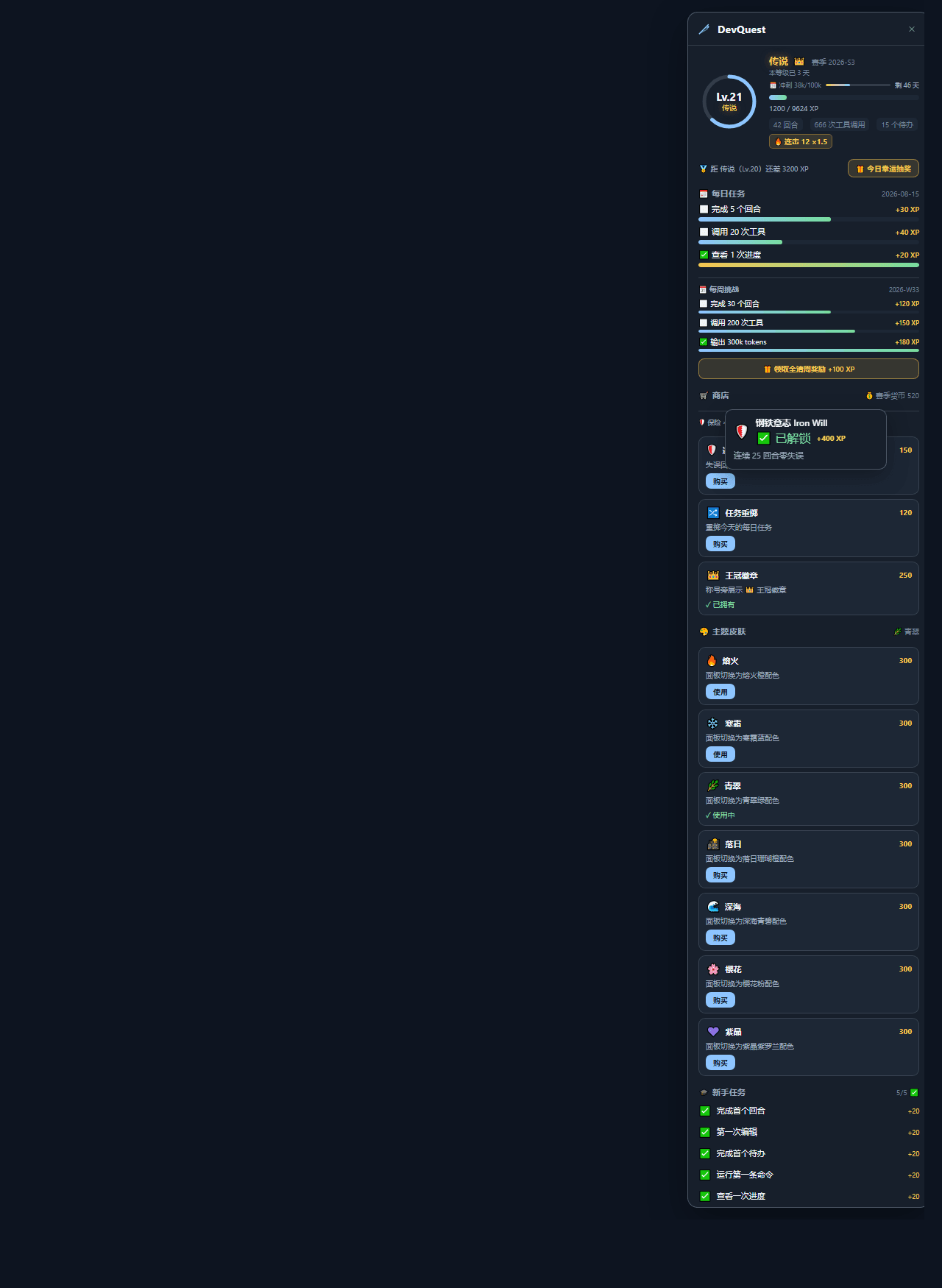 lucky8197/dsh-devquest
把开发变成 RPG 的 DSH 插件:回合/工具/待办积累 XP、47 枚成就+稀有度、每日/每周挑战、每日抽奖、赛季商店、7 款主题皮肤、多称号、活跃日历+荣誉墙。事件流驱动,装好自动计分。
lucky8197/dsh-devquest
把开发变成 RPG 的 DSH 插件:回合/工具/待办积累 XP、47 枚成就+稀有度、每日/每周挑战、每日抽奖、赛季商店、7 款主题皮肤、多称号、活跃日历+荣誉墙。事件流驱动,装好自动计分。
-
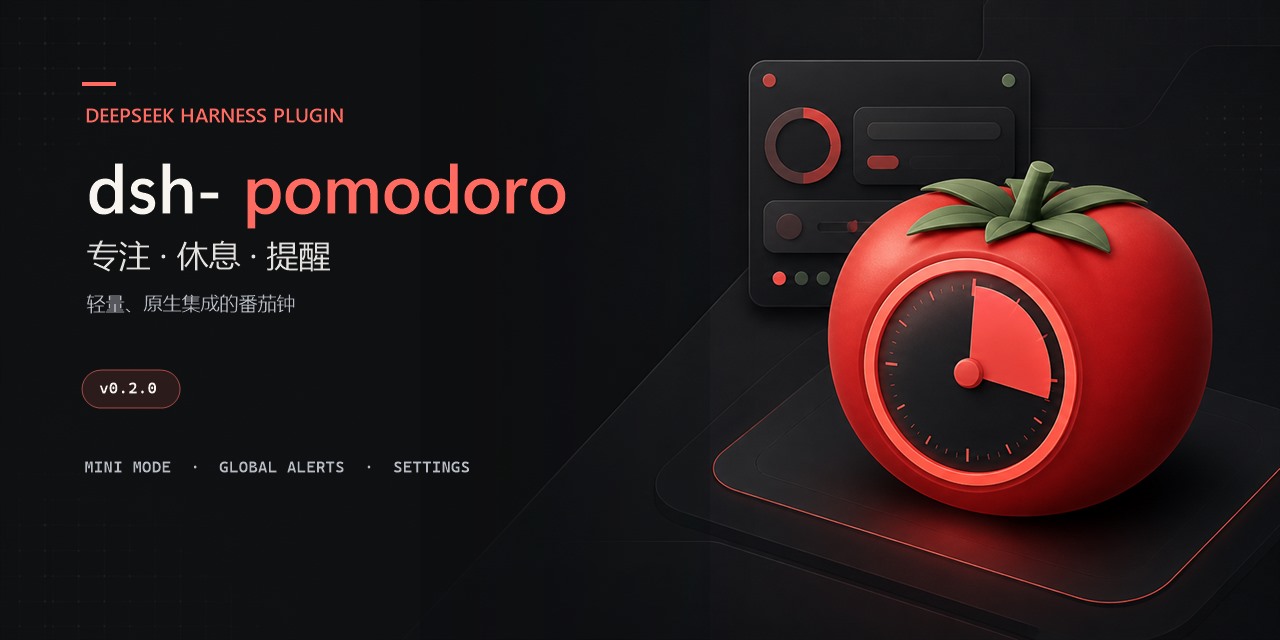 causebefore/dsh-pomodoro
DeepSeek Harness Web 番茄钟插件:可配置专注与休息时长,提供侧栏入口和可拖动浮动面板
causebefore/dsh-pomodoro
DeepSeek Harness Web 番茄钟插件:可配置专注与休息时长,提供侧栏入口和可拖动浮动面板
- miisaka19800/dsh-restart-fab A floating one-click restart button for the DeepSeek Harness web GUI — self-contained, cross-platform.
- Whale-Zhang/dsh-cron-tasks Scheduled tasks for DeepSeek Harness: sidebar jobs, isolated run history, cron/at schedules.
-
 YLifeOnlyOnce/dsh-calendar
See at a glance what DeepSeek did, and when. 📅 A beautiful usage calendar for DeepSeek Harness — every project and task…
YLifeOnlyOnce/dsh-calendar
See at a glance what DeepSeek did, and when. 📅 A beautiful usage calendar for DeepSeek Harness — every project and task…
-
 GanyuanRan/Aegis
Make AI coding agents architecture-aware: baseline-first, evidence-verified, drift-checked, and safe across long tasks.
GanyuanRan/Aegis
Make AI coding agents architecture-aware: baseline-first, evidence-verified, drift-checked, and safe across long tasks.
-
 shengsheng90/DSH-taskboard
Native local Taskboard plugin for DeepSeek Harness. SQLite-backed projects, Agent claim/review, and a native Web UI — no…
shengsheng90/DSH-taskboard
Native local Taskboard plugin for DeepSeek Harness. SQLite-backed projects, Agent claim/review, and a native Web UI — no…