HaoyueQin/dsh-better-reasoning-effort
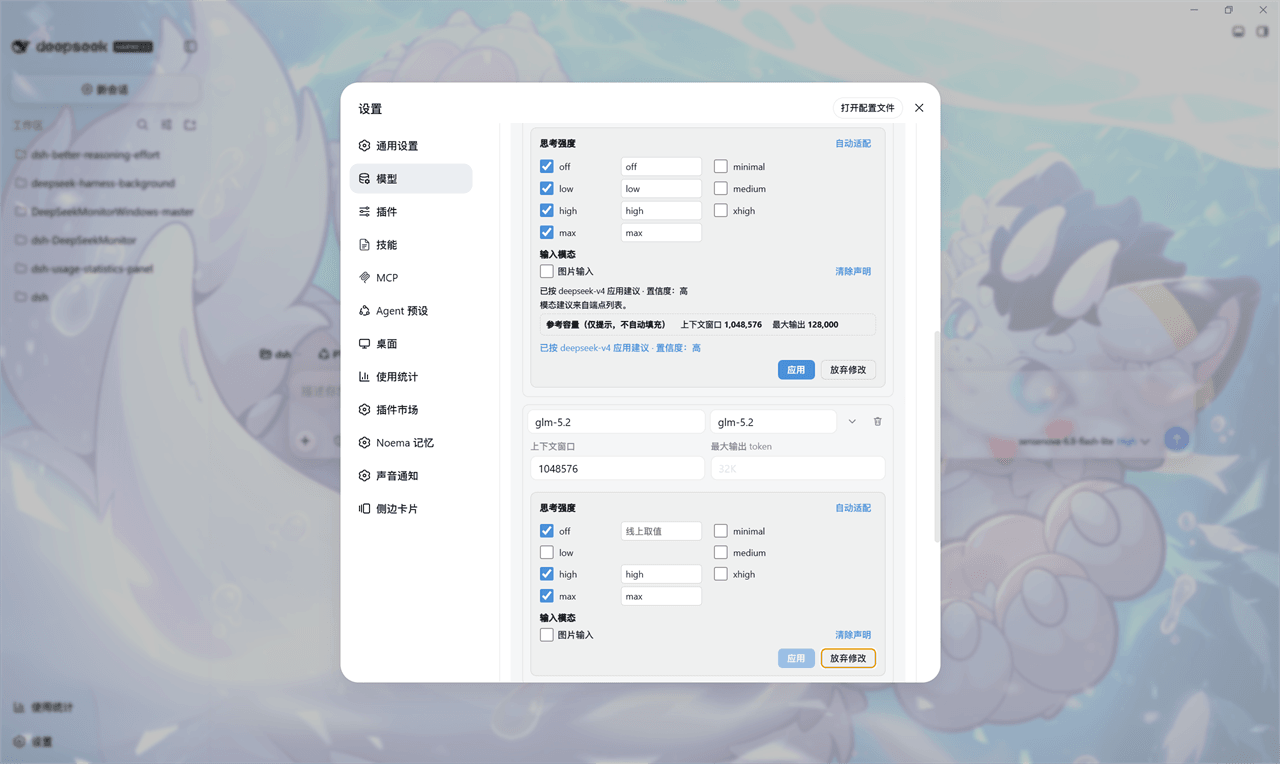
Reasoning-effort editing for third-party models in DeepSeek Harness: per-model thinking levels with a knowledge base + protocol inference, edited inside the official Models page card.
项目介绍Project Overview
DSH Better Reasoning Effort 是 DeepSeek Harness 的插件,为第三方模型在官方 Models 页面内联注入推理强度和输入模态编辑器。它通过内置知识库与协议推断自动适配每个模型的思考级别与图像输入能力,免去手写 settings.yaml。适用于自定义或第三方模型需要切换推理等级、开启视觉输入的场景。注意:自动适配的 loopback 探测仅允许 IP 字面量主机,域名形式会返回 403。
DSH Better Reasoning Effort is a DeepSeek Harness plugin that injects an in-line editor for reasoning-effort levels and input modalities on the official Models page, targeting third-party models. It auto-adapts per-model thinking levels and image-input support from a built-in knowledge base plus wire-protocol inference, avoiding hand-written settings.yaml. Use it when configuring custom or third-party providers that need adjustable reasoning tiers or vision input. Note: its loopback auto-adapt probe only allows IP-literal hosts, so domain-named LAN deployments receive a 403 on that route.
请帮我了解并安装插件:【dsh-better-reasoning-effort】【https://github.com/HaoyueQin/dsh-better-reasoning-effort】把上面这条消息直接发给当前会话里的 DSH,让它帮你了解并安装。安装命令不一定准确,发给 DSH 更稳。Send this message to DSH in your current session. CLI install commands may not be accurate across systems — DSH will figure it out for you.
或使用命令行安装(适合开发者)Or use CLI install (for developers)
命令行安装CLI Install
dsh plugin --profile web add dsh-better-reasoning-effort把 HaoyueQin/dsh-better-reasoning-effort 加入你的 DSH 配置(web profile)即可启用。
READMEREADME
DSH Better Reasoning Effort








English | 中文
Reasoning-effort and input-modality editing for third-party models in DeepSeek Harness — thinking levels and image-input support declared per model, auto-adapted from a model knowledge base + wire-protocol inference, edited right inside the official Models page card.
Why
The llm-pi-ai adapter of DeepSeek Harness natively supports per-model reasoningEfforts declarations (which thinking levels a model accepts, and the exact string to send on the wire for each). But the official Models page editor deliberately keeps this field out of reach — the official notes say it is a per-model capability and a provider-level knob would break some models. As a result:
- Third-party models get no thinking-level picker in the composer (
getSupportedThinkingLevelsshort-circuits to["off"]); - Only the official DeepSeek API (the built-in catalog) can set reasoning effort;
- Setting levels for a third-party model meant hand-writing the
reasoningEfforts/compatblocks insettings.yaml. - Hand-declared third-party models are treated as text-only (
inputdefaults to["text"]): image attachments are refused before they are sent, the read-image tool refuses, and every gateway path in between gates on the same flag. The core already accepts a per-modelinput: ["text", "image"]declaration — the official page just does not expose it either.
This plugin brings both configuration surfaces back into the UI: edit right inside the official model editor card, plus one-click auto-adapt.
Features
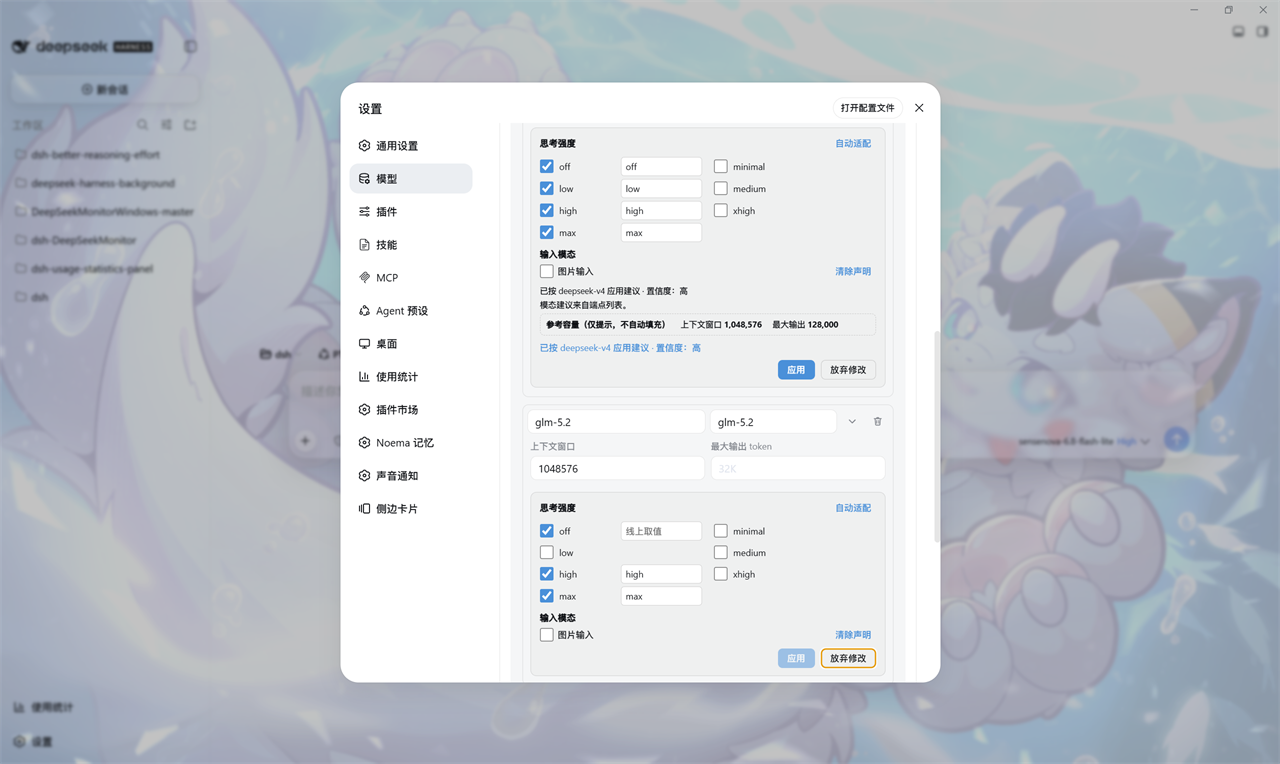
- In-page injection: an editor block appears in the official Models page under each model row's disclosure, next to context window / max tokens — not a separate settings page, but part of the official editing flow (same
settings.mutatecontract, same save style). The block spans the full row; its level rows split into the same two columns as the official capacity pair. It now carries two sections — Reasoning effort and Input modalities — owned by one pair of Apply/Reset buttons at the bottom. - Create-card staging: the editor also appears while a provider is still being created — auto-adapt works from the typed protocol/endpoint, Stage holds the declaration, and the plugin writes it automatically the moment the provider is saved (a declaration already in the document is never overwritten).
- Input-modality declaration: one checkbox ("Image input") turns a hand-declared model vision-capable end to end — composer attachments, the read-image tool, and proxy gating all key off the same flag. Unchecking narrows the declaration to text-only; clearing it writes a durable
inputUnsetmarker that host auto-fill respects, exactly like its reasoning-efforts sibling. - Zoned suggestion display: Auto-adapt reports what it applied (source · confidence) on its own line, says where modality advice came from (endpoint listing / knowledge base / name heuristic — the last one explicitly flagged low-confidence), and renders reference capacities (context window, max output) in a separate read-only block marked "hints only, never auto-filled". Values are thousands-grouped so you can copy them straight into the official capacity inputs by hand.
- Auto-adapt: a built-in model knowledge base (DeepSeek V3/V4/R1 with its vision experiment; OpenAI GPT-4o/GPT-5.1–5.6 by generation, the o-series, the gpt-oss open weights and the non-reasoning
-chatlines; Claude 4.x/4.6/Opus-4.7+/5, Gemini, Grok 4.3–4.6, Mistral Magistral / Medium 3.5 / Small latest; Qwen incl. Qwen-VL/QvQ, GLM incl. GLM-4V/5V and GLM-5.2/5.3, Kimi K2.5/K2.6/K2.7-Code/K3, MiniMax M3's thinking toggle, Doubao, Hunyuan hy3, Step incl. 3.5/3.6/3.7 — every entry re-verified against each vendor's official docs on 2026-08-24 and cross-checked against the public OpenRouter catalog; vision-capable variants carry their own entries so the base stem never claims images for them) plus protocol inference keyed by pi-ai's real wire protocols (openai-completions/openai-responses/anthropic-messages, plus a DeepSeek endpoint dialect frombaseURL) fills recommended levels and wire spellings in one click. Families whose endpoints expose no effort-style control reachable here (Llama, Nova, Phi, Cohere, Perplexity sonar) deliberately carry no entry — the low-confidence generic suggestion is more honest. Compat suggestions are gated to the one protocol whose gate accepts them. - Endpoint evidence: Auto-adapt also probes the provider's RAW
/modelslisting through a same-origin host route (credential resolved server-side, never echoed) and fuses the signal by confidence — an explicit "does not reason" wins outright; knowledge-base wire values stay authoritative; every suggestion is labeled high / medium / low so you know what to double-check. The same probe reads modality disclosures (OpenRouter-stylearchitecture.input_modalities, models.dev-style nesting,supported_features/capabilitiesvision flags,supports_vision) and the advertised context length; an explicit listing outranks the knowledge base, silence changes nothing. - Host auto-fill: on every settings update, models without a
reasoningEffortsdeclaration get a recommended one — and missing input-modality declarations are filled too (opt out viamodalityAutofill: false; declared parts, explicitfalse, and deliberately unset markers are never touched, and capacities are never written at all). The write is optimistic-locked: if your edit moved the namespace first, the fill backs off and waits for the next update — it never fights you for the write. - Three intents: all levels off = unset the declaration (back to inheritance — persisted as a
reasoningEffortsUnsetmarker so auto-fill respects it, even across restarts); onlyoffarmed = disable reasoning (false); levels armed = write the declaration. The editor stays in sync with official-page re-renders and pushed settings changes without clobbering your in-flight edits. - Defensive injection: the injector keys off the official page's DOM (aria-labels / classes). If an official upgrade changes the structure, injection simply stops and the official page is untouched; the next scan re-injects once the structure is back.
- Bilingual copy (中文 / English).
Install
Requires DeepSeek Harness 0.1.1-rc.1 or newer (@deepseek-ai/dsh-api-remotes@^0.1.1-rc.1; the host half also peers on @deepseek-ai/dsh-settings@^0.1.1-rc.1 and @deepseek-ai/schemastery@^3.18.0). The wire contract is verified against 0.1.1-rc.2; older release-candidate lines are not supported.
From npm
# under the dsh web profile
dsh plugin --profile web add dsh-better-reasoning-effort
From GitHub
# under the dsh web profile
dsh plugin --profile web add github:HaoyueQin/dsh-better-reasoning-effort
The github: source only pulls source; lib/ is built by the package's prepare hook. pnpm does not run build scripts of git dependencies by default — the installer prints the allowBuilds key it needs; follow that and add again.
Local development
npm install && npm run build
dsh plugin --profile web add link:D:/Project/dsh-better-reasoning-effort
Restart dsh web, hard-refresh the browser. Each model row's disclosure on the official Models page now carries a "Reasoning effort" block.
Usage
- Configure a third-party provider (API key etc.) on the official Models page.
- Expand a model row: the editor block sits under the official capacity fields.
- Check levels (off / minimal / low / medium / high / xhigh / max) and fill the wire values (e.g. give
highthe spellingultra, and the gateway receivesultrawhen you pick High in the composer); - Toggle Image input under Input modalities to declare what the model accepts (unchecked with no declaration = inherit the provider default, usually text-only);
- Click Auto-adapt to fill recommended levels and modalities from the knowledge base / protocol / endpoint listing — reference capacities show up as read-only hints you can copy into the official fields yourself;
- Click Apply to write the setting.
- Check levels (off / minimal / low / medium / high / xhigh / max) and fill the wire values (e.g. give
- All levels off + Apply = unset the declaration; only
offchecked + Apply = disable reasoning (false); Clear declaration on the modality row + Apply = back to inheriting the provider default.
Declared models are immediately selectable for reasoning effort in the composer's model picker, and image-declared models accept attachments end to end.
Configuration
The host half accepts optional configuration on its profile row (the values below are the defaults):
- insert:
    - id: dsh-better-reasoning-effort
      name: dsh-better-reasoning-effort
      config:
        # Auto-fill undeclared models on boot and after settings updates.
        autofill: true
        # Whether the auto-fill above also fills input-modality declarations.
        modalityAutofill: true
        # Upstream /models probe fetch timeout, in milliseconds.
        probeTimeoutMs: 15000
        # Boot-fill retry backoff schedule; [] means "try exactly once".
        bootRetryDelaysMs: [1000, 2000, 4000, 8000, 16000, 30000]
Set autofill: false to disable the silent auto-fill entirely — the browser-side Auto-adapt button keeps working.
How it works
Browser (lib/client.js)                  Host (lib/index.js)
├─ DOM injector                          └─ Auto-fill
│   MutationObserver on the models page      settings/updated → adds a
│   → mounts EffortEditor in each            recommended reasoningEfforts
│     model row's disclosure                 for undeclared models
├─ EffortEditor (React component)             (knowledge base + inference)
│   level checkboxes / wire values /
│   input-modality toggle /
│   auto-adapt (zoned suggestions) / apply
│   └─ writes settings.mutate (llm-pi-ai)
- Knowledge base + protocol inference:
suggestEfforts()insrc/knowledge.ts, a pure function shared by host and browser — fusing endpoint signals, curated entries (levels, modalities, reference capacities), a name heuristic, and protocol inference. - DOM injection:
reconcile()insrc/client/injector.tslocates model rows by the official button aria-label (Capacities/容量) and mounts the editor into the capacity disclosure. - Writing:
createEditorApi()insrc/client/ops.tsrewritesproviders.<route>.models[i].reasoningEfforts— and, when an intent travels,.input— viasettings.mutate, preserving every other row field; on a revision conflict it re-reads and retries once (the same recovery the official settings form uses). - Shared constants:
src/constants.tscarries the plugin id, settings namespace, and DOM marker used by both halves.
Development
npm run typecheck   # tsc strict check on src
npm test            # vitest: knowledge / inference / autofill / DOM injection / writing
npm run build       # lib/*.js + lib/client.js (module-loader bundle)
Contract version: @deepseek-ai/dsh-api-remotes@0.1.1-rc.2 (client contract types), verified by typecheck, the test suite, and a full build against the 0.1.1-rc.2 packages.
Known limitations
- Injection depends on the official Models page's current DOM (aria-label/class). If an official upgrade changes the structure, injection pauses until adapted; the official page is unaffected meanwhile.
- The auto-adapt probe route answers loopback and IP-literal Hosts only — the core
/apifence's Host-allowlist discipline without itstrustedHostsescape hatch (a rebound page always names the attacker's domain in Host, so named hosts are refused outright). LAN deployments serving the GUI under a domain name get a 403 from this one route (IP-literal LAN hosts keep working); every other feature is unaffected. reasoningEffortsdeclarations are suggestions: which levels/spellings an endpoint actually accepts is up to its docs — tweak each in the UI.- The knowledge base is not exhaustive — spellings drift as vendors ship models, and families without an effort ladder carry no entry at all; unlisted models fall back to protocol inference + generic levels and can be adjusted by hand.
- The modality vocabulary follows pi-ai's core (
text/imagetoday). Wider support some gateways serve (PDF, audio, video) is recorded per family until the core vocabulary grows — declaring them is impossible today by design, not oversight. - Name-heuristic modality advice (vision-flavored ids like
*-vl*/*vision*/gpt-4o) is deliberately low-confidence and labeled as such — verify before relying on it.
License
MIT
相关推荐Related
-
 ruvnet/ruflo
🌊 The original agent meta-harness. Deploy intelligent multi-player swarms, coordinate autonomous workflows, and build c…
ruvnet/ruflo
🌊 The original agent meta-harness. Deploy intelligent multi-player swarms, coordinate autonomous workflows, and build c…
-
 amruthpillai/reactive-resume
A one-of-a-kind resume builder that keeps your privacy in mind. Completely secure, customizable, portable, open-source a…
amruthpillai/reactive-resume
A one-of-a-kind resume builder that keeps your privacy in mind. Completely secure, customizable, portable, open-source a…
-
 volcengine/OpenViking
Self-evolving Context Database for AI Agents. Unify Agent Memory, Knowledge RAG and Skills.
volcengine/OpenViking
Self-evolving Context Database for AI Agents. Unify Agent Memory, Knowledge RAG and Skills.
-
 Molunerfinn/PicGo
:rocket: The Ultimate Image Uploader for Efficient Creators. Supports Obsidian, Typora, VS Code etc. and 60+ image hosti…
Molunerfinn/PicGo
:rocket: The Ultimate Image Uploader for Efficient Creators. Supports Obsidian, Typora, VS Code etc. and 60+ image hosti…
-
 titanwings/colleague-skill
将冰冷的离别化为温暖的 Skill,欢迎加入数字生命1.0!Transforming cold farewells into warm skills? It's giving rebirth era. Welcome to Digital …
titanwings/colleague-skill
将冰冷的离别化为温暖的 Skill,欢迎加入数字生命1.0!Transforming cold farewells into warm skills? It's giving rebirth era. Welcome to Digital …
-
 nocobase/nocobase
NocoBase is an open-source AI + no-code platform for building business systems fast. Instead of generating everything fr…
nocobase/nocobase
NocoBase is an open-source AI + no-code platform for building business systems fast. Instead of generating everything fr…
-
 Tencent/WeKnora
Open-source LLM knowledge platform: turn raw documents into a queryable RAG, an autonomous reasoning agent, and a self-m…
Tencent/WeKnora
Open-source LLM knowledge platform: turn raw documents into a queryable RAG, an autonomous reasoning agent, and a self-m…
- Nagi-ovo/voyager Enhancement suite for Gemini, AI Studio, Claude & ChatGPT — plus a prompt manager for any web UI, DeepSeek Harness inclu…