happyren/dsh-agent-messaging
用于DeepSeek Harness的跨会话验证、声明与决策账本——确保两个代理会话不会相互重复、矛盾或死锁。
Project Overview项目介绍
This is a purpose-built plugin for DeepSeek Harness (DSH) that enables cross-session agent communication and coordination. It solves the common problem where separate DSH agent sessions, whether running in the web UI, as a headless process, across separate worktrees, or in independent dsh processes, cannot share information with each other, forcing users to manually relay critical updates between them. To install and build the plugin from source, you first run npm install to pull all required dependencies, then npm run verify to run type checking, all tests, and complete the full build process.
The plugin implements a simple address and mailbox system, so one session can directly send targeted messages to another named session. It supports three delivery modes that change how the receiving session handles the incoming message: interrupt the current processing step, wait until the next turn to process the message, or add the new context silently without interrupting. All incoming messages are rendered as dedicated cards in the session transcript, with the sender name, delivery mode, and message content clearly marked, so users can immediately tell it is a message from another agent, not from a human user or the DSH core framework.
This plugin is released under the permissive MIT open source license, so it can be used and modified freely for both personal and commercial projects. It has several documented limitations to note before first use: messages are delivered on a best-effort basis, expired messages are dropped to reduce transcript bloat, offline sessions are still listed as reachable until their records are pruned, and tool-call cards do not currently have custom rendering. It is built against the release candidate (rc) version of DSH, which is still a developer preview with no backwards compatibility guarantee, so you may need to adjust the plugin after a major DSH version upgrade.
这是一款专为DeepSeek Harness(DSH)开发的原生插件,核心功能是实现DSH多代理会话之间的通信、验证与协作。它支持Web UI、无后台运行、不同工作树、独立dsh进程等多种场景下的跨会话消息传递,让不同会话可以直接交换信息,无需用户手动在不同会话间转发内容。
该插件实现了地址邮箱机制,一个会话可以给指定目标会话发送消息,支持三种投递模式:打断当前步骤、在下一轮处理、静默投递。消息会在会话记录中以独立卡片展示,标注发送方、投递模式和消息内容,发送方会话ID对应独立卡片颜色,即使会话标题变更也能保持一致,方便用户快速区分代理消息和用户输入、框架上下文。
该插件遵循MIT开源许可协议,使用TypeScript开发,需要Node.js和npm环境进行本地构建开发。它存在一些已知限制:消息是尽力投递,过期消息会被丢弃;不保证离线会话的可达性;工具调用卡片暂不支持自定义渲染,且适配的是DSH开发预览版,框架升级后可能需要重新适配。
请帮我安装这个 DSH 插件。安装前先完成【兼容性检查 + 安全性检查】,检查通过再动手。

插件:dsh-agent-messaging(happyren/dsh-agent-messaging)
仓库:https://github.com/happyren/dsh-agent-messaging
本站详情页:https://www.yhbd.top/plugins/happyren-dsh-agent-messaging/
本站登记:类型 plugin · 归类 原生 DSH 插件 · 许可证 MIT · ⭐ 6 · 最近提交 2026-09-12 · 主语言 TypeScript

按下面顺序执行,每步先把结论告诉我,再进入下一步:

【1 兼容性检查】
① 我这边:DSH 版本、Node 版本、操作系统、当前 profile(web / desktop)。
② 读它的 README、package.json、插件 manifest,列出它要求的 DSH 版本 / Node 版本 / 操作系统 / 外部依赖 / 需要另外先装的运行时。
③ 逐条比对,结论只写「满足 / 不满足 / 未知」三种;不满足的给出可行替代方案。
④ 检查是否和我已装的插件冲突:命令名重复、skill / tool 重名、端口占用、重复注册的 MCP server。

【2 安全性检查】
① 仓库可信度:和上面「本站登记」是否一致;star / fork 数、创建时间、最近提交,是否归档或长期停更。
② 安装脚本:逐行看 package.json 的 preinstall / install / postinstall,以及 install.sh、setup.ps1 之类脚本。出现 curl|bash、下载后直接执行、混淆代码、访问与插件功能无关的域名,立刻停下来告诉我,不要继续装。
③ 依赖:列出新增依赖,标出无人维护、或与知名包拼写近似的可疑包(typosquatting)。
④ 权限与副作用:它会读写哪些目录、访问哪些域名、需要哪些 DSH 权限(filesystem / network / shell / clipboard 等),以及怎么卸载和回滚。
⑤ 如果它要求 sudo / 管理员权限,或权限明显超出功能所需,先停下来问我。

【3 安装】
上面两步没有「不满足」和「高危项」时才执行;用官方推荐方式安装,不要自行提权。

【4 汇报】
用表格输出:检查项 / 结论 / 依据 / 是否需要我决策。拿不准的一律写「未知」并说明要我怎么确认——不要猜,也不要替我决定。
Send this message to DSH in your current session: it verifies compatibility and security first (answering met / not met / unknown item by item) and only installs once everything checks out — it will stop and ask you if it finds a high-risk item. The box scrolls; the copy is the full prompt. CLI install commands may not be accurate across systems, so DSH is the safer route.把上面这条消息直接发给当前会话里的 DSH:它会先核对兼容性与安全性(逐条给「满足 / 不满足 / 未知」),确认没问题再安装,有高危项会停下来问你。框内可滚动,复制到的是完整提示词;安装命令不一定准确,发给 DSH 更稳。
- Only 6 stars - very few users, little community feedback星标只有 6,几乎没人在用,遇到问题缺少社区反馈
DSH walks through these 9 checksDSH 会逐条核对这 9 项
Compatibility兼容性
- DSH, Node, OS and profile requirementsDSH 版本 / Node 版本 / 操作系统 / profile 是否满足要求
- External dependencies and runtimes (Electron / Python / Docker, ...)外部依赖与运行时(Electron / Python / Docker 等)是否齐备
- Conflicts with installed plugins: command names, skill / tool names, ports, duplicate MCP registration与已装插件是否冲突:命令名、skill / tool 重名、端口占用、重复 MCP 注册
Security安全性
- Repo matches the facts registered here; archived or abandoned?仓库是否与页面登记一致,是否归档或长期停更
- Safety of preinstall / install / postinstall and install.sh / setup.ps1preinstall / install / postinstall 与 install.sh、setup.ps1 是否安全
- curl|bash, download-then-execute, obfuscation, unrelated domains → stop immediatelycurl|bash、下载即执行、混淆代码、无关域名 → 立刻停止
- Typosquatting or unmaintained packages among the new dependencies新增依赖里有没有 typosquatting 或无人维护的包
- Requested permissions vs. what the feature actually needs申请了哪些权限、是否超出功能所需(filesystem / network / shell / clipboard)
- Any sudo / admin requirement, plus uninstall and rollback是否要求 sudo / 管理员权限,以及卸载与回滚方式
Anything uncertain must be marked unknown with a note on how to confirm it. This site's signal screen is a static snapshot, not a security audit.拿不准的必须标「未知」并说明要我怎么确认。本站的信号筛查是静态快照,不能替代安全审计。
Or use CLI install (for developers)或使用命令行安装(适合开发者)
CLI Install命令行安装
dsh plugin --profile web add github:happyren/dsh-agent-messaging把 happyren/dsh-agent-messaging 加入你的 DSH 配置(web profile)即可启用。
READMEREADME
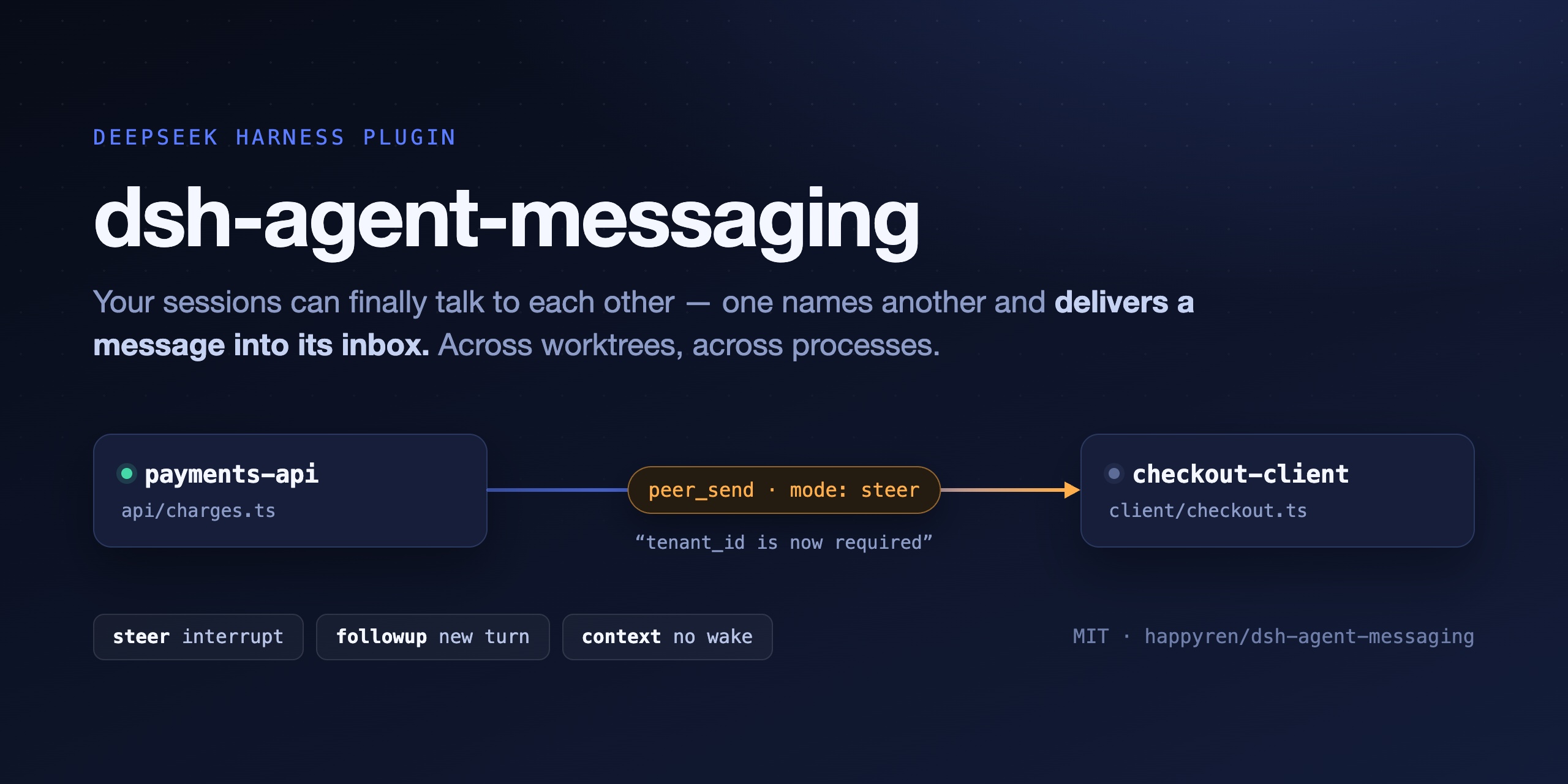



dsh-agent-messaging
Cross-session verification, claims and a decision ledger for DeepSeek Harness — so two agent sessions don't repeat, contradict or deadlock each other.
Two sessions you started yourself — in the Web UI, in a headless run, in separate
worktrees, in separate dsh processes — cannot tell each other anything. When one
discovers a breaking change the other is about to trip over, you are the transport:
you read it in one terminal and retype it in the other.
This plugin gives them an address and a mailbox. One session names another and delivers a message into its inbox; the harness schedules it like any other model-facing input.
session "payments-api"                      session "checkout-client"
        │                                              │
        │  peer_send  to: checkout-client              │
        │             mode: steer                      │
        ├─────────────────────────────────────────────►│  interrupts at the next step
        │  "tenant_id is now required on ChargeRequest │
        │   — your call site will break"               │
An arriving message is its own card in the transcript, so a reader can tell at a glance that another agent spoke — not the human, and not the harness injecting context:

Showing the opening section of the README — the full document lives in the repository以上为 README 开头摘要,完整文档在仓库内 · View the full README on GitHub →在 GitHub 查看完整 README →
Related相关推荐
- ranxianglei/billion-context 基本稳定可用 A context-compression plugin for small context windows (a 100K context is enough), token savings (5x fewer tokens…
-
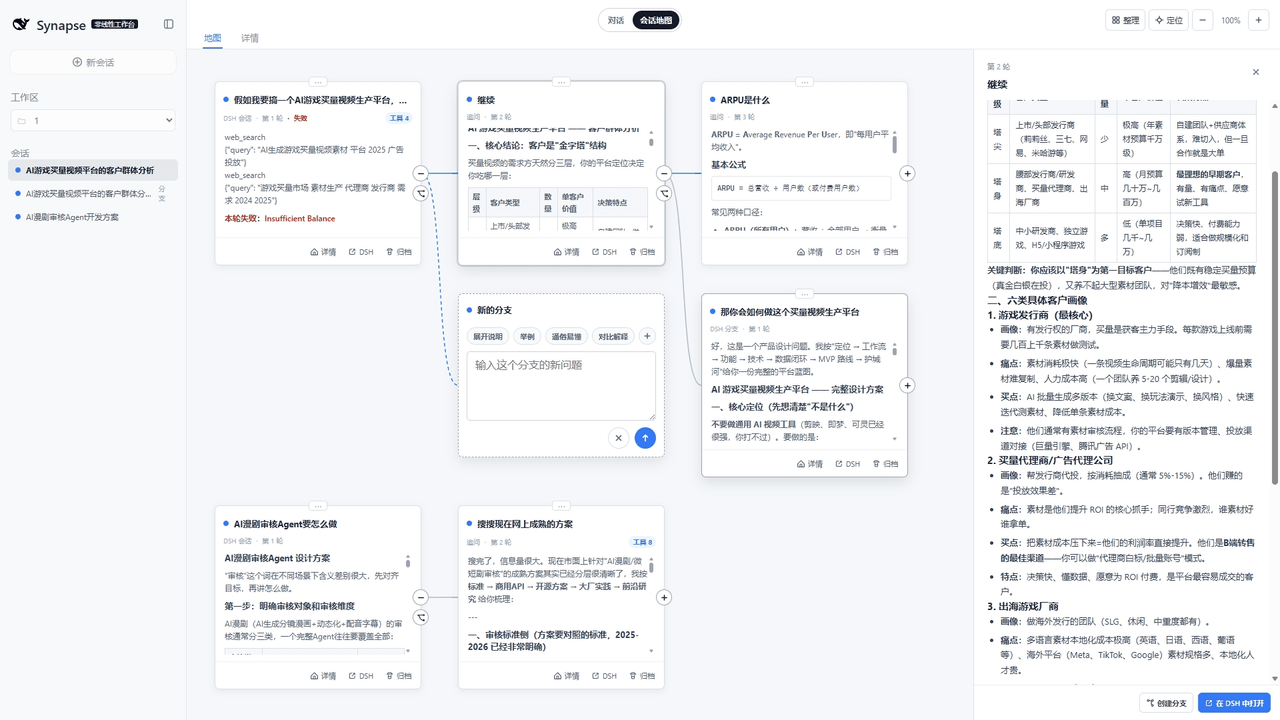 liangmianya/dsh-synapse
A visual, non-linear conversation workspace plugin for DeepSeek Harness ; A canvas-based session explorer and branching …
liangmianya/dsh-synapse
A visual, non-linear conversation workspace plugin for DeepSeek Harness ; A canvas-based session explorer and branching …
-
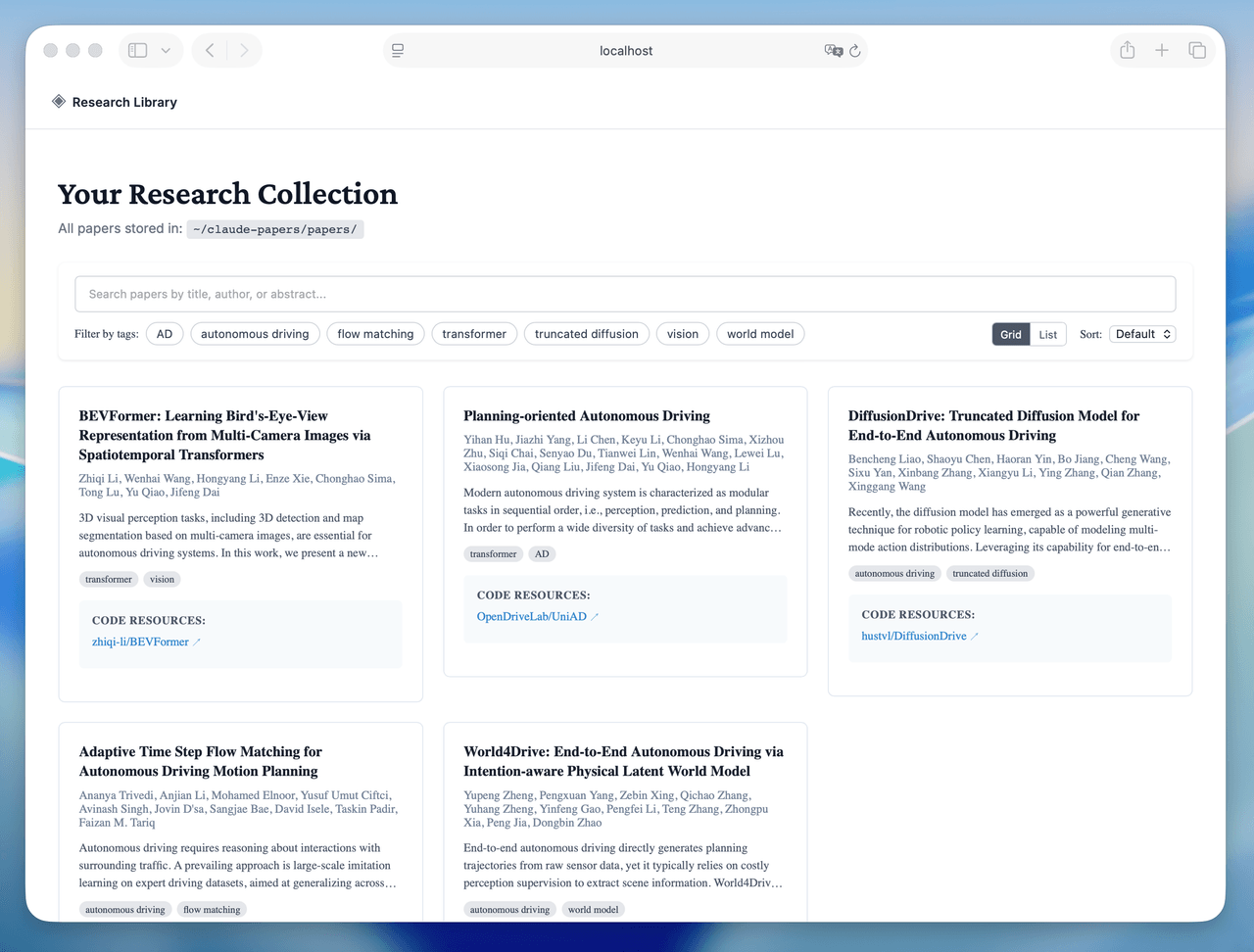 alaliqing/claude-paper
📖 Cross-agent research paper toolkit for Claude Code, Codex, OpenCode, and DeepSeek Harness—quick summaries, deep study…
alaliqing/claude-paper
📖 Cross-agent research paper toolkit for Claude Code, Codex, OpenCode, and DeepSeek Harness—quick summaries, deep study…
-
 acryldev/acryl
ACRYL - Agent Context Relay Yielding Lifecycles. One persistent workspace, one canonical context, any coding agent.
acryldev/acryl
ACRYL - Agent Context Relay Yielding Lifecycles. One persistent workspace, one canonical context, any coding agent.
-
 omdsh-dev/dsh-annotation
DSH Web 选中批注插件:选文字→批注→回车随消息发送;气泡隐藏批注块(零闪烁);回复按 Annotation N 逐条对照(可悬浮芯片)。官方 bundle,零核心改动
omdsh-dev/dsh-annotation
DSH Web 选中批注插件:选文字→批注→回车随消息发送;气泡隐藏批注块(零闪烁);回复按 Annotation N 逐条对照(可悬浮芯片)。官方 bundle,零核心改动
-
 Anionex/dsh-turn-rewind
deepseek harness对话和代码状态回退插件 | DSH — rewind conversation and workspace state, powered by a persistent Change Ledger
Anionex/dsh-turn-rewind
deepseek harness对话和代码状态回退插件 | DSH — rewind conversation and workspace state, powered by a persistent Change Ledger
-
 Tyan66666/billion-context-dsh
Model-driven context management (Active Context Pruning / ACP) for the DeepSeek Harness — the model decides when and wha…
Tyan66666/billion-context-dsh
Model-driven context management (Active Context Pruning / ACP) for the DeepSeek Harness — the model decides when and wha…
-
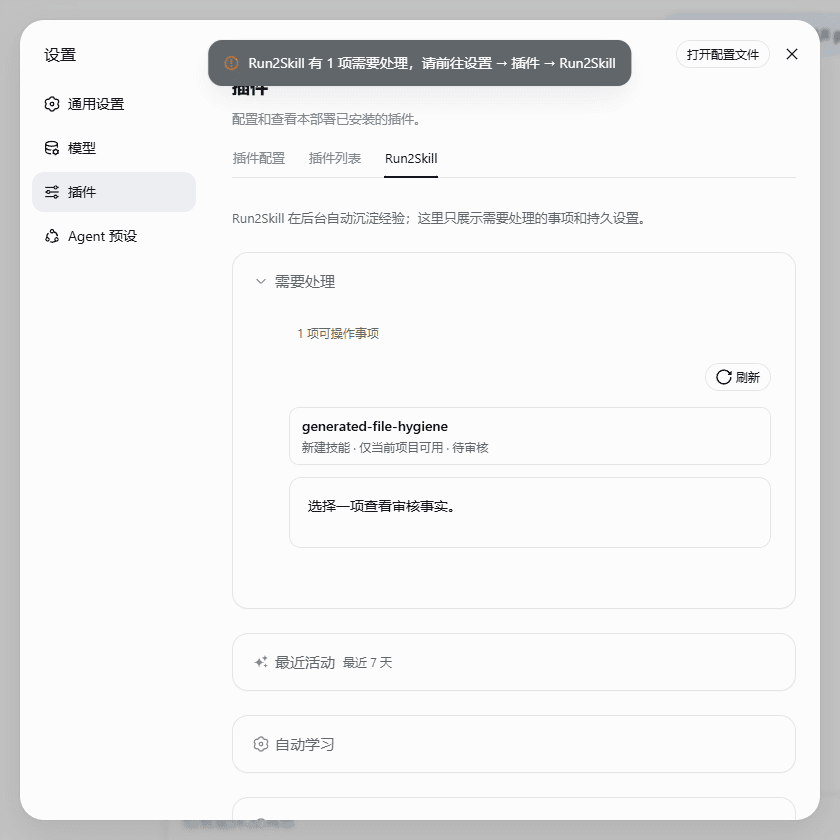 qkycir-123/dsh-run2skill
Automatically turn successful DeepSeek Harness sessions into reusable, reviewable Agent Skills.
qkycir-123/dsh-run2skill
Automatically turn successful DeepSeek Harness sessions into reusable, reviewable Agent Skills.