hytime/dsh-thinking-effort
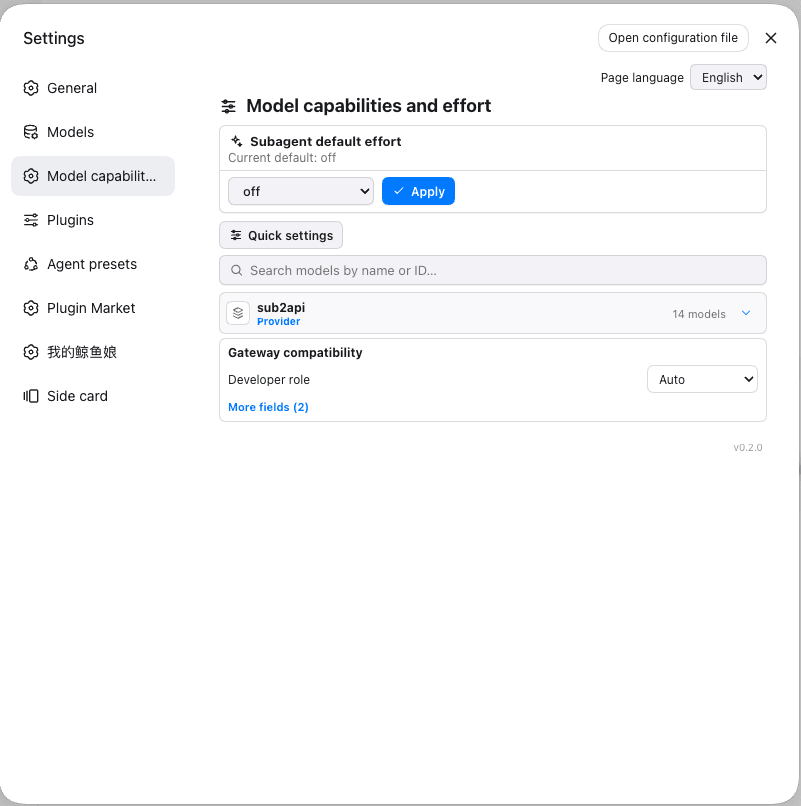
A DeepSeek Harness plugin for reasoning-effort defaults and protocol-aware gateway compatibility settings for llm-pi-ai models.
Project Overview项目介绍
This is a DSH-native plugin built exclusively for the DeepSeek Harness agent framework. It adds support for configurable reasoning effort levels to hand-declared llm-pi-ai models, and sets a default reasoning effort for DSH subagents that do not already have an explicit value set. It is compatible with all DSH versions starting from 0.1.0-rc.7, and automatically detects available runtime capabilities to provide fallbacks for older DSH builds. When the DSH schema exposes the required gateway fields, it supports 15 common llm-pi-ai compatibility fields out of the box.
The plugin is targeted at DSH users who work with custom hand-declared third-party large language models via the llm-pi-ai adapter. After installation through the DSH plugin system, users will see a reasoning effort slider in the DSH Composer interface, which they can use to set different effort levels for each custom model. Users can also set a uniform default reasoning effort for all subagents, and the plugin will never override any explicitly specified reasoning values already set on individual requests.
The plugin is released under the permissive MIT open source license, so it is free to use, modify, and redistribute for any purpose. Every new release is tested against four official DSH version representatives to ensure cross-version compatibility before publishing. It has several documented limitations, including that only seven standard reasoning levels are supported, non-off levels require gateway support, and host configuration changes require a DSH restart to take effect.
这是一个专为 DeepSeek Harness (DSH) 开发的原生插件,作用是为用户手动声明的 llm-pi-ai 模型添加可配置的推理难度等级,同时为 DSH 的子代理设置默认推理难度。它支持从 0.1.0-rc.7 开始的多个 DSH 版本,可自动检测运行时能力,针对旧版 DSH 提供兼容回退,当 DSH 暴露对应 schema 时,可支持 llm-pi-ai 的 15 个通用网关兼容字段。
主要面向使用 DSH 搭配自定义声明第三方大模型的用户,典型工作流是用户安装插件后,即可在 DSH 的 Composer 界面看到推理难度滑块,为自定义模型配置不同的推理等级,也可以为所有子代理设置统一的默认推理难度,不覆盖已经在请求中明确指定的推理设置,也不会干扰未配置推理的现有请求。
插件采用 MIT 许可证开源,可免费使用修改,每个版本发布前都会经过四个不同 DSH 版本的兼容性测试。目前已知的使用限制包括:仅支持 llm-pi-ai 定义的七个标准推理等级,非 off 等级需要网关支持对应值,修改主机端配置后需要重启 DSH 才能生效,设置修改后需要刷新网页。
请帮我安装这个 DSH 插件。安装前先完成【兼容性检查 + 安全性检查】,检查通过再动手。

插件:dsh-thinking-effort(hytime/dsh-thinking-effort)
仓库:https://github.com/hytime/dsh-thinking-effort
本站详情页:https://www.yhbd.top/plugins/hytime-dsh-thinking-effort/
本站登记:类型 plugin · 归类 原生 DSH 插件 · 许可证 MIT · ⭐ 40 · 最近提交 2026-10-01 · 主语言 TypeScript

按下面顺序执行,每步先把结论告诉我,再进入下一步:

【1 兼容性检查】
① 我这边:DSH 版本、Node 版本、操作系统、当前 profile(web / desktop)。
② 读它的 README、package.json、插件 manifest,列出它要求的 DSH 版本 / Node 版本 / 操作系统 / 外部依赖 / 需要另外先装的运行时。
③ 逐条比对,结论只写「满足 / 不满足 / 未知」三种;不满足的给出可行替代方案。
④ 检查是否和我已装的插件冲突:命令名重复、skill / tool 重名、端口占用、重复注册的 MCP server。

【2 安全性检查】
① 仓库可信度:和上面「本站登记」是否一致;star / fork 数、创建时间、最近提交,是否归档或长期停更。
② 安装脚本:逐行看 package.json 的 preinstall / install / postinstall,以及 install.sh、setup.ps1 之类脚本。出现 curl|bash、下载后直接执行、混淆代码、访问与插件功能无关的域名,立刻停下来告诉我,不要继续装。
③ 依赖:列出新增依赖,标出无人维护、或与知名包拼写近似的可疑包(typosquatting)。
④ 权限与副作用:它会读写哪些目录、访问哪些域名、需要哪些 DSH 权限(filesystem / network / shell / clipboard 等),以及怎么卸载和回滚。
⑤ 如果它要求 sudo / 管理员权限,或权限明显超出功能所需,先停下来问我。

【3 安装】
上面两步没有「不满足」和「高危项」时才执行;用官方推荐方式安装,不要自行提权。

【4 汇报】
用表格输出:检查项 / 结论 / 依据 / 是否需要我决策。拿不准的一律写「未知」并说明要我怎么确认——不要猜,也不要替我决定。
Send this message to DSH in your current session: it verifies compatibility and security first (answering met / not met / unknown item by item) and only installs once everything checks out — it will stop and ask you if it finds a high-risk item. The box scrolls; the copy is the full prompt. CLI install commands may not be accurate across systems, so DSH is the safer route.把上面这条消息直接发给当前会话里的 DSH:它会先核对兼容性与安全性(逐条给「满足 / 不满足 / 未知」),确认没问题再安装,有高危项会停下来问你。框内可滚动,复制到的是完整提示词;安装命令不一定准确,发给 DSH 更稳。
- 40 stars - an early-stage project星标 40,属于早期项目
DSH walks through these 9 checksDSH 会逐条核对这 9 项
Compatibility兼容性
- DSH, Node, OS and profile requirementsDSH 版本 / Node 版本 / 操作系统 / profile 是否满足要求
- External dependencies and runtimes (Electron / Python / Docker, ...)外部依赖与运行时(Electron / Python / Docker 等)是否齐备
- Conflicts with installed plugins: command names, skill / tool names, ports, duplicate MCP registration与已装插件是否冲突:命令名、skill / tool 重名、端口占用、重复 MCP 注册
Security安全性
- Repo matches the facts registered here; archived or abandoned?仓库是否与页面登记一致,是否归档或长期停更
- Safety of preinstall / install / postinstall and install.sh / setup.ps1preinstall / install / postinstall 与 install.sh、setup.ps1 是否安全
- curl|bash, download-then-execute, obfuscation, unrelated domains → stop immediatelycurl|bash、下载即执行、混淆代码、无关域名 → 立刻停止
- Typosquatting or unmaintained packages among the new dependencies新增依赖里有没有 typosquatting 或无人维护的包
- Requested permissions vs. what the feature actually needs申请了哪些权限、是否超出功能所需(filesystem / network / shell / clipboard)
- Any sudo / admin requirement, plus uninstall and rollback是否要求 sudo / 管理员权限,以及卸载与回滚方式
Anything uncertain must be marked unknown with a note on how to confirm it. This site's signal screen is a static snapshot, not a security audit.拿不准的必须标「未知」并说明要我怎么确认。本站的信号筛查是静态快照,不能替代安全审计。
Or use CLI install (for developers)或使用命令行安装(适合开发者)
CLI Install命令行安装
dsh plugin --profile web add @hytime/dsh-thinking-effort把 hytime/dsh-thinking-effort 加入你的 DSH 配置(web profile)即可启用。
READMEREADME
dsh-thinking-effort
A DSH (DeepSeek Harness) plugin that adds configurable reasoning effort levels to hand-declared llm-pi-ai models and sets a default reasoning effort for subagents.



- 中文 README
- 日本語 README
- 한국어 README
- Installation guide
- 中文安装指南
- 日本語インストールガイド
- 한국어 설치 안내
- Changelog
- 日本語 changelog
- 한국어 changelog
Compatibility boundaries: DSH Runtime compatibility covers the Settings transport only: modern DSH exposes
remote.settings, while legacy DSH exposesconnection.api.settings. The plugin detects the available runtime capability and keeps the legacy fallback optional, so the settings page does not require a Remote provider on older DSH builds.Gateway Protocol compatibility is a separate layer. When the DSH schema exposes them, the plugin supports 18 common scalar
llm-pi-ai.compatfields, grouped into role/reasoning, format/output, streaming/tools, and storage/cache. Boolean fields offerAuto, supported, and unsupported; enum fields offerAutoand their concrete values; number fields takeAutoor an integer. DSH0.1.0-rc.7does not provide gateway compat settings. DSH0.1.0-rc.8through<0.1.2-alpha.1provide the other fields, but notsupportsFinishReasonorsupportsThinkingTokenBudget; DSH0.1.2-alpha.1through<0.1.3-alpha.2expose 15 of them, and0.1.3-alpha.2and later expose all 18 when supported by the schema. The optionaldsh-llm-openai-completionstransport can take over eligible custom OpenAI-compatible thinking providers when it is installed and enabled.Autounsets the current-layer override and restores the next value in the inheritance chain.DSH
0.1.2-alpha.1and later accept language-pack locale IDs throughLocaleRuntime. This plugin registersjaandkodynamically, so no DSH core fork is required. Older DSH builds that only expose built-in locale IDs supportzhandenonly.The published runtime entries are
lib/index.js(Host) andlib/client.js(Client). After changing TypeScript or locale sources, runnpm run buildbefore running DSH or packing the plugin. Current DSH does not expose a public semver metadata contract, so runtime capability detection is authoritative. An optional version is used only when explicit metadata or test input supplies it; unknown valid versions still use the detected capabilities. The plugin supports both modernremote.settingsand legacyconnection.api.settings.The Host registers its
dsh-thinking-effortSettings namespace through the host-provided SettingsinstallSectionwhen available, and falls back to the legacyregisterpath otherwise. Under the0.1.7+ entry-config model neither path exists, and the section comes from the exportedConfiginstead. It does not depend on@deepseek-ai/dsh-settingsat runtime, so the package installs cleanly into DSH profiles configured withautoInstallPeers: falsewithout introducing a second Cordis runtime.
Showing the opening section of the README — the full document lives in the repository以上为 README 开头摘要,完整文档在仓库内 · View the full README on GitHub →在 GitHub 查看完整 README →
Related相关推荐
-
 xmanrui/dsh-im
通过扫码或机器人凭据把IM机器人接入DeepSeek Harness(支持飞书、微信、钉钉、企业微信、QQ、Slack、Telegram、Discord和WhatsApp)。 Connect IM bots to DeepSeek Harn…
xmanrui/dsh-im
通过扫码或机器人凭据把IM机器人接入DeepSeek Harness(支持飞书、微信、钉钉、企业微信、QQ、Slack、Telegram、Discord和WhatsApp)。 Connect IM bots to DeepSeek Harn…
-
 tencent-connect/dsh-qqbot
让 QQ Bot 接入 DeepSeek Harness(dsh)的官方插件
tencent-connect/dsh-qqbot
让 QQ Bot 接入 DeepSeek Harness(dsh)的官方插件
-
 flymysql/dsh-remote
Remote-work assistant for DeepSeek Harness (DSH): connect SSH (key or password), pick a remote workspace, operate with r…
flymysql/dsh-remote
Remote-work assistant for DeepSeek Harness (DSH): connect SSH (key or password), pick a remote workspace, operate with r…
- cpj-dev/dsh-plugin-cc Bridge Deepseek-harness into Claude Code for review, critique, delegation, and session import.
-
 whiteguo233/dsh-openbiliclaw
OpenBiliClaw 是本地运行的跨平台个性化内容推荐 Agent,持续理解你的兴趣并主动找内容。本仓库是它的 DeepSeek Harness 插件:DSH 界面常驻第四栏(推荐/内容库/对话/画像/设置),注册 22 个 Agent…
whiteguo233/dsh-openbiliclaw
OpenBiliClaw 是本地运行的跨平台个性化内容推荐 Agent,持续理解你的兴趣并主动找内容。本仓库是它的 DeepSeek Harness 插件:DSH 界面常驻第四栏(推荐/内容库/对话/画像/设置),注册 22 个 Agent…
-
 omdsh-dev/dsh-lark
Lark/Feishu IM bot channel for DeepSeek Harness | 飞书 DeepSeek Harness (DSH)插件
omdsh-dev/dsh-lark
Lark/Feishu IM bot channel for DeepSeek Harness | 飞书 DeepSeek Harness (DSH)插件
-
 hanshanyike/dsh-yolo
把对话里说过的重要事情,变成持续可跟进的计划。 为 deepseek-harness 打造的个人助手:从对话中整理事项、跟踪变化,并在需要时提醒你。
hanshanyike/dsh-yolo
把对话里说过的重要事情,变成持续可跟进的计划。 为 deepseek-harness 打造的个人助手:从对话中整理事项、跟踪变化,并在需要时提醒你。
-
 THEWOLFWALKER/dsh-notifier
DSH notification & remote-control plane: 28 outbound channels, 6 inbound controls, Native Notify & Control UI, live hot-…
THEWOLFWALKER/dsh-notifier
DSH notification & remote-control plane: 28 outbound channels, 6 inbound controls, Native Notify & Control UI, live hot-…