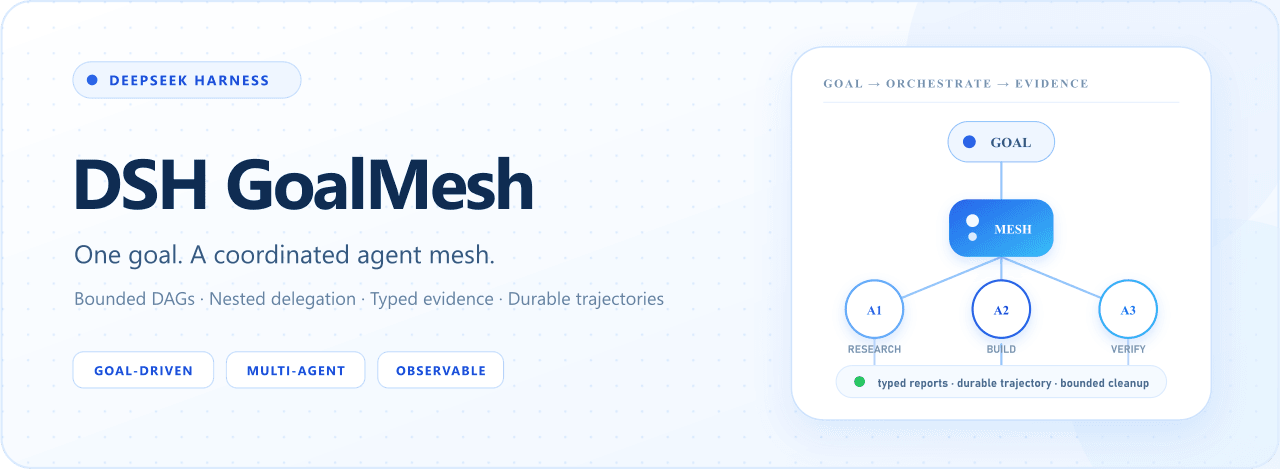
Jarad-z/dsh-goalmesh
Goal-driven multi-agent orchestration for DeepSeek Harness — bounded DAG scheduling, nested delegation, typed evidence, and durable trajectory UI.
项目介绍Project Overview
DSH GoalMesh 是 DeepSeek Harness 插件,提供 goal_mesh 工具:校验声明式任务 DAG,调度有界专家代理,传递类型化依赖结果,支持嵌套分解,并在 DSH Web 展示完整执行轨迹。适合把单一目标拆成可观测、依赖明确的多代理工作流。注意它是 DSH 插件而非 Codex 插件,需匹配指定 Harness 版本并应用运行时补丁。
DSH GoalMesh is a DeepSeek Harness plugin exposing the goal_mesh tool. It validates a declarative task DAG, launches bounded specialist agents, propagates typed dependency results, supports nested decomposition, and renders the full execution trajectory in DSH Web. Use it to turn one objective into an observable, dependency-aware multi-agent workflow. Caveat: it is a DSH plugin, not a Codex plugin, and requires a specific Harness version plus runtime patch.
请帮我了解并安装插件:【dsh-goalmesh】【https://github.com/Jarad-z/dsh-goalmesh】把上面这条消息直接发给当前会话里的 DSH,让它帮你了解并安装。安装命令不一定准确,发给 DSH 更稳。Send this message to DSH in your current session. CLI install commands may not be accurate across systems — DSH will figure it out for you.
或使用命令行安装(适合开发者)Or use CLI install (for developers)
命令行安装CLI Install
dsh plugin --profile web add github:Jarad-z/dsh-goalmesh把 Jarad-z/dsh-goalmesh 加入你的 DSH 配置(web profile)即可启用。
READMEREADME
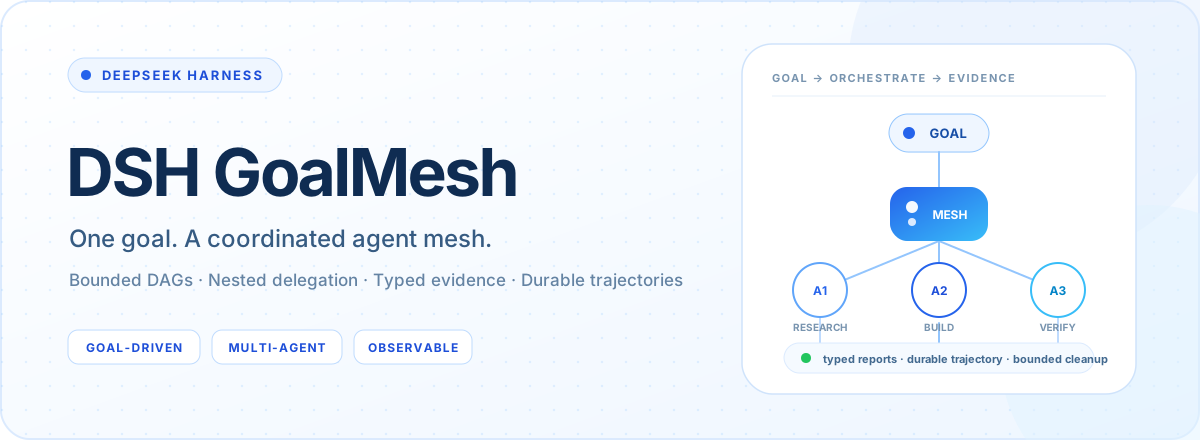
Goal-driven multi-agent orchestration for DeepSeek Harness.
Turn one objective into a bounded agent graph—and keep every decision, dependency, and result observable.





Why · How it works · Capabilities · Protocol · Development
One goal in. A coordinated mesh out.
DSH GoalMesh is a DeepSeek Harness
Plugin that exposes one model-facing tool: goal_mesh. It validates a declarative
task DAG, launches bounded specialist agents, propagates typed dependency results,
supports nested decomposition, and renders the full execution trajectory in DSH Web.
01 · Goal-nativeEvery agent receives the immutable global goal, a focused objective, and explicit acceptance criteria. |
02 · Multi-agent by designDAG scheduling, bounded concurrency, nested delegation, deadlines, and cancellation share one owner. |
03 · Evidence-firstTyped reports and durable events make live execution and replay explainable from the same task tree. |
[!NOTE] GoalMesh is a DSH Plugin, not a Codex Plugin. It runs inside the DeepSeek Harness Profile and follows Cordis Entry/Fiber lifecycle ownership.
Why GoalMesh
- Goal fidelity — local work remains anchored to the same success criteria and constraints.
- Structured concurrency — admission, deadlines, cancellation, failure propagation, and cleanup are bounded by one coordinator.
- Dependency-aware execution — tasks start only after prerequisites settle, with explicit
fail,skip, orpartialbehavior. - Safe recursive delegation — child agents can open nested meshes through attempt-fenced, child-scoped leases.
- Stable typed results — every child returns a
TaskReport; task identity and input order remain deterministic. - Durable observability — live events and replay fold into the same Web task tree, including trusted child-Session navigation.
How it works
%%{init: {"theme": "base", "themeVariables": {
  "primaryColor": "#eff6ff",
  "primaryTextColor": "#0f2c52",
  "primaryBorderColor": "#60a5fa",
  "lineColor": "#60a5fa",
  "secondaryColor": "#ffffff",
  "tertiaryColor": "#f0f9ff",
  "fontFamily": "Inter, ui-sans-serif, system-ui"
}}}%%
flowchart LR
  G["Global goal<br/>criteria + constraints"] --> T["goal_mesh"]
  T --> C["GoalMesh Coordinator<br/>single-writer owner"]
  C --> D["DAG Scheduler<br/>capacity + policy + deadlines"]
  D --> A1["Agent A<br/>research"]
  D --> A2["Agent B<br/>build"]
  D --> A3["Agent C<br/>verify"]
  A1 --> R["Typed TaskReports"]
  A2 --> R
  A3 --> R
  R --> C
  C --> E["Durable trajectory"]
  E --> U["DSH Web task tree"]
  A2 -. "bounded nested mesh" .-> D
The coordinator sits above root and child agents. Children never receive the mutable run ledger; they operate through revocable leases, so siblings cannot mutate one another's state. Cordis fibers own every tool registration, listener, service, and live resource from mount through disposal.
Capabilities
| Capability | v0.3 |
|---|---|
| Foreground bounded parallelism | ✅ |
| Static task DAGs and dependency materialization | ✅ |
| Collect-all, fail-fast, and quorum policies | ✅ |
| Fail, skip, and partial dependency propagation | ✅ |
| Nested local GoalMesh calls | ✅ |
| Parent permit release/reacquire during nested work | ✅ |
| Durable trajectory replay and Web task tree | ✅ |
| Runtime invariant validation | ✅ |
| Detached/background execution | Planned |
| Automatic task retry | Planned |
| Distributed provider-aware capacity | Planned |
Package layout
| Package | Responsibility |
|---|---|
dsh-goalmesh-plugin |
Installable composition bundle and Cordis patch |
dsh-tool-goalmesh |
Host tool, coordinator, scheduler, recorder, and invariant companion |
dsh-client-ui-goalmesh |
Inert Node entry and DSH Web trajectory client |
dsh-goalmesh/
├─ packages/
│  ├─ goalmesh-plugin/       # bundle + cordis.patch.yml
│  ├─ tool-goalmesh/         # orchestration runtime
│  └─ client-ui-goalmesh/    # durable trajectory UI
├─ docs/                     # architecture and execution contract
├─ harness-patches/          # minimal public Harness prerequisites
└─ tests/                    # coordinator, nesting, replay, UI, invariants
The split follows DeepSeek Harness ownership boundaries: Host scheduling works in a headless Profile, while the installable bundle composes Host, invariant, and Web entries.
Tool protocol
A root invocation declares one goal and an invocation-local task graph:
{
  "goal": {
    "statement": "Ship a release-ready API migration plan",
    "success_criteria": [
      "Every breaking change has an owner",
      "Rollback and verification steps are explicit"
    ],
    "constraints": [
      "Preserve backward compatibility during rollout"
    ]
  },
  "tasks": [
    {
      "key": "surface",
      "description": "Map the public API surface",
      "objective": "Identify every affected endpoint and consumer",
      "acceptance_criteria": [
        "The inventory is complete and evidence-linked"
      ]
    },
    {
      "key": "rollout",
      "description": "Design the rollout",
      "objective": "Produce staged migration and rollback steps",
      "acceptance_criteria": [
        "Each stage has a measurable gate"
      ],
      "depends_on": ["surface"],
      "dependency_failure": "partial"
    }
  ],
  "failure_mode": "collect_all"
}
Nested invocations omit goal. Ownership comes from the scoped lease captured by the
Host tool—never from model-provided IDs.
Development
GoalMesh v0.3 targets DeepSeek Harness 0.1.0-rc.5 at public baseline
47f943859bef60e4160492346772ded9b24f765a, plus the minimal runtime patch in
harness-patches/goalmesh-prerequisites.patch.
[!IMPORTANT] Keep
deepseek-harnessanddsh-goalmeshas sibling directories. Workspace dependencies intentionally resolve against that layout.
mkdir goalmesh-dev && cd goalmesh-dev
git clone https://github.com/deepseek-ai/deepseek-harness.git
git -C deepseek-harness checkout 47f943859bef60e4160492346772ded9b24f765a
git -C deepseek-harness submodule update --init --recursive
git clone https://github.com/Jarad-z/dsh-goalmesh.git
git -C deepseek-harness apply ../dsh-goalmesh/harness-patches/goalmesh-prerequisites.patch
cd dsh-goalmesh

corepack enable
corepack install --global pnpm@11.7.0
pnpm --dir ../deepseek-harness install --frozen-lockfile
pnpm --dir ../deepseek-harness run build:lib
pnpm install --frozen-lockfile
pnpm check
Useful commands
| Command | Purpose |
|---|---|
pnpm build |
Build Host and Web packages |
pnpm typecheck |
Check the full TypeScript project graph |
pnpm test:unit |
Run the Vitest suite |
pnpm lint |
Run oxlint |
pnpm check |
Build, test, and lint—the CI contract |
Build artifacts are emitted under packages/tool-goalmesh/lib/ and
packages/client-ui-goalmesh/lib/. The ready-to-compose Profile patch lives at
packages/goalmesh-plugin/cordis.patch.yml.
Design guarantees
- The root tool returns only after its invocation and owned resources settle.
- Unknown model fields and forged ownership identifiers are rejected.
- The global goal is read-only; children report only against local task goals.
- Coordinator transitions are serialized and checked by runtime invariants.
- Durable UI events are observational; the Web client never becomes a second scheduler.
- Provider removal stops new admission without abandoning already-owned cleanup.
Read the architecture contract for the complete design. Version boundaries and implementation order are recorded in the execution plan.
Contributing
Contributions are welcome. Start with CONTRIBUTING.md and run
pnpm check before opening a pull request. Report security issues through GitHub's
private vulnerability reporting flow described in SECURITY.md.
Released under the MIT License.
Built for explicit goals, bounded agents, and inspectable outcomes.
相关推荐Related
-
 nexu-io/open-design
🎨 Best DeepSeek Harness Design Plugin. The open-source Claude Design alternative. 🖥️ Local-first desktop app. 🖼️ Your…
nexu-io/open-design
🎨 Best DeepSeek Harness Design Plugin. The open-source Claude Design alternative. 🖥️ Local-first desktop app. 🖼️ Your…
-
 ruvnet/ruflo
🌊 The original agent meta-harness. Deploy intelligent multi-player swarms, coordinate autonomous workflows, and build c…
ruvnet/ruflo
🌊 The original agent meta-harness. Deploy intelligent multi-player swarms, coordinate autonomous workflows, and build c…
-
 amruthpillai/reactive-resume
A one-of-a-kind resume builder that keeps your privacy in mind. Completely secure, customizable, portable, open-source a…
amruthpillai/reactive-resume
A one-of-a-kind resume builder that keeps your privacy in mind. Completely secure, customizable, portable, open-source a…
-
 esengine/DeepSeek-Reasonix
DeepSeek-native AI coding agent for your terminal. Engineered around prefix-cache stability — leave it running.
esengine/DeepSeek-Reasonix
DeepSeek-native AI coding agent for your terminal. Engineered around prefix-cache stability — leave it running.
-
 volcengine/OpenViking
Self-evolving Context Database for AI Agents. Unify Agent Memory, Knowledge RAG and Skills.
volcengine/OpenViking
Self-evolving Context Database for AI Agents. Unify Agent Memory, Knowledge RAG and Skills.
-
 Molunerfinn/PicGo
:rocket: The Ultimate Image Uploader for Efficient Creators. Supports Obsidian, Typora, VS Code etc. and 60+ image hosti…
Molunerfinn/PicGo
:rocket: The Ultimate Image Uploader for Efficient Creators. Supports Obsidian, Typora, VS Code etc. and 60+ image hosti…
-
 titanwings/distilly
Distilly — Distill how they think into reusable Skills for any Agent or Bot. Formerly Colleague Skill(原同事 Skill).
titanwings/distilly
Distilly — Distill how they think into reusable Skills for any Agent or Bot. Formerly Colleague Skill(原同事 Skill).
-
 titanwings/colleague-skill