LeemanCheung/dsh-agent-preset-recommender
隐私安全的本地Codex、Claude Code、WorkBuddy和CodeBuddy活动扫描器,推荐DSH代理预设。
项目介绍Project Overview
DSH 主机端插件,本地扫描 Codex、Claude Code、CodeBuddy 与 WorkBuddy 的会话、项目和工作流元数据,基于聚合证据以确定性规则推荐 minimal 或 standard 能力预设及可选能力。完全本地化,不调用大模型、不发起网络请求、不修改预设或安装任何组件。所有输出均为有界可读文本,并附带置信度与数值证据。适用场景:希望依据本地工具使用频次获得 DSH 代理预设建议的用户。注意事项:推荐反映观测到的本地频次,不评估任务质量,亦不验证相关产品是否已安装或已认证。
A host-side DSH plugin that boundedly scans local Codex, Claude Code, CodeBuddy, and WorkBuddy session, project, and workflow metadata, then deterministically maps aggregate evidence to minimal or standard capability presets with optional delegation, workflow, web, MCP, and LSP capabilities. Use it when advisory, on-demand preset guidance based on local tool activity is needed. All output is bounded readable text with confidence and numerical evidence. There is no LLM call, network request, preset mutation, or installation. Recommendations reflect observed local frequency, not task quality, and do not verify whether referenced products are installed or authenticated.
请帮我了解并安装插件:【dsh-agent-preset-recommender】【https://github.com/LeemanCheung/dsh-agent-preset-recommender】把上面这条消息直接发给当前会话里的 DSH,让它帮你了解并安装。安装命令不一定准确,发给 DSH 更稳。Send this message to DSH in your current session. CLI install commands may not be accurate across systems — DSH will figure it out for you.
或使用命令行安装(适合开发者)Or use CLI install (for developers)
命令行安装CLI Install
dsh plugin --profile web add github:LeemanCheung/dsh-agent-preset-recommender把 LeemanCheung/dsh-agent-preset-recommender 加入你的 DSH 配置(web profile)即可启用。
READMEREADME
dsh-agent-preset-recommender



English | 中文
A persistent, host-side DeepSeek Harness bundle that privately summarizes local Codex, Claude Code, and WorkBuddy/CodeBuddy activity and recommends a built-in DSH agent preset. It is advisory only: there is no LLM call, installation, preset mutation, or network request.
Preview
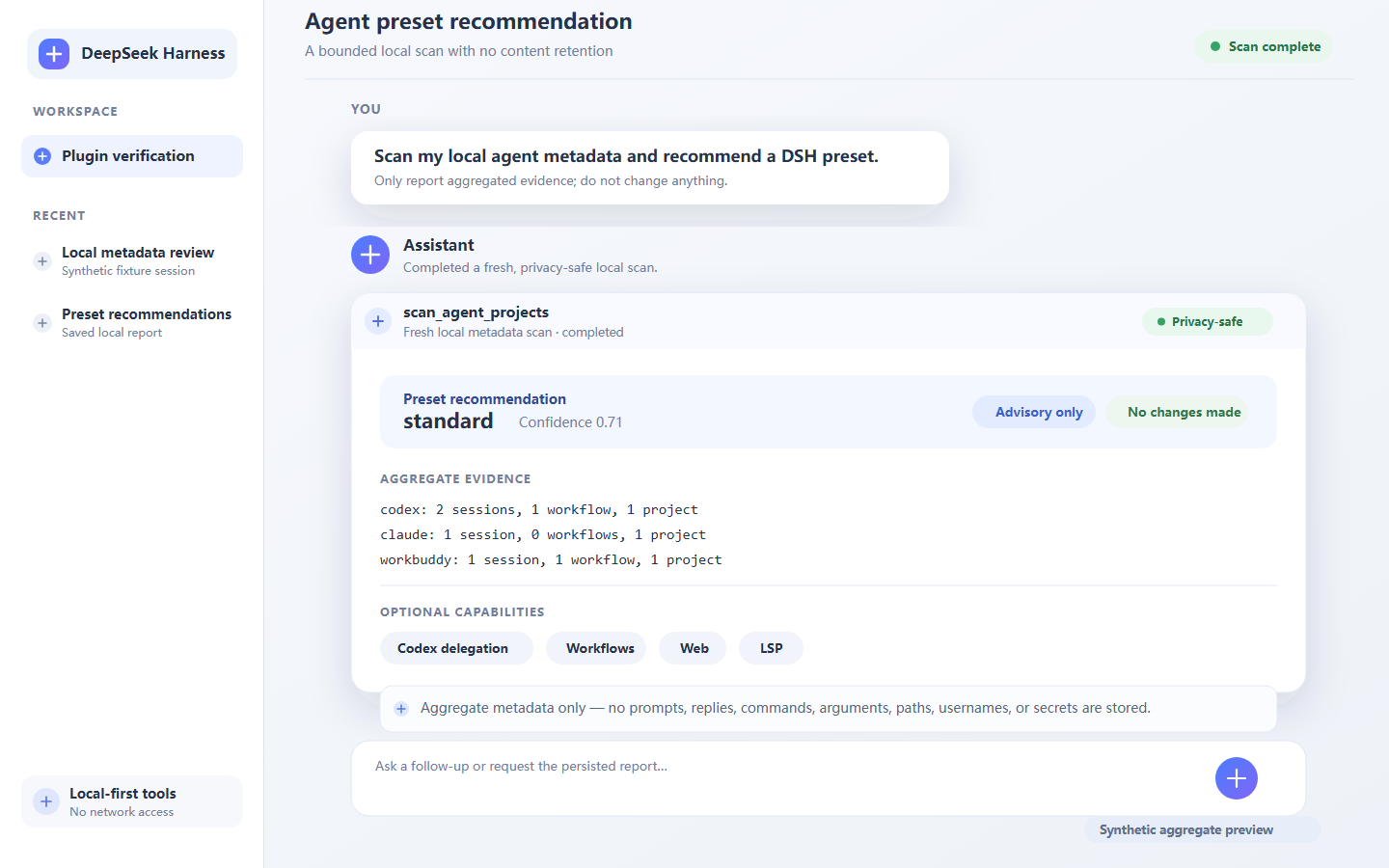
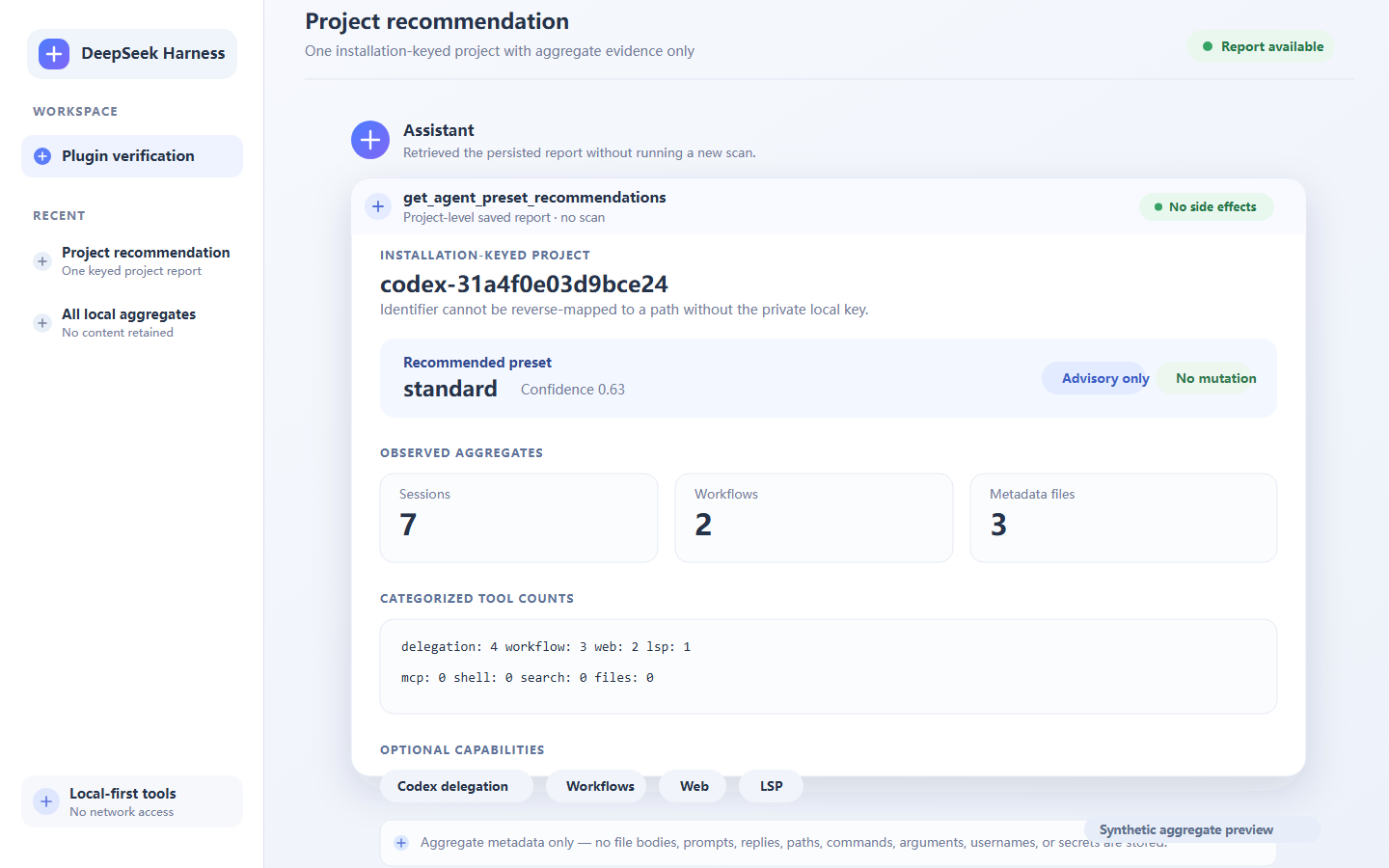
These previews use synthetic aggregate fixture data. They illustrate the bounded tool results only; no user sessions, paths, prompts, commands, or secrets appear.
Capability map
| Area | What the plugin does | Deliberate boundary |
|---|---|---|
| Local inventory | Boundedly scans supported session, project, and workflow metadata from Codex, Claude Code, CodeBuddy, and WorkBuddy. | Skips caches, builds, .git, symlinks, inaccessible roots, and unknown content. |
| Privacy-preserving evidence | Aggregates tool, session, workflow, and day-level activity under installation-local HMAC project IDs. | Never persists prompts, replies, commands, arguments, raw events, paths, usernames, secrets, or file bodies. |
| Deterministic advice | Maps observed evidence to minimal/standard capability presets plus optional delegation, workflow, web, MCP, and LSP capabilities. |
Does not infer the code presentation variant, judge task quality, or alter a preset. |
| Agent-facing access | Provides scan_agent_projects for a fresh bounded scan and get_agent_preset_recommendations for the saved report. |
Both tools return bounded readable text; neither installs, enables, or authenticates anything. |
| Durable local operation | Atomically persists a private report, supports startup and scheduled scans, and serializes all scan triggers. | No LLM call, network request, discovered-command execution, or background work survives plugin disposal. |
Install
dsh plugin --profile web add github:LeemanCheung/dsh-agent-preset-recommender
Restart the selected DSH profile after installation. The package declares dsh.bundle.patch and mounts one host plugin.
What it recommends
Observed aggregate behavior is mapped to:
- capability presets:
minimalorstandard.
code is a Code Mode presentation variant of standard, so this scanner never infers it from local activity volume or silently recommends it as a capability tier.
- optional capabilities: Codex delegation, Claude Code delegation, workflows, web, MCP, and LSP.
Every recommendation includes confidence and numerical evidence. Thresholds are deterministic and local; results never automatically change DSH.
Exact recommendation and evidence rules
standardis recommended when at least one recognized session, workflow, or categorized tool call exists. Metadata files alone—and an empty observation set—yieldminimal.- Codex/Claude Code delegation needs a recognized session from that source. Workflows need a workflow count or
workflow-category tool call;web,MCP, andLSPneed their corresponding category count. - Confidence is
0with no observations; otherwise it ismin(0.95, 0.35 + 0.2 × log10(observations + 1)), rounded to two decimal places, where observations are sessions + workflows + categorized tool calls. - Tool names first use exact delegation aliases, then the fixed heuristic order delegation → workflow → MCP → LSP → web → shell → search → files; the first match wins and unmatched names are
other. These are trend signals, not an audit of every product tool.
Architecture
cordis.patch.yml → src/index.js (Cordis lifecycle + raw model tools)
                    ├─ scanner.js (bounded traversal and aggregation)
                    ├─ extractors.js (selected JSON/JSONL metadata fields)
                    ├─ recommender.js (deterministic rules)
                    ├─ store.js (atomic private report file)
                    └─ render.js (bounded readable tool output)
Runtime code is plain ESM JavaScript for Node.js 20+. It uses Node built-ins plus @deepseek-ai/schemastery for plugin configuration validation. Tool definitions are registered directly through ctx.tools.register and do not import unpublished DSH tool runtime helpers.
Privacy
The scanner persists aggregate metadata only:
- source and installation-keyed project identifier;
- categorized tool counts;
- session, workflow, and project-metadata counts;
- first/last observation dates (day-level);
- recommendation, confidence, and evidence counts;
- an explicit machine-readable privacy declaration.
It never persists prompts, responses, commands, tool arguments, raw events, absolute paths, usernames, secrets, or file contents. Project identifiers are derived with a random installation-local HMAC key, so report IDs cannot be dictionary-matched without the private key. WorkBuddy/CodeBuddy memory metadata is counted from file presence and modification time only; workflow/plan files are likewise never opened. The scanner makes no network requests and runs no discovered command.
Cache, dependency, build, output, coverage, virtual-environment, and .git directories are skipped. Symbolic links are not followed.
The default report is:
$DSH_HOME/state/agent-preset-recommender/report.json
If DSH_HOME is unset, ~/.dsh is used. The directory also holds a private random identity.key used only to derive project IDs. Report writes use a same-directory temporary file and atomic rename; restrictive permissions are requested where the platform supports them.
Supported locations and formats
| Source | Defaults | Read behavior |
|---|---|---|
| Codex | $CODEX_HOME/sessions, $CODEX_HOME/archived_sessions or ~/.codex/* |
Bounded .jsonl/.json; selected session/project and tool-name fields |
| Claude Code | $CLAUDE_CONFIG_DIR/projects or ~/.claude/projects |
Bounded .jsonl/.json; selected project and tool_use name fields; workflow sidecars, journals, task/session/plan stores, and global history are excluded |
| Claude personal workflows | $CLAUDE_CONFIG_DIR/workflows or ~/.claude/workflows |
.js file presence and day only; scripts are never opened. Add project-local <repo>/.claude/workflows explicitly to claudeWorkflowRoots if desired |
| Claude transcripts | Disabled | Scanned only when claudeTranscriptRoots is explicitly configured |
| CodeBuddy CLI | $CODEBUDDY_CONFIG_DIR/projects or ~/.codebuddy/projects |
Bounded canonical project .jsonl records; ~/.codebuddy/workflows/*.js and project-local workflow scripts are inventoried by presence only. Process maps, tool-result/blob directories, and workflow runtime sidecars are excluded |
| WorkBuddy | $WORKBUDDY_CONFIG_DIR/projects or ~/.workbuddy/projects, ~/.workbuddy-ai/projects |
Heuristic, version-sensitive project .jsonl inventory; native session layout is not vendor-contracted, so it is never treated as proof of CodeBuddy session equivalence |
| Project-local CodeBuddy/WorkBuddy metadata | <project>/.codebuddy or <project>/.workbuddy memory, workflows, plans, or automations |
Count and day only, including workflow .js; content is not read; memory never becomes workflow evidence |
Formats vary between product releases. CodeBuddy paths/workflow scripts are documented; WorkBuddy session-file detection is an observed heuristic. Unknown fields are ignored, malformed records are skipped, and malformed files are counted as errors without stopping the scan.
Configuration
Configure the inserted agent-preset-recommender row in a DSH patch:
- id: agent-preset-recommender
  config:
    scanOnStart: true
    intervalMinutes: 360      # 0 disables scheduled scans
    maxFilesPerSource: 500
    maxBytesPerFile: 1048576
    recentDays: 90
    stateDirectory: ''        # empty = $DSH_HOME/state/agent-preset-recommender
    codexRoots:
      - ~/.codex/sessions
      - ~/.codex/archived_sessions
    claudeRoots:
      - ~/.claude/projects
    claudeTranscriptRoots: [] # opt in explicitly
    claudeWorkflowRoots:
      - ~/.claude/workflows   # inventory only; script content is never read
    workbuddyRoots:
      - ~/.codebuddy
      - ~/.workbuddy
      - ~/.workbuddy-ai
      - ~/WorkBuddy
      - ~/CodeBuddy
Defaults honor CODEX_HOME, CLAUDE_CONFIG_DIR, CODEBUDDY_CONFIG_DIR, and WORKBUDDY_CONFIG_DIR when DSH starts. Supplying an explicit root list in the plugin configuration takes precedence over those defaults.
Bounds are validated: intervalMinutes is 0–35,791, maxFilesPerSource 1–100,000, maxBytesPerFile 1 KiB–64 MiB, and recentDays 1–3,650. Missing/inaccessible roots are skipped. Startup, scheduled, and tool-triggered scans share one serialized queue and are aborted on plugin disposal.
Set both scanOnStart: false and intervalMinutes: 0 to disable automatic scans; the model tool can still scan on demand. Before deleting the state directory to reset the report, stop the plugin: this also removes identity.key, intentionally rotating every keyed project ID.
Model tools
scan_agent_projects
Runs and persists a fresh scan. Optionally refresh only selected sources:
{ "sources": ["codex", "claude"] }
Unselected source aggregates from the previous report remain intact.
get_agent_preset_recommendations
Reads the persisted report without scanning:
{}
Or retrieve one keyed project:
{ "project_id": "codex-0123456789abcdef" }
Both tools return bounded readable text strings. Omitting sources or passing an empty list scans every source; a selected-source scan preserves the prior aggregate for unselected sources.
Each persisted source report exposes filesConsidered, truncatedFiles, skippedOld, skippedOversize, skippedLimit, and parseOrAccessErrors alongside counts. Summary output lists at most 50 projects and is capped at 12,000 characters; query a project_id for its bounded detail.
Limitations
- Metadata schemas are intentionally conservative; unrecognized tool events may be undercounted.
- Keyed IDs are stable only while the private state directory remains available; deleting
identity.keyintentionally creates a new identifier set. - A recommendation reflects observed local frequency, not task quality or organizational policy.
- The plugin does not verify that optional products or capabilities are installed or authenticated.
- JSONL files above the byte cap are prefix-sampled within the byte/record bounds; their remaining data, oversized JSON files, old files, and older files beyond a source limit are intentionally omitted. Compressed Codex
.jsonl.zstrollouts are not read in 0.1.6. Claude workflow scripts and dynamic workflow sidecars are deliberately not parsed.
Development
npm install
npm test
Tests use synthetic temporary fixtures and Node's built-in node:test; no local product data is read. See SECURITY.md for private vulnerability reporting guidance.
License
相关推荐Related
-
 nexu-io/open-design
🎨 Best DeepSeek Harness Design Plugin. The open-source Claude Design alternative. 🖥️ Local-first desktop app. 🖼️ Your…
nexu-io/open-design
🎨 Best DeepSeek Harness Design Plugin. The open-source Claude Design alternative. 🖥️ Local-first desktop app. 🖼️ Your…
-
 ruvnet/ruflo
🌊 The original agent meta-harness. Deploy intelligent multi-player swarms, coordinate autonomous workflows, and build c…
ruvnet/ruflo
🌊 The original agent meta-harness. Deploy intelligent multi-player swarms, coordinate autonomous workflows, and build c…
-
 amruthpillai/reactive-resume
A one-of-a-kind resume builder that keeps your privacy in mind. Completely secure, customizable, portable, open-source a…
amruthpillai/reactive-resume
A one-of-a-kind resume builder that keeps your privacy in mind. Completely secure, customizable, portable, open-source a…
-
 esengine/DeepSeek-Reasonix
DeepSeek-native AI coding agent for your terminal. Engineered around prefix-cache stability — leave it running.
esengine/DeepSeek-Reasonix
DeepSeek-native AI coding agent for your terminal. Engineered around prefix-cache stability — leave it running.
-
 volcengine/OpenViking
Self-evolving Context Database for AI Agents. Unify Agent Memory, Knowledge RAG and Skills.
volcengine/OpenViking
Self-evolving Context Database for AI Agents. Unify Agent Memory, Knowledge RAG and Skills.
-
 Molunerfinn/PicGo
:rocket: The Ultimate Image Uploader for Efficient Creators. Supports Obsidian, Typora, VS Code etc. and 60+ image hosti…
Molunerfinn/PicGo
:rocket: The Ultimate Image Uploader for Efficient Creators. Supports Obsidian, Typora, VS Code etc. and 60+ image hosti…
-
 titanwings/distilly
Distilly — Distill how they think into reusable Skills for any Agent or Bot. Formerly Colleague Skill(原同事 Skill).
titanwings/distilly
Distilly — Distill how they think into reusable Skills for any Agent or Bot. Formerly Colleague Skill(原同事 Skill).
-
 titanwings/colleague-skill