Letter2025/dsh-task-worktree
Complete Git worktree support for DeepSeek Harness: task-scoped isolated checkouts on their own branches, recorded in a per-repo manifest that survives sessions and restarts
项目介绍Project Overview
dsh-task-worktree 是为 DeepSeek Harness 提供任务级 Git worktree 工作流的社区插件:每个任务在独立分支的隔离检出中工作,清单持久化、跨会话保留,主工作区不被改动。适合需要并行任务隔离、避免污染主目录时使用。注意:finish、bring-back、remove 等交付与清理操作仅人工执行,bring-back 要求主工作区干净。
dsh-task-worktree is a community plugin adding task-scoped Git worktree workflows to DeepSeek Harness. Each task runs in an isolated checkout on its own branch, tracked in a persistent per-repo manifest across sessions, leaving the main workspace untouched. Use it for parallel or isolated task work. Caveat: finish, bring-back, and remove are human-only commands, and bring-back requires a clean main workspace.
请帮我了解并安装插件:【dsh-task-worktree】【https://github.com/Letter2025/dsh-task-worktree】把上面这条消息直接发给当前会话里的 DSH,让它帮你了解并安装。安装命令不一定准确,发给 DSH 更稳。Send this message to DSH in your current session. CLI install commands may not be accurate across systems — DSH will figure it out for you.
或使用命令行安装(适合开发者)Or use CLI install (for developers)
命令行安装CLI Install
dsh plugin --profile web add dsh-task-worktree把 Letter2025/dsh-task-worktree 加入你的 DSH 配置(web profile)即可启用。
READMEREADME
dsh-task-worktree






Complete Git worktree support for DeepSeek Harness.
A community plugin that gives DSH the task-scoped worktree workflow of Qoder / Codex / Claude Code: each task gets its own isolated git worktree checkout on its own branch, recorded in a per-repo manifest so it survives sessions and restarts. The main workspace stays untouched; conversations that use a worktree are marked with a branch badge on the session header (no workspace entry is created), and the changes can be brought back (Move to local) or committed directly on the worktree branch — always under explicit human control.
It follows the design of Qoder's Worktree execution environment, Codex's codex worktree create --permanent, and Claude Code's --worktree sessions, adapted to DSH's session/workspace model.
Design
| Concept (this plugin) | Qoder | Codex | Claude Code |
|---|---|---|---|
| Task-scoped isolated checkout | Worktree execution environment | codex worktree create --permanent |
claude --worktree <name> |
Worktrees live in <repo>/.dsh-worktrees/ |
background worktree checkout | .codex/worktrees/ |
.claude/worktrees/ |
| Durable registry survives restarts | per-session | global index | session binding |
| Own branch per task | branch selector | — | worktree-<name> |
| Open as a DSH workspace from the GUI | panel selector | codex worktree open |
launches into the worktree |
| Mark the conversation using the worktree | session badge | — | — |
| Bring changes back to main | Move to local | — | exit/cleanup prompt |
| Direct commit on the worktree branch | Review & commit panel | commit in the worktree session | commit in the worktree |
| Carry uncommitted main changes in | Include uncommitted changes toggle | — | .worktreeinclude |
| Auto-ignore the worktree directory | — | — | .gitignore tip |
How it works
Blank conversation: pick "Worktree mode" in the dock dropdown (before the
conversation starts) → optional branch name (auto-prefixed "worktree/")
   │  send the first message → the host injects an instructions context block
   ▼  the model calls worktree_create on that same turn
   │  git worktree add -b worktree/<name> <repo>/.dsh-worktrees/worktree/worktree/<name>
   │  NO workspace is registered, NO conversation switch — the session header
   │  badge marks the worktree this conversation uses
   ▼  work continues in the same conversation (the model uses absolute paths
      inside the checkout); when done the model reminds you how to clean up
   │
   ├─ /worktree bring-back worktree/<name>   → merge the branch into the main branch
   │                                            (requires a clean main workspace)
   ├─ /worktree finish worktree/<name> <msg>  → commit on the worktree branch, keep it
   └─ /worktree remove worktree/<name> --force→ delete the worktree + branch
                                                (--force also deletes uncommitted changes)
- Start in worktree mode: on a blank conversation the dock selector shows
「Branch:」 before you send anything — picking "Worktree mode" ARMS the
session, and the branch-name field is optional (typed names are
auto-prefixed
worktree/, blank lets the model propose one). The mode selector disappears once the conversation starts; the session-header badge takes over the indication. - Send your first message — the host injects one
instructionscontext block (shown as 上下文注入) right before your message: create the worktree with aworktree/-prefixed branch, work inside the checkout path, and at the end remind the user with copy-paste cleanup commands (bring-backorremove --force). - Or skip the mode and ask the agent directly: "用 worktree 隔离干活,任务叫 xxx"
— the model calls
worktree_create; the name is both the branch and the relative path (slashes allowed). - No workspace entry is created, so the sidebar stays uncluttered. The badge on the session header shows the branch name while the conversation is in worktree mode.
- When done:
bring-back/finish/remove(all human-only, as above);/worktree list/status/pruneinspect and clean up (prunealso drops stale workspace registrations for removed checkouts).
Install
dsh plugin --profile web add dsh-task-worktree
Requires: DeepSeek Harness 0.1.0-rc.7 package line, Git 2.31+, Node 20+.
Model tools
| Tool | Purpose |
|---|---|
worktree_create {name, baseCommit?, includeUncommitted?} |
Create a task worktree (name = branch and relative path, slashes allowed); optionally carry uncommitted main-workspace changes in |
worktree_list |
List the repository's managed worktrees (state / dirty / branch) |
worktree_status {name?} |
Status of one worktree, or the one the current session is inside |
Delivery and cleanup actions (finish / bring-back / remove) stay human-only — the model never reaches them.
Human commands
/worktree mode-on [<name>]     arm worktree mode (injection with the next message)
/worktree mode-off             disarm worktree mode
/worktree create <name> [<base>] [--carry]
/worktree list
/worktree status [<name>]
/worktree finish <name> <message>
/worktree bring-back <name> [<message>]
/worktree remove <name> [--force]
/worktree prune
Safety model
@deepseek-ai/*are peerDependencies only — the host supplies them; the plugin never installs infrastructure copies into a profile (a second instance breaksTOOL_RUNTIME_SCHEDULER's unique symbol and kills tool calls).bring-backrequires a clean main workspace (MAIN_DIRTY) and refuses to run from inside the worktree.removerefuses the worktree the current session is working inside (IN_USE).- All git operations go through
ctx.subprocess(harness-managed); the test path uses a child_process runner. - Manifest writes are atomic (tmp + rename);
prunedrops records whose checkout no longer exists.
Local development
npm test              # smoke test: full lifecycle on a scratch repository
npm pack --dry-run    # inspect the tarball before publishing
License
MIT — see LICENSE
相关推荐Related
-
 nexu-io/open-design
🎨 Best DeepSeek Harness Design Plugin. The open-source Claude Design alternative. 🖥️ Local-first desktop app. 🖼️ Your…
nexu-io/open-design
🎨 Best DeepSeek Harness Design Plugin. The open-source Claude Design alternative. 🖥️ Local-first desktop app. 🖼️ Your…
-
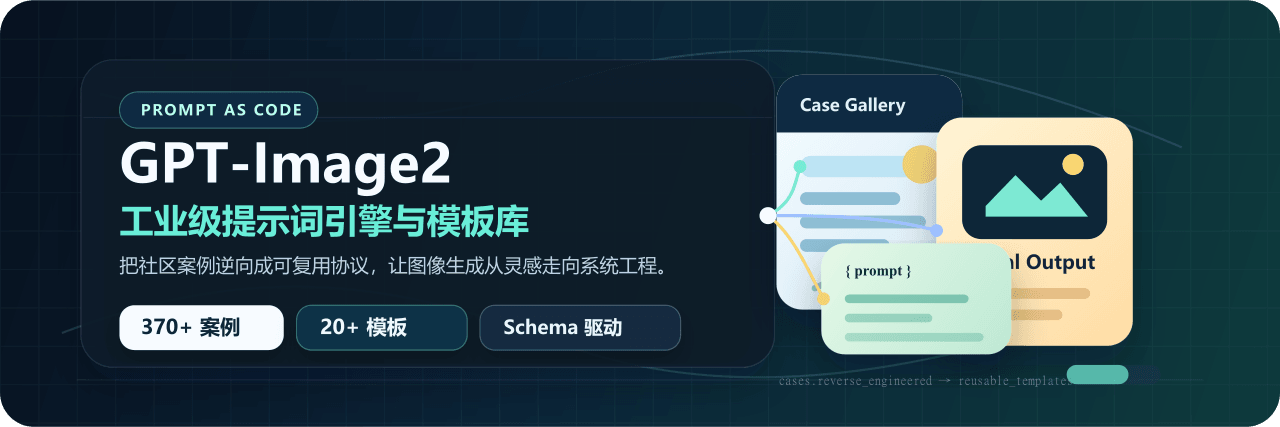 freestylefly/awesome-gpt-image-2
Prompt as Code | GPT-Image2 工业级提示词引擎与模板库,530+ 个案例逆向工程,20+ 套工业级模板,并提炼出Skills,持续更新中
freestylefly/awesome-gpt-image-2
Prompt as Code | GPT-Image2 工业级提示词引擎与模板库,530+ 个案例逆向工程,20+ 套工业级模板,并提炼出Skills,持续更新中
-
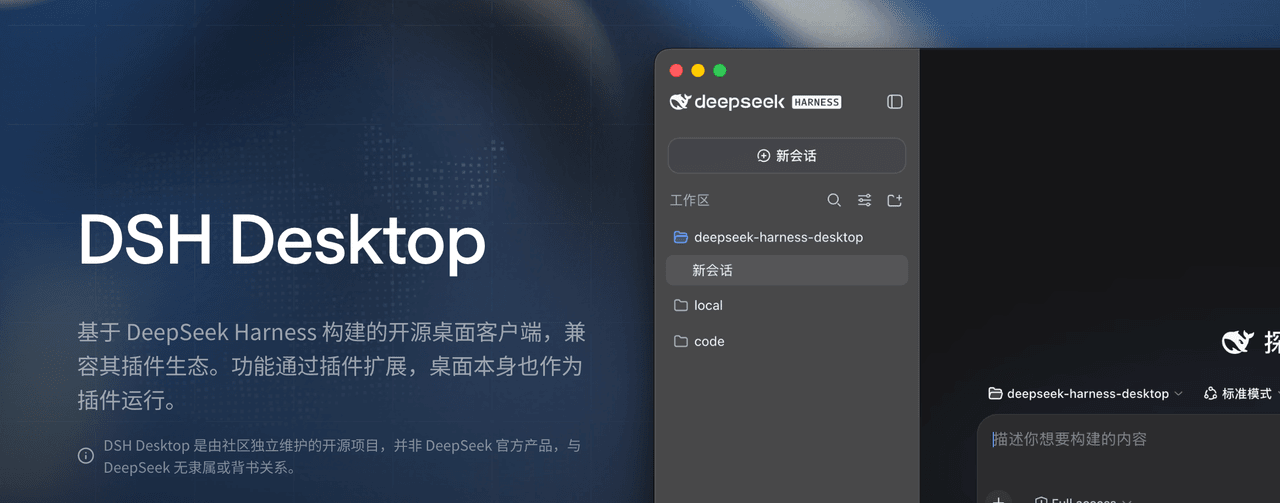 anywhere-labs/dsh-desktop
为 DeepSeek Harness (DSH) 插件生态打造的现代化桌面端解决方案。万物皆「插件」,桌面本身也是「插件」。
anywhere-labs/dsh-desktop
为 DeepSeek Harness (DSH) 插件生态打造的现代化桌面端解决方案。万物皆「插件」,桌面本身也是「插件」。
- Nagi-ovo/voyager Enhancement suite for Gemini, AI Studio, Claude & ChatGPT — plus a prompt manager for any web UI, DeepSeek Harness inclu…
-
 walkinglabs/learn-harness-engineering
Harness engineering beginner tutorial, from 0 to 1
walkinglabs/learn-harness-engineering
Harness engineering beginner tutorial, from 0 to 1
-
 awesome-dsh-plugin/awesome-dsh-plugin
A curated list of plugins for DeepSeek Harness (dsh) · DeepSeek Harness 插件精选列表
awesome-dsh-plugin/awesome-dsh-plugin
A curated list of plugins for DeepSeek Harness (dsh) · DeepSeek Harness 插件精选列表
-
 MemTensor/MemOS
Self-evolving memory OS for LLM & AI Agents: ultra-persistent memory, hybrid-retrieval, and cross-task skill reuse, with…
MemTensor/MemOS
Self-evolving memory OS for LLM & AI Agents: ultra-persistent memory, hybrid-retrieval, and cross-task skill reuse, with…
- yjh051108/dsh-routing-suite dsh-routing-suite — injector + router-standard kit: install the runtime injector first, then the task-aware reasoning-mo…