loongsuite/dsh-plugin
为DeepSeek Harness(dsh)提供OpenTelemetry追踪:将每个智能体交互转化为GenAI跨度树——包括步骤、带TTFT的LLM调用、工具执行和令牌使用情况——通过标准OTLP导出至Jaeger、Grafana Tempo、SigNoz、Langfuse或任何兼容的后端。
项目介绍Project Overview
@loongsuite/dsh-plugin 是 DeepSeek Harness 的独立可观测性插件,将 DSH 的会话、代理循环、LLM 流与工具生命周期转为 OpenTelemetry GenAI traces 和指标,通过 OTLP/HTTP protobuf 导出至任意兼容后端。适用于需要统一追踪 DSH 运行时的开发与运维场景。注意:内容采集默认关闭,开启后会将提示、响应与工具数据发往后端,需审核后端留存与访问控制。需 Node.js 22.19+,DSH 版本需 ≥0.1.0-rc.6 且 <0.2.0。
@loongsuite/dsh-plugin is a standalone observability plugin for DeepSeek Harness that converts DSH sessions, agent loops, LLM streams, and tool lifecycles into OpenTelemetry GenAI traces and metrics, exported over OTLP/HTTP protobuf to any compatible backend. Use it when you need unified tracing across DSH runs. Content capture is off by default; enabling it may send prompts, responses, and tool data to the configured backend, so review retention and access controls first.
请帮我了解并安装插件:【dsh-plugin】【https://github.com/loongsuite/dsh-plugin】把上面这条消息直接发给当前会话里的 DSH,让它帮你了解并安装。安装命令不一定准确,发给 DSH 更稳。Send this message to DSH in your current session. CLI install commands may not be accurate across systems — DSH will figure it out for you.
或使用命令行安装(适合开发者)Or use CLI install (for developers)
命令行安装CLI Install
dsh plugin --profile web add @loongsuite/dsh-plugin把 loongsuite/dsh-plugin 加入你的 DSH 配置(web profile)即可启用。
READMEREADME
LoongSuite observability for DeepSeek Harness
English | 简体中文
@loongsuite/dsh-plugin is a standalone, open-source observability plugin for
DeepSeek Harness (dsh). It observes DSH's native
session, agent loop, LLM stream, and tool lifecycle, converts them into OpenTelemetry GenAI traces
and metrics, and exports standard OTLP/HTTP protobuf to any compatible backend.
LoongSuite is an open-source observability collection ecosystem built on OpenTelemetry. This repository is its native DSH integration. The plugin does not depend on or require LoongSuite Pilot, a sidecar, a local JSONL tap, or any particular vendor's backend.
Status: stable
0.1.xrelease. Install@loongsuite/dsh-pluginfrom npm or the DSH plugin market.
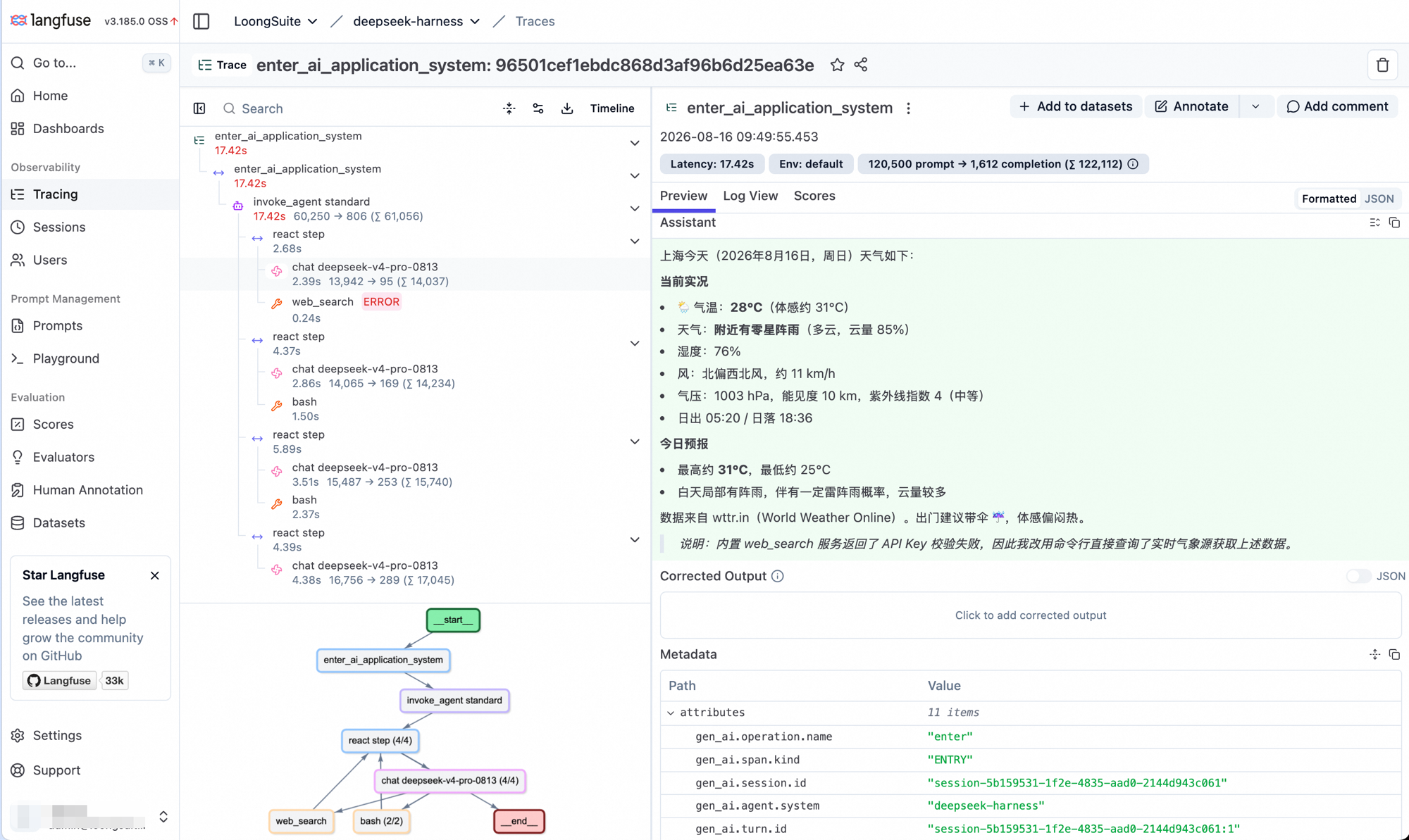
One DSH turn exported over OTLP into self-hosted Langfuse: four react steps, per-call latency
and token counts, a failed web_search followed by bash fallbacks, and the
ENTRY span's GenAI attributes. Content capture was enabled for this capture; it is off by
default.
Data model
DSH session/event + llm/stream
                │
                ▼
      lifecycle coordinator
                │
                ▼
   LoongSuite GenAI OTel utility
                │
                ▼
 private TracerProvider + MeterProvider
                │  OTLP/HTTP protobuf
                ▼
  any OpenTelemetry-compatible backend
One DSH turn produces a single trace with this shape:
ENTRY
└── AGENT
    └── STEP
        ├── LLM
        └── TOOL
Each real LLM attempt gets its own LLM span, so retries remain visible under the same step. Tool
calls are correlated with their results by DSH call ID. Errors, aborts, incomplete streams, and
plugin shutdown close live spans with an error status instead of leaving them open. Subagent
sessions create their own trace and carry DSH parent-session and delegation attributes.
When content capture is enabled, ENTRY and AGENT input messages contain only the turn's direct
source.kind=user input. Synthetic DSH context such as runtime snapshots, agent instructions,
skill catalogs, goals, and coordinator relays remains visible on the LLM span, but prior-turn
conversation history is excluded so every trace contains only its own turn context. Later LLM
spans in a tool loop retain assistant tool calls and tool results produced earlier in the same
turn. ENTRY and AGENT output messages contain only the final stop response; a turn that never
reaches stop falls back to its last available assistant message.
The plugin also exports the standard gen_ai.client.operation.duration and
gen_ai.client.token.usage metrics. It does not export OpenTelemetry logs; it can coexist with a
separate DSH log exporter.
GenAI invocation construction and semantic attributes are powered by the
@loongsuite/otel-util-genai SDK.
Compatibility
| Component | Supported range | Fully verified version(s) |
|---|---|---|
| DeepSeek Harness | >=0.1.0-rc.6 <0.2.0 |
0.1.0-rc.6 headless and Web profiles |
| Node.js | >=22.19.0 |
22.19, 24.19, and 25.9 on macOS |
DSH release candidates older than 0.1.0-rc.6 are not supported. Each plugin release is tested
against the latest published DSH version rather than treating successful bundle composition alone
as full runtime compatibility.
Install and run
If you have no OTLP backend yet, examples/quickstart starts a
local Jaeger backend and gets you a trace in three commands.
Add the plugin to every DSH profile you want to observe:
dsh plugin --profile web add @loongsuite/dsh-plugin
dsh plugin --profile headless add @loongsuite/dsh-plugin
For local development, replace the package name with the checkout path:
dsh plugin --profile web add /absolute/path/to/dsh-plugin
Set a service name and an OTLP/HTTP collector endpoint, then start that profile normally:
export OTEL_SERVICE_NAME=dsh-agent
export OTEL_EXPORTER_OTLP_ENDPOINT=http://localhost:4318
export OTEL_EXPORTER_OTLP_HEADERS='authorization=Bearer%20your-token'

dsh --profile web
# or: dsh --profile headless "summarize this workspace"
The shared endpoint is expanded to /v1/traces and /v1/metrics. The exporter uses the standard
OpenTelemetry default when no endpoint is configured.
Configure the plugin
Environment variables are enough for most deployments. You can also edit the plugin row in
$DSH_HOME/profiles/<profile>/cordis.patch.yml (by default under ~/.dsh):
- id: loongsuite-observability
  config:
    endpoint: http://localhost:4318
    serviceName: dsh-agent
    headers:
      authorization: Bearer your-token
    resourceAttributes:
      deployment.environment.name: development
    captureContent: false
    exportMetrics: true
Explicit plugin settings take precedence over environment variables.
To enable content capture without editing the profile, set the GenAI content mode before starting DSH:
export OTEL_INSTRUMENTATION_GENAI_CAPTURE_MESSAGE_CONTENT=SPAN_ONLY
dsh --profile web
| Setting | Default | Meaning |
|---|---|---|
enabled |
true |
Disable collection without uninstalling the bundle. |
endpoint |
unset | Shared OTLP/HTTP base URL; the plugin appends each signal path. |
traceEndpoint / metricEndpoint |
unset | Complete signal-specific URL; takes precedence over endpoint. |
headers |
{} |
Headers added to both exporters. |
serviceName |
OTEL_SERVICE_NAME or deepseek-harness |
OpenTelemetry service.name. |
resourceAttributes |
{} |
Additional string-valued resource attributes. |
captureContent |
environment setting or false |
Export prompts, responses, tool definitions, arguments, and results. |
contentMaxChars |
128000 |
Maximum serialized characters per captured content attribute. |
exportMetrics |
environment setting or true |
Export LLM duration and token metrics. |
maxExportBatchSize |
512 |
Maximum spans per export batch. |
maxQueueSize |
2048 |
Maximum queued spans. Must not be smaller than the batch size. |
traceExportIntervalMs |
5000 |
Trace batch delay. |
metricExportIntervalMs |
60000 |
Metric export interval. |
exportTimeoutMs |
30000 |
OTLP export timeout. |
debug |
false |
Emit additional plugin lifecycle diagnostics through the DSH logger. |
Supported standard OpenTelemetry variables are:
OTEL_EXPORTER_OTLP_ENDPOINTOTEL_EXPORTER_OTLP_TRACES_ENDPOINTandOTEL_EXPORTER_OTLP_METRICS_ENDPOINTOTEL_EXPORTER_OTLP_HEADERSOTEL_EXPORTER_OTLP_TRACES_HEADERSandOTEL_EXPORTER_OTLP_METRICS_HEADERSOTEL_SERVICE_NAMEOTEL_RESOURCE_ATTRIBUTESOTEL_INSTRUMENTATION_GENAI_CAPTURE_MESSAGE_CONTENT(SPAN_ONLYorSPAN_AND_EVENTenables span content whencaptureContentis omitted)OTEL_METRICS_EXPORTER(nonedisables metrics whenexportMetricsis omitted)
Header and resource values use the standard comma-separated, percent-encoded key=value syntax.
Privacy and runtime behavior
Content capture is off by default. With that default, prompts, responses, tool schemas, arguments,
and results are not attached to spans; structural metadata and token counts are still exported.
Enabling captureContent or setting the content-capture environment variable to SPAN_ONLY or
SPAN_AND_EVENT can send source code, credentials, personal data, or other sensitive content to
the configured backend. Review backend retention and access controls before enabling it. Set
captureContent: false explicitly when a profile must remain content-free regardless of the
process environment.
The plugin owns private OpenTelemetry providers and never replaces DSH's or another library's
global provider. It also disposes listeners and flushes providers with the DSH plugin lifecycle.
When attached to an already-running/HMR-reloaded profile, it adopts existing session identities but
starts collection at the next native turn/start; historical events are not replayed or duplicated.
Development
Node.js 22.19 or newer and pnpm are required.
pnpm install
pnpm run check
pnpm test
pnpm run build
pnpm pack
See CONTRIBUTING.md for the implementation invariants and release checklist.
License
相关推荐Related
-
 nexu-io/open-design
🎨 Best DeepSeek Harness Design Plugin. The open-source Claude Design alternative. 🖥️ Local-first desktop app. 🖼️ Your…
nexu-io/open-design
🎨 Best DeepSeek Harness Design Plugin. The open-source Claude Design alternative. 🖥️ Local-first desktop app. 🖼️ Your…
-
 ruvnet/ruflo
🌊 The original agent meta-harness. Deploy intelligent multi-player swarms, coordinate autonomous workflows, and build c…
ruvnet/ruflo
🌊 The original agent meta-harness. Deploy intelligent multi-player swarms, coordinate autonomous workflows, and build c…
-
 amruthpillai/reactive-resume
A one-of-a-kind resume builder that keeps your privacy in mind. Completely secure, customizable, portable, open-source a…
amruthpillai/reactive-resume
A one-of-a-kind resume builder that keeps your privacy in mind. Completely secure, customizable, portable, open-source a…
-
 esengine/DeepSeek-Reasonix
DeepSeek-native AI coding agent for your terminal. Engineered around prefix-cache stability — leave it running.
esengine/DeepSeek-Reasonix
DeepSeek-native AI coding agent for your terminal. Engineered around prefix-cache stability — leave it running.
-
 volcengine/OpenViking
Self-evolving Context Database for AI Agents. Unify Agent Memory, Knowledge RAG and Skills.
volcengine/OpenViking
Self-evolving Context Database for AI Agents. Unify Agent Memory, Knowledge RAG and Skills.
-
 Molunerfinn/PicGo
:rocket: The Ultimate Image Uploader for Efficient Creators. Supports Obsidian, Typora, VS Code etc. and 60+ image hosti…
Molunerfinn/PicGo
:rocket: The Ultimate Image Uploader for Efficient Creators. Supports Obsidian, Typora, VS Code etc. and 60+ image hosti…
-
 titanwings/distilly
Distilly — Distill how they think into reusable Skills for any Agent or Bot. Formerly Colleague Skill(原同事 Skill).
titanwings/distilly
Distilly — Distill how they think into reusable Skills for any Agent or Bot. Formerly Colleague Skill(原同事 Skill).
-
 titanwings/colleague-skill