lpeixin/dsh-project-compass
An AI-powered DSH plugin for codebase analysis, developer onboarding, and project-level Q&A. 项目罗盘 / Project Compass — DSH 插件,通过 AST、依赖图、RAG 和 LLM 分析代码库,自动生成架构、模块、调用链与上手指南,并提供项目级 AI Q&A,帮助开发者快速理解和接手项目。
Project Overview项目介绍
dsh-project-compass (Project Compass) is a codebase reconnaissance and citation-backed Q&A plugin built for DeepSeek Harness. It registers six tools with the model through Cordis using the uniform project_compass_* namespace, exposes a single /compass command to humans, and ships only named exports (name, inject, apply) with no default export. Host services are reached solely through ctx.get(...), so when the default session model or LLM service is unavailable the plugin degrades to deterministic output.
The typical workflow is: point it at an unfamiliar project path, run project_compass_report to produce six artifacts in one pass — ONBOARDING.md, ARCHITECTURE.md, MODULE_MAP.md, KEY_FLOWS.md, GETTING_STARTED.md and a machine-readable project-compass.json — then keep querying with project_compass_ask. Every claim is routed through a validator that requires paths, line numbers and symbols to actually exist; failed claims are dropped and counted rather than silently surfaced. The target audience includes new developers inheriting legacy code, tech leads estimating the blast radius of a change, and AI agents that need stable project context without re-grepping every turn; the optional contextInjection flag injects a short project brief into the system prompt when enabled.
Dependencies are strictly limited to node:* built-ins — no npm packages, no install scripts, no build output — and the package is pure ESM with "type": "module". Writes are confined to <project>/.project-compass/ and <project>/docs/project-compass/, and on first write a *-rule .gitignore is dropped into the machine-state directory so absolute local paths never get committed by accident. Detailed docs (docs/TOOLS.md, docs/CONFIG.md, docs/ARCHITECTURE.md, docs/OUTPUT-FORMAT.md, docs/VERIFICATION.md, docs/ROADMAP.md) are currently Chinese-only; license is MIT; tests run via node --test and the smoke test via node scripts/compass-cli.mjs analyze <path>.
dsh-project-compass(Project Compass 项目罗盘)是一款面向 DeepSeek Harness 的代码库侦察与可引用问答插件。它通过 Cordis 工具注册为模型暴露 6 个 project_compass_* 工具,同时为用户提供 /compass 命令,并把工具命名空间统一规范。核心能力是把陌生代码库转化为 6 份带 path:line 引用的制品:ONBOARDING、ARCHITECTURE、MODULE_MAP、KEY_FLOWS、GETTING_STARTED 与 project-compass.json。
典型工作流是:拿到一个陌生项目路径后运行 project_compass_report,一次性产出上述 6 份文档,再用 project_compass_ask 持续追问;回答附带引用并经过校验,路径、行号、符号必须真实存在。它面向接手遗留项目的新成员、做变更评估的技术负责人,以及需要项目上下文作为系统提示注入的 AI 代理。contextInjection 选项默认关闭,启用后可在同一会话中持续携带项目简报。
依赖方面仅允许使用 node:* 内置模块,零 npm 依赖、零安装脚本、零构建产物;写入范围只触及目标项目的 .project-compass/ 与 docs/project-compass/,不会修改任何业务代码。机器状态目录会在首次写入时自动创建 .gitignore 以避免误提交根路径。文档 docs/TOOLS.md、CONFIG.md、ARCHITECTURE.md 等目前为中文版;许可为 MIT;测试使用 node --test,冒烟测试使用 node scripts/compass-cli.mjs analyze。
请帮我安装这个 DSH 插件。安装前先完成【兼容性检查 + 安全性检查】,检查通过再动手。

插件:dsh-project-compass(lpeixin/dsh-project-compass)
仓库:https://github.com/lpeixin/dsh-project-compass
本站详情页:https://www.yhbd.top/plugins/lpeixin-dsh-project-compass/
本站登记:类型 client · 归类 原生 DSH 插件 · 许可证 MIT · ⭐ 3 · 最近提交 2026-10-03 · 主语言 JavaScript

按下面顺序执行,每步先把结论告诉我,再进入下一步:

【1 兼容性检查】
① 我这边:DSH 版本、Node 版本、操作系统、当前 profile(web / desktop)。
② 读它的 README、package.json、插件 manifest,列出它要求的 DSH 版本 / Node 版本 / 操作系统 / 外部依赖 / 需要另外先装的运行时。
③ 逐条比对,结论只写「满足 / 不满足 / 未知」三种;不满足的给出可行替代方案。
④ 检查是否和我已装的插件冲突:命令名重复、skill / tool 重名、端口占用、重复注册的 MCP server。

【2 安全性检查】
① 仓库可信度:和上面「本站登记」是否一致;star / fork 数、创建时间、最近提交,是否归档或长期停更。
② 安装脚本:逐行看 package.json 的 preinstall / install / postinstall,以及 install.sh、setup.ps1 之类脚本。出现 curl|bash、下载后直接执行、混淆代码、访问与插件功能无关的域名,立刻停下来告诉我,不要继续装。
③ 依赖:列出新增依赖,标出无人维护、或与知名包拼写近似的可疑包(typosquatting)。
④ 权限与副作用:它会读写哪些目录、访问哪些域名、需要哪些 DSH 权限(filesystem / network / shell / clipboard 等),以及怎么卸载和回滚。
⑤ 如果它要求 sudo / 管理员权限,或权限明显超出功能所需,先停下来问我。

【3 安装】
上面两步没有「不满足」和「高危项」时才执行;用官方推荐方式安装,不要自行提权。

【4 汇报】
用表格输出:检查项 / 结论 / 依据 / 是否需要我决策。拿不准的一律写「未知」并说明要我怎么确认——不要猜,也不要替我决定。
Send this message to DSH in your current session: it verifies compatibility and security first (answering met / not met / unknown item by item) and only installs once everything checks out — it will stop and ask you if it finds a high-risk item. The box scrolls; the copy is the full prompt. CLI install commands may not be accurate across systems, so DSH is the safer route.把上面这条消息直接发给当前会话里的 DSH:它会先核对兼容性与安全性(逐条给「满足 / 不满足 / 未知」),确认没问题再安装,有高危项会停下来问你。框内可滚动,复制到的是完整提示词;安装命令不一定准确,发给 DSH 更稳。
- Only 3 stars - very few users, little community feedback星标只有 3,几乎没人在用,遇到问题缺少社区反馈
- Desktop client: installation downloads an executable - verify the publisher and checksums桌面客户端:安装会下载可执行文件,请核对发布者与校验和
DSH walks through these 9 checksDSH 会逐条核对这 9 项
Compatibility兼容性
- DSH, Node, OS and profile requirementsDSH 版本 / Node 版本 / 操作系统 / profile 是否满足要求
- External dependencies and runtimes (Electron / Python / Docker, ...)外部依赖与运行时(Electron / Python / Docker 等)是否齐备
- Conflicts with installed plugins: command names, skill / tool names, ports, duplicate MCP registration与已装插件是否冲突:命令名、skill / tool 重名、端口占用、重复 MCP 注册
Security安全性
- Repo matches the facts registered here; archived or abandoned?仓库是否与页面登记一致,是否归档或长期停更
- Safety of preinstall / install / postinstall and install.sh / setup.ps1preinstall / install / postinstall 与 install.sh、setup.ps1 是否安全
- curl|bash, download-then-execute, obfuscation, unrelated domains → stop immediatelycurl|bash、下载即执行、混淆代码、无关域名 → 立刻停止
- Typosquatting or unmaintained packages among the new dependencies新增依赖里有没有 typosquatting 或无人维护的包
- Requested permissions vs. what the feature actually needs申请了哪些权限、是否超出功能所需(filesystem / network / shell / clipboard)
- Any sudo / admin requirement, plus uninstall and rollback是否要求 sudo / 管理员权限,以及卸载与回滚方式
Anything uncertain must be marked unknown with a note on how to confirm it. This site's signal screen is a static snapshot, not a security audit.拿不准的必须标「未知」并说明要我怎么确认。本站的信号筛查是静态快照,不能替代安全审计。
Or use CLI install (for developers)或使用命令行安装(适合开发者)
CLI Install命令行安装
dsh plugin --profile web add github:lpeixin/dsh-project-compass把 lpeixin/dsh-project-compass 加入你的 DSH 配置(web profile)即可启用。
READMEREADME
English | 中文
dsh-project-compass · Project Compass 项目罗盘
Codebase reconnaissance and citation-backed Q&A for DeepSeek Harness.
Project Compass reads an existing project and turns "how is this thing put together" into a set of evidence-cited documents, plus a question-answering interface you can keep asking.
It does not require you to get the project running first, does not require you to read all the code, and does not go online. Give it a path and it returns six artifacts: an onboarding guide, an architecture description, a module map, the key flows, the steps to get it running, and a machine-readable JSON.
Documentation language. The detailed documents under
docs/— TOOLS, CONFIG, OUTPUT-FORMAT, ARCHITECTURE, ROADMAP and VERIFICATION — are currently written in Chinese. If you need English versions, please raise it in an issue.
Table of contents
- What problem it solves
- Output artifacts
- Capability matrix
- Installation
- Quick start
- Configuration
- Tools and command reference
- How it works: the six-step pipeline
- Privacy and security
- How it integrates with DSH
- Development and testing
- License
What problem it solves
When you take over an unfamiliar codebase, the expensive part is not reading code — it is not knowing where to start reading, and not knowing what will break when you change something.
| Situation | What it used to cost | What Project Compass gives you |
|---|---|---|
| New developer onboarding | A colleague explains verbally for two hours, and afterwards you still don't know where the entry point is; the README was last updated three years ago | GETTING_STARTED.md gives runnable steps to get up and running, ONBOARDING.md gives a reading order arranged by role, and every item carries path:line so you can jump straight into the code |
| Inheriting a legacy project | No documentation, the original owner has left, and changing one line feels like a three-day risk | ARCHITECTURE.md + MODULE_MAP.md give module boundaries, dependency direction, cycles and high-risk modules; risks come with reasons, not with feelings |
| A tech lead reviewing a change | "How big is the blast radius of this change?" can only be guessed from experience | A module / file / symbol three-level dependency graph plus reachability from entry points, so blast radius is something you look at rather than guess at; key flows come with Mermaid sequence diagrams |
| An AI agent that needs project context | Every turn re-greps, the context fills up with scattered fragments, and it still invents files that do not exist | project_compass_ask returns answers with citations (path:line + symbol + rationale); every claim passes a validator first — paths, line numbers and symbols must really exist, and claims that fail validation are explicitly dropped and counted |
Showing the opening section of the README — the full document lives in the repository以上为 README 开头摘要,完整文档在仓库内 · View the full README on GitHub →在 GitHub 查看完整 README →
Related相关推荐
-
 feicaiclub/deepseek-harness-whitepaper
DeepSeek Harness 白皮书 · 131 页入门加进阶综合教程:从装上它、看懂它,到自己扩展它。面向想深入研究 agent harness 的开发者,所有结论回源码核对。
feicaiclub/deepseek-harness-whitepaper
DeepSeek Harness 白皮书 · 131 页入门加进阶综合教程:从装上它、看懂它,到自己扩展它。面向想深入研究 agent harness 的开发者,所有结论回源码核对。
- diguike/book-deepseek-harness 《一切皆插件》— DeepSeek Harness 源码精读、Mini 实现与插件开发实战。21 章 + 可运行的 mini-dsh + 真实插件案例,全部数据实测。
- mlosun/dsh-docs-panel DSH WebUI 里的「随身手册」:全局 Markdown 笔记,任何工作区随时可读。
- tetckx/deep-structural-analysis-skill Deep Structural Analysis — a multi-perspective structural analysis skill for complex social, economic, philosophical, an…
- zoahdev/dsh-ecosystem The living map of the DeepSeek Harness plugin ecosystem: curated plugin catalog with quality signals, bug radar, gap rad…
-
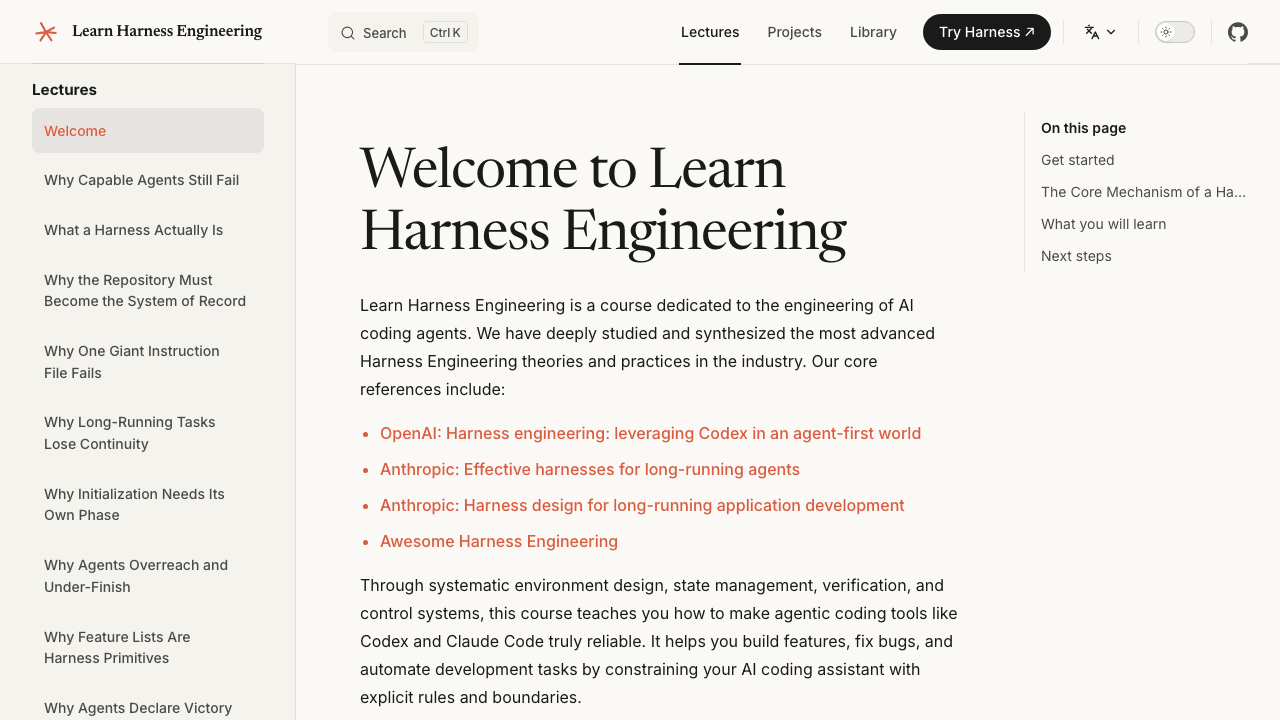 walkinglabs/learn-harness-engineering
Harness engineering beginner tutorial, from 0 to 1
walkinglabs/learn-harness-engineering
Harness engineering beginner tutorial, from 0 to 1
-
 Electricitysheep/dsh-handbook
DeepSeek Harness (dsh) 从 0 到 1 深度手册:安装/插件开发/性能调优/实测案例/同模型多 Agent 实测对比(中文 + 英文 PDF)
Electricitysheep/dsh-handbook
DeepSeek Harness (dsh) 从 0 到 1 深度手册:安装/插件开发/性能调优/实测案例/同模型多 Agent 实测对比(中文 + 英文 PDF)
-
 humblebanana/open-record-replay
Open-source macOS record-and-replay workflow recorder for computer use agents. Captures mouse, keyboard, and UI events a…
humblebanana/open-record-replay
Open-source macOS record-and-replay workflow recorder for computer use agents. Captures mouse, keyboard, and UI events a…