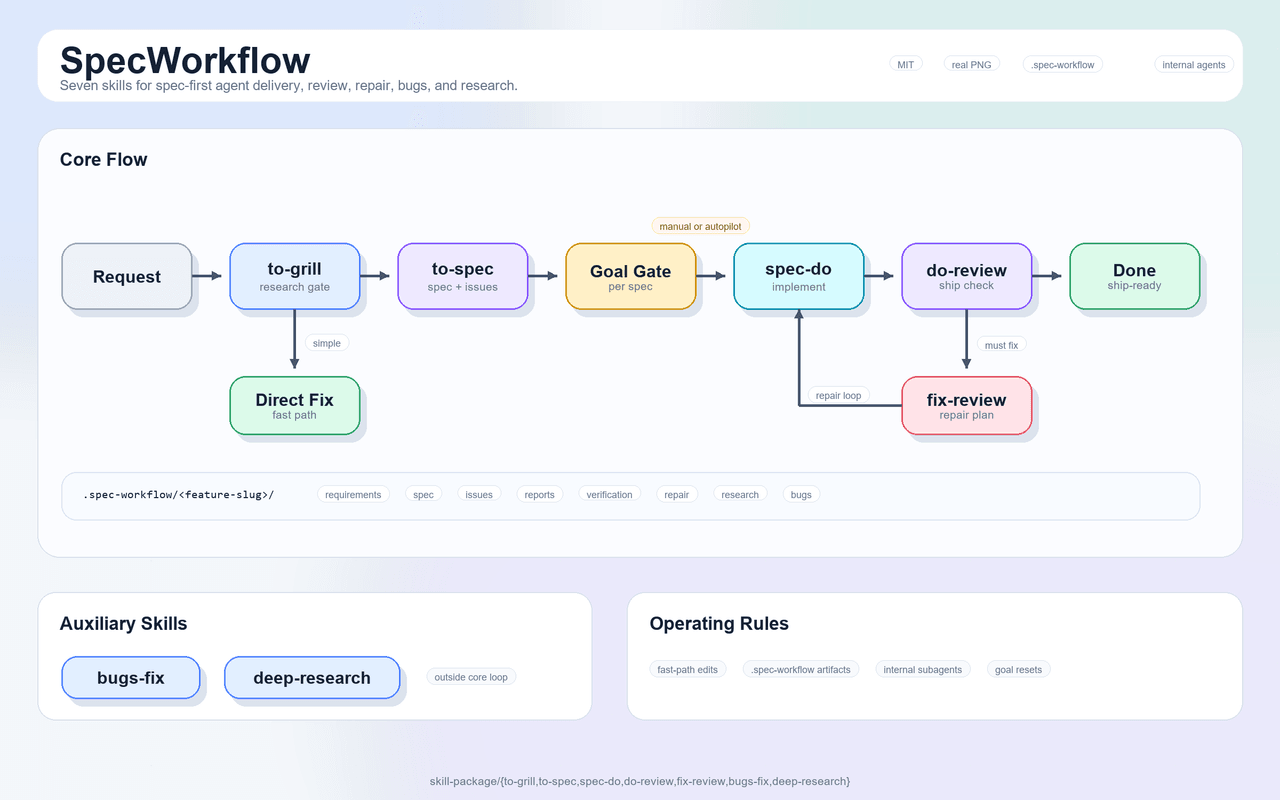
MoonCoder-HAPPY/SpecWorkflow
适用于DSH的工作流技能包:需求、规格、实现、审查、修复、缺陷及研究
项目介绍Project Overview
SpecWorkflow 是面向 DeepSeek Harness 等 Agent Skills 兼容工具的可共享工作流技能包,引导代理从粗略请求走向需求、规格、编码、评审、修复、调试与溯源研究。适用于模糊、跨模块或发布敏感的任务;简单编辑可保持直接处理。注意:完整流程需在 .spec-workflow/ 下维护工件。
SpecWorkflow is a shareable workflow skill pack for DeepSeek Harness and other Agent Skills-compatible tools. It guides an agent from a rough request through requirements, implementation spec, code execution, delivery review, repair planning, bug diagnosis, and source-backed research. Use it for ambiguous, cross-module, product-facing, or release-sensitive work; simple edits stay direct. Note: full workflow artifacts live under .spec-workflow/.
请帮我了解并安装插件:【SpecWorkflow】【https://github.com/MoonCoder-HAPPY/SpecWorkflow】把上面这条消息直接发给当前会话里的 DSH,让它帮你了解并安装。安装命令不一定准确,发给 DSH 更稳。Send this message to DSH in your current session. CLI install commands may not be accurate across systems — DSH will figure it out for you.
或使用命令行安装(适合开发者)Or use CLI install (for developers)
命令行安装CLI Install
dsh plugin --profile web add specworkflow把 MoonCoder-HAPPY/SpecWorkflow 加入你的 DSH 配置(web profile)即可启用。
READMEREADME
SpecWorkflow
English | 中文
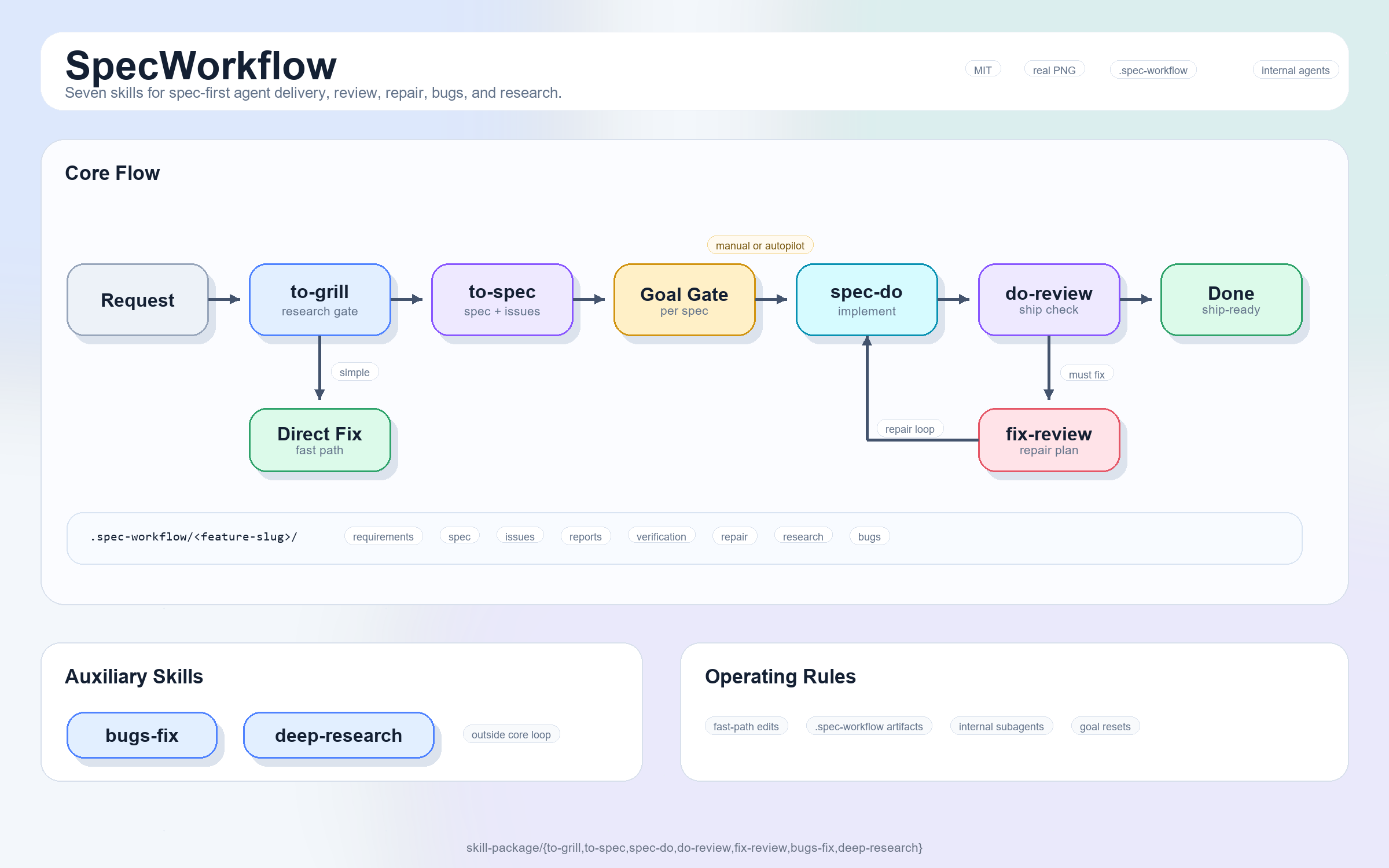
SpecWorkflow is a shareable workflow skill pack for DeepSeek Harness and other Agent Skills-compatible tools. It gives an agent a disciplined path from a rough request to requirements, an implementation spec, code execution, delivery review, repair planning, bug diagnosis, and source-backed research.
It is intentionally not a heavy process for every request. Small, concrete edits can stay direct; ambiguous, cross-module, product-facing, data, permission, API, or release-sensitive work gets promoted into the full workflow.
What It Does
| Stage | Skill | What it handles |
|---|---|---|
| Research | deep-research |
Source-backed investigation against docs, APIs, standards, code, or other primary sources. |
| 1 | to-grill |
Requirement grilling, ambiguity removal, risk review, and the direct-fix vs full-workflow decision. |
| 2 | to-spec |
Implementation-ready specs, amendments, acceptance criteria, validation plans, and optional tickets. |
| 3 | spec-do |
Execution from an approved spec, issue set, amendment, or repair plan. |
| 4 | do-review |
Final delivery review against request, spec, code, evidence, and acceptance criteria. |
| 5 | fix-review |
Repair specs and repair tickets for must-fix review findings. |
| Debug | bugs-fix |
Reproduction, root-cause diagnosis, repair, and fix evidence for bugs or regressions. |
Install
DSH
dsh plugin --profile web add specworkflow
dsh web
Other Agents
npx specworkflow install codex
Install globally with -g:
npx specworkflow install -g codex
Replace codex with another preset when needed:
| Input | Project install | Global install with -g |
|---|---|---|
codex, openai, agents, agent, agent-skills, agents-md, goose, zed, amp, sourcegraph-amp |
.agents/skills |
~/.agents/skills |
gemini, gemini-cli, antigravity, google-antigravity |
.agents/skills |
~/.gemini/antigravity/skills |
claude, claude-code, claudecode |
.claude/skills |
~/.claude/skills |
cursor, cursor-agent, cursor-native |
.cursor/skills |
~/.cursor/skills |
copilot, github-copilot, vscode, vs-code |
.github/skills |
~/.github/skills |
dsh, deepseek, deepseek-harness |
.dsh/skills |
~/.dsh/skills |
opencode, open-code |
.opencode/skills |
~/.opencode/skills |
windsurf, cascade |
.windsurf/skills |
~/.windsurf/skills |
cline, claudine |
.cline/skills |
~/.cline/skills |
roo, roo-code, roocode |
.roo/skills |
~/.roo/skills |
qwen, qwen-code, qwencode |
.qwen/skills |
~/.qwen/skills |
kiro |
.kiro/skills |
~/.kiro/skills |
kilo, kilo-code, kilocode |
.kilo/skills |
~/.kilo/skills |
augment, augment-code, augmentcode, auggie |
.augment/skills |
~/.augment/skills |
openclaw, claw |
skills |
~/.openclaw/skills |
Unknown plain names are rejected so a typo does not create the wrong folder. For unsupported agents, pass an explicit project-level skills path:
npx specworkflow install .my-agent/skills
With -g, relative explicit paths are resolved from your home directory.
Quick Start
Typical feature work:
Use to-grill to clarify this request, then move to to-spec when the requirement is ready.
Simple edits should stay simple:
Make the table font larger.
SpecWorkflow should route that kind of request to direct implementation instead of forcing the full five-stage path.
Workflow
SpecWorkflow does not start by writing a spec. It starts by deciding whether the request deserves one. Small, obvious work such as copy edits, style tweaks, or a missing guard should stay direct.
The full route is for work with product meaning, data semantics, permission boundaries, cross-module impact, release risk, or enough ambiguity that guessing would be expensive. Once a request enters the route, keep its artifacts under one .spec-workflow/<feature-slug>/ folder so every later pass has the same source of context.
to-grill -> to-spec -> spec-do -> do-review -> fix-review -> spec-do repair -> do-review
to-grill turns a vague request into something solid. It should inspect the repo before asking questions, separate facts the code can answer from decisions only the user can make, and decide whether the work should be direct, deferred, or promoted into a spec. When it hands off, it leaves a requirements conclusion that the next stage can actually use.
to-spec turns that conclusion into an implementation contract. A useful spec names the scope, the non-goals, the affected modules, the data and permission rules, the user-visible behavior, and the evidence that will prove the work is done. If the task is changing an existing spec, it records the amendment and its impact instead of pretending the work starts from a blank page.
spec-do is the first stage that should touch production code. It checks the branch, dirty worktree, and auto-commit permission before implementation, then works from the approved spec, tickets, amendment, or repair plan. Temporary evidence can live under .spec-workflow, but durable tests belong in the project's own test tree. Business logic should be wired for real, not mocked away just to make a validation run pass.
When implementation claims to be finished, do-review decides whether that claim holds. It compares the original request, spec, code diff, tests, and evidence, then looks for missed requirements, regressions, edge cases, and acceptance gaps. Review is not a quiet repair pass and not a place to expand scope; its job is a clear ship / no-ship judgment.
If the review finds must-fix issues, fix-review turns them into a focused repair plan. It cares about root cause, priority, verification, and whether the repair should be split into tickets. That plan goes back to spec-do, and the repair returns to do-review. The loop stays short: repair what blocks delivery, then review again.
deep-research and bugs-fix sit beside the main route rather than inside it. Reach for deep-research when the answer depends on primary sources, official docs, API behavior, standards, or external facts. Start with bugs-fix when the problem is already a failure, regression, exception, or performance issue; reproduce first, then diagnose the root cause.
Goal Mode is a continuous-execution switch for one spec at a time. Once the user explicitly enables it, the agent can move through implementation, review, repair planning, repair implementation, and another review without pausing at every handoff. It is not unlimited permission: product choices, safety concerns, git decisions, validation gaps, environment problems, and scope changes still stop the run.
Directory Output
SpecWorkflow keeps workflow files under .spec-workflow so project code and agent evidence stay separate.
.spec-workflow/<feature-slug>/
  requirements.md
  spec.md
  issues/
  amendments/
  implementation/
  review/
  repair-spec.md
  repair-issues/
  verification/
  debug/
  bugs/
  research/
Project tests still belong in the project's real test directories, not under .spec-workflow.
Verify
After installing into DSH:
dsh --profile web --dump-config
The composed config should include:
# == specworkflow
- id: specworkflow
  name: specworkflow
You can also ask the agent which SpecWorkflow skills are available and when to use to-grill.
Uninstall
dsh plugin --profile web remove specworkflow
Replace web with the profile you installed into.
License
MIT. See LICENSE.
相关推荐Related
-
 nexu-io/open-design
🎨 Best DeepSeek Harness Design Plugin. The open-source Claude Design alternative. 🖥️ Local-first desktop app. 🖼️ Your…
nexu-io/open-design
🎨 Best DeepSeek Harness Design Plugin. The open-source Claude Design alternative. 🖥️ Local-first desktop app. 🖼️ Your…
-
 freestylefly/awesome-gpt-image-2
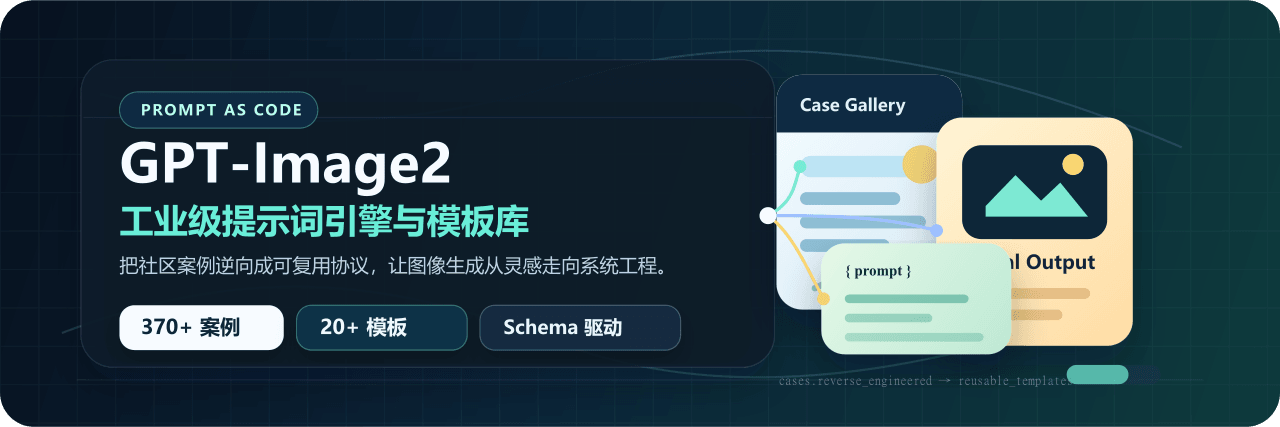
Prompt as Code | GPT-Image2 工业级提示词引擎与模板库,530+ 个案例逆向工程,20+ 套工业级模板,并提炼出Skills,持续更新中
freestylefly/awesome-gpt-image-2
Prompt as Code | GPT-Image2 工业级提示词引擎与模板库,530+ 个案例逆向工程,20+ 套工业级模板,并提炼出Skills,持续更新中
-
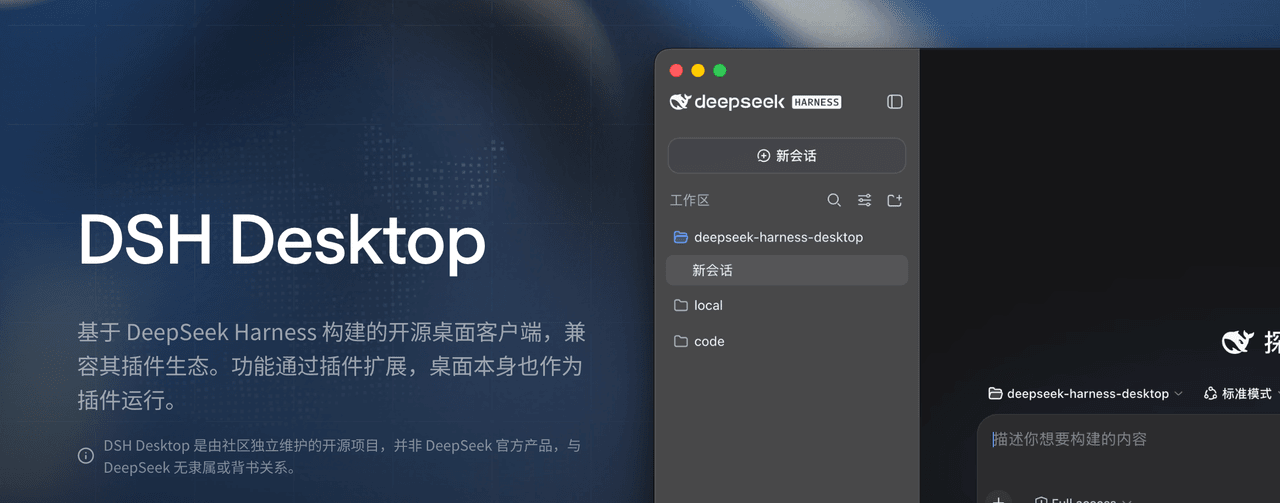 anywhere-labs/dsh-desktop
为 DeepSeek Harness (DSH) 插件生态打造的现代化桌面端解决方案。万物皆「插件」,桌面本身也是「插件」。
anywhere-labs/dsh-desktop
为 DeepSeek Harness (DSH) 插件生态打造的现代化桌面端解决方案。万物皆「插件」,桌面本身也是「插件」。
- Nagi-ovo/voyager Enhancement suite for Gemini, AI Studio, Claude & ChatGPT — plus a prompt manager for any web UI, DeepSeek Harness inclu…
-
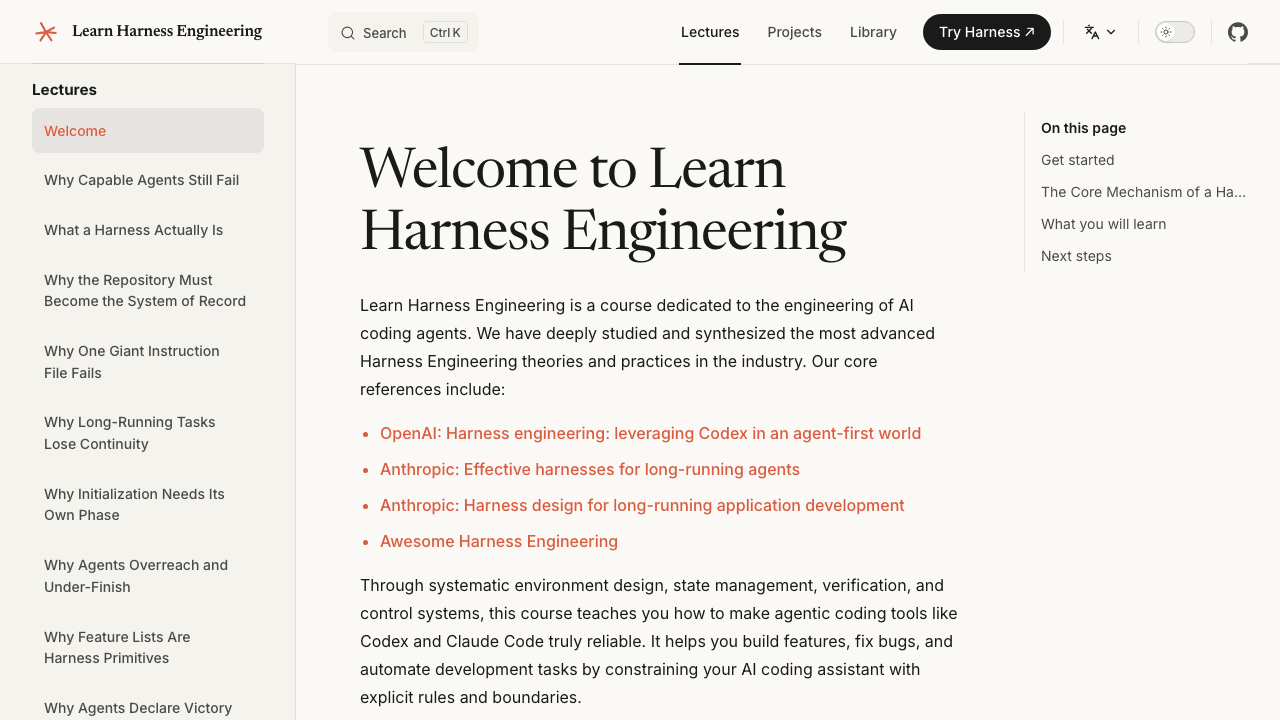 walkinglabs/learn-harness-engineering
Harness engineering beginner tutorial, from 0 to 1
walkinglabs/learn-harness-engineering
Harness engineering beginner tutorial, from 0 to 1
-
 awesome-dsh-plugin/awesome-dsh-plugin
A curated list of plugins for DeepSeek Harness (dsh) · DeepSeek Harness 插件精选列表
awesome-dsh-plugin/awesome-dsh-plugin
A curated list of plugins for DeepSeek Harness (dsh) · DeepSeek Harness 插件精选列表
-
 MemTensor/MemOS
Self-evolving memory OS for LLM & AI Agents: ultra-persistent memory, hybrid-retrieval, and cross-task skill reuse, with…
MemTensor/MemOS
Self-evolving memory OS for LLM & AI Agents: ultra-persistent memory, hybrid-retrieval, and cross-task skill reuse, with…
- yjh051108/dsh-routing-suite dsh-routing-suite — injector + router-standard kit: install the runtime injector first, then the task-aware reasoning-mo…