myYangyunfan/dsh_cardian
cardian — DeepSeek Harness knowledge-center plugin: RepoWiki notes / flashcards / memory in a local Obsidian vault
Project Overview项目介绍
dsh_cardian is a Cordis plugin built specifically for the DeepSeek Harness (DSH) desktop client, designed to reproduce the "Knowledge Center" capability model found in mainstream agentic IDEs. It is organized around three pillars: RepoWiki, which scans local code repositories to generate a Wiki skeleton that an agent later back-fills with semantic descriptions; Knowledge Cards, which store atomic knowledge units as Markdown files with YAML frontmatter, grouped by category and tag; and Memory, a cross-session persistent memory layer scoped by project, importance, and fact type. Every artifact is persisted as a standard Markdown file inside a local Obsidian vault, so the graph view in Obsidian can natively link cards, memories, and wiki pages together.
The installation flow begins with cloning the repository, running npm install (which triggers the prepare script to build the React/TypeScript sidebar client into lib/client.js), and then loading the package into DSH via npm install dsh-cardian inside the host, after which the insert line from cordis.patch.yml is merged into the active profile and a "🌳 知识树 / Knowledge Tree" entry appears at the bottom of the left sidebar. The plugin is aimed at developers and researchers who want long-term project knowledge accumulation, cross-session memory reuse, and Obsidian-driven graph exploration; an autonomous CLI (node cli.mjs) and an examples/demo.mjs seeder are also shipped so the engine can run without the DSH host as a standalone local knowledge base.
Dependencies are minimal: Node.js plus npm pulls in react, tsdown, and typescript automatically, and the node:test suite covers the core engine, the DSH adapter layer, path-safety checks, and round-trip integrity. The project is MIT-licensed and includes a docs/research subfolder that codifies the official DSH plugin contract, the Cordis field hierarchy, and cross-framework adapter patterns (MCP, A2A, OpenAI, LiteLLM, vLLM). First-run caveats include manually merging the cordis.patch.yml snippet, and the optional "Condense" AI enrichment requires the host to expose an agents service; when that service is missing the skeleton is still produced and can be filled in later.
dsh_cardian 是一款专为 DeepSeek Harness(DSH)打造的 Cordis 插件,名为 "cardian",致力于在 DSH 桌面端复刻主流代理式 IDE 的"知识中心"能力模型。核心围绕三大支柱:RepoWiki 扫描本地代码仓库生成 Wiki 骨架并由 Agent 回填语义描述;Knowledge Cards 以原子化的 Markdown+YAML 文件承载可分类检索的知识单元;Memory 实现跨会话持久化记忆,按 scope 区分事实与重要性。所有内容均落地为本地 Obsidian 仓库中的标准 Markdown 文件,可直接打开、检索与图谱化。
安装方式为克隆仓库后执行 npm install(自动构建客户端),随后在 DSH 桌面对该目录运行 npm install dsh-cardian,并将 cordis.patch.yml 中的 insert 行合并至当前 profile,左侧栏底部即出现"🌳 知识树 / Knowledge Tree"入口。典型工作流面向需要长期沉淀项目知识、跨会话复用记忆、并希望借助 Obsidian 图谱关联的开发与研究用户;项目还提供独立 CLI(node cli.mjs)与 demo 脚本,可在无 DSH 主进程时作为纯本地知识库使用。
依赖方面仅需 Node.js 与 npm(自动安装 react、tsdown、typescript),通过 node:test 覆盖核心、适配层与路径安全;项目以 MIT 协议开源,并附带 docs/research 子目录系统梳理 DSH 官方插件契约、Cordis 框架字段层级与跨框架适配器模式。首启需手动合并 cordis.patch.yml 的 insert 片段,AI 凝练功能依赖宿主提供 agents 服务,缺失时仅生成骨架。
请帮我安装这个 DSH 插件。安装前先完成【兼容性检查 + 安全性检查】,检查通过再动手。

插件:dsh_cardian(myYangyunfan/dsh_cardian)
仓库:https://github.com/myYangyunfan/dsh_cardian
本站详情页:https://www.yhbd.top/plugins/myyangyunfan-dsh-cardian/
本站登记:类型 plugin · 归类 原生 DSH 插件 · 许可证 MIT · ⭐ 2 · 最近提交 2026-09-02 · 主语言 JavaScript

按下面顺序执行,每步先把结论告诉我,再进入下一步:

【1 兼容性检查】
① 我这边:DSH 版本、Node 版本、操作系统、当前 profile(web / desktop)。
② 读它的 README、package.json、插件 manifest,列出它要求的 DSH 版本 / Node 版本 / 操作系统 / 外部依赖 / 需要另外先装的运行时。
③ 逐条比对,结论只写「满足 / 不满足 / 未知」三种;不满足的给出可行替代方案。
④ 检查是否和我已装的插件冲突:命令名重复、skill / tool 重名、端口占用、重复注册的 MCP server。

【2 安全性检查】
① 仓库可信度:和上面「本站登记」是否一致;star / fork 数、创建时间、最近提交,是否归档或长期停更。
② 安装脚本:逐行看 package.json 的 preinstall / install / postinstall,以及 install.sh、setup.ps1 之类脚本。出现 curl|bash、下载后直接执行、混淆代码、访问与插件功能无关的域名,立刻停下来告诉我,不要继续装。
③ 依赖:列出新增依赖,标出无人维护、或与知名包拼写近似的可疑包(typosquatting)。
④ 权限与副作用:它会读写哪些目录、访问哪些域名、需要哪些 DSH 权限(filesystem / network / shell / clipboard 等),以及怎么卸载和回滚。
⑤ 如果它要求 sudo / 管理员权限,或权限明显超出功能所需,先停下来问我。

【3 安装】
上面两步没有「不满足」和「高危项」时才执行;用官方推荐方式安装,不要自行提权。

【4 汇报】
用表格输出:检查项 / 结论 / 依据 / 是否需要我决策。拿不准的一律写「未知」并说明要我怎么确认——不要猜,也不要替我决定。
Send this message to DSH in your current session: it verifies compatibility and security first (answering met / not met / unknown item by item) and only installs once everything checks out — it will stop and ask you if it finds a high-risk item. The box scrolls; the copy is the full prompt. CLI install commands may not be accurate across systems, so DSH is the safer route.把上面这条消息直接发给当前会话里的 DSH:它会先核对兼容性与安全性(逐条给「满足 / 不满足 / 未知」),确认没问题再安装,有高危项会停下来问你。框内可滚动,复制到的是完整提示词;安装命令不一定准确,发给 DSH 更稳。
- Only 2 stars - very few users, little community feedback星标只有 2,几乎没人在用,遇到问题缺少社区反馈
DSH walks through these 9 checksDSH 会逐条核对这 9 项
Compatibility兼容性
- DSH, Node, OS and profile requirementsDSH 版本 / Node 版本 / 操作系统 / profile 是否满足要求
- External dependencies and runtimes (Electron / Python / Docker, ...)外部依赖与运行时(Electron / Python / Docker 等)是否齐备
- Conflicts with installed plugins: command names, skill / tool names, ports, duplicate MCP registration与已装插件是否冲突:命令名、skill / tool 重名、端口占用、重复 MCP 注册
Security安全性
- Repo matches the facts registered here; archived or abandoned?仓库是否与页面登记一致,是否归档或长期停更
- Safety of preinstall / install / postinstall and install.sh / setup.ps1preinstall / install / postinstall 与 install.sh、setup.ps1 是否安全
- curl|bash, download-then-execute, obfuscation, unrelated domains → stop immediatelycurl|bash、下载即执行、混淆代码、无关域名 → 立刻停止
- Typosquatting or unmaintained packages among the new dependencies新增依赖里有没有 typosquatting 或无人维护的包
- Requested permissions vs. what the feature actually needs申请了哪些权限、是否超出功能所需(filesystem / network / shell / clipboard)
- Any sudo / admin requirement, plus uninstall and rollback是否要求 sudo / 管理员权限,以及卸载与回滚方式
Anything uncertain must be marked unknown with a note on how to confirm it. This site's signal screen is a static snapshot, not a security audit.拿不准的必须标「未知」并说明要我怎么确认。本站的信号筛查是静态快照,不能替代安全审计。
Or use CLI install (for developers)或使用命令行安装(适合开发者)
CLI Install命令行安装
dsh plugin --profile web add github:myYangyunfan/dsh_cardian把 myYangyunfan/dsh_cardian 加入你的 DSH 配置(web profile)即可启用。
READMEREADME
cardian · DeepSeek Harness Knowledge-Center Plugin
English · 中文 (简体)
A DeepSeek Harness (dsh) plugin that reproduces the "Knowledge Center" capability model of mainstream agentic IDEs. RepoWiki / Knowledge Cards / Memory — all internalized and persisted into a local Obsidian vault: every knowledge card, every memory, every RepoWiki page is a Markdown file with YAML frontmatter, ready to be opened, searched, and graphed in Obsidian.
Engineering-wise it benchmarks against open-source practices such as basic-memory, 12-factor-agents, claude-obsidian (see the 10 iterations in ITERATIONS.md).
Quick Start (plug & play)
git clone https://github.com/myYangyunfan/dsh_cardian.git
cd dsh_cardian
npm install            # installs react + tsdown + typescript, auto-builds the client (prepare script)
npm test               # test suite all green
npm run build:client   # manually build the sidebar UI → lib/client.js (install usually does this)
As a dsh plugin: install dsh-cardian into dsh desktop (npm install <this dir> or npm install dsh-cardian) and merge the insert line from cordis.patch.yml into the active profile; a 「🌳 知识树 / Knowledge Tree」 entry appears at the bottom of the left sidebar. See docs/dsh-integration.md.
Standalone (pure local knowledge base, no dsh host):
node cli.mjs status --vault ./cardian-vault
node cli.mjs card add "Closure" "closure = function + lexical environment" --tags js
node examples/demo.mjs      # seeds a demo vault; open ./cardian-vault in Obsidian
The Three Pillars
| Feature | Directory | Role | Tools |
|---|---|---|---|
| RepoWiki | Repos/ |
Scans local code repos to build a Wiki skeleton; agent back-fills semantic descriptions | cardian.wiki.* |
| Knowledge Cards | Cards/ |
Atomic knowledge units grouped/retrieved by category & tags | cardian.card.* |
| Memory | Memory/ |
Cross-session persistent memory grouped by scope; facts / importance | cardian.memory.* |
Cross-section tools: cardian.recall (budgeted recall), cardian.search (keyword + semantic hybrid), cardian.tagCloud, cardian.backlinks, cardian.related, cardian.doctor/schema/reindex, cardian.export/import/importMarkdown, cardian.status; two-way sync & code graph via cardian.wiki.sync/graph; layered skill export via cardian.skill.export; memory promotion via cardian.memory.promote.
Showing the opening section of the README — the full document lives in the repository以上为 README 开头摘要,完整文档在仓库内 · View the full README on GitHub →在 GitHub 查看完整 README →
Related相关推荐
- justhalfbit/dsh-plugin-memory DeepSeek Harness (DSH) 跨会话记忆插件:对话模型边干边记的 Markdown 项目记忆,支持专题文件渐进式披露、可选后台静默蒸馏、按项目隔离与热更新设置面板。机制对齐 Claude Code auto memory。 …
- YanKaFei/kitten-punch-screenwriting kitten-punch-screenwriting,是生产级中文编剧创作与剧本诊断系统,覆盖概念超短片、短片、电影长片、剧集/连续剧与竖屏短剧/微短剧。内置主角驱动因果、场景价值转折、潜台词、中文去AI味、故事状态机、人物知识边界、关系连…
- lovezi0/dsh-memory-palace 把 WorkBuddy 的文件式记忆系统移植进 [DeepSeek Harness](https://www.deepseek.com/harness/) —— 为 Harness 提供**跨会话持久化、人类可直接编辑的 Markdown …
- Adkid-Zephyr/Liltloom 语织:中文优先、用户可控的 AI 写作风格记忆层,让 AI 学会你的表达,需要时再调用。Chinese-first style memory for AI; DeepSeek Harness adapter included.
- AlowEnsoul/dsh-rag-kb DeepSeek Harness 本地 RAG 知识库插件:本地文档切片、向量化、语义检索,全程本地运行(Ollama + 纯前端/主机端)。A local-first RAG knowledge base plugin for DeepS…
-
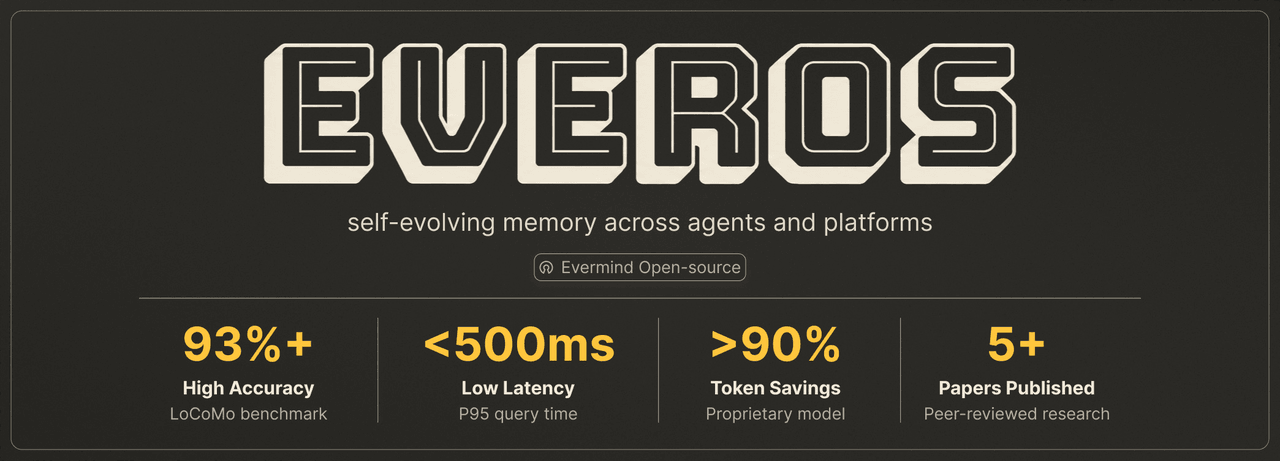 EverMind-AI/EverOS
One portable memory layer for every AI agent: local-first, Markdown-native, user-owned, and self-evolving across apps, t…
EverMind-AI/EverOS
One portable memory layer for every AI agent: local-first, Markdown-native, user-owned, and self-evolving across apps, t…
-
 MemTensor/MemOS
Self-evolving memory OS for LLM & AI Agents: ultra-persistent memory, hybrid-retrieval, and cross-task skill reuse, with…
MemTensor/MemOS
Self-evolving memory OS for LLM & AI Agents: ultra-persistent memory, hybrid-retrieval, and cross-task skill reuse, with…
-
 plastic-labs/honcho
Memory library for building stateful agents
plastic-labs/honcho
Memory library for building stateful agents