oil-oil/dsh-vision
DeepSeek Harness的近原生图像理解能力
项目介绍Project Overview
dsh-vision 是 DeepSeek Harness 的视觉插件。当主模型支持图像时,原图直传不做预处理;若选用 deepseek-official 等纯文本模型,则由配置的视觉模型观察原图,其输出作为不可信附件上下文注入,再由 DeepSeek 生成最终回答。图像可联合分析,支持云端与本地 OCR 兜底。密钥只入、不可回读。注意本地回退主要依赖 OCR,不等同于完整多模态理解。
dsh-vision is a plugin for DeepSeek Harness that bridges vision capability into text-only models. When the main model supports images, originals pass through natively with no preprocessing or OCR. When the model is text-only, a configured vision model observes the images and its output is injected as untrusted attachment context for DeepSeek to produce the final answer. Multi-image inputs are analyzed jointly. Supported providers include ZenMux, Alibaba Cloud Model Studio, TokenDance, and OpenRouter, with macOS Vision or Tesseract as local fallback. API keys are write-only in the UI and never read back. Caveat: local fallback is OCR-based and is not equivalent to full multimodal understanding.
请帮我了解并安装插件:【dsh-vision】【https://github.com/oil-oil/dsh-vision】把上面这条消息直接发给当前会话里的 DSH,让它帮你了解并安装。安装命令不一定准确,发给 DSH 更稳。Send this message to DSH in your current session. CLI install commands may not be accurate across systems — DSH will figure it out for you.
或使用命令行安装(适合开发者)Or use CLI install (for developers)
命令行安装CLI Install
npx @deepseek-ai/dsh plugin --profile web add github:oil-oil/dsh-vision把 oil-oil/dsh-vision 加入你的 DSH 配置(web profile)即可启用。
READMEREADME
English | 中文



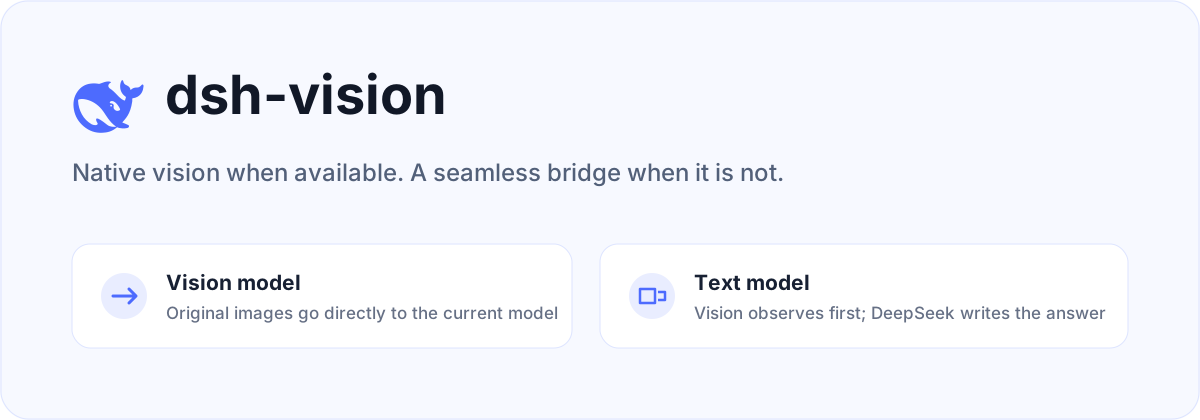
dsh-vision is a plugin for DeepSeek Harness. Vision-capable models keep receiving images natively. When the selected main model is text-only, the plugin asks a separate vision model to observe the original images, then lets the original DeepSeek model produce the final answer.
How it works
| Main model | Image path | Final answer |
|---|---|---|
| Supports images | Original images are sent directly, without preprocessing or OCR | Current model |
deepseek-official or another text-only model |
A configured vision model observes the original images; its output is injected as untrusted attachment context | DeepSeek |
| Cloud vision unavailable | Falls back to macOS Vision or Tesseract | DeepSeek |
The plugin does not replace the main model selected in Harness. Multiple image attachments are analyzed together, so comparisons and combined evidence work naturally. The user's task is forwarded unchanged instead of being wrapped in a fixed report template.
Install
Use the plugin manager built into DeepSeek Harness:
npx @deepseek-ai/dsh plugin --profile web add github:oil-oil/dsh-vision
Restart Harness, then paste or drag images into the composer as usual. The plugin replaces the official deepseek-official adapter while preserving its model catalog, settings, and credentials. It also adds a Vision Recognition card to Settings → Plugins → Plugin configuration.
DeepSeek Harness is still in Developer Preview. This release supports
0.1.0-rc.6and0.1.0-rc.7; its settings-card registration satisfies both the legacy list Slot and the current keyed Slot without relying on private runtime inspection.
Configure Vision Recognition
Open Settings → Plugins → Plugin configuration → Vision Recognition. Select ZenMux, Alibaba Cloud Model Studio, TokenDance, or OpenRouter, then enter its API key. The same card lets you change the model ID, API endpoint, and image limit.
The API key is stored through Harness's official credential service. It is write-only in the browser: the plugin can report whether a key exists, but never reads it back into the page, chat, settings document, or session log.
Routing follows the user's choice. A provider selected in Vision Recognition is primary for text-only models. Other enabled Harness vision routes, an existing see configuration, and local OCR are failover only. When the current main model supports images, the original images pass through natively and none of these bridge routes are used.
Choose Automatic to skip plugin-managed cloud credentials. The bridge then tries image-capable models already configured in Harness, followed by see-compatible private configuration and local OCR. A Harness custom model must declare image as an input modality or it remains a text model.
Advanced file configuration
Most setups should use the UI. The equivalent non-secret fields live in the existing llm-deepseek section of $DSH_HOME/settings.yaml:
llm-deepseek:
  visionBackend: zenmux
  visionBackendModel: qwen/qwen3.7-plus
  visionBackendBaseURL: https://zenmux.ai/api/v1
  maxImages: 8
Do not put API keys in this file. Save them in the Vision Recognition card or provide the matching environment variable. Changes apply without a restart.
see-skill compatibility
If Harness has no usable vision model, the plugin also reads ~/.config/see/config.env. It supports ZenMux, Alibaba Cloud Model Studio, OpenRouter, and TokenDance. Environment variables override the private config file.
export SEE_PROVIDER=zenmux
export ZENMUX_API_KEY=your-key
SEE_PROVIDER selects the primary provider. Other providers with configured keys are failover routes only. If no provider is selected and only one is configured, that provider is used.
When no cloud key is available, or every cloud route fails, the plugin tries local capabilities:
- macOS: built-in Vision OCR, with no extra dependency.
- Linux / Windows: Tesseract with the required language data installed.
Local fallback is primarily OCR and is not equivalent to full multimodal understanding.
Security boundary
- Original images are sent only to vision services configured by the user.
- Vision output is marked as untrusted observation data; instructions inside an image receive no system authority.
- Generated vision context affects only the current model request and does not rewrite message history.
- API keys are resolved through Harness credentials or the user's private see config and are never written to this repository.
Development
pnpm install
pnpm check
The project is available under the MIT License. Cloud routing, joint multi-image analysis, and local fallback behavior are based on the MIT-licensed oil-oil/see-skill. The DeepSeek icon comes from the official deepseek-ai/deepseek-harness repository.
相关推荐Related
-
 nexu-io/open-design
🎨 Best DeepSeek Harness Design Plugin. The open-source Claude Design alternative. 🖥️ Local-first desktop app. 🖼️ Your…
nexu-io/open-design
🎨 Best DeepSeek Harness Design Plugin. The open-source Claude Design alternative. 🖥️ Local-first desktop app. 🖼️ Your…
-
 ruvnet/ruflo
🌊 The original agent meta-harness. Deploy intelligent multi-player swarms, coordinate autonomous workflows, and build c…
ruvnet/ruflo
🌊 The original agent meta-harness. Deploy intelligent multi-player swarms, coordinate autonomous workflows, and build c…
-
 amruthpillai/reactive-resume
A one-of-a-kind resume builder that keeps your privacy in mind. Completely secure, customizable, portable, open-source a…
amruthpillai/reactive-resume
A one-of-a-kind resume builder that keeps your privacy in mind. Completely secure, customizable, portable, open-source a…
-
 volcengine/OpenViking
Self-evolving Context Database for AI Agents. Unify Agent Memory, Knowledge RAG and Skills.
volcengine/OpenViking
Self-evolving Context Database for AI Agents. Unify Agent Memory, Knowledge RAG and Skills.
-
 Molunerfinn/PicGo
:rocket: The Ultimate Image Uploader for Efficient Creators. Supports Obsidian, Typora, VS Code etc. and 60+ image hosti…
Molunerfinn/PicGo
:rocket: The Ultimate Image Uploader for Efficient Creators. Supports Obsidian, Typora, VS Code etc. and 60+ image hosti…
-
 titanwings/colleague-skill
将冰冷的离别化为温暖的 Skill,欢迎加入数字生命1.0!Transforming cold farewells into warm skills? It's giving rebirth era. Welcome to Digital …
titanwings/colleague-skill
将冰冷的离别化为温暖的 Skill,欢迎加入数字生命1.0!Transforming cold farewells into warm skills? It's giving rebirth era. Welcome to Digital …
-
 nocobase/nocobase
NocoBase is an open-source AI + no-code platform for building business systems fast. Instead of generating everything fr…
nocobase/nocobase
NocoBase is an open-source AI + no-code platform for building business systems fast. Instead of generating everything fr…
-
 Tencent/WeKnora
Open-source LLM knowledge platform: turn raw documents into a queryable RAG, an autonomous reasoning agent, and a self-m…
Tencent/WeKnora
Open-source LLM knowledge platform: turn raw documents into a queryable RAG, an autonomous reasoning agent, and a self-m…