Rianico/dsh-better-edit
用于DeepSeek Harness(dsh)的哈希锚定读取/编辑/批量编辑/撤销上次编辑工具——pi-hashline-edit-lsz的dsh移植版
项目介绍Project Overview
dsh-better-edit 是 DeepSeek Harness 的编辑插件,基于哈希锚点定位执行文件修改。核心能力:用 3 字符内容哈希替代行号与字符串匹配,原子批量编辑,失败时返回拒绝并附新锚点供重试。适用场景:长会话、多轮重构、外部漂移后的代码改动。注意事项:仅支持已读取行,未读取的编辑会被拒;空白不敏感但字符串内空格不区分;不适用于单行小改与新文件。
dsh-better-edit is a DeepSeek Harness plugin for file editing via hash-anchored positioning. Core capability: replaces line numbers and string matching with 3-character content hashes, supports atomic batched edits up to 32, and returns fresh anchors for retry on failure. Use it for long sessions, multi-step refactors, and edits after external drift. Caveat: only lines previously served can be edited, whitespace-insensitive anchors do not distinguish spaces inside string literals, and the plugin offers little advantage for one-line tweaks or new files.
请帮我了解并安装插件:【dsh-better-edit】【https://github.com/Rianico/dsh-better-edit】把上面这条消息直接发给当前会话里的 DSH,让它帮你了解并安装。安装命令不一定准确,发给 DSH 更稳。Send this message to DSH in your current session. CLI install commands may not be accurate across systems — DSH will figure it out for you.
或使用命令行安装(适合开发者)Or use CLI install (for developers)
命令行安装CLI Install
npx @deepseek-ai/dsh plugin --profile web add dsh-better-edit把 Rianico/dsh-better-edit 加入你的 DSH 配置(web profile)即可启用。
READMEREADME
dsh-better-edit
A better edit tool for DeepSeek Harness
Powered by hash‑anchored positioning — not by line numbers, not by string replacement, fewer tokens, more context space for real work.
English · 简体中文



Quick Start • Why Hashline • Tools • Comparison • How Anchors Work • Development • Acknowledgments







"The harness — not the model — is the bottleneck." — Can Bölük, The Harness Problem
This is the harness fix. Content hashes replace line numbers — an edit above never shifts the anchor below. Every range is verified against what the agent actually saw. Stale or unseen lines are hard-rejected with fresh anchors to retry — no
readneeded.3 tool calls vs 6 · -55.8% tokens · 23/23 correctness. Same external-drift refactor, same correct file (single stochastic run vs OMP; full method). Benchmark envelope numbers are deterministic — see Benchmark.
Why you need this
If you've watched an agent corrupt a file because line 47 became line 74 after an insert — this is for you.
Before: str_replace / line numbers |
After: hashline edit |
|---|---|
| Model re-types old code (output billed ~5-6× input) | Sends two 3-char hashes — old text is never echoed |
| One insert above shifts every number below → wrong line lands silently | Anchors are content addresses → edits above don't move anchors below |
| No check that the range matches what was shown | Every line verified against served rows; [E_RANGE_STALE]/[E_RANGE_UNSERVED] reject before any write, then reject-and-serve returns fresh HASH│content to retry |
[!TIP] Shining points — honest and measured:
- Self-healing, not silent. External edits never get overwritten — stale ranges are rejected and re-served as fresh
HASH│contentto retry; orphaned serves heal without a full re-read (ADR-0008). Fail-closed, not auto-merge.- Formatter-tolerant. ASCII-whitespace-insensitive anchors survive
prettier/black/eslint --fixbetween edits (formatOnSave, watcher, CI). Linter-only assumption — whitespace inside string literals is not distinguished (ADR-0005).- Chained & batched, no re-read ritual. Anchors for untouched lines stay valid; diff/echo/reject rows count as serves.
editbatches up to 32 same-file edits atomically ([E_BATCH_ABORT]), ~-40% envelope vsstr_replaceon the pinned 12-edit corpus.- Read guard enforced. Never edits what it hasn't seen —
[E_RANGE_UNSERVED]/[E_RANGE_UNVERIFIED]/[E_STALE_ANCHOR]reject before any write, thenreject-and-serve.- Fewer round-trips in practice. Dated run: 3 calls vs 6 for the OMP wrapper on the same external-drift refactor, same correct file; envelope vs
str_replaceis the durable number — reproducible via the upstream battery (same hashline algorithm, method). Correctness23/23deterministic.
Not for one-line touch-ups (near parity) or brand-new files (write). It pays off in long sessions and structural edits — anywhere an edit must not land on the wrong line.
Deep dive: Why Hashline · Comparison · Benchmark
Quick Start — from install to verified edit in 30s
Install (pick one)
npx @deepseek-ai/dsh plugin --profile web add github:Rianico/dsh-better-edit   # from github
npx @deepseek-ai/dsh plugin --profile web add dsh-better-edit   # from npm
npx @deepseek-ai/dsh plugin --profile web add /path/to/dsh-better-edit   # from a local checkout
No config. The profile's next session runs with the hashline tools installed. To verify the layer is active:
dsh --profile <name> --dump-config # shows a "# == dsh-better-edit" layer
| Requirement | |
|---|---|
| Node | ^22.19.0 || >=24.0.0 (dsh's requirement; the store uses node:sqlite) |
| Profile | a dsh profile (dsh plugin initializes one on first use) |
| Backends | sandboxed / remote filesystems supported (writes go through ctx.fs) |
See it work
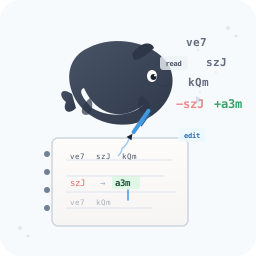
read returns every line prefixed by its hash — the hash is the line's address:
ve7│function hello() {
szJ│  console.log("world");
kQm│}
edit targets a range of hashes, so edits always land on the lines you meant:
{ "path": "src/main.ts", "edits": [["szJ", "szJ", " console.log('hi');"]] }
and returns a diff with fresh anchors, so the next edit verifies cleanly with no re-read:
- szJ │   console.log("world");
+ a3m │   console.log('hi');
  kQm │ }
Chained edits stay cheap — anchors for untouched lines remain valid, diff/echo rows count as serves, and read becomes on-demand recovery, not a ritual. Try batching — one edit call, same-file, atomic:
{ "path": "src/main.ts", "edits": [["a1b", "a1b", "new line 1\n"], ["c3d", "c3d", "new line 2"]] }
One fails, none write ([E_BATCH_ABORT]).
[!TIP] Want proof before you install? The upstream 23/23 tool battery runs with no LLM — stale edits are rejected before they corrupt a file, on every run. Same hashline algorithm, same verification.
Configuration
Tenancy and prompt guidance are both declared once, read at agent/session-start, and need no code changes.
Store tenancy — central by default
The store lives at $DSH_HOME/plugins/dsh-better-edit/runtime/<name>-<hash8>/ by default (central).
[!NOTE] DB files are disposable caches — they are rebuilt automatically on the next
read(hashes are re-derived from file content). Feel free torm -rfanyruntime/<name>-<hash8>/orhash-store.sqlite*to reclaim disk; no user data is lost (only anchor history and undo snapshots).
To opt into legacy co-location or a custom root:
# $DSH_HOME/plugins/dsh-better-edit/config.yaml
storeDir: central              # where the store lives: "central" (default, in $DSH_HOME/.../runtime/<name>-<hash8>/) | "workspace" (legacy <ws>/.dsh_better_edit/) | "/abs/path" (custom root)
autoGitignore: false           # workspace only: when .git exists but .gitignore lacks .dsh_better_edit/, true = auto-append ".dsh_better_edit/", false = warn once
undo_ttl_s: 604800             # undo history TTL in seconds; -1 = keep forever (default 604800 = 7 days)
storeMaxAgeS: 2592000          # central janitor: max idle age in seconds before a runtime/<name>-<hash8>/ dir is evicted (default 2592000 = 30 days)
storeMaxTotalBytes: 524288000  # central janitor: max total bytes under runtime/ before LRU eviction (default 524288000 = 500 MB)
[!TIP] If the file does not exist, a default
config.yamlwith commented defaults is generated on first boot (never overwrites an existing file).
Env overrides yaml (env > yaml > central), malformed falls back to central with a warning:
DSH_BETTER_EDIT_STORE_DIR=central|workspace|/abs
DSH_BETTER_EDIT_AUTO_GITIGNORE=true|false  # case-insensitive
runtime/<name>-<hash8>/ is ls-readable with a .wsPath sidecar. See docs/specs/issue-24-store-tenancy.md for lifecycle (janitor mtime>storeMaxAgeS then LRU, WAL checkpoint, undo TTL).
Guidance per preset
The tool:read / tool:edit / tool:undo_last_edit prompt sections are plain-markdown files per agent preset, overridable without touching the plugin:
$DSH_HOME/plugins/dsh-better-edit/<preset>/<section>.md
(default home ~/.dsh, so ~/.dsh/plugins/dsh-better-edit/). The section table:
| File | Section | Default order |
|---|---|---|
read.md |
tool:read |
130 |
edit.md |
tool:edit |
131 |
undo_last_edit.md |
tool:undo_last_edit |
133 |
On first boot the plugin seeds the three shipped presets — standard/, code/, minimal/, cordis/ — each with the compiled guidance as editable files (plus order front-matter). See Configuration details for reset/restore. Full spec: docs/specs/issue-24-store-tenancy.md and guidance docs.
Reset / restore defaults
Emptying or deleting an override file restores that section's compiled default guidance and order: the default renders at session-start, and the file re-seeds at next boot.
- Reset = delete the file, or empty it AND remove the front-matter fence. A whitespace-only file with no fence means "I want the default" — the compiled default renders, and the file re-seeds at next boot for any preset dir, shipped or custom.
- Blank on purpose = keep a valid fence. Any well-formed
---fence — even a keyless---\n---\n, even an empty body — is a deliberate-intent signal: the file is explicit content and is never reset or re-seeded. - Broken fence = fast fail. A
---fence that does not parse (missing closing---, non-integerorder, unknown key) is rejected: the malformed text is never injected into the context, the compiled default renders, a warning names the file and the reason, and the file is left untouched on disk for repair. - Shipped vs custom. Shipped preset files (
standard,code,minimal,cordis) re-seed at boot; a deleted custom-preset override stays absent — absence is no override. Deleting a whole<preset>/directory re-seeds all three section files at boot (shipped presets). - Reset restores the current bundle defaults — a plugin upgrade yields new defaults.
Re-seeding happens at boot, never mid-session.
Why Hashline
Correctness, not just brevity. Every resolved edit range is verified against the
served rows — what read, a post-edit diff, or a rejection echo actually showed the model.
A line inside the range that changed on disk since it was served, or was never served, is
hard-rejected before any file I/O: [E_RANGE_STALE] / [E_RANGE_UNSERVED] /
[E_RANGE_UNVERIFIED], and the current range is echoed as fresh HASH│content rows. The
retry needs no read. Served state is session-scoped, so sub-agent serves never validate the main session's edits and vice versa.
Content-addressed anchors. Anchors are derived from line content (ASCII-whitespace
stripped), not position: edit one part of a file and the hashes of the rest stay put, so
chained edits need no re-reads. Re-inserting identical text keeps its hash — "edit X with
X" doesn't rotate the anchor. Anchors are unique by construction — repeated } or
import lines never share one.
Chained edits without re-reading. Post-edit diff rows, auto-read rows, and rejection
echoes all count as serves. read is on-demand recovery, not a per-edit ritual.
Stop the loop. A no-op edit reports No changes made and leaves anchors alone; the
same no-op re-sent three times is refused ([E_NOOP_LOOP]). edit applies up to 32
edits atomically — any stale item aborts the whole batch with [E_BATCH_ABORT].
Token economics: envelope savings
The compact JSON contract is primarily a token-saving envelope change. It removes repeated field names and escaped wrapper syntax while leaving the verified edit semantics unchanged:
editis one uniform payload:{ "path": path, "edits": [[from, to, replacement], …] }—pathhoisted, arity byedits.length;- replacement text is emitted once, and the old text is never repeated in the call.
Theoretical benchmark — serialized envelopes
This benchmark counts only the serialized edit payloads, not model reasoning, tool descriptions, reads, retries, or cache traffic. Same hashline algorithm as upstream — numbers reproduced from pi-better-edit/benchmarks/results/ (pinned 12-edit corpus, cl100k_base):
| snapshot | str_replace |
pi/dsh-better-edit: edit |
pi/dsh-better-edit: edit (multi-item) |
OMP: per-edit | OMP: one batch |
|---|---|---|---|---|---|
| external pinned 12-edit corpus, current-envelope recount | 1,015 | 609 (-40.0%) | 582 (-42.7%) | 590 (-41.9%) | 480 (-52.7%) |
| local 12-edit configuration snapshot | 358 | 272 (-24.0%) | 241 (-32.7%) | 268 (-25.1%) | 180 (-49.7%) |
All percentages are savings against the str_replace value in the same row. The external row uses the pinned corpus, current object-root tuple envelopes, and current 3-character anchors. The local row is reproducible with npm run benchmark in the upstream repo; correctness is measured separately with the battery.
Practical benchmark — coding-agent session
This benchmark measures a real coding-agent loop rather than serialized envelopes. The practical advantage is round-trip efficiency: hashline completed the scenario in 3 tool calls, versus 6 for OMP. Upstream runs pi with opencode-go/gpt-5.6-luna at high thinking. Same algorithm downstream — we reference the upstream dated artifact:
| engine | tool calls | total tokens | saved vs OMP baseline | final correctness |
|---|---|---|---|---|
| OMP patch wrapper | 6 | 28,467 | 0.0% | ✅ |
hashline edit (multi-item) |
3 (fewest) | 12,593 | -55.8% | ✅ |
Both engines preserved the external change and produced the expected final file in this sample. This result is one stochastic model run; it must not be read as a universal performance claim. Latest dated artifact: 2026-08-17 practical token benchmark · hashline library battery · tool battery.
Scope & honesty. These numbers are payload + round-trip measures, not throughput claims. The benchmark payload is deterministic; the practical run is stochastic. Dated results live upstream in
benchmarks/results/; we do not re-run locally because the algorithm is identical.
Tools
| Tool | What it does |
|---|---|
read |
Returns a text file with every line as HASH│content. offset (1-based), limit. Paged output ends with [Showing lines N-M of T. Use offset=… to continue.]. Lines >200KB shown as a marker with a sed hint — hash anchors need full lines. |
read_skill |
Same file read as plain text — no HASH│ prefixes, no served rows. For skill content (SKILL.md or any file); records no serves, so editing a file read this way starts with a [E_RANGE_UNSERVED] serve on the first edit. |
edit |
An object-root payload { "path": path, "edits": [[remove_from, remove_to, replacement_text], …] }; the path may be null for anchor-based inference. A single item edits one range; several items batch same-file edits atomically (up to 32). Verifies every line of each inclusive range and reject-and-serve returns fresh anchors. |
undo_last_edit |
{ path } restores the most recent successful edit with its original content, BOM, line endings, and anchors; persisted across restarts. |
edit accepts { "path": path, "edits": [[remove_from, remove_to, replacement_text], …] }. The path
position is a non-empty string or null for unique anchor-based inference. Each range is inclusive,
and an empty replacement deletes the range. All items are checked before file I/O and applied
atomically to that one file — one item per call is the norm, several same-file items batch in one call.
Error codes
| Code | Meaning |
|---|---|
[E_BAD_SHAPE] |
The payload is not the fixed tuple shape, or a tuple member has an unknown, missing, or wrongly-typed value. |
[E_BAD_REF] |
An anchor in the inclusive range is not a bare 3-char hash. |
[E_STALE_ANCHOR] |
An anchor does not match any line in the current file; call read for fresh anchors. |
[E_AMBIGUOUS_ANCHOR] |
An anchor matches multiple lines; call read for fresh anchors. |
[E_INVALID_PATCH] |
A replacement_text line is a diff-preview row (+HASH│, -HASH│, - │). The marker is stripped automatically with a warning. |
[E_BARE_HASH_PREFIX] |
A replacement_text line starts with a hash-like HASH│ prefix. The prefix is stripped automatically with a warning. |
[E_BAD_OP] |
Range start line is after range end line. The pair is swapped automatically with a warning. |
[E_WOULD_EMPTY] |
An edit would empty a non-empty file; use write instead. |
[E_NOT_FOUND] |
The path does not exist. |
[E_ACCESS] |
The path is not readable or writable. |
[E_NOT_TEXT] |
The path is a directory, binary file, image, or UTF-16/UTF-32 encoded text; hashline editing only supports text files. |
[E_NOT_OBSERVED] |
The file has not been observed in this session (read-before-write); call read first. |
[E_UNDO_STALE] |
undo_last_edit refused: the file was modified or deleted after the last edit. |
[E_UNDO_UNAVAILABLE] |
Undo history could not be persisted to the hash store; the edit was refused and the file was left unchanged. |
[E_FILE_TOO_LARGE] |
The file exceeds the 238,328-line hashline limit. |
[E_RANGE_STALE] |
A line inside the resolved edit range changed on disk since it was served (read output, diff, or rejection feedback). The edit is refused and the current range is echoed as fresh HASH│content rows; retry with those rows (no read needed). |
[E_RANGE_UNSERVED] |
A line inside the resolved edit range was never served to the model (paged reads, truncated output). The edit is refused and the current range is echoed as fresh HASH│content rows. |
[E_RANGE_UNVERIFIED] |
A boundary anchor (remove_from/remove_to) has no served position or was served at multiple positions, so the range cannot be verified against served state. The edit is refused and the current range is echoed as fresh HASH│content rows. |
[E_NOOP_LOOP] |
The exact same edit (same path, anchors, and replacement) was re-sent and produced no changes 3 consecutive times — the range already contains the replacement. The edit is refused and the current range is echoed as fresh HASH│content rows. |
[E_BATCH_ABORT] |
A multi-item edit call was rejected as a whole: an item failed validation or served-state verification. Nothing was written; the failing item's current range is echoed as fresh HASH│content rows. |
Comparison
Capability comparison
| dsh-better-edit (this) | @oh-my-pi/hashline | str_replace (Claude Code / Codex) |
|
|---|---|---|---|
| Layer | dsh tools: read / read_skill / edit / undo_last_edit |
patch-engine library: Patcher / Patch / Filesystem / SnapshotStore |
built-in str_replace |
| Address format | HASH│ — 3-char content hash, no line number |
[path#tag] — full-file content tag + line numbers |
text match |
| Whitespace-insensitive anchors | ✅ all ASCII whitespace stripped — survives prettier/black/eslint --fix |
~ n/a (anchors are line numbers) | ❌ |
| Duplicate lines | ✅ unique per line (collision-resolved); ambiguity → [E_AMBIGUOUS_ANCHOR] |
~ position-based — repeats fine, position unverified | ❌ first occurrence |
| Verified against what the model saw | ✅ every resolved line, per session — [E_RANGE_STALE]/[E_RANGE_UNSERVED] reject before write |
~ seen-lines provenance + file-version tag (H7) | ❌ first match wins |
| Stale interior | ✅ reject + fresh anchors ([E_RANGE_STALE]) |
~ recovery-with-warning, else MismatchError |
❌ may overwrite |
| Blind edit — lines never shown | ✅ hard reject ([E_RANGE_UNVERIFIED] / [E_RANGE_UNSERVED]) |
~ reject when seen-lines recorded (H7) | ❌ |
| Batch atomicity | ✅ edit multi-item — all-or-nothing, [E_BATCH_ABORT] |
✅ multi-section preflight (H8) | ❌ |
| Undo (persisted) | ✅ survives restarts | ❌ none | ❌ |
| Sub-agent session isolation | ✅ session-keyed served state | ~ | — |
| Deterministic battery | ✅ 23/23 | ✅ 10/10 library (own seam) | — |
| Runtime | dsh (Node) | Bun ≥ 1.3.14 (TS source) | — |
~= occasionally / inconsistently.—= not specified / not applicable.
Different jobs, same lineage
Both this plugin and @oh-my-pi/hashline descend from the harness-problem insight that
the model should never re-type old code, but they are different layers.
@oh-my-pi/hashline is a patch-language library: [path#tag] headers bind every hunk
to a full-file content hash, PUT N.=M: addresses lines by number, and it ships multi-hunk
documents, a pluggable filesystem for any backend (disk, in-memory, network), and
session-aware 3-way-merge recovery on stale tags. Its payload per edit is lighter and it cannot
be confused by repeated text — the line number is unambiguous.
This plugin is a dsh tool pair: read hands the model 3-char content hashes, edit
takes two of them, and every resolved line is verified against the served state — no line
numbers to renumber, no tag to refetch, a wrong anchor can never land on the wrong line,
and undo_last_edit survives restarts. Its trade-offs: a JSON envelope per edit costs a
little payload, and it lives inside dsh (Node) rather than as a standalone patcher (Bun). Pick
hashline-the-library for a cross-backend patch format; pick hashline-the-tool for verified,
content-addressed edits in your agent. Syntax-aware structural edits and file-lifecycle operations
remain outside this verified line-range contract.
What you get
- Verified before it writes — every line of the resolved range is checked against served rows; stale or never-served interiors are hard-rejected (
[E_RANGE_STALE]/[E_RANGE_UNSERVED]/[E_RANGE_UNVERIFIED]) and re-served as fresh anchors. - Session-keyed — sub-agent serves never validate the main session's edits and vice versa.
- Drift notices — served territory outside the range that changed on disk is reported once per episode, not as a warning.
- Chained without re-reads — diff, auto-read, and rejection rows all count as serves.
- Atomic batch — up to 32 same-file edits in one
editcall, all-or-nothing with[E_BATCH_ABORT]. - Formatter-tolerant — ASCII-whitespace-insensitive anchors survive re-indents; unique by construction (bitset probing).
Correctness in edge cases
The battery below measures behavior, where the two hashline implementations actually diverge. These are the real failure modes from the harness-problem literature, and what each tool does when they hit:
| Edge case | hashline edit (this) |
@oh-my-pi/hashline patch |
|---|---|---|
| Wrong address (off-by-one anchor / line number) | Impossible — anchors resolve to specific lines; every resolved line is verified against served state, rejected before anything is written | Possible — a wrong line number against a current tag applies silently at the wrong place; the tag proves the file version, never the lines |
| File changed on disk after the model's view | Hard reject + fresh anchors echoed (reject-and-serve); retry needs no read |
Tag mismatch → refuse or best-effort 3-way merge onto unknown current content, with an explicit recovery banner |
| An edit above shifts the file | Nothing shifts — anchors are content addresses; the diff serves fresh anchors | Every edit renumbers — the format's own #1 rule is "re-ground after every edit"; the model carries the bookkeeping |
| Repeated / identical text | Per-line hashes are unique (collision-resolved); ambiguity → [E_AMBIGUOUS_ANCHOR] |
Position-based, so repeats don't confuse it — but the position itself is unverified |
| Lines never shown to the model | [E_RANGE_UNSERVED] — hard reject with fresh anchors |
Undisplayed hunks rejected when seen-lines are recorded — same reliance on the model knowing what it saw |
| Multi-edit batch fails mid-way | edit multi-item — atomic, all-or-nothing; the failing item is echoed as fresh serves |
Multi-section patches preflighted up front — also atomic |
The oh-my-pi payload saving is a lighter wire format; the table above is what that format asks the model to hold in its head instead — renumbering, tag-chasing — the exact component that fails most with replace-style edits. This plugin's contract is: a wrong edit cannot land, and any rejection needs no re-read. Both engines gate the same guarantee — stale edits are detected, never silently applied — with different policies when drift is found (recover-with-warning vs fail-closed rejection).
Reproducible benchmark
The claims above are measured, not asserted. Two deterministic batteries — no LLM in the loop, no sampling: a run either reproduces or it doesn't.
Tool battery — 23 scenarios (2026-08-17):
| vs expected verdict | correct | silent data-loss cases |
|---|---|---|
| dsh-better-edit (same algorithm as pi-better-edit 1.1.4) | 23/23 | 0 |
Reproduce via upstream: npm run eval in pi-better-edit (this plugin shares the hashline algorithm byte-for-byte). Library battery for @oh-my-pi/hashline is 10/10 separately.
Full method, per-scenario tables, and limitations: upstream benchmarks/README.md and benchmarks/results/.
See Configuration under Quick Start for guidance overrides and store tenancy.
How Anchors Work
Each line is canonicalized (all ASCII whitespace — spaces, tabs, carriage returns, and
line feeds — stripped) and hashed with xxhash-wasm
(xxHash32), then mapped to a 3-character string over A-Za-z0-9 — 62³ = 238,328 possible
anchors. Canonicalization keeps anchors stable across formatting passes and editor-save
cycles: a line that changes only in ASCII whitespace keeps its anchor, so external linting
between edits does not invalidate it. Everything that is not ASCII whitespace stays
significant — string contents, regex classes, comments, quotes, semicolons, and Unicode
whitespace (NBSP) all rotate the anchor. One caveat: ASCII whitespace inside string
literals and regexes is stripped too, so a whitespace-only change within a string is
invisible to verification — benign in practice because formatters never alter string
contents. Token-level edits (quote style, semicolons, brace placement) therefore still
reject as stale.
The alphabet is sized for an LLM consumer — the model tokenizes rather than squinting at
glyphs, so case and digits are all included. The URL-safe specials - and _ are
deliberately excluded: a hash starting with - is shape-identical to a diff-preview
deletion row, and -/_ at a line start are markdown-active, inviting mis-copying.
Anchors are unique by construction. If a line's base hash collides with an already-assigned
hash, the next free hash is allocated from a bitset by probing with a stride coprime to the
hash space (O(1) amortized; the stride is 62² + 62 + 1, so runs of blank lines or repeated
} land on anchors that differ in all three characters). Every line therefore gets a
unique anchor; two byte-identical lines never share one. The same guarantee sets the file
size cap: at most 238,328 lines per file, beyond which read and edit reject with
[E_FILE_TOO_LARGE] (use write for very large files).
Hashes live in a persistent per-file store
(<workspace>/.dsh_better_edit/hash-store.sqlite, honoring XDG_CONFIG_HOME on
non-Windows) that keeps the hashes of unchanged lines across edits.
How It Replaces the Built-in Tools
dsh's tool registry resolves per scope: an agent sees agent → preset → global, and its own
layer always wins. The built-in read/edit live on the agent-preset layer, so a plain global
registration cannot replace them. This plugin:
- Mounts as a host-plane Cordis plugin via its
cordis.patch.ymlbundle patch. - On
agent/session-start, registers the hashline tools and thetool:read/tool:editprompt sections on the agent's own scope layer — they shadow the preset's built-ins for that agent and unwind automatically when the agent is disposed. - Leaves the built-in
writein place, but a scopedtools/post-executelistener appends the hashline auto-read to write results.
Store
Hash snapshots, served-state rows, and undo history live in one SQLite store — central by default ($DSH_HOME/plugins/dsh-better-edit/runtime/<name>-<hash8>/hash-store.sqlite, ls-readable with .wsPath sidecar). Legacy co-located <workspace>/.dsh_better_edit/ is still supported via storeDir: workspace in config.yaml and is copied once on first central open. Parallel sessions in different workspaces keep separate stores (the session cwd is carried through each tool call), so one project's anchors and undo history never leak into another's. Outside a tool call (tests, previews) the store falls back to the shared DeepSeek Harness home ($DSH_HOME/plugins/dsh-better-edit/hash-store.sqlite).
A 7-day TTL prunes served rows; undo_ttl_s (default 7d, -1 forever) prunes undo clones; missing-file snapshots are pruned on throttled openStore; corrupt stores are quarantined and rebuilt automatically. The central janitor (apply + agent/session-start throttled >24h) evicts mtime>storeMaxAgeS (default 2592000 s = 30 days) then LRU to count<100 && sum<500MB, never deleting live hash(workspaceCwd), with wal_checkpoint(TRUNCATE) on close. DB files are disposable caches — safe to delete, rebuilt on next read.
Project Structure
dsh-better-edit/
├── src/
│   ├── hashline/        # hash + served-state core (ported from pi-better-edit)
│   ├── tool-read.ts     # read  — HASH│content, offset/limit paging
│   ├── tool-edit.ts     # edit  — {path, edits:[[hash,hash,text]]}, reject-and-serve
│   ├── tool-undo.ts     # undo_last_edit
│   ├── sandbox.ts       # FsSandboxController mirror (sandbox_permissions/justification)
│   ├── write-hook.ts    # auto-read appended to write results
│   ├── served-store.ts  # per-workspace SQLite store (node:sqlite)
│   └── workspace.ts     # session-cwd AsyncLocalStorage carrier
├── benchmark/           # frozen 103-line fixture (reference upstream for reproducible numbers)
│   └── corpus/          # frozen 103-line fixture
├── test/                # ported + regression tests
├── assets/              # logo + banner
├── cordis.patch.yml     # bundle patch
└── package.json         # dsh.bundle manifest
Development
npm install
npm run typecheck   # tsc --noEmit
npm test            # vitest run
npm run build       # tsc → lib/
Releasing (tag-first)
npm run release -- 0.3.1                 # bump + CHANGELOG move + commit + tag + push → GitHub release
npm publish --registry https://registry.npmjs.org   # blocked until the version is tagged
npm run release bumps package.json/lockfile, moves the CHANGELOG [Unreleased] section to the
version, commits, tags vX.Y.Z, and pushes — the tag push creates the GitHub release from the
changelog. npm publish refuses to run until that tag exists (prepublishOnly gate), so every npm
version is always already tagged and released.
Benchmark
Measured on the same 103-line file with the same 12 replacements (8 single-line, 4 multi-line of
3/6/10/15 lines), tokenized with the pinned js-tiktoken cl100k_base. Three arms emit the same
replacements: this plugin's edit (two 3-char anchors via edits tuple), a str_replace tool (old text echoed
verbatim), and @oh-my-pi/hashline in both of
its modes — one [path#tag] section per edit (seq) and one multi-hunk batch document (batch). Same hashline algorithm, so we reference the upstream reproducible results:
| Criterion | hashline | str_replace | oh-my-pi seq / batch |
|---|---|---|---|
| Replaced text sent over the wire | ✅ never | ❌ every edit | ✅ never |
| Output tokens saved (12-edit session) | ✅ 31% | ❌ 0% | ✅ 42% / 53% |
| Multi-line range savings (3–15 lines) | ✅ 29–47% | ❌ 0% | ✅ 40–53% |
| Effective cost at 5× output pricing | ✅ ~1.4× less | ❌ 1× | ✅ ~1.7× / ~2.1× less |
| Ranges verified against served state | ✅ 100% | ❌ none | ~ file version only |
| Line numbers the model must track | ✅ none — content anchors | ✅ none — text match | ❌ renumber every edit |
| Deterministic, reproducible locally | ✅ via upstream npm run benchmark |
— | — |
| Scenario | Lines | hashline | str_replace | oh-my-pi seq | oh-my-pi batch |
|---|---|---|---|---|---|
| single-line ×8 | 1 | 309 | 324 | 241 | — |
| multi-line ×4 | 3–15 | 393 | 691 | 349 | — |
| TOTAL ×12 | 702 | 1015 | 590 | 480 |
Saved vs str_replace: hashline 313 (31%) · oh-my-pi per-edit 425 (42%) · oh-my-pi batch 535 (53%).
Upstream is the source of truth for reproducibility: pi-better-edit/benchmark/README.md and benchmarks/results/. This plugin shares the hashline algorithm byte-for-byte, so we do not re-run locally.
Scope & honesty. The benchmark measures request-payload tokens — what the model emits per edit call — with identical read traffic excluded (it cancels) and identical replacement text. It does not model transcription failure and retries, which is where the real-world gap is largest. The correctness gap behind those numbers is spelled out above in Correctness in edge cases.
Roadmap
Current state (0.3.1): hashline edit with merged payload {path, edits:[[hash,hash,text]]}, whitespace-insensitive anchors, orphan healing, per-workspace store, 674 tests.
Next
- Verify 0.3.1 live in a dsh session after the orphan-healing + canon changes.
- Keep benchmark reference in sync with upstream releases (algorithm is shared).
- Re-check plugin wiring against the next dsh release (pinned to
0.1.0-rc.6; dsh is in developer preview and promises breaking changes).
Contributing
See CONTRIBUTING.md (or just open an issue). The most valuable contributions right now are more edge-case tests for the served-state verification.
License
MIT License — see LICENSE for details. Ported from pi-better-edit.
Acknowledgments
Hash-anchored editing descends from Can Bölük's The Harness Problem — the post that showed the harness, not the model, is the bottleneck, and that anchored edits beat search-and-replace. This project stands on the shoulders of:
- pi-hashline-edit by RimuruW — the original pi-coding-agent extension that introduced hash anchors and the strict-semantics policy.
- pi-hashline-edit-pro by YuGiMob — the hardened fork this project is self-maintained from (3-char hashes, collision resolution, served-state verification, persisted undo).
- pi-better-edit — the upstream this project tracks. The hashline core is ported; the tool layer is rewritten on dsh's plugin API.
- @oh-my-pi/hashline by can1357 — the original oh-my-pi implementation and the hashline patch-language concept.
Related reading: Hash anchors + Myers diff + single-token anchors (dirac.run) (a design review of the O(S+R) → O(R) edit-call saving) and an independent hashline-vs-replace benchmark.
Star History
⭐ If hashline editing made your agent edit better, give it a star!
相关推荐Related
-
 nexu-io/open-design
🎨 Best DeepSeek Harness Design Plugin. The open-source Claude Design alternative. 🖥️ Local-first desktop app. 🖼️ Your…
nexu-io/open-design
🎨 Best DeepSeek Harness Design Plugin. The open-source Claude Design alternative. 🖥️ Local-first desktop app. 🖼️ Your…
-
 ruvnet/ruflo
🌊 The original agent meta-harness. Deploy intelligent multi-player swarms, coordinate autonomous workflows, and build c…
ruvnet/ruflo
🌊 The original agent meta-harness. Deploy intelligent multi-player swarms, coordinate autonomous workflows, and build c…
-
 amruthpillai/reactive-resume
A one-of-a-kind resume builder that keeps your privacy in mind. Completely secure, customizable, portable, open-source a…
amruthpillai/reactive-resume
A one-of-a-kind resume builder that keeps your privacy in mind. Completely secure, customizable, portable, open-source a…
-
 esengine/DeepSeek-Reasonix
DeepSeek-native AI coding agent for your terminal. Engineered around prefix-cache stability — leave it running.
esengine/DeepSeek-Reasonix
DeepSeek-native AI coding agent for your terminal. Engineered around prefix-cache stability — leave it running.
-
 volcengine/OpenViking
Self-evolving Context Database for AI Agents. Unify Agent Memory, Knowledge RAG and Skills.
volcengine/OpenViking
Self-evolving Context Database for AI Agents. Unify Agent Memory, Knowledge RAG and Skills.
-
 Molunerfinn/PicGo
:rocket: The Ultimate Image Uploader for Efficient Creators. Supports Obsidian, Typora, VS Code etc. and 60+ image hosti…
Molunerfinn/PicGo
:rocket: The Ultimate Image Uploader for Efficient Creators. Supports Obsidian, Typora, VS Code etc. and 60+ image hosti…
-
 titanwings/distilly
Distilly — Distill how they think into reusable Skills for any Agent or Bot. Formerly Colleague Skill(原同事 Skill).
titanwings/distilly
Distilly — Distill how they think into reusable Skills for any Agent or Bot. Formerly Colleague Skill(原同事 Skill).
-
 titanwings/colleague-skill