
Rottenwooood/dsh-mnemos
Project Overview项目介绍
dsh-mnemos is a DSH plugin for governed, cross-session memory. It routes every write through a single approval gate, marks external imports as unverified to resist poisoning, manages lifecycles via heat-based cleanup (active to archived, pinned never deleted), promotes approved rules to DSH SKILLs, and syncs through SQLite plus Markdown in a git repo. An open bus (ctx.mnemosBus) lets other plugins recall, record, and subscribe. Use it when DSH agents need auditable, evolvable, multi-source memory. Caveat: the isomorphic git backend can time out on slow links; prefer the system backend and watch open items.
dsh-mnemos 是 DSH 插件,提供跨会话受治理的记忆系统。核心能力包括统一审批门、抗投毒标记、热度清理、活跃→归档生命周期、规则可晋升为 DSH SKILL、SQLite+Markdown+git 同步及开放总线(ctx.mnemosBus)。适用于需要可审计、可演化、可导入多源历史记忆的 DSH 代理。注意事项:isomorphic git 后端在弱网下偶发超时,建议优先使用 system 后端并关注待办项。
请帮我了解并安装插件:【dsh-mnemos】【https://github.com/Rottenwooood/dsh-mnemos】Send this message to DSH in your current session. CLI install commands may not be accurate across systems — DSH will figure it out for you.把上面这条消息直接发给当前会话里的 DSH,让它帮你了解并安装。安装命令不一定准确,发给 DSH 更稳。
Or use CLI install (for developers)或使用命令行安装(适合开发者)
CLI Install命令行安装
dsh plugin --profile web add dsh-mnemos把 Rottenwooood/dsh-mnemos 加入你的 DSH 配置(web profile)即可启用。
READMEREADME
dsh-mnemos
A governed, self-evolving, extensible DSH plugin for cross-session memory.
Compatibility: adapted to DSH v0.1.2-rc.1.





Why mnemos
The whole thing hangs on four design principles.
Every memory passes a gate — auditable. Every write — model tools, /memory, third-party plugins, the browser — goes through one approval gate: sensitive / duplicate / out-of-budget writes are rejected, risky ones wait for a human. Model/import/third-party memories are marked unverified and bounded at injection (anti-poisoning). Every write / approval / rejection is audited.
It evolves and corrects itself. Sessions distill into ordinary memories. Any active non-protocol memory can be formally written as a DSH SKILL, a standard Markdown skill file any agent can load on demand, after which the source memory is soft-deleted so the skill is the only active form. Facts update in place (the old value stays recoverable in git); only genuine conflicts become replacement proposals for a human. Heat-based cleanup keeps the store bounded (active → archived → restorable;
pinnednever leaves).Your data — importable from other agents, manageable, cross-device syncable. Local SQLite (WAL + FTS5); every memory is also a Markdown file in a git repo — history, diff, rollback, restore, backup, and cross-device sync (via push/pull). Imports ChatGPT / Claude Code / Codex / DSH history.
An open memory bus.
ctx.mnemosBusis an open memory bus: any DSH plugin canrecallmemories,recordits own (stamped with a declared identity, always routed to the human approval queue), andsubscribeto memory changes — plus runtime blacklist and revocation. A versioned ABI (ctx.mnemosAbi) exposes real effect numbers to external tools, proven by a conformance suite. Details in the For developers section.
Features
For users
- Model tools (the model uses them in-session):
memory_search(recall) ·memory_record(write one entry now, gated, can update an outdated memory in place) ·memory_distill(batch-distill the buffered conversation → memory candidates, incremental dedup) ·memory_to_skill(formalize one memory as a skill) ·memory_list·memory_stats. - Injection. Once per session, a memory index is injected (one line per memory: type · short-id · topic · keywords, byte-stable, KV-cache friendly, negligible token cost). The model drills into details with
memory_getormemory_research. When more than N minutes have passed and a keyword hits, the matching index entries are injected again. - Environment conventions.
protocol-typed memories (environment/tool conventions, e.g. sandbox constraints) ride a separate channel: injected once at the session's first step and re-attached after each context compaction, so they are always present before the agent acts; they never enter the memory index. - Hits. A
memory_getormemory_searchcall counts as a hit. - /memory commands — the complete list, usage scenarios, and troubleshooting live in docs/HANDOVER.md; the key ones:
/memory search <query> | list | stats /memory approve <id> | reject <id> /memory import <source> <path> auto-detected: chatgpt|claude|codex|dsh /memory distill [path] /memory skill list /memory git <status|log|rollback|restore|remote|push|pull|backup> /memory bus <blacklist|unblacklist|list|revoke|writers> - Browser UI (better-sidebar "记忆" tab): overview, approval queue (approve / reject / edit-then-approve / batch-approve low-risk), memory list with search/filter/edit/version-history/rollback/delete, deleted-memory recovery, rejection history, and git sync.
- Distillation. Unlike
memory_record(one entry written now), distillation hands the whole buffered conversation to a dedicated specialist that batch-mines memory candidates and conflict-replacement proposals in one pass; an incremental cursor ensures already-distilled content is never reprocessed. Each memory carries 2–5 keywords (triggering injection), and all candidates pass the approval gate.memory_to_skillformally writes an approved active non-protocol memory as a portable DSH SKILL and then soft-deletes the source memory.
For developers
The open memory bus — ctx.mnemosBus
dsh-mnemos isn't just for the model and the human — it exposes its memory store to any other DSH plugin through a bus. A plugin mounts it with ctx.inject(['mnemosBus']) and gets three primitives:
| Primitive | What it does | Guardrails |
|---|---|---|
bus.recall({ query, limit }) |
Search memories (or list by scope/workspace). Read-only — never writes, never bumps the usage ledger. | — |
bus.record(input, identity) |
Request a memory write. | Must declare who it is ({ name, version } → stamped plugin:<name>@<version>, source: third_party). The write always enters the human approval queue — never direct, never auto-approved, regardless of confidence. Audited. |
bus.subscribe(listener) |
Watch store changes: memory committed / proposal pending / memory replaced / memory revoked. | Subscriber errors never break the bus. |
Governance that applies to every third-party write:
- Runtime blacklist —
bus.blacklistPlugin('name', reason)(or/memory bus blacklist): from then on that plugin's writes are denied with an audit entry.unblacklistPlugin/listBlacklistto manage. - Revocation —
bus.revoke(memoryId, identity): a third-party write can be deleted, but only the owning plugin or a human may revoke it. - Per-writer attribution —
bus.state()/bus.listByWriter(name)let the approval panel group pending items by which plugin proposed them.
So another plugin gets the same treatment as the model: an identity stamp, the approval gate, an audit trail, and a kill switch. The bus does not trust anything by default — sharing memory with mnemos is permissioned, not assumed.
Measurement ABI — ctx.mnemosAbi
Versioned recall / get / state / probe for external tools and evals to read real numbers (active / pending / unverified / verified / injections / hit-rate).
Import adapters
src/domain/imports/ — chatgpt, claude-code, codex, dsh; auto source detection in detect.ts.
Benchmarks
Deterministic effect eval
# from the deepseek-harness directory
node --import tsx/esm /path/to/dsh-mnemos/scripts/eval/run-eval.mts
| Metric | Value |
|---|---|
| Fact recall hit@1 | 0.94 |
| Fact recall MRR | 0.94 |
| Noise-query precision (don't recall what shouldn't be) | 1.00 |
| State tracking (current value after revision) | pass |
| Frozen memory index per session | 8 lines ≈ 207 tokens (KV-cache friendly) |
| Index covers the correct memory | 100% |
Public dataset benchmarks (LongMemEval-S / LoCoMo-10)
Measured on the production retrieval path (FTS5 multi-level ladder: all-words AND → any-word OR → substring, fused with bigram-similarity via RRF) against deja-vu's published numbers, same protocol. Methodology details: scripts/bench/BENCHMARKS.md.
| Dataset | dsh-mnemos (production path) | deja-vu (official) |
|---|---|---|
| LongMemEval-S (cleaned, 470 q, hit@1) | 87.2% | 85.3% |
| LoCoMo-10 (1982 QA, R@1) | 60.9% | 69.8% |
Honest notes:
- LongMemEval-S: we beat deja-vu on every reported metric (hit@1 87.2% vs 85.3%, MRR 0.914 vs 0.896, evidence-recall@1 56.3% vs 55.0%).
- LoCoMo-10: we trail (60.9% vs 69.8%). LoCoMo sessions are longer and the questions lean on cross-session reasoning; deja-vu's stem layer and stronger ranking variants win there. Closing this gap is on the roadmap, not a defect.
Install & quick start
Compatibility (honest): developed and verified on Linux / Node ≥ 22.19 / DSH web profile. Windows/macOS are untested.
# npm channel
dsh plugin --profile web add dsh-mnemos

# git channel
dsh plugin --profile web add git+https://github.com/Rottenwooood/dsh-mnemos.git

# tarball channel
npm pack   # in this repo
dsh plugin --profile web add ./dsh-mnemos-<version>.tgz
Restart with dsh web; configure under Settings → dsh-mnemos; the "记忆" tab appears in the sidebar. Uninstall: dsh plugin --profile web remove dsh-mnemos (the memory database is kept).
3 steps to your first memory:
- In a session, tell the model to remember something (it calls
memory_record), or import history from the settings page (default directory~/.dsh/sessions). - Click "现在提炼" (Distill now) — or enable
distillAuto— so the LLM turns buffered sessions into memories. - Next session, the model starts with the injected memory index and drills down with
memory_get.
Configuration
All settings live in Settings → dsh-mnemos and mostly apply live. Highlights:
| Key | Purpose |
|---|---|
enabled |
master switch |
autoApprove / autoApproveConfidence |
auto-approve high-confidence model writes / threshold |
injectionEnabled / injectLimit / injectMaxBytes |
injection on/off, count and byte budgets |
protocolInjectEnabled |
inject environment/tool-convention (protocol) memories — once at the session's first step, re-attached after each context compaction; not part of the memory index |
gitRemoteUrl / gitBackend / syncEnabled |
cross-machine sync: remote / backend / auto-sync |
distillAuto / distillEveryNTurns |
auto-distill on/off and interval (user turns) |
cleanupDays |
archive-candidate age: how many days without any injection/hit or update before a memory becomes a cleanup candidate |
sessionLogDirs / backfillEnabled |
backfill historical session logs at startup |
The full 34-field table, YAML snippets, usage scenarios, and troubleshooting: docs/HANDOVER.md.
How it compares
vs dsh-memento
Different philosophies. dsh-memento is a capability seam: a typed ctx.memory contract, hard per-track/per-layer character budgets, and a dsh-memory-protocol with an adapter registry (mem0 / Hermes / CLAUDE.md) and a read-only MCP server — strong on ecosystem interoperability. dsh-mnemos is a complete memory product: distillation, memory/SKILL formalization, a full lifecycle, and measured retrieval.
| Dimension | dsh-mnemos | dsh-memento |
|---|---|---|
| Retrieval | FTS5 ladder + bigram RRF, public benchmark numbers | substring search (no FTS5), no published numbers |
| Lifecycle / heat eviction / pinned | yes | no |
| Distillation / memory / SKILL | yes (LLM, approval-gated) | no |
| git version history + cross-machine sync | yes (one .md per memory) | no |
| Third-party writes | bus: identity-stamped, approval-queue, blacklist, revoke | adapter registry (pure data conversion), MCP server |
| Protocol spec / MCP / adapters | bus + ABI + conformance; no MCP yet | dsh-memory-protocol v1 + MCP + adapters |
| npm / releases | not yet published | published, multi-channel install |
| README | English + 中文 | 5 languages |
vs deja-vu
deja-vu is a Go memory engine whose public long-memory benchmarks we replicate same-protocol. We win LongMemEval-S (87.2% vs 85.3%) and trail LoCoMo (60.9% vs 69.8%) — details in Benchmarks. We bring, on top of retrieval, the governance/lifecycle layer (approval gate, trust tiers, conflict replacement proposals, git) that deja-vu does not have.
TODO
These are the gaps between "functional and measured" and "formally released":
- Cross-platform verification — developed on Linux; test Windows / macOS.
- Schema upgrade-path tests — user_version 1 migrations are exercised only on dev databases.
- npm publish — have published .
- Distill-mode benchmark at scale — the real-LLM distill pipeline is wired and validated on a single question; a representative sample (10–20 questions across types) is not yet run (provider quota/cost bound).
- Stress tests — concurrent writes, thousands of memories (index/search performance), long-run behavior (WAL growth, git repo growth).
- Stabilize the
isomorphicgit backend — it can time out / be flaky on slow connections in our testing; worth a reliability pass or documentingsystemas the recommended sync backend. - MCP server — align with memento's read-only stdio server for external clients.
- Optional: a dsh-memory-protocol spec + adapter registry to match memento's ecosystem surface.
Design sources
| dsh-mnemos mechanism | Aligns with |
|---|---|
Frozen index injection + memory_get drill-down (recall ≠ injection) |
engram / meow / memory-manager / LongMemEval |
| Power-law heat ranking + reinforcement counts | dsh-evolve decay semantics |
| Bounded occupancy + source-marked anti-poisoning | 2608.21230 / Veracium |
| Active → archived → deleted + pinned (never hard-delete) | dsh-evolve state machine |
| Conflict replacement proposal (new value supersedes old; contradictions never silently dropped) | StateMemBench / MELD |
| Environment conventions re-attached at first step + after compaction (compression-cliff defense) | 2608.22752 |
| Open measurement ABI + conformance | memento conformance suite |
| Effect ledger + reproducible eval | memlab / LongMemEval methodology |
| Third-party memory bus (identity + approval + blacklist + revoke) | memento adapters / tool-memory sharing |
| Multi-source history import (ChatGPT/Claude Code/Codex/DSH) | migration-tool convention (import → distill) |
Development & verification
pnpm install
pnpm run typecheck
pnpm test                 # 156 unit tests
pnpm run build:client     # after touching src/client/

scripts/run-verify.sh     # typecheck+unit → deterministic eval → ABI conformance → real registry composition
License
MIT
Star History
Related相关推荐
-
 vshulcz/deja-vu
One memory shared by Claude Code, Codex, Cursor, Copilot CLI, OpenClaw and 20 more coding agents, built from the session…
vshulcz/deja-vu
One memory shared by Claude Code, Codex, Cursor, Copilot CLI, OpenClaw and 20 more coding agents, built from the session…
-
 mnemon-dev/mnemon
LLM-supervised persistent memory for AI agents — graph-based recall, cross-session knowledge, single binary. Works with …
mnemon-dev/mnemon
LLM-supervised persistent memory for AI agents — graph-based recall, cross-session knowledge, single binary. Works with …
-
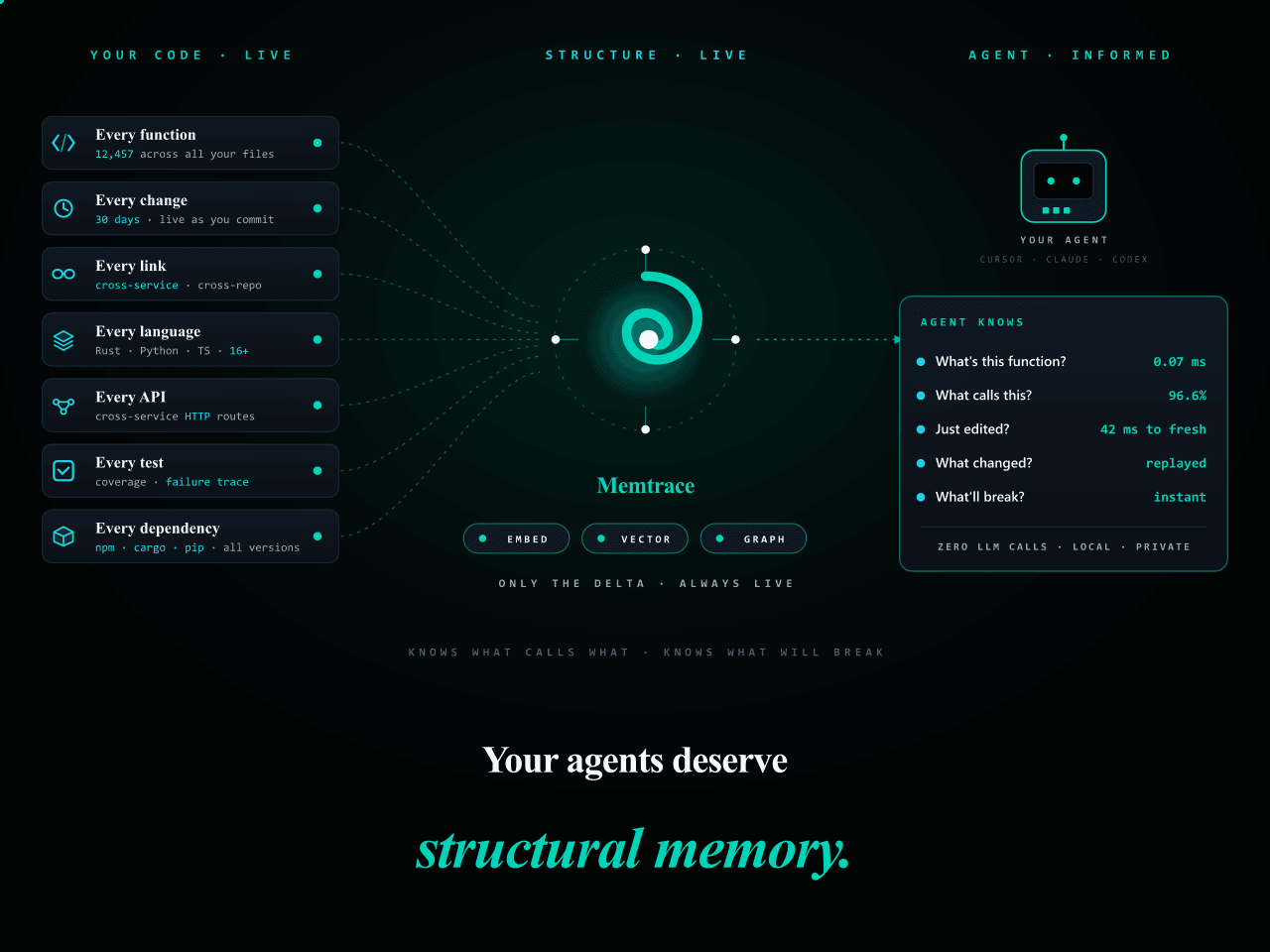 syncable-dev/memtrace-public
Structural memory for AI coding agents. Bi-temporal graph, MCP-native, zero LLM calls. Cursor · Claude Code · Codex · De…
syncable-dev/memtrace-public
Structural memory for AI coding agents. Bi-temporal graph, MCP-native, zero LLM calls. Cursor · Claude Code · Codex · De…
-
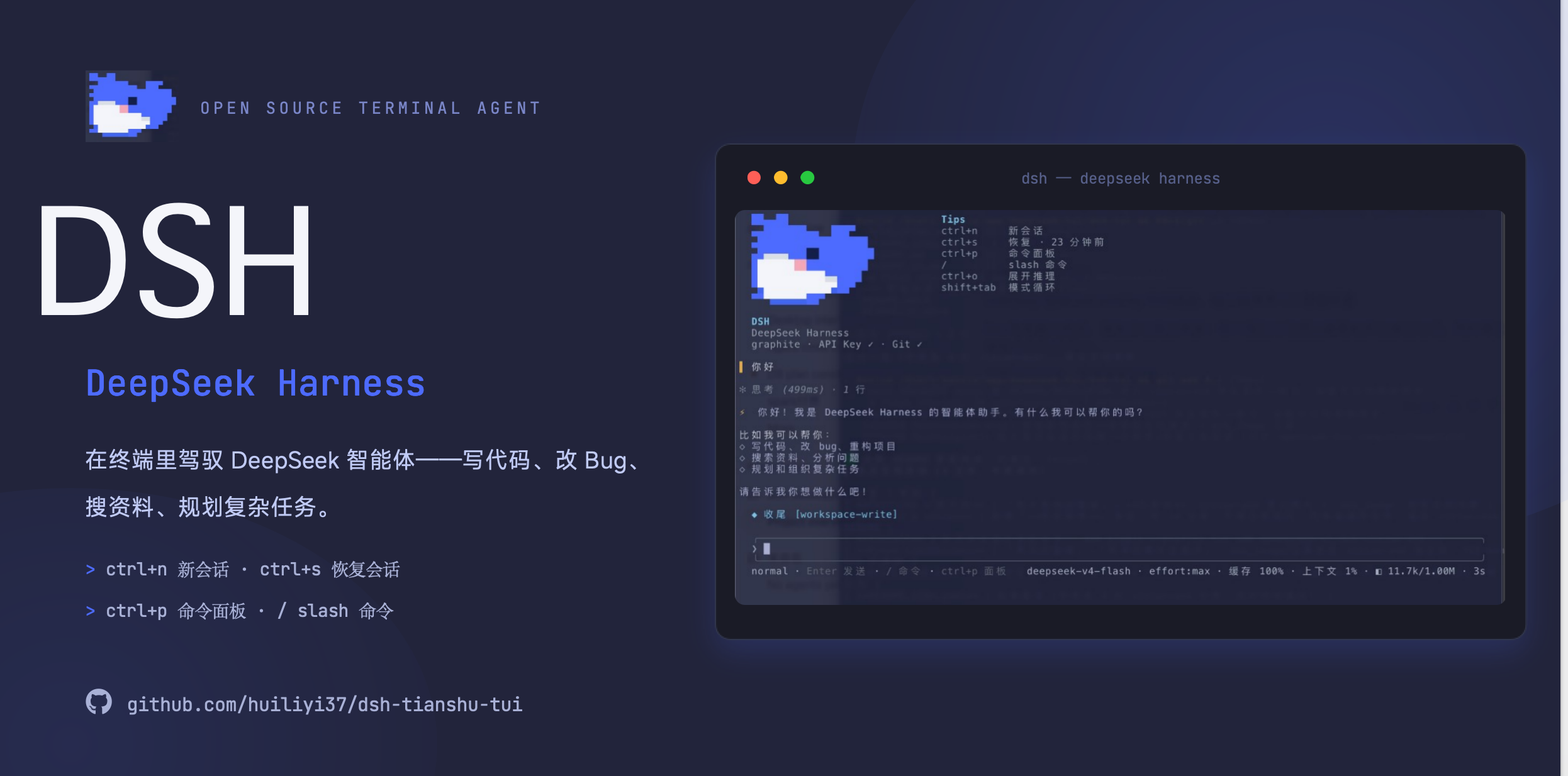 huiliyi37/dsh-tianshu-tui
官方 DeepSeek Harness 的交互式终端 UI 插件:自研 ANSI 极简交互渲染、流式 Markdown/工具卡、16+ 主题、slash 命令与选择器、输入历史与本地偏好持久化、LSP 诊断、memory记忆,很丝滑的开发体…
huiliyi37/dsh-tianshu-tui
官方 DeepSeek Harness 的交互式终端 UI 插件:自研 ANSI 极简交互渲染、流式 Markdown/工具卡、16+ 主题、slash 命令与选择器、输入历史与本地偏好持久化、LSP 诊断、memory记忆,很丝滑的开发体…
-
 xiehuan123/dsh-deepread
Evidence-first reading for AI agents — turn articles, books and PDFs into traceable claims, evidence, source locations a…
xiehuan123/dsh-deepread
Evidence-first reading for AI agents — turn articles, books and PDFs into traceable claims, evidence, source locations a…
-
 PerryLink/dsh-plugin-guide
Installable DSH bundle: the dsh-plugin-guide plugin-development knowledge base as an on-demand agent skill. Official doc…
PerryLink/dsh-plugin-guide
Installable DSH bundle: the dsh-plugin-guide plugin-development knowledge base as an on-demand agent skill. Official doc…
-
 1na-ko/dsh-hdc-bridge
DSH 原生鸿蒙开发助手:hdc 设备闭环调试 + 设备面板(官方 client 插件形态)+ 离线官方知识层(Tier-1 随包)+ DevEco CLI 构建/签名/模拟器控制 / DSH-native HarmonyOS dev as…
1na-ko/dsh-hdc-bridge
DSH 原生鸿蒙开发助手:hdc 设备闭环调试 + 设备面板(官方 client 插件形态)+ 离线官方知识层(Tier-1 随包)+ DevEco CLI 构建/签名/模拟器控制 / DSH-native HarmonyOS dev as…
-
 1841220388zzzcccxxx-star/dsh-git-graph
Embedded git repository graph visualizer for the DeepSeek Harness Web GUI | 嵌入式 Git 仓库图谱可视化插件(提交历史图 / 分支过滤 / 文件 diff / V…
1841220388zzzcccxxx-star/dsh-git-graph
Embedded git repository graph visualizer for the DeepSeek Harness Web GUI | 嵌入式 Git 仓库图谱可视化插件(提交历史图 / 分支过滤 / 文件 diff / V…