shaneconner/canon
Canonical project memory for the Pi coding agent: one governing article per asset, an append-only journal, capsule surfacing. A project wiki with a spine.
Project Overview项目介绍
pi-canon is a canonical project-memory system built for the Pi coding agent and mirrored for three other harnesses. Each governed asset is paired with exactly one authoritative article whose path is derived from the asset's own path, so src/core/config.ts is governed by articles/src/core/config.md, and beneath the articles sits an append-only journal, one file per event. When a tool call touches a governed asset, that article's single dense line arrives in the session unprompted, which means the agent does not have to know in advance that there was something to look up; path detection is best effort, but resolving a detected path to its article is not. Free knowledge is treated as a normal case, so untethered articles are allowed alongside tethered ones.
The repository ships as an installable package for four platforms in parallel. On Pi it installs via pi install npm:pi-canon or by cloning into ~/.pi/agent/extensions/, and it requires Node 22.18 or later together with Pi 0.83 or later on the 0.x line. On Codex and Claude Code the same repo is consumed as a marketplace: codex plugin marketplace add shaneconner/canon followed by codex plugin add canon@canon, or claude plugin marketplace add shaneconner/canon --scope user followed by claude plugin install canon@canon --scope user, and an absolute checkout path works for local development. On DeepSeek Harness the install is dsh plugin --profile <name> add dsh-canon, which pulls a separately published npm package called dsh-canon built from the same mirrored core but without the retriever and without the settings screen.
Typical users are developers who want a long-running coding agent to retain durable, governed knowledge of a project without manual retrieval. The Codex and Claude Code builds launch the same dependency-free MCP server and expose the same canon actions as the Pi build; Codex surfaces capsules after each tool result, Claude Code deduplicates one capsule packet across each parallel tool batch right before the next model request, and both emit a single write-after reminder before the agent stops. No configuration is required, the store is created on first write at <project>/.canon, the package imports only node:fs and node:path, makes no network calls, runs no git, and loads under plain Node with no build step; hooks are inert in projects without .canon/articles. License is MIT, all measurements were taken under Codex with GPT 5.6 on an OpenAI subscription, and other models or API-metered access are explicitly untested.
pi-canon 是一种面向编码代理的"项目记忆"系统,核心思想是为每个被管理的资产维护一篇权威文章。文章路径由资产自身路径推导,例如 src/core/config.ts 由 articles/src/core/config.md 管辖;下方还有一个仅追加的日志层,每一次工具调用触及受管资产时,对应文章的一行精简内容会被自动送入会话,代理无需主动查询。
它同时面向 Pi、Codex、Claude Code 与 DeepSeek Harness 四个平台发布。Pi 通过 pi install npm:pi-canon 安装,也可克隆到 ~/.pi/agent/extensions/;Codex 与 Claude Code 均把仓库作为 marketplace 添加并安装 canon@canon;DeepSeek Harness 则通过 dsh plugin --profile <name> add dsh-canon 安装独立的 npm 包 dsh-canon,该构建不包含检索器与设置界面。Codex 与 Claude Code 的插件共用同一个零依赖 MCP 服务器,并暴露相同的 canon 动作。
典型用户是希望让代理在不显式检索的情况下也能"记得"项目关键事实的开发者。首次运行无需任何配置,仓库会在首次写入时于 <project>/.canon 自动创建;要求 Node 22.18 及以上、Pi 0.83 及以上(0.x 线),包仅导入 node:fs 与 node:path,不发起网络请求、不执行 git、不需要构建步骤。在不含 .canon/articles 的项目中钩子是惰性的。授权协议为 MIT,性能与召回率测量全部在 Codex + GPT 5.6 + OpenAI 订阅这一组合下完成,其他模型或按量计费通道未经测试。
请帮我安装这个 DSH 插件。安装前先完成【兼容性检查 + 安全性检查】,检查通过再动手。

插件:canon(shaneconner/canon)
仓库:https://github.com/shaneconner/canon
本站详情页:https://www.yhbd.top/plugins/shaneconner-canon/
本站登记:类型 plugin · 归类 多平台兼容工具(非 DSH 原生) · 许可证 MIT · ⭐ 2 · 最近提交 2026-10-03 · 主语言 TypeScript · 未检测到 DSH 插件清单

按下面顺序执行,每步先把结论告诉我,再进入下一步:

【1 兼容性检查】
① 我这边:DSH 版本、Node 版本、操作系统、当前 profile(web / desktop)。
② 读它的 README、package.json、插件 manifest,列出它要求的 DSH 版本 / Node 版本 / 操作系统 / 外部依赖 / 需要另外先装的运行时。
③ 逐条比对,结论只写「满足 / 不满足 / 未知」三种;不满足的给出可行替代方案。
④ 检查是否和我已装的插件冲突:命令名重复、skill / tool 重名、端口占用、重复注册的 MCP server。

【2 安全性检查】
① 仓库可信度:和上面「本站登记」是否一致;star / fork 数、创建时间、最近提交,是否归档或长期停更。
② 安装脚本:逐行看 package.json 的 preinstall / install / postinstall,以及 install.sh、setup.ps1 之类脚本。出现 curl|bash、下载后直接执行、混淆代码、访问与插件功能无关的域名,立刻停下来告诉我,不要继续装。
③ 依赖:列出新增依赖,标出无人维护、或与知名包拼写近似的可疑包(typosquatting)。
④ 权限与副作用:它会读写哪些目录、访问哪些域名、需要哪些 DSH 权限(filesystem / network / shell / clipboard 等),以及怎么卸载和回滚。
⑤ 如果它要求 sudo / 管理员权限,或权限明显超出功能所需,先停下来问我。

【3 安装】
上面两步没有「不满足」和「高危项」时才执行;用官方推荐方式安装,不要自行提权。

【4 汇报】
用表格输出:检查项 / 结论 / 依据 / 是否需要我决策。拿不准的一律写「未知」并说明要我怎么确认——不要猜,也不要替我决定。
Send this message to DSH in your current session: it verifies compatibility and security first (answering met / not met / unknown item by item) and only installs once everything checks out — it will stop and ask you if it finds a high-risk item. The box scrolls; the copy is the full prompt. CLI install commands may not be accurate across systems, so DSH is the safer route.把上面这条消息直接发给当前会话里的 DSH:它会先核对兼容性与安全性(逐条给「满足 / 不满足 / 未知」),确认没问题再安装,有高危项会停下来问你。框内可滚动,复制到的是完整提示词;安装命令不一定准确,发给 DSH 更稳。
- Only 2 stars - very few users, little community feedback星标只有 2,几乎没人在用,遇到问题缺少社区反馈
- No DSH plugin manifest detected - it may only carry the dsh-plugin topic, so the install method must be confirmed on the spot未检测到 DSH 插件清单:可能只是打了 dsh-plugin 话题,安装方式要现场确认
- Not DSH-native: a multi-platform tool that may require Node / Electron or another runtime first非 DSH 原生,是多平台兼容工具:可能要先装 Node / Electron 等运行时
DSH walks through these 9 checksDSH 会逐条核对这 9 项
Compatibility兼容性
- DSH, Node, OS and profile requirementsDSH 版本 / Node 版本 / 操作系统 / profile 是否满足要求
- External dependencies and runtimes (Electron / Python / Docker, ...)外部依赖与运行时(Electron / Python / Docker 等)是否齐备
- Conflicts with installed plugins: command names, skill / tool names, ports, duplicate MCP registration与已装插件是否冲突:命令名、skill / tool 重名、端口占用、重复 MCP 注册
Security安全性
- Repo matches the facts registered here; archived or abandoned?仓库是否与页面登记一致,是否归档或长期停更
- Safety of preinstall / install / postinstall and install.sh / setup.ps1preinstall / install / postinstall 与 install.sh、setup.ps1 是否安全
- curl|bash, download-then-execute, obfuscation, unrelated domains → stop immediatelycurl|bash、下载即执行、混淆代码、无关域名 → 立刻停止
- Typosquatting or unmaintained packages among the new dependencies新增依赖里有没有 typosquatting 或无人维护的包
- Requested permissions vs. what the feature actually needs申请了哪些权限、是否超出功能所需(filesystem / network / shell / clipboard)
- Any sudo / admin requirement, plus uninstall and rollback是否要求 sudo / 管理员权限,以及卸载与回滚方式
Anything uncertain must be marked unknown with a note on how to confirm it. This site's signal screen is a static snapshot, not a security audit.拿不准的必须标「未知」并说明要我怎么确认。本站的信号筛查是静态快照,不能替代安全审计。
Or use CLI install (for developers)或使用命令行安装(适合开发者)
CLI Install命令行安装
dsh plugin --profile web add dsh-canon把 shaneconner/canon 加入你的 DSH 配置(web profile)即可启用。
READMEREADME
pi-canon
Canonical project memory for the Pi coding agent. Every asset has at most one governing article, at an address computed from the asset's own path: src/core/config.ts is governed by articles/src/core/config.md. Beneath the articles sits an append-only journal, one file per event. When a tool call touches a governed asset, that article's one dense line arrives in the session unasked, so the agent does not have to know there was something to look up. Detecting the path in a tool call is best effort; resolving it to an article is not.
One setup measured, others welcome. pi-canon was developed and tested under one configuration: Codex, with GPT 5.6 as the worker model, on an OpenAI subscription. Every number in this README was measured there. Other models, other providers, and API-metered access are untested. If you run it under a different setup, feedback is welcome and so are pull requests.
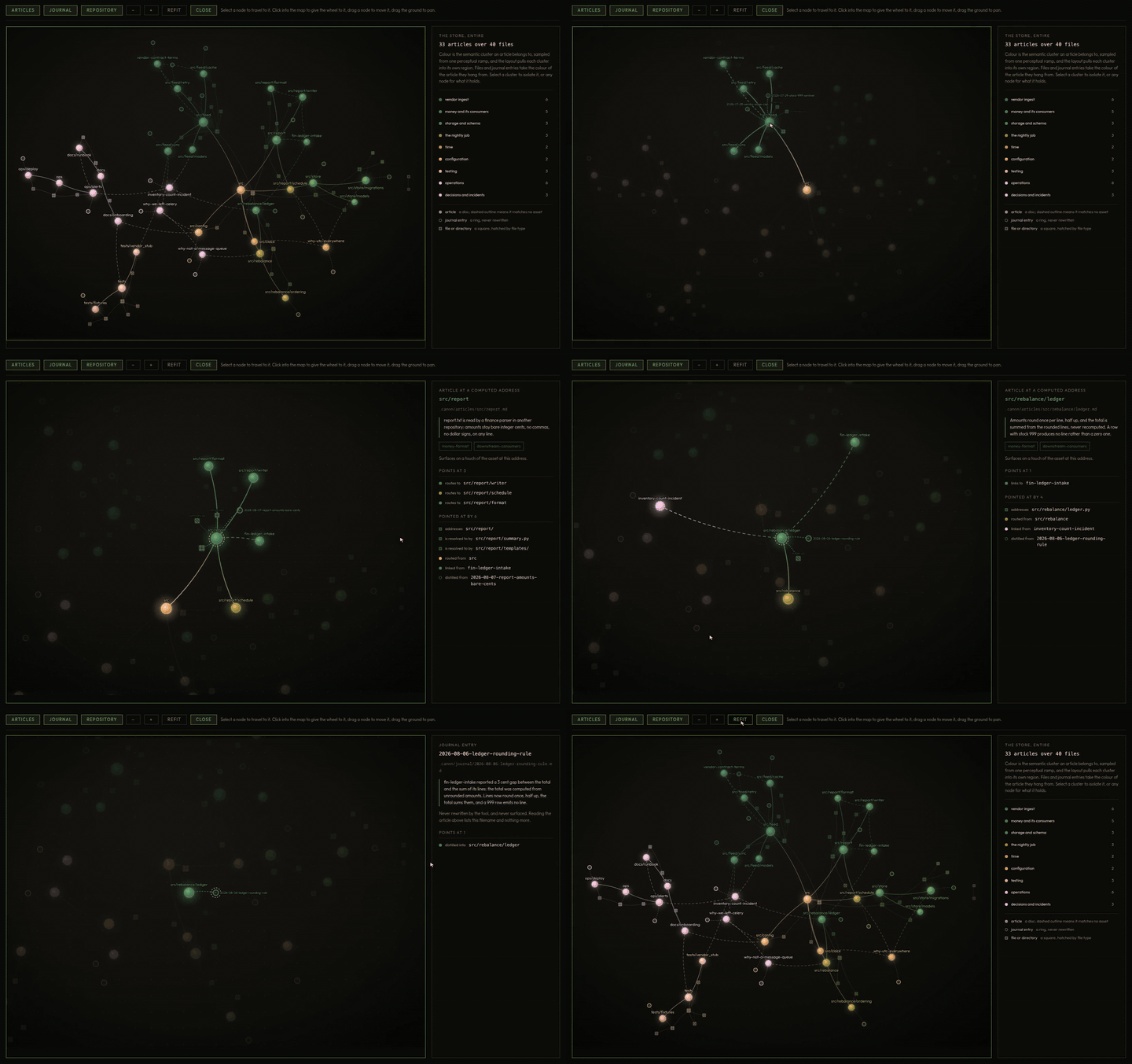
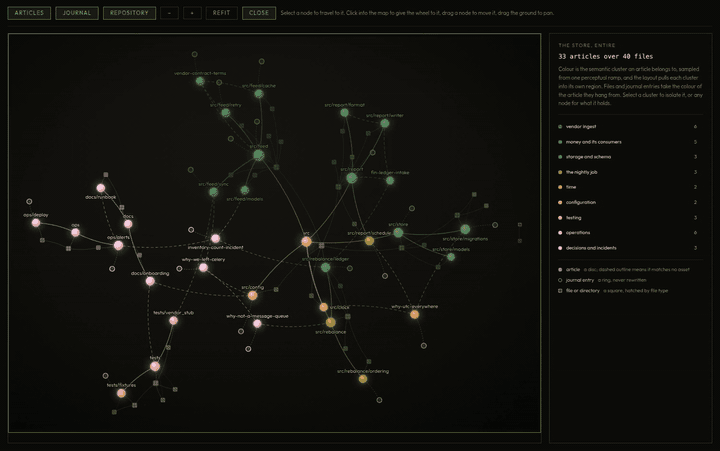
An illustrative store: 33 articles, 20 journal entries, 40 files. Discs are articles, rings are journal entries hanging under the article each was distilled into, and a square tethered beneath a disc is the asset that article was named for. Six of the articles match no asset and hang untethered, because free knowledge is not a special case here. Selecting a node opens what it holds, what it points at, and what points at it.
Install
Pi
pi install npm:pi-canon
Or clone this repo into ~/.pi/agent/extensions/. Node 22.18 or later, Pi 0.83 or later on the 0.x line. Nothing to configure: the store is created on first write at <project>/.canon. The package imports node:fs and node:path and nothing else, makes no network calls, runs no git, and loads under plain node with no build step.
Codex
The repository is a Codex marketplace. Add it once, then install the plugin at user scope:
codex plugin marketplace add shaneconner/canon
codex plugin add canon@canon
For a local checkout under development, replace shaneconner/canon with its absolute path. Start a new Codex thread after installing or updating it.
Showing the opening section of the README — the full document lives in the repository以上为 README 开头摘要,完整文档在仓库内 · View the full README on GitHub →在 GitHub 查看完整 README →
Related相关推荐
-
 zilliztech/memsearch
A persistent, unified memory layer for all your AI agents (e.g. Claude Code, Codex, DSH), backed by Markdown and Milvus.
zilliztech/memsearch
A persistent, unified memory layer for all your AI agents (e.g. Claude Code, Codex, DSH), backed by Markdown and Milvus.
-
 text2future/flowix
Notes for you, Memory for your agents. / 内置 Deepseek harness Agent / 适用 办公 & 写作 & Coding
text2future/flowix
Notes for you, Memory for your agents. / 内置 Deepseek harness Agent / 适用 办公 & 写作 & Coding
-
 tinqiao-oss/engramory
A portable memory protocol for AI agents — load it as standing rules; a curation discipline + reference spec + optional …
tinqiao-oss/engramory
A portable memory protocol for AI agents — load it as standing rules; a curation discipline + reference spec + optional …
-
 a86582751/dsh-nexttavern
DeepSeek Harness 长篇角色扮演agent(DSH酒馆插件):SillyTavern 角色卡导入、行动选项卡、分支对话管理、长篇记忆、关键词与语义混合检索、交互式角色卡创作、世界书、多角色 Agent 集群、文风预设、小说与角…
a86582751/dsh-nexttavern
DeepSeek Harness 长篇角色扮演agent(DSH酒馆插件):SillyTavern 角色卡导入、行动选项卡、分支对话管理、长篇记忆、关键词与语义混合检索、交互式角色卡创作、世界书、多角色 Agent 集群、文风预设、小说与角…
- Amakurai/dsh-liketavern A DeepSeek Harness (dsh) plugin — turns dsh web into a SillyTavern-style roleplay frontend: character cards, prompt pres…
-
 xiehuan123/dsh-deepread
Evidence-first reading for AI agents — turn articles, books and PDFs into traceable claims, evidence, source locations a…
xiehuan123/dsh-deepread
Evidence-first reading for AI agents — turn articles, books and PDFs into traceable claims, evidence, source locations a…
- lna-lab/distill-kura 蒸留蔵 — distilled long-term memory for agents: recall by meaning, writing gated by evidence, one kura per agent mode. Ship…
-
 PerryLink/dsh-plugin-guide
Installable DSH bundle: the dsh-plugin-guide plugin-development knowledge base as an on-demand agent skill. Official doc…
PerryLink/dsh-plugin-guide
Installable DSH bundle: the dsh-plugin-guide plugin-development knowledge base as an on-demand agent skill. Official doc…