sidleo/llm-wiki
Project Overview项目介绍
llm-wiki is an open-source, agent-first knowledge base whose storage layer strictly follows the Open Knowledge Format v0.2 (OKF v0.2) specification, while its operations layer reproduces Karpathy's llm-wiki pattern of ingest, query, lint, and index. A single core library and one shared data bundle drive four consumption forms that share semantics, namely the DSH native plugin, a Codex plugin, an MCP server, and a portable skill/CLI form, so the same Markdown concepts behave identically whether reached through a chat host or the command line. Per-directory rule files such as APPEND_SYSTEM_PROMPT.md are re-read every turn by the DSH before_agent_start hook, injected through Codex SessionStart / UserPromptSubmit lifecycle events without duplicating unchanged content, and reissued on demand by the MCP server when the bundle changes after initialize. A graphical configuration card under DSH Settings → Plugins exposes bundle management, Git remote status with one-click sync/init/clone, and a health panel that surfaces validate and lint counts plus an index-rebuild action.
Typical workflows start with wiki_list to expose the full directory tree, followed by wiki search and wiki get for targeted retrieval; reading a concept surfaces automatic backlinks that list the rules and pitfalls citing it, while writes pass through AGENTS.md write gates that require human confirmation for protected concept types. The intended audience is technical teams or individual researchers who want a vendor-neutral, version-controlled glossary, decision log, or style guide that both humans and agents can edit and audit side by side, with Obsidian or Feishu Drive available for visual browsing. Multiple bundles can be registered through ~/.agents/wiki-registry.json, the DSH plugin's dataDirs config block, or the runtime wiki_use / wiki dirs commands, and the active bundle can be scoped to one conversation or persisted globally, which makes it straightforward to keep separate workspaces for work and personal notes.
Dependencies center on Node.js, with subpackages requiring npm install (and --legacy-peer-deps for the pi extension); runtime parameters are deployment-level and live in the profile's cordis.patch.yml, deliberately hidden from the GUI card to avoid drift. The Feishu backend never deletes files on either side — deletions appear in the change list but require explicit paths and a bot-identity capable of writing — and conflicts in concepts or AGENTS.md files halt sync rather than overwrite. The test suites total more than one hundred and fifty checks across the core, DSH plugin mock, settings card host half, Git remote sync, Feishu backends, autosync scheduler, real-deletion safety, MCP SDK parity, and Codex lifecycle, but first-run users should still explore examples/demo-bundle with wiki list --dataDir examples/demo-bundle before porting their own collections. The repository ships under the MIT license.
llm-wiki 是一款以"代理优先"为设计理念的开源知识库,存储格式严格遵循 Open Knowledge Format v0.2(OKF v0.2)规范,操作流程沿用 Karpathy 所提出的 llm-wiki 模式,提供摄取、查询、校验与索引四大环节。项目以单一核心库加统一数据清单为基础,对外派生出四种使用形态:DSH 原生插件、Codex 插件、MCP 服务器,以及独立的 skill/CLI 命令行工具,各形态共享同一份 OKF 文档集合并保持行为一致。它通过 before_agent_start、MCP initialize、SessionStart 等钩子或内联注入方式,把每个目录下的 APPEND_SYSTEM_PROMPT.md 规则实时并入到代理的系统提示中,从而确保检索、创建与更新操作均携带约束策略。
典型使用场景为:开发者在任意目录建立 Markdown 概念文件构成的 OKF 知识包,启动对应形态后调用 wiki_list 浏览目录树,再用 wiki get、wiki search 钻取细节并查看反链。系统会自动维护 index.md 与 log.md,对过期与孤立节点进行标记,并支持多 bundle 注册与会话级切换,适用于需要长期沉淀团队规范、术语表与协作规则的技术团队或写作团队。同步后端提供 Git 仓库与飞书云盘两种选项,方便本地编辑、多机同步及人类可视化浏览。
依赖方面,核心为 Node.js,所有形态共用 OKF 解析与同源测试库;运行需安装各子包依赖(推荐 --legacy-peer-deps)。已通过的核心测试覆盖 smoke、DSS 插件 Mock、DSH 配置卡、Git 同步、飞书后端、自动同步及三形态一致性;飞书与真实删除需配置 lark-cli 并受限于变更列表对比策略,不会双端删文件。许可证为 MIT,首次运行建议先体验 examples/demo-bundle 再逐步迁移自有知识库。
请帮我安装这个 DSH 插件。安装前先完成【兼容性检查 + 安全性检查】,检查通过再动手。

插件:llm-wiki(sidleo/llm-wiki)
仓库:https://github.com/sidleo/llm-wiki
本站详情页:https://www.yhbd.top/plugins/sidleo-llm-wiki/
本站登记:类型 plugin · 归类 原生 DSH 插件 · 许可证 MIT · ⭐ 6 · 最近提交 2026-09-21 · 主语言 JavaScript · 未检测到 DSH 插件清单

按下面顺序执行,每步先把结论告诉我,再进入下一步:

【1 兼容性检查】
① 我这边:DSH 版本、Node 版本、操作系统、当前 profile(web / desktop)。
② 读它的 README、package.json、插件 manifest,列出它要求的 DSH 版本 / Node 版本 / 操作系统 / 外部依赖 / 需要另外先装的运行时。
③ 逐条比对,结论只写「满足 / 不满足 / 未知」三种;不满足的给出可行替代方案。
④ 检查是否和我已装的插件冲突:命令名重复、skill / tool 重名、端口占用、重复注册的 MCP server。

【2 安全性检查】
① 仓库可信度:和上面「本站登记」是否一致;star / fork 数、创建时间、最近提交,是否归档或长期停更。
② 安装脚本:逐行看 package.json 的 preinstall / install / postinstall,以及 install.sh、setup.ps1 之类脚本。出现 curl|bash、下载后直接执行、混淆代码、访问与插件功能无关的域名,立刻停下来告诉我,不要继续装。
③ 依赖:列出新增依赖,标出无人维护、或与知名包拼写近似的可疑包(typosquatting)。
④ 权限与副作用:它会读写哪些目录、访问哪些域名、需要哪些 DSH 权限(filesystem / network / shell / clipboard 等),以及怎么卸载和回滚。
⑤ 如果它要求 sudo / 管理员权限,或权限明显超出功能所需,先停下来问我。

【3 安装】
上面两步没有「不满足」和「高危项」时才执行;用官方推荐方式安装,不要自行提权。

【4 汇报】
用表格输出:检查项 / 结论 / 依据 / 是否需要我决策。拿不准的一律写「未知」并说明要我怎么确认——不要猜,也不要替我决定。
Send this message to DSH in your current session: it verifies compatibility and security first (answering met / not met / unknown item by item) and only installs once everything checks out — it will stop and ask you if it finds a high-risk item. The box scrolls; the copy is the full prompt. CLI install commands may not be accurate across systems, so DSH is the safer route.把上面这条消息直接发给当前会话里的 DSH:它会先核对兼容性与安全性(逐条给「满足 / 不满足 / 未知」),确认没问题再安装,有高危项会停下来问你。框内可滚动,复制到的是完整提示词;安装命令不一定准确,发给 DSH 更稳。
- Only 6 stars - very few users, little community feedback星标只有 6,几乎没人在用,遇到问题缺少社区反馈
- No DSH plugin manifest detected - it may only carry the dsh-plugin topic, so the install method must be confirmed on the spot未检测到 DSH 插件清单:可能只是打了 dsh-plugin 话题,安装方式要现场确认
DSH walks through these 9 checksDSH 会逐条核对这 9 项
Compatibility兼容性
- DSH, Node, OS and profile requirementsDSH 版本 / Node 版本 / 操作系统 / profile 是否满足要求
- External dependencies and runtimes (Electron / Python / Docker, ...)外部依赖与运行时(Electron / Python / Docker 等)是否齐备
- Conflicts with installed plugins: command names, skill / tool names, ports, duplicate MCP registration与已装插件是否冲突:命令名、skill / tool 重名、端口占用、重复 MCP 注册
Security安全性
- Repo matches the facts registered here; archived or abandoned?仓库是否与页面登记一致,是否归档或长期停更
- Safety of preinstall / install / postinstall and install.sh / setup.ps1preinstall / install / postinstall 与 install.sh、setup.ps1 是否安全
- curl|bash, download-then-execute, obfuscation, unrelated domains → stop immediatelycurl|bash、下载即执行、混淆代码、无关域名 → 立刻停止
- Typosquatting or unmaintained packages among the new dependencies新增依赖里有没有 typosquatting 或无人维护的包
- Requested permissions vs. what the feature actually needs申请了哪些权限、是否超出功能所需(filesystem / network / shell / clipboard)
- Any sudo / admin requirement, plus uninstall and rollback是否要求 sudo / 管理员权限,以及卸载与回滚方式
Anything uncertain must be marked unknown with a note on how to confirm it. This site's signal screen is a static snapshot, not a security audit.拿不准的必须标「未知」并说明要我怎么确认。本站的信号筛查是静态快照,不能替代安全审计。
Or use CLI install (for developers)或使用命令行安装(适合开发者)
CLI Install命令行安装
dsh plugin --profile web add github:sidleo/llm-wiki把 sidleo/llm-wiki 加入你的 DSH 配置(web profile)即可启用。
READMEREADME
llm-wiki — Agent Knowledge Base in Pure OKF v0.2 Markdown
An open-source, generic, agent-first knowledge base: the format layer strictly follows the Open Knowledge Format v0.2, and the operations layer follows Karpathy's llm-wiki pattern (ingest / query / lint + index / log). It ships in four consumption forms that share one core library and one data bundle.
Design Principles
- Strictly OKF v0.2 — the official spec is the single source of truth for the format; no custom frontmatter fields, no magic features at the consumption layer.
- Generic and vendor-neutral — not tied to any business or domain; the same bundle is readable and writable by any agent.
Features
- Progressive disclosure — every session carries injected tool guidance plus the active bundle/category list;
wiki_listshows the whole tree first, then you search and drill in. - Real cross-links + automatic backlinks — concepts reference each other with Markdown links; reading a concept automatically surfaces the pitfalls and rules that cite it.
- Directory-level rules (
AGENTS.md) — per-directory write gates (which concept types need human confirmation) and behavioral conventions, resolved bottom-up with child directories overriding parents. - Per-directory prompt injection (
APPEND_SYSTEM_PROMPT.md) — each category defines its own behavior rules; identical content across all five forms and effective immediately after an edit. DSH rides a constant section plus a runtime-context snapshot; the pi extension hooksbefore_agent_startto re-read them every turn and append them to that turn's system prompt; the Codex plugin injects them throughSessionStart/UserPromptSubmithooks (no duplicate injection when unchanged, refresh next turn, rebuild after compaction); the MCP server sends the same text through theinitializeinstructionsfield (the protocol only delivers it once per connection — reconnect or callwiki rulesafter an edit); the skill/CLI form has no injection hook, so it useswiki rules(no args = load every rule verbatim) plus rules automatically appended towiki get/create/updateresponses — the rules travel with the data, so nothing depends on the agent remembering to load them. See SPEC-EXTENSIONS.md. - Lifecycle —
stale_afterexpiry,status: deprecated(concept-level) and directory-level deprecation, auto-maintainedindex.md/log.md. - Validation & health —
wiki_validate(OKF compliance) andwiki_lint(broken links, orphans, stale entries, missing index). - Multiple bundles — register several wiki directories as named bundles and switch between them (session-level or persisted globally).
- Online knowledge base (two backends) — one
wiki_sync/wiki syncentry point, dispatched by the bundle's backend:- Local directory + Git remote: commit → fetch/merge → push for multi-machine collaboration; force-push is never used.
- Feishu cloud drive: the bundle lives in a Feishu Drive folder as a tree of native
.mdfiles (zero OKF format loss), read and written file-by-file throughlark-cli; humans browse/download in Feishu, agents do the reading and writing. Both backends share one conflict policy:index.mdis regenerated locally,log.mdis merged as a union (never blocks), and a concept /AGENTS.mdchanged on both sides stops the sync with a conflict list — nothing is auto-overwritten. The Feishu backend never deletes files on either side (deletions are only reported).
- Graphical configuration (DSH Web GUI) — an llm-wiki card under Settings → Plugins → Plugin configuration: named directories (add/rename/remove/set default), Git remote status with one-click sync/init/clone, and a health panel (validate/lint counts + rebuild index). Runtime parameters are deployment-level (the profile's
cordis.patch.yml) and are deliberately not editable from the card.
Showing the opening section of the README — the full document lives in the repository以上为 README 开头摘要,完整文档在仓库内 · View the full README on GitHub →在 GitHub 查看完整 README →
Related相关推荐
-
 zilliztech/memsearch
A persistent, unified memory layer for all your AI agents (e.g. Claude Code, Codex, DSH), backed by Markdown and Milvus.
zilliztech/memsearch
A persistent, unified memory layer for all your AI agents (e.g. Claude Code, Codex, DSH), backed by Markdown and Milvus.
-
 text2future/flowix
Notes for you, Memory for your agents. / 内置 Deepseek harness Agent / 适用 办公 & 写作 & Coding
text2future/flowix
Notes for you, Memory for your agents. / 内置 Deepseek harness Agent / 适用 办公 & 写作 & Coding
-
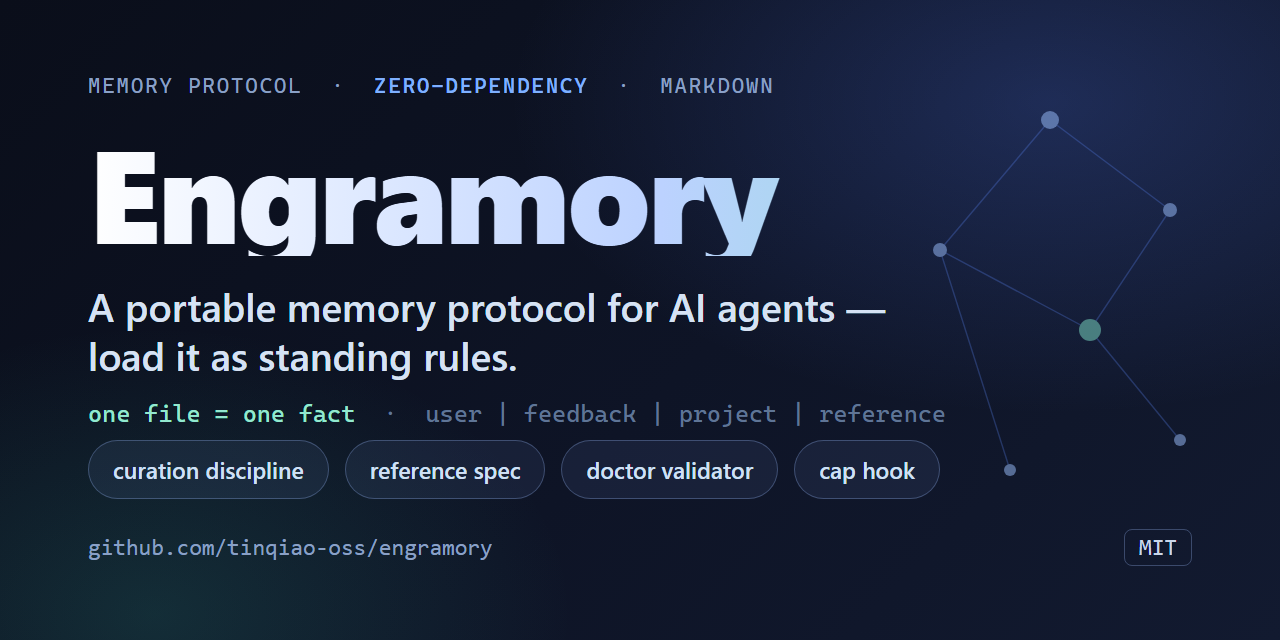 tinqiao-oss/engramory
A portable memory protocol for AI agents — load it as standing rules; a curation discipline + reference spec + optional …
tinqiao-oss/engramory
A portable memory protocol for AI agents — load it as standing rules; a curation discipline + reference spec + optional …
-
 a86582751/dsh-nexttavern
DeepSeek Harness 长篇角色扮演agent(DSH酒馆插件):SillyTavern 角色卡导入、行动选项卡、分支对话管理、长篇记忆、关键词与语义混合检索、交互式角色卡创作、世界书、多角色 Agent 集群、文风预设、小说与角…
a86582751/dsh-nexttavern
DeepSeek Harness 长篇角色扮演agent(DSH酒馆插件):SillyTavern 角色卡导入、行动选项卡、分支对话管理、长篇记忆、关键词与语义混合检索、交互式角色卡创作、世界书、多角色 Agent 集群、文风预设、小说与角…
- Amakurai/dsh-liketavern A DeepSeek Harness (dsh) plugin — turns dsh web into a SillyTavern-style roleplay frontend: character cards, prompt pres…
-
 xiehuan123/dsh-deepread
Evidence-first reading for AI agents — turn articles, books and PDFs into traceable claims, evidence, source locations a…
xiehuan123/dsh-deepread
Evidence-first reading for AI agents — turn articles, books and PDFs into traceable claims, evidence, source locations a…
- lna-lab/distill-kura 蒸留蔵 — distilled long-term memory for agents: recall by meaning, writing gated by evidence, one kura per agent mode. Ship…
-
 PerryLink/dsh-plugin-guide
Installable DSH bundle: the dsh-plugin-guide plugin-development knowledge base as an on-demand agent skill. Official doc…
PerryLink/dsh-plugin-guide
Installable DSH bundle: the dsh-plugin-guide plugin-development knowledge base as an on-demand agent skill. Official doc…