skepsun/dsh-engram
极简·省 token 的 DSH 长期记忆插件:零 LLM 自动捕获、符号索引渐进披露、ESR 证据闭环。Minimalist token-saving memory for DeepSeek Harness: zero-LLM auto-capture, symbolic index, ESR-lite evidence closure.
Project Overview项目介绍
dsh-engram is a minimalist long-term memory plugin for DeepSeek Harness, distilled from symbolic-index and pi-esr. It auto-captures commits, key-file edits, and test failures via pattern matching with a secret redactor, injecting a frozen ~700-char [ENGRAM] block into prompts to keep the KV-cache prefix stable. Recall uses in-process BM25 with entity-neighborhood and time decay, falling back to DSH's session FTS (plus a bounded CJK substring scan) on zero hits. Memory-to-memory supersedes/contradicts flags are honored, failing commands auto-sediment a procedure once they succeed, and ESR-lite gives tasks a draft→active→stable lifecycle gated by artifact/evaluation/memory_ref evidence. Use it when you need cross-session facts, reusable fix patterns, and goal handoffs. Caveat: the index block is hard-capped at 700 characters, so deeper context must be pulled via engram_recall / engram_detail, and the recall engine is fully mechanical with no LLM in the loop.
dsh-engram 是 DeepSeek Harness 的极简长期记忆插件,源自 symbolic-index 与 pi-esr。零 LLM 自动捕获提交、关键文件改动、测试失败等事件,附 secret_redactor 脱敏;提示注入一个固定 700 字符的 [ENGRAM] 索引块,KV 缓存友好,agent 通过 engram_recall / engram_detail 渐进取用。BM25+实体邻接+时间衰减的本地召回可在 zero-hit 时回退至 DSH FTS,CJK 查询还会扫最近会话日志。支持 supersedes/contradicts 语义、错误→修复闭环(procedure 自动沉积)、ESR-lite 任务生命周期(需 artifact/evaluation/memory_ref 证据)。适用:跨会话沉淀事实、复用失败修复、追踪目标结果。注意:索引块以 700 字符预算硬限,超出记忆不会进入系统提示,须靠 recall/detail 拉取;ESR 关闭 verifyArtifact 或未配 cwd 时 artifact 校验可能失败。
请帮我了解并安装插件:【dsh-engram】【https://github.com/skepsun/dsh-engram】Send this message to DSH in your current session. CLI install commands may not be accurate across systems — DSH will figure it out for you.把上面这条消息直接发给当前会话里的 DSH,让它帮你了解并安装。安装命令不一定准确,发给 DSH 更稳。
Or use CLI install (for developers)或使用命令行安装(适合开发者)
CLI Install命令行安装
dsh plugin --profile web add dsh-engram把 skepsun/dsh-engram 加入你的 DSH 配置(web profile)即可启用。
READMEREADME
dsh-engram

Minimalist long-term memory for DeepSeek Harness, distilled from the symbolic-index and pi-esr ideas — with one goal: save tokens.
- Zero-LLM intake — auto-captures meaningful events from tool results by pure
pattern matching (git milestones with a written
-mcommit message, edits to key files, repeated errors), plus an explicitengram_store. Nothing on the hot path calls a model, and pure plumbing —git push/git stash/ silent commits — is deliberately never recorded (see Auto-capture policy below). Every write is run through a deterministic secret redactor first — API keys, JWTs,Bearertokens, private keys, AWS/Stripe/Slack/GitHub tokens andkey=valuesecret shapes are replaced with<REDACTED:…>markers before the dedup hash, the char cap, and storage, so sensitive text can never land on disk. Failing test runs are recognized by pure patterns (npm test,node --test, vitest/pytest/jest, failure lines) and captured astags:["error","test"]entries with a raised signal. DSH goal-domain integration: a completed or blocked goal (goal/changesession event) auto-sediments as ahandoff/errormemory (tag:goal), so the outcome of a goal survives its session (see theGET /api/dsh-engram/goalsread surface). - Symbolic index + progressive disclosure — a compact
[ENGRAM]block (default budget 700 chars ≈ 175 tokens; one line per memory) is injected at prompt assembly and frozen per session, keeping the request prefix byte-stable for KV-cache reuse. The agent drills down withengram_recall/engram_detailinstead of dumping raw hits into context; recall ranks the in-domain pool with an in-process BM25 pass (TF·IDF with label/phrase boosts plus a gentle time-decay factor — deterministic, zero deps), appends a compact entity-neighborhood table (reusing esr_link:node --rel--> node · conf%) for entity-anchored hits, re-warms the olderrorentry when a new failure is near-identical (repeat-failure revival: recency + hit climb toward promoteHits so the failure resurfaces instead of piling up), and on zero local hits falls back to DSH's own cross-session full-text index (ctx.sessionQuery, filtered by cwd) instead of building a parallel SQLite index; when the FTS fallback also comes back empty and the query contains CJK characters (Chinese FTS5 tokenization), recall runs a bounded substring scan over the newest session logs (zstd-decompressed, LRU-cached) and appends matched past sessions — deterministic# past sessionslines, capped files and bytes. - Session-start auto-recall (
autoRecallOnStart, default on) — the pull-only design had a gap proven in real use: recall tools relied on model initiative, and in practice the model almost never callsengram_recallon its own (19 real sessions, thousands of tool calls, ~5 recall calls total). So at the FIRST assembly of a new session the host runs one deterministic BM25 recall keyed on the session's first user message and injects the top ≤autoRecallLimithits as a[RECALL]block (default 700-char budget, "few and precise" — agentmemory candidate ①). Relevant memory is in context even without a single recall call. Pure rule, zero LLM, pure read (never bumpshits); superseded stale truth does not occupy an injection slot (still fetchable viaengram_detail); frozen per session together with[ENGRAM]for prefix stability. - Memory-to-memory semantics —
engram_storeaccepts optionalsupersedes/contradictsmemory ids (validated against the same workspace). A superseded ("stale truth") memory is demoted to the tail of recall and excluded from the[ENGRAM]block, while the superseding statement keeps the line; a contradicted memory stays ranked but is flagged· contradicted by <id>. Old rows are never deleted — re-fetchable, just honestly ranked. Opt-inautoSupersedeconfig (default off) auto-marks entity-anchored replacement updates ("改用 / no longer / switched…") as superseding their matching older row; explicitsupersedesalways wins. - Failure→fix closure (zero LLM) — error memories carry a
cmd:signature tag; when that same command later succeeds, engram auto-sediments aprocedurememory (fixed: <cmd> — N earlier failing runs now succeed), tags the earlier error rowsresolved(never re-ranking them), and recall then surfaces the fix instead of the stale failure. - ESR-lite closure protocol —
esr_task/esr_close/esr_linkgive tasks adraft → active → stablelifecycle wherestablerequires real evidence (artifact/evaluation/memory_ref), surfacing closure gaps instead of letting the agent declare victory without proof. WithverifyArtifacton (default), a non-URL artifact is resolved against the workspace (= the session cwd) and must exist on disk — otherwise the task stays ACTIVE with the reason;force:true(or disabling the toggle) skips the disk check, the three gates are still mandatory. The tool and the web forms share one gate (store.evidenceGate), so the two surfaces can never drift. Tasks are never isolated graph nodes:esr_task(entity=…)one-call wiring auto-creates theent_<slug>node and hangs the task on it (task --relates_to--> entity, idempotent), so a task created with a domain anchor immediately shows a relation; andesr_depwrites the dependency edge into both the task'sdeps(blocker logic) and the shared links table, making every task dependency a first-class visible edge in the graph. - ESR trigger mechanism (pi-esr-aligned, hybrid: static protocol + frozen
snapshot + monotonically accumulated actionables + pull) — prefix-cache
stability is the point. Teaching the model WHEN to use ESR is a static
methodology section (byte-identical every turn); the
[ESR]block is a deterministic per-session frozen snapshot (set at session start, deterministically sorted, timestamps excluded, explicitly "WILL NOT auto-refresh") plus the session's monotonically accumulated actionables: thepromote:/root-cause:/close:/stale:/escalate:lines are APPENDED exactly once, the moment each matures, and stay frozen for the rest of the session (never removed) — so the prefix changes only when genuinely new decision-point info appears, never per-turn, while the timely nudges (narrow funnel / recurring failure / work done / stale / balance) stay in context. Live state is still pulled viaesr_status(full deterministic view +since_revisionshort "unchanged" response + derived actionables). Thetools/resultrecorder feeds the actionables' data sources; P4 conversion metering stays (#suggest-*tags + 10-minute attribution +GET /api/dsh-engram/triggerstats). Pure rules, zero LLM. - Session-end todo auto-sink (draft safety net,
autoSinkTodosOnEnddefault on) — during a session the native todo stays cheap, per-session working memory that dies with the session. But when a session closes at its teardown edge (session/disposed) while its plan still has pending todos, they are auto-landed as ESRdrafttasks (name = the todo text, description marked 「源自会话计划」, deduped against existing task names, capped bymaxTasksPerWorkspace), so the plan never silently evaporates. Sinking to draft — not active — keeps them out of the[ESR]active rows and creates no evidence obligation; an explicitesr_claim/esr_taskstep is still what promotes a draft to active. The "nothing auto-written during the session" trade-off is unchanged; only the end-of-session data-loss gap is closed. Disable via profile patch or the settings card. - Memory GC (pi-esr constraints) — a scheduled, mechanical, archive-only
sweep: TTL-expired memories are archived, over-cap workspaces evict the
lowest-value entries, stable tasks past their retention window leave the
[ESR]surface, and dangling link edges are dropped. The working set (active task refs, task memories, indexed hits) is never touched, and nothing is hard-deleted — every archived entry keeps its id and stays re-fetchable. - Context GC (auto-GC = replaces DSH's auto-compact) — NOT the memory-panel
GC. It takes over the host's
compactionservice and swaps DSH's lossy LLM-summary compression for mechanical eviction + re-fetch pointers: evicted turns are scanned for engram/ESR anchors (#memory-id,tsk_*,ent_*,file_path) and replaced with one line "this detail lives atengram_detail/engram_recall/ the [ESR] block"; only un-provenanced turns get a scoped LLM narrative (gcNarrative, default on, off = fully mechanical). All six GC constraints hold (working-set-protected, pointer-salience, no-provenance-no-evict…); any error falls back to the default compressor — compaction is never broken. - Web viewer — a memory browser with benchmark-ish stats and a config card, built entirely on DSH's native settings slots (no third-party UI package).
MIT · node >= 22.19 · host-half + browser-half in one package
Why another memory plugin?
Surveys of the existing DSH plugin ecosystem show the recall-bridge, approval-gate, LLM-distillation and vector/graph niches are already crowded. dsh-engram fills the three gaps that matter for token discipline:
- No model in the write path — capture is deterministic pattern matching.
- No raw text in the prompt — a bounded symbolic index is injected, plus the top ≤ N memories auto-recalled for the session's first message (within budget); deeper retrieval stays on demand ("retrieved ≠ full-text injected").
- Honest task closure — STABLE cannot be declared without evidence.
DSH already provides cross-session FTS (ctx.sessionQuery), storage
(ctx.storageDomain), prompt-injection hooks and settings slots; dsh-engram is a
thin composition layer over them, not a re-implementation.
Security model
The DSH plugin ecosystem is young and unvetted — there is no official directory, no signature check, and the harness's read/write permission tiers do not constrain what a plugin's own code can do. So the trust bar for a memory plugin is higher than for a tool: a memory plugin sits on your prompt prefix and writes to disk on your behalf. dsh-engram's model, stated plainly:
- No network, ever. The plugin has no outbound socket, no telemetry, no update pinger. Nothing here can leak your sessions off the machine.
- No shell, no filesystem access beyond one storage file. It never executes
commands and never touches arbitrary paths. All data lives in the single
storage-domain unit
~/.dsh/storages/dsh_engram.json(plus the session-log reads it makes through DSH's ownctx.sessionQuery). - Secrets are redacted before they can land on disk. Every write path —
engram_store, auto-capture, and the import/restore route — runs text through the deterministicredactTextrule engine (API keys, JWTs,Bearertokens, private keys,key=valuesecret shapes) before the dedup hash, the char cap, and storage. Nothing sensitive is ever persisted, so nothing sensitive can be recalled later. - Doing harm requires your harness's own permissions. The plugin only asks
the host to do things via the same seams the tools you already trust use. It
does not widen sandbox policy or escalate to
danger-full-access— if you keep your profile's defaults, engram inherits exactly those bounds. - Read-mostly web API, loopback-fenced. The GUI routes under
/api/dsh-engramreject any non-loopback caller unless you explicitly whitelist a hostname viatrustedHosts; even then the same-origin fence holds. - Verifiable.
npm run dsh-engram -- doctor(/scripts/dsh-engram.mjs doctor) reports what the plugin is configured to touch; the whole store is inspectable, nothing is opaque. If you ever doubt a claim in this section, the code to check islib/redact.js,lib/store.jsand this plugin'scordis.patch.yml.
What this deliberately does not claim: it is not an air-gap. If your profile
grants the agent danger-full-access or a shell, the agent can use those —
engram is a memory layer, not a sandbox. The point above is that dsh-engram
itself adds no surface of its own.
Data contract: export / import
Memory should not be a hostage. The four tables (memories / tasks / links / entities) can be dumped and restored through a stable, versioned, machine-readable shape — so the corpus survives a reinstall, a machine move, or (when a thin adapter is written) a move to another harness, MCP end-point or Claude Code skill. The contract is plain JSON with a self-describing header:
GET  /api/dsh-engram/export?workspace=/path/to/project   # one workspace
GET  /api/dsh-engram/export                              # every workspace
{
  "meta": { "format": "dsh-engram/export", "version": 1, "exportedAt": 1724…, "workspace": "/path/to/project" },
  "memories": [ /* all rows, archived included — a backup never loses provenance */ ],
  "tasks":    [ /* draft/active/stable + archived */ ],
  "links":    [ /* typed edges */ ],
  "entities": [ /* graph nodes */ ]
}
Restore is idempotent by default and gated when destructive:
POST /api/dsh-engram/import # body: { payload, mode, dryRun?, workspace?, confirm? }
mode: "merge"(default) — writes only rows whoseidis absent, so a backup can be re-applied any number of times without duplicating anything. Each row keeps its ownworkspace.mode: "replace"— wipes the targetworkspacefrom all four tables, then restores only its rows. Destructive, so it additionally requiresconfirm: "restore"in the body.dryRun: true— computes the identical plan (what would be written / skipped) without writing a single row.- Import honors the same invariants as
storeMemory: memory text passes the secret redactor before touching disk, and rows that would break the contract (missing id/workspace, empty text, overmaxMemoryChars, id already present in merge, over the workspace memory cap) are skipped and listed in the response report instead of aborting the batch.
A restore round-trip for one workspace is then:
curl -s "http://127.0.0.1:3080/api/dsh-engram/export?workspace=$PWD" -o engram-backup.json
curl -s -X POST http://127.0.0.1:3080/api/dsh-engram/import \
  -H "content-type: application/json" \
  -d "{\"payload\": $(cat engram-backup.json), \"mode\": \"merge\"}"
Compatibility
- DSH 版本 / DSH versions:
>=0.1.2-alpha.2 <0.2.0-0(dsh-engram0.3.7; releases0.2.0–0.3.6support the old generation only — see matrix below) - 最后验证日期 / Last verified: 2026-09-10 — full regression on
dsh-v0.1.5-alpha.1; real-machine settings GET/PUT/conflict/reset/restart-persistence ondsh 0.1.5-rc.1(isolated profile) - 安装方式已验证 / Verified install:
dsh plugin --profile web add dsh-engram
Short version. Every published release (
0.2.0…0.3.6) supports the old DSH API graph (0.1.0-rc.7/0.1.1, peers^0.1.0-rc.7) only. DSH0.1.2-alpha.2and newer are not compatible with those releases — the settings/client API family broke there. New-DSH support starts with0.3.7, the first release of the new API generation (described below).
| dsh-engram release | Status | DSH support | Declared via |
|---|---|---|---|
0.2.0 … 0.3.6 (npm, GitHub v0.3.3–v0.3.6) |
published | old DSH only — 0.1.0-rc.7 / 0.1.0-rc.8 / 0.1.1-rc.1 / 0.1.1-rc.2 |
peers @deepseek-ai/dsh-*@^0.1.0-rc.7 |
0.3.7 (npm, GitHub v0.3.7) |
published | new DSH only — >=0.1.2-alpha.2 <0.2.0-0 |
engines.dsh + peers >=0.1.2-alpha.2 <0.2.0-0 |
Where the API family broke — 0.1.2-alpha.2
0.1.2-alpha.2 is the first version of the new API family and the first that
breaks the released plugin versions:
@deepseek-ai/dsh-settingsremovedsettingsNamespace()andinstallSettingsSection()— the exact imports every release ≤0.3.6uses — and replaced them withsettings.installSection. The old host half fails to load on0.1.2-alpha.2+.- The web client half swapped its inject set:
@deepseek-ai/dsh-client-runtimeno longer exists in the new family (replaced bydsh-api-remotesplusdsh-client-locale/-conversation/-renderer/-ui-settings-plugins), and the settings card used to talk throughctx.remote.settings. - Supporting bumps at the same boundary:
@deepseek-ai/cordis^4.0.1 → ^4.0.2,@deepseek-ai/schemastery^3.18.1 → ^3.18.2, and@deepseek-ai/dshstopped shippingconfig/agent-presetsin the package (moved todsh.configTrees).
The web config card no longer depends on any of this: since 0.3.7 it reads
and writes the dsh-engram settings namespace through the plugin's own
HTTP route (/api/dsh-engram/settings, same-origin fetch like the memory
viewer), so the card is generation-agnostic on both sides of the
0.1.2-alpha.2 boundary.
So: keep DSH on 0.1.1-rc.2 or older while running a release ≤ 0.3.6, and
upgrade the plugin to >=0.3.7 before moving DSH to 0.1.2-alpha.2.
Current release — 0.4.0
This release declares support for DSH >=0.1.2-alpha.2 <0.2.0-0 and was fully
validated against the dsh-v0.1.5-alpha.1 source and web runtime from the local
deepseek-harness checkout.
| Component | Supported range |
|---|---|
| DSH runtime / host / client package family | >=0.1.2-alpha.2 <0.2.0-0 |
@deepseek-ai/cordis |
^4.0.2 |
@deepseek-ai/schemastery |
^3.18.2 |
| Node.js | >=22.19.0 |
0.1.2-alpha.2 is the minimum version for this API family: host settings use
settings.installSection, and the browser settings card reads and writes
through the plugin's own HTTP route (/api/dsh-engram/settings, see Route B
above). Host import and settings-registration smoke checks pass on
0.1.2-alpha.2 and 0.1.3-alpha.2; the full regression suite is validated
on 0.1.5-alpha.1 (real-machine GET/PUT/conflict/reset/persist-across-restart
all verified on dsh 0.1.5-rc.1 with an isolated profile). The older
0.1.0-rc.7 and 0.1.1 API graphs are outside this release's compatibility
range.
To install the DSH version used for validation:
npm install --global @deepseek-ai/dsh@0.1.5-alpha.1
dsh --version
Install
# from GitHub (this repo)
dsh plugin --profile web add github:skepsun/dsh-engram

# once published to npm
dsh plugin --profile web add dsh-engram

# local development (symlink — edits apply immediately)
dsh plugin --profile web add link:/path/to/dsh-engram
Then restart dsh web. Data persists in ~/.dsh/storages/dsh_engram.json.
The npm and GitHub installs below need no manual dependency step: pnpm installs
zodand vendors the optional@deepseek-ai/*peers into the plugin's ownnode_modules, and the CLI auto-registers the plugin into the profile'sdsh.profile.bundles. Thesetup-linksstep below is only for thelink:development workflow, where pnpm deliberately does not install a symlinked directory's dependencies.
A fresh session is required to see the injected
[ENGRAM]/[ESR]blocks and the tools; both prompts and the tools registry are assembled per session.
Dependencies for link: installs
A symlinked plugin resolves its imports from its own node_modules, so the
host-side dependencies must be present next to the checkout — they are not
tracked by git:
cd /path/to/dsh-engram
node scripts/setup-links.mjs     # one command: links the @deepseek-ai
                                 # workspace packages into node_modules AND
                                 # installs zod (reused from the harness
                                 # pnpm store, or via `npm install`)
The script auto-locates the harness checkout at ../deepseek-harness (also
works when it sits next to the repo's parent, e.g. E:\deepseek-harness +
E:\kototoro_demo\dsh-engram); override with DSH_HARNESS_DIR. Without this
step, dsh web boot fails with ERR_MODULE_NOT_FOUND: Cannot find package 'zod' (and would fail on the @deepseek-ai/* peers next). node scripts/setup-links.mjs --check prints the state without writing anything.
What you get in the GUI
After restart, inside the native DSH settings surface:
Sidebar "ESR 看板" entry + full-screen kanban — one more row under New Session with a live active-task badge (polled from /overview every 30s across all workspaces). Clicking it opens a full-screen board in the center column: 草稿 / 进行中(gaps) / 就绪(evidence ready) / 已闭环 columns, workspace filter + search, an inline create form, and per-card "补齐证据 → 关闭" closure forms sharing the esr_close gates (artifact + evaluation + memory_refs). A 看板 / 图谱 (board/graph) toggle in the header reuses the full relation graph (esr_node/esr_link force-directed SVG: entity circles + task check badges, drag/zoom/select for relation details), following the workspace filter and refreshed by the same 20s polling. Following the task-board precedent, the entry and the board are DOM-mounted and self-heal (MutationObserver re-inserts on shell re-renders), with cross-panel exclusivity against task-board/ssh (opening one evicts the others; clicking a sidebar session/workspace row hands the center column back to the conversation). The conversation subtree stays mounted underneath and is hidden by
html[data-dsh-engram-board-active], so toggling loses no state.Unified task strip above the composer — the conversation dock that DSH ships for its built-in todo tool is taken over (same
conversation.input.dockcell /id: todoat a lower priority) and merged into one modern control: the session's current plan (todo_write'stodosprojection) plus the workspace's persistent ESR tasks (with evidence-gap badges and an inline "补齐证据 → close" form) plus the relation graph rendered as node → relation → node chips with entity/task names resolved. It only shows while there is something to show, stays live with 15s polling, and the built-in plan still renders (without the ESR parts) if the loopback-fenced API is unreachable. A workspace-switcher chip leads the strip: it defaults to following the current session (the tooltip says so), and its dropdown pins the ESR task/relation source to any workspace (✓ marks the active pin; the × or "follow session" entry reverts). Switching refetches immediately and is a pure UI focus change — the model's session context and the per-session frozen injection blocks are untouched.Settings → Engram Memory — a standalone first-class settings section (right after the Plugins section, not a child tab of it). Default "All workspaces" view shows every workspace's memories/tasks/links grouped by workspace (dropdown + prev/next workspace pager; the memory table additionally pages 10 rows per page with a jump dropdown, fixed column widths, 3-line clamped content ellipsis and full text on hover). Overview stat cards (counts by workspace/kind, auto-capture totals, per-workspace
[ENGRAM]index token estimate, cumulative GC totals), a searchable / filterable memory table with archive + delete actions, an ESR task board with an inline "new task" form and a per-task "fill evidence to close" (artifact / evaluation / memory_ref → STABLE, same gates as esr_close), a node + relation list (nodes are domain objects the model registers via esr_node — package/service/repo/concept; relations via esr_link), a separate relation-graph tab (hand-rolled force-directed SVG, no chart library so the bundle stays pure: entities as circles, tasks as check badges, relations colored per type with direction arrows; drag nodes, pan, wheel-zoom, re-layout, hover highlights the neighborhood, clicking a node pops a floating panel with its incident relations and linked objects; dangling links are counted and warned about), an injection-preview tab that renders the exact[ENGRAM]index block (order 40) and[ESR]task/closure block (order 41) the model sees each session — same pure functions as the system-prompt sections — as two terminal-style panes with per-line coloring (block headers, task lines, drill hint, and the data-drivenescalate:reminder highlighted), line/char/~token cost chips plus memory/task/link/node count chips, 20s auto-refresh and one-click copy of the raw block text (backed by the newGET /api/dsh-engram/preview?workspace=…route). Every ESR task card (board and ESR tab) carries an evidence-progress ring — a small three-arc SVG donut mapping artifact · evaluation · memory_ref, all green when closure-ready, amber while gapped, gray with no evidence yet; the board header adds an aggregate ring showing overall evidence completeness (%) plus how many in-progress tasks are closure-ready. Pure SVG, no chart library, bundle stays clean. A telemetry dashboard tab turns the /stats usage rollup (workspace × day) into a pure-SVG dashboard: three gauges for ESR proactivity (benchmarked against the 0.34 escalate threshold, amber + hint when low), recall hit rate and detail follow-through, five stat cards (total / esr / memory calls, avg hits per query, failures), a 14-day mem-vs-esr stacked bar chart and a Top-8 tool breakdown (mem blue / esr purple), 20s auto-refresh with an automatic small-sample (<10 calls) warning. A details sidebar (master–detail) opens on the right when you click any task / memory / node / relation row: task cards show state badge, evidence ring, full id + timeline, gap list, clickable memory references and an inline "fill evidence to close" form that refreshes the lists on success; memory cards show full text, tags, signal/hits/TTL and provenance metadata; node cards list all incident relations (typed, colored, with direction + confidence); clicking a task's memory reference jumps straight to that memory, with a hint when it is not in the loaded set. And a memory-GC panel (dry-run toggle + run button + pointer report). The GUI create/close use the host's newPOST /api/dsh-engram/tasksandPOST /api/dsh-engram/tasks/closeroutes. Model-side proactivity is driven by the [ENGRAM]/[ESR] injected blocks: multi-step work gets a task now, recurring domain objects get a node, related tasks/nodes get a link.Real behaviour telemetry (agent observability) — the ESR page opens with an "agent behaviour" panel fed by a new
usagetable (per workspace × day rollup) +GET /api/dsh-engram/stats: everyengram_*/esr_*tool call is recorded (counts, failures, recall mechanics). Reported ratios: ESR proactivity = esr calls / (memory + esr calls); recall hit rate = recalls returning ≥1 hit / total recalls; mean hits per query; detail conversion = a engram_detail following a hit recall within 8 session events. Per-tool counts + a 14-day daily rollup are shown too. Numbers are real, from real sessions — lift ESR proactivity by watching this panel and tuning the injected prompt.Settings → Plugins → Plugin configuration → dsh-engram — a collapsible config card in the same style as the built-in "Shell / Agent loop / Web search" cards: title + one-line description + chevron, collapsed by default, click to expand/collapse. Open, its ~12 options render under four groups — Capture & Search / Index / Lifecycle & GC / Security. Changes apply to new sessions (frozen blocks stay stable); Discard / Save with an "unsaved" badge on the header. The card drives the namespace through the connection's own settings RPCs (not the isLoopback-gated scope), so it stays editable even when the GUI is reached through an operator-authorized tunnel.
The browser half is served by DSH's client-module loader directly from this
package (dsh.client + exports["./client"], no web-application rebuild); the
data comes from the loopback-fenced /api/dsh-engram/* route family. The fence
stays closed by default; to reach the memory viewer from an authorized tunnel
hostname, list it in the plugin's trustedHosts config (e.g. via the registry
or a profile patch):
// patch/engram.json
{ "engram": { "trustedHosts": ["cream-club-fragrances-caught.trycloudflare.com"] } }
If you change client/src, rebuild the bundle with:
npm run build:client
Tools
| Tool | Purpose | Kind |
|---|---|---|
engram_store |
Explicitly store one memory (kind, tags, optional entity anchor, optional supersedes/contradicts ids, optional source/conditions) |
write |
engram_recall |
Deterministic keyword recall over workspace memories; optional search_sessions FTS over past sessions; opt-in scope=global/recallScope cross-workspace recall with [W:<ws>] origin markers |
read |
engram_detail |
Full record of one memory id (provenance, tags, hits) | read |
esr_task |
Create a task entity (draft → active) | write |
esr_close |
Close a task via the evidence protocol (artifact + evaluation + memory_ref) | write |
esr_link |
Add a typed relation between two entities (mini graph) | write |
esr_dep |
Add a dependency edge (blocks / relates-to / parent-of) between tasks | write |
esr_claim |
Atomically claim a task (assignee + claimedAt, draft → active) | write |
esr_unclaim |
Release a claimed task's assignee | write |
esr_ready |
List claimable tasks (no open blocker, unclaimed) | read |
esr_status |
Pull live ESR state + derived hints (since_revision short "unchanged" response) |
read |
esr_node |
Create/update an entity node (stable symbol) | write |
esr_gc |
Run the memory GC for the workspace (dry_run:true previews) |
write |
esr_model |
Precomputed mental model of the workspace (brief/full, max_chars) |
read |
The [ESR] block is a frozen per-session snapshot and never auto-refreshes —
call esr_status for the live truth.
GC: two planes — memory-panel reclamation + Context GC (replacing auto-compact)
Memory-panel reclamation (store maintenance)
A scheduled sweep (gcIntervalHours, default 24h) plus a manual esr_gc /
GUI button keeps the store bounded the pi-esr way — mechanical, working-set
protected, archive-only:
- TTL-expired memories are archived (soft; the id stays, retrievable via the GUI's archived filter);
- over-cap workspaces evict the lowest-value non-protected memories;
- stable tasks past
gcStableRetentionDaysbecome archived and leave[ESR]; - links whose both endpoints are gone are dropped (dangling edges).
GC never touches the working set: memories referenced by an active task
(memory_refs), task-kind memories, and already-indexed hits
(hits >= promoteHits). Run esr_gc with dry_run: true to preview. Nothing
is hard-deleted — the report ends with re-fetch pointers for everything it
archived, so archives are recoverable, not lost.
Context GC (replaces DSH's auto-compact)
DSH's default context compression is a lossy LLM full summary
(compaction-basic): evicted history is crushed into prose — un-queryable, and
the summary itself burns tokens. dsh-engram's auto-GC replaces it:
ContextGcEngine extends BasicCompactionEngine overrides the single
summarize() hook and swaps the summary body for:
- Scan — the evicted messages are scanned for provenance anchors: memory
ids echoed by
engram_store/engram_recall/engram_detail,tsk_*/ent_*touched byesr_*, andfile_pathanchors (esr_gcand other management calls are NOT anchors); - Pointer summary — every evicted category carries an explicit re-fetch
call (
engram_detail(id: "…")/engram_recall(query)/ the [ESR] block /esr_ready); the active working set is restated, never evicted; - Narrative safety net — only un-provenanced turns (pure chat / reasoning)
get a scoped LLM summary (
gcNarrative, default on; off = the whole path is zero-LLM and un-provenanced turns are kept as truncated verbatim).
Triggers follow DSH's own compaction timing (step pressure / context-overflow /
/compact); the lock, replay validation, tool-call/result pairing and token
pricing are all reused from the basic engine. Any error falls back to the
default compressor — compaction is never broken; with gcReplacesCompaction: false (or a host without dsh-compaction-basic) a bare BasicCompactionEngine
is mounted instead, so the compaction service never disappears while
dsh-engram is installed. Mounting registers the compaction service on the
plugin's fiber, so unloading/reloading engram restores the default engine.
Shrink gate: the harness refuses any checkpoint that is not strictly smaller than the evicted span (
summary is not smaller than the shadowed content) and rolls the compaction back — otherwise the context never shrinks and the session eventually hits the model-side overflow. Context GC self-predicts that gate: it mirrors the harness framing with the hosttokenMeter(verified token-for-token identical) and truncates the pointer/narrative body to the evicted span's token budget (the pointer head and working set survive; the trimmed tail stays recoverable in the session log), so compactions actually commit. Full from-scratch usage:docs/CONTEXT-GC-GUIDE.zh.md.
Where it is enabled (the entry point)
Assembly happens on two planes — and web is now fully automatic, zero config:
- Host plane (headless / TUI / base profiles) — on by default, zero config:
the main plugin (
lib/index.js) mounts the engine insidectx.effectviamountCompactionEngine(ctx, resolved, { readWorkspace }) → new Engine(), registering thecompactionservice on its own fiber; the plugin patch disables the basecompaction-basicrow, making engram the sole host-plane provider.gcReplacesCompaction: true(default) →ContextGcEngine;false→ a bareBasicCompactionEngine. Tune via profile patch (config: { gcReplacesCompaction: false }) or the settings card'sgcNarrativeknob (narrative off = fully mechanical). - Preset plane (web profile) — fully automatic, zero config, covers every
preset: web keeps compaction inside each agent preset's isolated realm
(the shipped presets mount their own
compaction-basic), unreachable from a host-plane row — and unreachable from a profile patch too (mountPresetbuilds itsInclude.Configwith no patches; verified against the harness source). So on boot, once theagentPresetsservice is ready, the plugin auto-edits every preset that still has the stock layout — the default preset plus the whole roster (shipped root +~/.dsh/.agent-presetsuser root:standard,code,cordis, and your own presets): it swaps thecompaction-basicrow inside thecompactiongroup fordsh-engram/compaction. That auto-wiring is:- on by default (
autoWebCompaction: true, toggle in the settings card's memory-GC section), idempotent — an already-wired preset is left alone; what "off" means: the plugin stops auto-wiring on later boots (the headless/TUI/base host plane is unaffected) — it does NOT un-wire presets that were already wired; usenpm run web-compaction:revertfor that; - per-preset: only stock-layout presets are touched — a preset with a
custom compaction group, or none at all (e.g. the shipped
minimalpreset), is never written, only logged; - backed up + validated: a create-only
agent.cordis.yml.engram.bakholds each original next to its file, every result is re-read and verified after writing, and any doubt rolls that file back; a failure only warns and that session keeps DSH's default summarizer — the host plane is never affected. - config actually propagates: the engine config written into each row
comes from the live settings (
gcReplacesCompaction/gcNarrative) — with "already wired but with a different config" treated as a refresh, so changing the settings knobs re-provisions the web rows on the next boot instead of being silently ignored. - A fully equivalent manual CLI, shipped in the npm package
(scans both the shipped and the user root;
--file <path>targets one):
(in the repo,npx dsh-engram status # stock = untouched · wired = active · custom = hands-off npx dsh-engram doctor # status + ranked next steps for every gap found npx dsh-engram enable # same as the boot-time auto-wiring (usually a no-op) npx dsh-engram revert # restore the stock row everywhere — run BEFORE uninstallingnpm run web-compaction:*is an alias of the same CLI.) Either way thecompactiongroup becomes:
- id: compaction
  name: cordis:group
  group: true
  isolate:
    compaction: true
    toolResultPruner: true
  config:
    - id: engram-compaction       # replaces the original compaction-basic
      name: dsh-engram/compaction
      config:
        gcReplacesCompaction: true   # from settings; false = default LLM summary for this session
        gcNarrative: true            # from settings; false = fully mechanical
    - id: command-compact
      name: '@deepseek-ai/dsh-command-compact'
    - id: tool-result-pruner
      name: '@deepseek-ai/dsh-compaction-tool-result-pruner'
      # keep the original config
⚠️ Uninstall = revert first: once a preset references
dsh-engram/compaction, removing dsh-engram leaves every such row dangling and web sessions hang on load — so runnpx dsh-engram revert(restores every preset) BEFORE uninstalling. A harness upgrade that ships a fresh standard preset overwrites the swap and self-heals the dangling reference. - on by default (
First impressions after an npm install (perceive / guide / configure)
- Automatic: install into a profile and boot once — the host plane is taken
over by
mountCompactionEngine, and the web plane byautoWebCompaction(default on) rewriting every stock preset at boot. Zero manual setup. - Perceivable: at boot the plugin writes an authoritative snapshot to
$DSH_HOME/engram/context-gc.status.json(hostplane mode + the per-presetwebresults + effective config). At any time runnpx dsh-engram statusornpx dsh-engram doctor; the web memory board (ESR kanban) also shows a header chip ("Context GC·主机 ·N 预设") fed by the overview API. Two startup log lines confirm it too:engram context-gc: compaction = Context GC …andengram web-provision: wired Context GC into preset …. - Configurable: one settings card (memory-GC section) governs everything:
autoWebCompaction(web auto-wiring on/off),gcReplacesCompaction(Context GC vs default summarizer),gcNarrative(narrative safety net). Changes take effect after restartingdsh web, and the web rows are refreshed to match automatically.
Verify it took: after restarting dsh web (or the profile) —
- host plane (headless/TUI/base): the startup log shows
engram context-gc: compaction = Context GC (mechanical eviction + re-fetch pointers); - web plane: the log shows one line per wired preset —
engram web-provision: wired Context GC into preset "standard" (…); restart dsh web so sessions pick it up, ornpx dsh-engram statusreportswiredfor each; sessions composed from ANY preset then compact via mechanical eviction + re-fetch pointers. A line like… keeping the existing compaction servicemeans another provider already ownscompactionin that realm (the swap didn't take);web-provision … skipped (custom)means that preset was customized (or has no compaction group) and was left untouched;dsh-compaction-basic unavailablemeans the backend is missing and everything falls back to the default compressor.
BoundaryPrune (subtask-boundary pruning, default OFF)
Context GC owns what a compaction summary says; BoundaryPrune owns when a
deterministic prune fires: at todo-completion progress and goal terminal
events, it calls DSH's own toolResultPruner (deterministic surface-replace,
zero LLM) so long-stale over-threshold tool results stop replaying in every
later request. The two switches are independent.
- Evidence chain (oracle analysis + proposal): 97 real sessions measured — 2.77B–7.53B chars of tool-result replay exposure (~692M–1.88M tokens), 96% of result bytes from bash/read/run_code; the counterfactual simulation says todo boundaries cover 79% of that exposure and a repayment gate lifts cache-aware net savings 12–32% on every threshold config.
- Repayment gate: a prune rewrites the prefix (one KV-cache break), so it
fires only while the session is still expected to run at least
boundaryPruneMinRemaining(default 50) more requests — expectation is a workspace-history prior with ×2 growth projection past it, so long sessions are never starved. - Honest activation surface: sessions with no goal and no todo progress simply never trigger (no boundary → no prune, zero side effects); the corpus-wide dry run activates on 38% of sessions. If the pruner service is absent the mechanism disables itself with one log line.
- Default off:
boundaryPrune: false. When on, the log showsengram boundary-prune (todo @N reqs): pruned ….
Auto-capture policy
Capture is deterministic and offline — it only sees tool results, never the conversation. Exactly what earns a memory record:
| Tool result | Action | Signal |
|---|---|---|
git commit … -m "subject" |
record — the written subject is the memory | 0.55 |
git merge / rebase / cherry-pick / tag / checkout -b |
record (milestone) | 0.5 |
git push / git stash / commit without -m |
skip — plumbing echo, not a decision | — |
| write/edit of a significant config & doc path | record | 0.3 |
| read of a config path | record | 0.3 |
| repeated tool error | record (deduped by message) | 0.25 |
Explicit engram_store writes are always recorded regardless of these rules
(rate-limited per session).
Who earns a [ENGRAM] index line (this is what actually touches the prompt):
signal >= minIndexSignal or hits >= promoteHits or kind === "task",
then capped by indexMaxLines / indexMaxChars. One extra guard keeps the pipe
clean: auto-captured git command echoes — text that embeds a shell chain
(git push: cd … && …) — stay out of the index even when above the signal
threshold, until recall hits have promoted them. Everything else sits quietly in
storage, reachable on demand via engram_recall / engram_detail — "retrieved ≠
injected".
Injected blocks
What the model actually sees (rendered once per session, then frozen):
ESR operating protocol (static, byte-identical every turn)
  1. Before starting: esr_ready to see claimable work; esr_status for live state.
  2. Multi-step work → esr_task (draft first); claim → esr_claim; finish → esr_close (all three gates).
  state is the single source of truth: unsure → call esr_status.

[ENGRAM] workspace: symbolic-index · 2 memories · 1 task(s) active · 0 links
[D] 06-18 Decided: use sqlite-vec for retrieval #a2331d87
[T] 06-18 Retrieval upgrade — ACTIVE · gap: artifact, evaluation, memory_ref #tsk_8b26
drill: use [RECALL] below · engram_detail <id> (full record) · engram_recall <query> (more) · esr_task/esr_node/esr_link (work)

[RECALL] recall · 1 hit(s) · first msg: retrieval
- [D] 06-18 Decided: use sqlite-vec for retrieval upgrade #a2331d87 ×2
context: use above · engram_detail <id> · engram_recall <query>

[ESR] tasks: 1 active / 1 stable
- tsk_0d: Retrieval upgrade — ACTIVE · gap: artifact, evaluation, memory_ref
- closed: tsk_9a (RAG eval)  ·  +1
snapshot from session start — WILL NOT auto-refresh; call esr_status for live state
# this-session actionables (frozen)
promote: 2 pending todo(s) vs 1 ESR task(s) — esr_task(name="…") #suggest-promote
Prefixes: [D] decision · [E] error · [P] procedure · [F] fact ·
[I] insight · [H] handoff · [T] task. A procedure re-used enough times
(hits >= promoteHits) becomes a "proven experience" — its prefix upgrades to
[P✓] and it is stably ranked first in the block (newest-first within each
group, keeping the block deterministic): our zero-LLM counterpart to TencentDB
Agent Memory's "Skill = validated, executable experience". Membership follows
the Auto-capture policy (signal threshold / recall promotion / git-echo guard),
bounded by the configured line and character budgets. # ids address the full
records via engram_detail. When a workspace has no tasks, [ESR] still renders
one line naming esr_task/esr_close so the mechanism stays visible to the
model instead of vanishing.
[RECALL] (session-start auto recall, autoRecallOnStart) runs one deterministic
BM25 pass over the workspace keyed on the session's first user message and injects
the top autoRecallLimit hits, bounded by the autoRecallMaxChars character
budget; nothing renders on zero hits or an empty workspace. It is a pointer — the
model should treat it as "this is relevant; engram_detail for the full record" —
rather than full-text dumping. It is a pure read (never bumps hits), superseded
stale truth never occupies a slot, and it freezes per session with [ENGRAM].
Config
Defaults are token-conscious; override any key via the profile patch
(~/.dsh/profiles/web/cordis.patch.yml) or the web config card:
- id: engram
  config:
    autoCapture: true        # zero-LLM tool-result capture
    sessionSearch: true      # engram_recall may also FTS past sessions
    recallScope: workspace   # recall scope: "workspace" (strict isolation, default) | "global" (opt-in cross-workspace recall with [W:<ws>] origin markers)
    autoRecallOnStart: true  # session-start auto recall (false = back to pure pull)
    autoRecallLimit: 3       # [RECALL] max injected hits (few and precise)
    autoRecallMaxChars: 700  # [RECALL] char budget
    autoCapturePerSession: 40
    indexMaxLines: 12        # [ENGRAM] line cap
    indexMaxChars: 700       # [ENGRAM] char cap (token budget)
    minIndexSignal: 0.4      # auto-captures below this stay out of the index
                             # (git command echoes are excluded regardless,
                             # until promoted by recall hits)
    promoteHits: 3           # ...until recalled this many times
    expireDays: 180          # memory TTL (0 = never)
    maxMemoriesPerWorkspace: 2000
    gcEnabled: true          # scheduled memory GC
    gcIntervalHours: 24      # sweep cadence
    gcStableRetentionDays: 120  # stable tasks leave [ESR] after this
    gcReplacesCompaction: true # Context GC: take over DSH auto-compact (false = keep the default LLM summarizer)
    gcNarrative: true        # scoped LLM narrative for un-provenanced turns; false = fully mechanical (zero LLM)
    engramIndexOrder: 40    # systemPrompt section order (before tools band)
    esrOrder: 41
Development
npm test            # 279 tests: core + web API + GC + usage-observability + Context GC + ESR triggers + BoundaryPrune (node:test)
npm run eval        # offline recall + structure benchmark (deterministic)
npm run build:client
Testing & evaluation (two layers of real testing)
npm run eval (eval/recall-bench.mjs) is the deterministic layer — LongMemEval-style: a controlled corpus (ASCII + CJK, known tags/entities/ timestamps) measured through the real store/recall path (openEngramDomain + domain.recall), reporting Precision@k / Recall@k / MRR / Hit@1 per probe (exact tag, substring, multi-term, CJK, phrase-single, ordering, negative) plus StructMemEval-flavoured structure metrics (exact-duplicate dedup rate, entity anchoring coverage, dangling-link hygiene). Honest, reproducible numbers — everyone gets the same output. Current run: AVG P@k 0.770 / AVG R@k 1.000 / MRR 0.889 / hit@1 0.889 / 0 negative false-positives / dedup 1.0.
/api/dsh-engram/stats + the observability panel is the real-session layer —
it answers how the model actually uses the memory in production (ESR
proactivity ratio, recall hit rate, detail conversion), while the eval
answers how good the retrieval layer itself is. The stats read the
concatenated multi-frame session.jsonl.zstd logs with Node's built-in
node:zlib (frame scan + one reused decoder handle) — no system zstd CLI
is required, so the telemetry works out-of-the-box on Windows and other
hosts without an external codec.
Repo layout: lib/ (host half: store / capture / index-block / tools / api /
settings), client/ (browser half, TSX + build.mjs), test/ (node:test).
Troubleshooting
The web GUI opens and immediately shows “Failed to load plugins”, with a loader error like:
failed to apply loader entry … (@linxin666/dsh-client-ui-web-ui-settings):
keyed slot "settings.plugin.item" requires options.key
Cause: DSH hosts since 0.1.0-rc.7 declare the config-card slot
settings.plugin.item as keyed by the settings namespace a card edits —
which is exactly how dsh-engram's own config card registers (under
key: "dsh-engram"). The @linxin666/dsh-web-ui-all family before 0.2.0
(dsh-client-ui-web-ui-settings) registered its group card into that slot
without a key, and because a single failed loader entry aborts the whole
boot, the GUI stays stuck on the failure page.
Fixes:
- Proper fix — upgrade the family:
@linxin666/dsh-web-ui-all@^0.2.x. The 0.2 line moved its settings surface out of the keyed slot into a first-levelsettings.section(the upstream fix for exactly this error). - Immediate unblock: add
key: "web-ui-plugins"to that onesettings.plugin.itemregistration in the installednode_modules/@linxin666/dsh-client-ui-web-ui-settings/lib/client.js, then restartdsh web. (Under namespace-keyed dispatch the group card simply stays hidden; nothing else on the page is affected.)
Related
- symbolic-index — the original cross-session memory plugin (5-signal RRF fusion, sqlite-vec, Dream Engine).
- pi-esr — project-lifetime evidence-driven task states; the closure protocol here is its lite form.
License
MIT
Related相关推荐
- kejixiaoliang/awesome-dsh-plugins DeepSeek Harness (DSH) 插件精选目录 — 14 类 280+ 个社区插件,覆盖 MCP / Skill / TUI / 多 Agent / 上下文记忆 / UI 皮肤,点链接直达仓库。Curated directory…
- maple110011/dsh-obsidian-math 面向数学笔记的 DeepSeek Harness 助手,驻留在 Obsidian 右侧栏。可直接读写数学笔记,维护分层长期记忆(画像、主题、类型化记录、原始证据),按 Rethlas 风格证明工作流工作,内置个人定理索引与问题模板库,并能把…
- Zoria-Lind/dsh-ecolink Memory ecosystem bridging the DeepSeek web app and local DSH — one local memory pool shared by a browser extension (harv…
-
 qomob/dsh
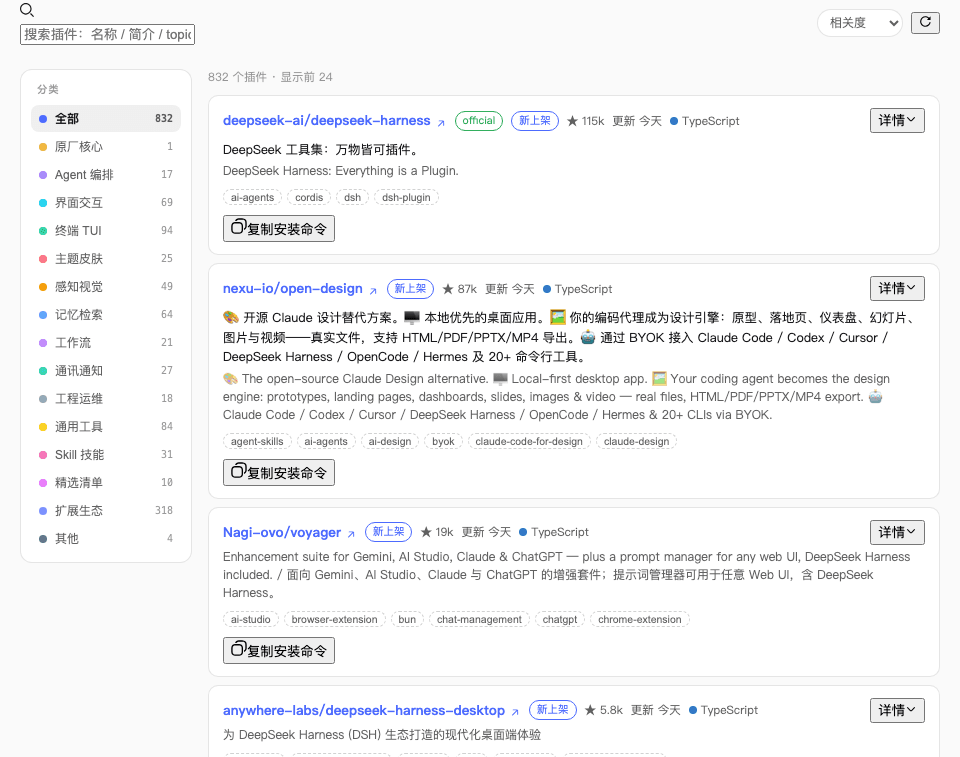
Home of dsh-plugin-hub: discover, evaluate, and install DeepSeek Harness (dsh) community plugins from inside dsh — plugi…
qomob/dsh
Home of dsh-plugin-hub: discover, evaluate, and install DeepSeek Harness (dsh) community plugins from inside dsh — plugi…
- lucky8197/dsh-weekly-digest DSH 插件:周报生成器——聚合最近 N 天的 git 提交、会话活动与每日记忆,自动生成 Markdown 周报,全程只读。Weekly Digest Generator for DeepSeek Harness.
- Samouswolf/DSH-Plugins DSH (DeepSeek Harness) 插件合集:DNA 记忆系统 + Agent 农场 + 进化引擎。零敏感、即插即用。 DSH plugins: DNA memory system + Agent Farm + Evolution…
- Winter-And-You-Gone/dsh-deep-verbs DeepSeek Harness 纯插件:思考状态行 'Deep diving...' 扩展为 53 条 deep 系短语的英/中双语池——回合开场随机一条,回合内随新思考段/工具调用切换(保底 3 秒),点击状态行切换中英文,不改 DSH…
-
 freestylefly/awesome-gpt-image-2
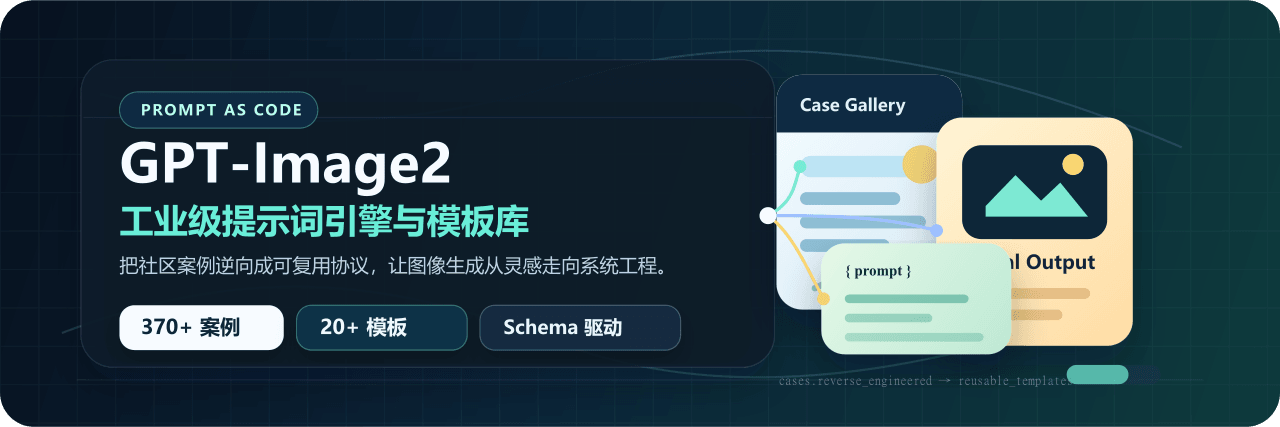
Prompt as Code | GPT Image 2 / 2.5 提示词与案例库,530+ 个案例、20+ 套工业级模板与可复用 Skills,新增 2.5 同提示词对比专区,附完整提示词与生成记录,持续更新。
freestylefly/awesome-gpt-image-2
Prompt as Code | GPT Image 2 / 2.5 提示词与案例库,530+ 个案例、20+ 套工业级模板与可复用 Skills,新增 2.5 同提示词对比专区,附完整提示词与生成记录,持续更新。