syyr1987/dsh-linghun
Linghun gives DeepSeek Harness agents a closing-mind identity, boundary-judgment discipline, and a hippocampus-style memory loop — every judgment has a source, every decision gets closed, and experience keeps flowing back into the next round. Endless planning is cut off by mechanism.
catalog descriptioncatalog 简介 / catalog description:灵魂(Linghun)— 给 DeepSeek Harness 装一个会思考的自我:认知循环 + 海马体三层记忆(序时账/情景归档/低置信降权遗忘)+ A2A 记忆管理团队联动。收口者身份锚点 + 边界判断纪律。
Project Overview项目介绍
Linghun (灵魂) is a native cognitive plugin purpose-built for the DeepSeek Harness (DSH) agent runtime, and it is installed with a single shell command: dsh plugin --profile web add dsh-linghun. The README pins the supported runtime to DSH >= 0.1.0-rc.7 and < 0.2.0, alongside Node.js >= 20.18, and ships as a bundle-manifest package named dsh-linghun. Once loaded, the plugin injects three prompt sections — soul:identity, soul:judgment, and soul:memory — and registers five tools (memory_append, memory_read, memory_consolidate, soul_read, soul_update) that govern both the soul card and the hippocampus-style memory loop.
The plugin is designed for users whose DSH agents plan endlessly but never close out: it introduces a "Closer" role, a six-class boundary-discipline scan, and a continuous cognition loop so every judgment has a source and every decision is finalized. On first launch, Linghun writes a default soul card to $DSH_HOME/linghun/identity.md; users edit four fields — name, personality, communication style, and an "Other" bucket — and changes apply immediately with no restart, while the agent itself can rewrite the card via soul_update. Memory lives under $DSH_HOME/linghun/memory/ as plain Markdown split into warm, episodic, and cold tiers.
Dependencies and limits are narrow: DSH plus Node.js are the only hard requirements, while tuning happens through cordis.patch.yml under the linghun.memory.assessment and linghun.memory.autoConsolidate namespaces, each gated by its own enabled switch. Engineering guardrails introduced in v0.2 — end-of-turn assessment and threshold-triggered consolidation — are enforced in code rather than by prompting, so the model cannot skip them by forgetting. Roadmap items LLM-distilled cold storage and dual-instance mutual verification remain unimplemented (targeted for v0.3 and v0.4), the project is MIT-licensed (© 2026 山越野人 & 岚客), and the only first-run caveat is to edit identity.md to set your persona.
Linghun(灵魂)是面向 DeepSeek Harness(DSH)代理的原生认知插件,通过 dsh plugin --profile web add dsh-linghun 命令安装,要求 DSH 版本不低于 0.1.0-rc.7 且低于 0.2.0,同时需要 Node.js 20.18 及以上运行环境。它以 bundle-manifest 形式打包,在代理提示中注入 soul:identity、soul:judgment、soul:memory 三个段,并对外暴露 memory_append、memory_read、memory_consolidate、soul_read、soul_update 五个工具,完整接管灵魂卡与海马体记忆循环。
该插件专为那些"只会规划不执行"的代理场景设计,提供收口者角色、边界判断纪律和六类边界扫描,适用于希望强化决策闭环、避免无止境推演的个人开发者与团队工作流。用户首次运行后可在 $DSH_HOME/linghun/identity.md 中编辑自己的灵魂卡,文件级身份优先级高于设置与内置默认值,代理也可通过 soul_update 自主迭代人格,记忆与卡片均以纯 Markdown 形式存储,便于搜索、版本管理与 Git 追踪。
依赖方面,插件需要在 cordis.patch.yml 中可调节 linghun.memory.assessment 与 autoConsolidate 的阈值与开关;v0.2 引入了回合结束评估与阈值自动合并机制,均由代码而非提示保证。当前版本不支持 LLM 蒸馏的冷存储与双实例交叉验证(规划于 v0.3/v0.4),MIT 协议开源,首次使用需注意修改 $DSH_HOME/linghun/identity.md 即可生效。
请帮我安装这个 DSH 插件。安装前先完成【兼容性检查 + 安全性检查】,检查通过再动手。

插件:dsh-linghun(syyr1987/dsh-linghun)
仓库:https://github.com/syyr1987/dsh-linghun
本站详情页:https://www.yhbd.top/plugins/syyr1987-dsh-linghun/
本站登记:类型 plugin · 归类 原生 DSH 插件 · 许可证 NOASSERTION · ⭐ 3 · 最近提交 2026-10-02 · 主语言 JavaScript

按下面顺序执行,每步先把结论告诉我,再进入下一步:

【1 兼容性检查】
① 我这边:DSH 版本、Node 版本、操作系统、当前 profile(web / desktop)。
② 读它的 README、package.json、插件 manifest,列出它要求的 DSH 版本 / Node 版本 / 操作系统 / 外部依赖 / 需要另外先装的运行时。
③ 逐条比对,结论只写「满足 / 不满足 / 未知」三种;不满足的给出可行替代方案。
④ 检查是否和我已装的插件冲突:命令名重复、skill / tool 重名、端口占用、重复注册的 MCP server。

【2 安全性检查】
① 仓库可信度:和上面「本站登记」是否一致;star / fork 数、创建时间、最近提交,是否归档或长期停更。
② 安装脚本:逐行看 package.json 的 preinstall / install / postinstall,以及 install.sh、setup.ps1 之类脚本。出现 curl|bash、下载后直接执行、混淆代码、访问与插件功能无关的域名,立刻停下来告诉我,不要继续装。
③ 依赖:列出新增依赖,标出无人维护、或与知名包拼写近似的可疑包(typosquatting)。
④ 权限与副作用:它会读写哪些目录、访问哪些域名、需要哪些 DSH 权限(filesystem / network / shell / clipboard 等),以及怎么卸载和回滚。
⑤ 如果它要求 sudo / 管理员权限,或权限明显超出功能所需,先停下来问我。

【3 安装】
上面两步没有「不满足」和「高危项」时才执行;用官方推荐方式安装,不要自行提权。

【4 汇报】
用表格输出:检查项 / 结论 / 依据 / 是否需要我决策。拿不准的一律写「未知」并说明要我怎么确认——不要猜,也不要替我决定。
Send this message to DSH in your current session: it verifies compatibility and security first (answering met / not met / unknown item by item) and only installs once everything checks out — it will stop and ask you if it finds a high-risk item. The box scrolls; the copy is the full prompt. CLI install commands may not be accurate across systems, so DSH is the safer route.把上面这条消息直接发给当前会话里的 DSH:它会先核对兼容性与安全性(逐条给「满足 / 不满足 / 未知」),确认没问题再安装,有高危项会停下来问你。框内可滚动,复制到的是完整提示词;安装命令不一定准确,发给 DSH 更稳。
- Only 3 stars - very few users, little community feedback星标只有 3,几乎没人在用,遇到问题缺少社区反馈
DSH walks through these 9 checksDSH 会逐条核对这 9 项
Compatibility兼容性
- DSH, Node, OS and profile requirementsDSH 版本 / Node 版本 / 操作系统 / profile 是否满足要求
- External dependencies and runtimes (Electron / Python / Docker, ...)外部依赖与运行时(Electron / Python / Docker 等)是否齐备
- Conflicts with installed plugins: command names, skill / tool names, ports, duplicate MCP registration与已装插件是否冲突:命令名、skill / tool 重名、端口占用、重复 MCP 注册
Security安全性
- Repo matches the facts registered here; archived or abandoned?仓库是否与页面登记一致,是否归档或长期停更
- Safety of preinstall / install / postinstall and install.sh / setup.ps1preinstall / install / postinstall 与 install.sh、setup.ps1 是否安全
- curl|bash, download-then-execute, obfuscation, unrelated domains → stop immediatelycurl|bash、下载即执行、混淆代码、无关域名 → 立刻停止
- Typosquatting or unmaintained packages among the new dependencies新增依赖里有没有 typosquatting 或无人维护的包
- Requested permissions vs. what the feature actually needs申请了哪些权限、是否超出功能所需(filesystem / network / shell / clipboard)
- Any sudo / admin requirement, plus uninstall and rollback是否要求 sudo / 管理员权限,以及卸载与回滚方式
Anything uncertain must be marked unknown with a note on how to confirm it. This site's signal screen is a static snapshot, not a security audit.拿不准的必须标「未知」并说明要我怎么确认。本站的信号筛查是静态快照,不能替代安全审计。
Or use CLI install (for developers)或使用命令行安装(适合开发者)
CLI Install命令行安装
dsh plugin --profile web add dsh-linghun把 syyr1987/dsh-linghun 加入你的 DSH 配置(web profile)即可启用。
READMEREADME
Linghun (灵魂) — End the Agent's Endless Planning
Your DeepSeek agent plans and plans, then does nothing. A page of strategy, zero execution. The model isn't weak — it's missing a closer. Linghun supplies it.
Linghun gives DeepSeek Harness agents a closing-mind identity, boundary-judgment discipline, and a hippocampus-style memory loop — every judgment has a source, every decision gets closed, and experience keeps flowing back into the next round. Endless planning is cut off by mechanism.
- The Closer (收口者): the LLM supplies intuition and candidate answers; the agent evaluates, filters, and closes — thinking, judging, and deciding happen on the agent's side. Planning must land.
- Boundary discipline: never force-precision on fuzzy concepts, never fake consistency on paradoxes, verify before asserting, never fabricate, and watch for "raise-the-cost-of-refusal" wording.
- Cognition loop: judgment has a source, feedback has attribution, improvement keeps its chain.
- Hippocampus (three-layer memory): warm buffer for recent facts → consolidation into episodic archive (same-day appends, never overwrites) → cold summary injected, so the same pit is not stepped into twice.
- Chronological ledger (序时账):
journal_readreturns the raw conversation ledger, archived by day — trace exactly what was said when, complementing the forgetful warm layer. - Confidence-weighted forgetting: every entry carries a confidence tag (high/medium/low).
Low-confidence entries inject with a 【需验证】 marker; entries overturned (
wrong) are flipped and excluded from injection — degraded confidence is a form of forgetting. - A2A memory team (linghun-assembler): share the cognitive-cycle team's ledger — judge
records, editor deliveries, archivist timelines — into the main brain via
memory_read. - Self-evolution: the agent reads and updates its own soul card via
soul_read/soul_update. - Closer's judgment role (判分身份职责): judgment/ruling tasks get a one-line identity role inside
soul:judgment— keep criteria consistent, bind every verdict to its source, judge only by the rules, never widen criteria to "seem useful", stop when the source of a criterion can't be stated. Drift signals and miss-kill anchors live in the judgment domain ontology (consult on demand, not injected every time). No separate supervision mechanism — low-pressure single-step judgment does not drift; reliability comes from domain rules, not from a monitor.
Showing the opening section of the README — the full document lives in the repository以上为 README 开头摘要,完整文档在仓库内 · View the full README on GitHub →在 GitHub 查看完整 README →
Related相关推荐
-
 ruvnet/ruflo
🌊 The original agent harness. Deploy intelligent multi-player swarms, coordinate autonomous workflows, and build conver…
ruvnet/ruflo
🌊 The original agent harness. Deploy intelligent multi-player swarms, coordinate autonomous workflows, and build conver…
-
 Tencent/WeKnora
Open-source LLM knowledge platform: turn raw documents into a queryable RAG, an autonomous reasoning agent, and a self-m…
Tencent/WeKnora
Open-source LLM knowledge platform: turn raw documents into a queryable RAG, an autonomous reasoning agent, and a self-m…
-
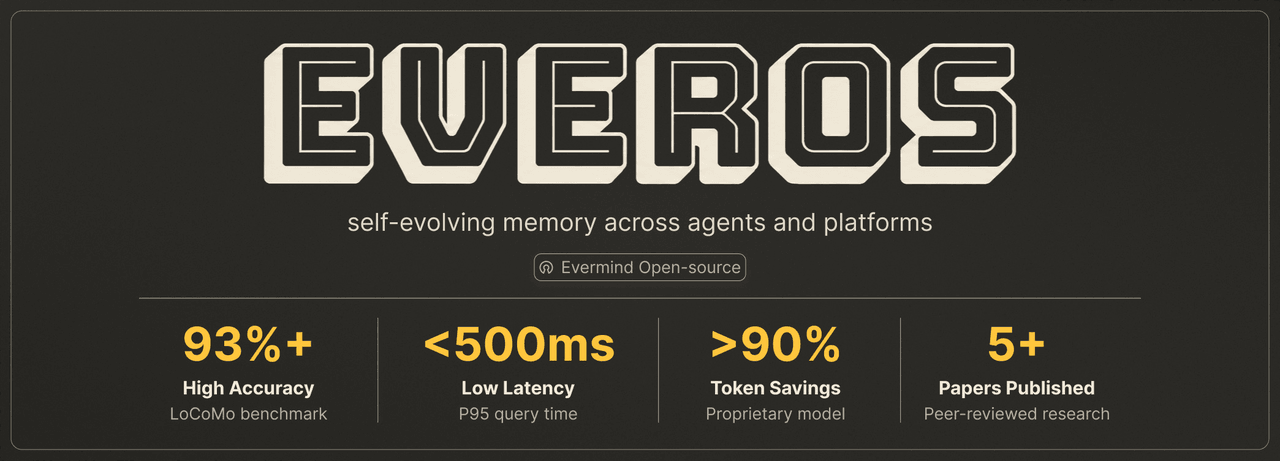 EverMind-AI/EverOS
One portable memory layer for every AI agent: local-first, Markdown-native, user-owned, and self-evolving across apps, t…
EverMind-AI/EverOS
One portable memory layer for every AI agent: local-first, Markdown-native, user-owned, and self-evolving across apps, t…
-
 MemTensor/MemOS
Self-evolving memory OS for LLM & AI Agents: ultra-persistent memory, hybrid-retrieval, and cross-task skill reuse, with…
MemTensor/MemOS
Self-evolving memory OS for LLM & AI Agents: ultra-persistent memory, hybrid-retrieval, and cross-task skill reuse, with…
-
 plastic-labs/honcho
Memory library for building stateful agents
plastic-labs/honcho
Memory library for building stateful agents
-
 agentscope-ai/ReMe
ReMe: Memory Management Kit for Agents - Remember Me, Refine Me.
agentscope-ai/ReMe
ReMe: Memory Management Kit for Agents - Remember Me, Refine Me.
-
 zilliztech/memsearch
A persistent, unified memory layer for all your AI agents (e.g. Claude Code, Codex, DSH), backed by Markdown and Milvus.
zilliztech/memsearch
A persistent, unified memory layer for all your AI agents (e.g. Claude Code, Codex, DSH), backed by Markdown and Milvus.
-
 vshulcz/deja-vu
The most accurate, cheapest and fastest memory for coding agents: searchable session history from Claude Code, Codex, Cu…
vshulcz/deja-vu
The most accurate, cheapest and fastest memory for coding agents: searchable session history from Claude Code, Codex, Cu…