tafcear/kimi-tide
DSH 里一个会话从头到尾只用一个模型:DeepSeek V4 便宜、快,但看不懂图片;Kimi K3 多模态、1M 超长上下文、编码强,但有额度与成本。写代码到一半想贴张截图,得手动切模型;切完又忘了切回来,额度哗哗流走。月汐就是这笔账的自动交警:你只管干活,它按任务类型、预算和模型长板,在每个步骤自动选路——选谁、为什么选,全都摆在面板上。
catalog 简介 / catalog descriptioncatalog description:🌊 kimi-tide(月汐)— DSH 模型路由插件:预设+规则驱动,每步自动在 Kimi 与 DeepSeek 间选路;图像护栏 + 配额面板 + 决策可观测 · preset+rule model router for DeepSeek Harness
安装Install
dsh plugin --profile web add github:tafcear/kimi-tide把 tafcear/kimi-tide 加入你的 DSH 配置(web profile)即可启用。
READMEREADME
🇨🇳 中文
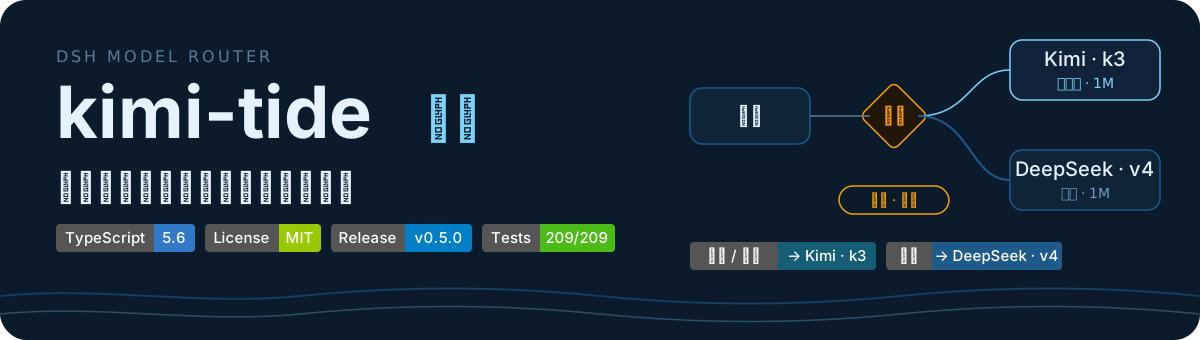
DSH 里一个会话从头到尾只用一个模型:DeepSeek V4 便宜、快,但看不懂图片;Kimi K3 多模态、1M 超长上下文、编码强,但有额度与成本。写代码到一半想贴张截图,得手动切模型;切完又忘了切回来,额度哗哗流走。月汐就是这笔账的自动交警:你只管干活,它按任务类型、预算和模型长板,在每个步骤自动选路——选谁、为什么选,全都摆在面板上。
架构
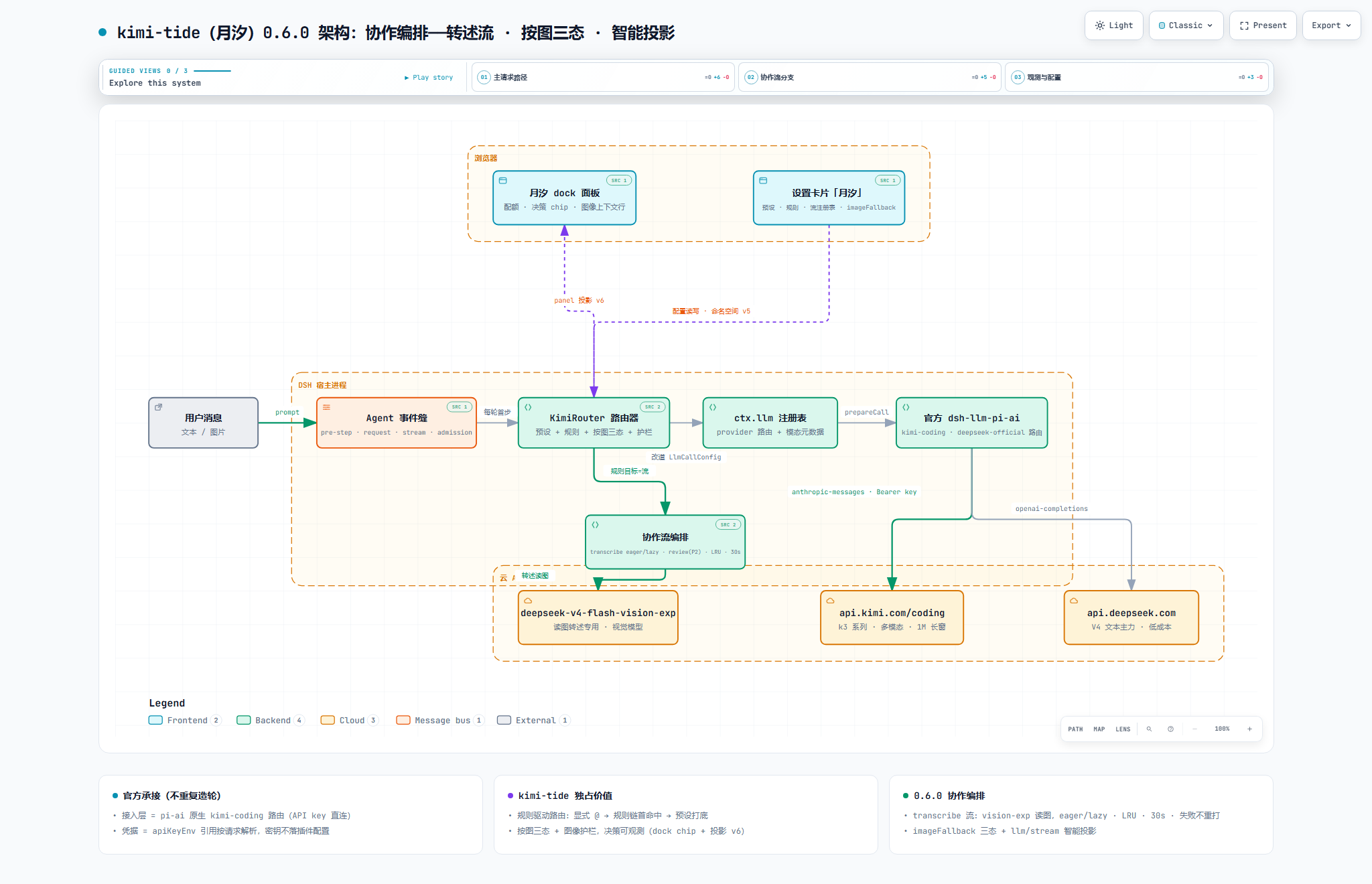
点击查看大图;
docs/assets/readme/kimi-tide-architecture.html下载后用浏览器打开,是可平移缩放/搜索/导出的交互式架构图(含明暗双主题)。
一次请求的决策流:
flowchart LR
    A["💬 你的消息<br>(本轮新消息)"] --> B{"显式 @模型?"}
    B -- "@kimi 等" --> H["🎯 显式指令<br>最高优先"]
    B -- 否 --> C["📏 预设规则链<br>带图 / 关键词组<br>首条命中生效"]
    C -- 命中 --> D["🌙 规则目标<br>(未接入则降级跳过)"]
    C -- 未命中 --> E["💰 预设默认模型<br>(打底)"]
    H --> J
    D --> F{"带图且目标<br>文本-only?"}
    E --> F
    F -- 是 --> G["🖼️ 图像护栏<br>改道多模态候选"]
    F -- 否 --> J["📋 dock 面板留痕<br>选谁 + 为什么"]
    G --> J
特性一览
- 🚦 预设路由:内置「省钱」「能力」两种预设,也可自建命名预设,设置卡片一键全局切换;按每个步骤决策,不是一会话绑定到死。
- 🎯 规则引擎(0.5.0):规则 =
带图/ 命名关键词组(内置「代码」「闲聊」两组,词表可改、可自建);首条命中生效,未命中走预设打底,不可用目标自动降级跳过。 - 🌊 协作编排(0.6.0):规则目标可指向协作流——预置图像转述流(vision-exp 读图转文字,eager/lazy 双时态,缓存+超时+失败不重打)与评审流(P2 触发);预设级带图兜底三态(锁存/盲答/懒转述);
llm/stream智能投影让文本模型凭转述文字接力看图。 - 🖼️ 图像护栏:带图消息自动改道多模态模型;按图三态状态表(native/transcribed/blind)防止历史含图后文本模型崩溃(
UNSUPPORTED_CONTENT)。 - 👁️ 决策可观测:dock 面板实时显示「这步选了谁、为什么」,会话日志留痕可复查——不黑箱。
- ⚙️ 官方设置卡片:路由配置就在 DSH「设置 → 月汐」里编辑,原生分层持久化,重启保持。
- 🔌 官方接入层(0.4.x):Kimi 模型经 pi-ai 原生
kimi-coding路由接入,一把 Console API Key 即可,不再需要 Kimi CLI 登录与令牌刷新。 - 📊 官方配额显示:dock 面板轮询 Kimi Code 用量接口,周配额 / 5h 窗口一目了然。
- ⌨️
/kimi-tide命令族:preset/show/set/export-config/import-config/refresh,配置可导出备份、可导入恢复。
快速开始
旧 OAuth 方案已退役,历史存档见
docs/legacy-setup.md。
1. 前置条件
- Node.js ≥ 22
- DSH
@deepseek-ai/dsh@0.1.1-rc.2及以上(0.6.0 起 peer 依赖;设置卡片依赖dsh-settings) - 一把 Kimi Code Console API Key(Kimi 控制台获取)
2. 配置 Kimi 路由(官方 Models 页)
DSH「设置 → Models」添加 provider kimi-coding,apiKeyEnv 填 KIMI_API_KEY(或自建引用名),在凭据区粘贴你的 Key。模型目录(k3 / k3-256k / kimi-for-coding / kimi-for-coding-highspeed)自动就位——密钥由 DSH 托管凭据存储,不落任何插件配置文件。
3. 安装插件
cd packages/dsh-kimi-tide
npm install && npm run build && npm pack
dsh plugin --profile web add ./dsh-kimi-tide-<version>.tgz
4. 用起来
重启 dsh web:
- 设置 → 月汐:在预设行选「省钱」或「能力」,路由器即刻上岗;
- 消息里
@kimi显式点将,或靠内置关键词组(如「代码」)自动改道; - dock 面板的 chip 实时显示每一步选了谁、为什么。
发布规范(重要):DSH 插件必须声明
dsh.bundle.patch(指向cordis.patch.yml)才能作为 profile 层加载。本插件已按官方规范声明,升级版本时请勿移除该字段。
项目思路
为什么做这个插件、以及它往哪里去——三段演进,三条原则。
timeline
    title 月汐演进路线
    0.1.x 接入 : 自研 OAuth 适配器把 Kimi Code 接进 DSH(能用了)
    0.2.x 路由 : 双模型自动分工 + dock 面板(会选了)
    0.3.0 评分 : 6 维能力评分引擎 + 决策留痕(选得有依据)
    0.4.x 收敛 : 官方设置卡片 + API key 直连,自研接入层退役(不重复造轮)
    0.5.0 规则 : 预设 + 规则驱动,评分引擎退役(好配、好懂)
    0.5.x+ 转述 : 图像转述模式(读图付费、正文省钱,rc.8 改设计)
- 第一段(自研接入):当初 DSH 没有 Kimi 通道,我们自研了 OAuth 适配器把订阅接进来。
- 第二段(路由与评分):接进来之后发现真正的痛点是「哪个任务该用谁」——于是有了双模型路由、能力评分和图像护栏。
- 第三段(收敛聚焦):宿主平台调研实锤 pi-ai 已原生内置 kimi-coding 路由(API key + 订阅 OAuth 双凭据)。自研接入层成了重复造轮,果断退役——月汐只做官方没有的事:路由、护栏、观测。0.5.0 更进一步:六维评分引擎整体退役,换成你能读懂、能改动的预设 + 规则。
三条原则:
- 官方优先:动手前先查官方生态;官方已提供的(适配器/设置页/模型选择器),坚决不重造。
- 规则透明:路由依据是人能读懂的预设与关键词组,不经黑箱打分;每条规则都可改、可排序、可删除。
- 决策可观测:每一次自动选路都有理由、有留痕、可复盘。
路由器详解
内置预设
| 预设 | 默认模型(打底) | 规则 | 适合谁 |
|---|---|---|---|
| 关闭 | — | — | 想完全手动选模型的人 |
| 省钱 | deepseek-v4-flash |
带图 → k3;代码关键词 → kimi-for-coding |
额度敏感、日常杂活多 |
| 能力 | k3 |
闲聊关键词 → deepseek-v4-flash;代码关键词 → kimi-for-coding |
追求最佳产出质量 |
预设即数据:内置预设与自定义预设同构,可在设置卡片新建/复制/删除命名预设、编辑规则与关键词组;activePreset 一键全局切换。
规则引擎(0.5.0)
- 规则条件:
带图/ 命名关键词组(内置「代码」「闲聊」两组,词表可改、可自建组)。 - 决策流:显式
@provider(最高优先)→ 预设规则链(列表顺序、首条目标可用者命中)→ 打底(预设默认模型)——未命中 ≠ 不动,而是路由到打底。 - 降级:规则目标未接入(不在全量枚举池)→ 自动跳过该规则,继续匹配/落打底;面板标灰提示。
- 候选枚举:从
ctx.llm实时目录全量枚举所有 provider 的模型并解析模态(0.5.0 起无白名单);配了但未接入的模型在面板标灰,不参与路由。
0.5.0 起能力评分引擎(六维评分/评分基线/预算窗口)整体退役——路由依据从「分数」变为「你写的规则」。v3 评分配置升级时自动迁移为预设(留档
.pre-v4),架构细节见packages/dsh-kimi-tide/docs/router.md。
图像护栏与锁存
- per-step 护栏:带图步骤命中文本-only 路由时按模态改道多模态候选(正确性护栏)。
- 宿主准入声明(
agent/image-admission,配合宿主补丁):新会话默认模型为文本-only 时,入口层先放行「会改道」的声明,带图轮才进得了 agent 循环。 - 会话锁存:图片一旦进入会话历史,该会话后续轮次强制按带图处理(带图规则必命中 + 护栏兜底改道多模态),防止文本模型序列化图片历史时崩溃。
已知限制
- 带图会话锁存死锁:锁存后整会话走多模态模型;若 Kimi 额度/Key 失效,会话无法切回文本模型(历史含图片)→ 只能新开会话。根解 = 图片不进主历史:「图像转述模式」改设计中(rc.2 宿主已提供 Modality/准入机制;子代理图片外包已裁撤——官方子代理仅文本)。
可用模型(经 kimi-coding 路由)
| 模型 ID | 说明 | 上下文 |
|---|---|---|
k3 |
Kimi K3 旗舰(多模态,1M 长窗) | 1M |
k3-256k |
Kimi K3 256K 版(多模态) | 256K |
kimi-for-coding |
Kimi K2.7 Code(多模态) | 256K |
kimi-for-coding-highspeed |
K2.7 Code 高速版(多模态) | 256K |
模态:4 模型在 pi-ai 目录均声明
input:["text","image"];DeepSeek 侧(deepseek-v4-flash/deepseek-v4-pro)为文本-only、1M 窗(pi-ai 目录实读)——多模态正是路由器要补偿的核心缺口。
配置
路由配置(设置 → 月汐,命名空间 kimi-tide-router,v4)
| 键 | 默认 | 说明 |
|---|---|---|
activePreset |
null |
激活预设 id(saving / capability / 自定义);null = 关闭 |
presets |
内置「省钱」「能力」 | 预设表:显示名 + 默认模型 + 有序规则表 |
presets.<id>.default |
— | 打底模型(未命中规则时的路由目标) |
presets.<id>.rules |
— | 规则表:条件(带图 / 关键词组)+ 目标模型,首条命中生效 |
keywordGroups |
内置 code / chitchat |
命名关键词组词表(用户可增删改) |
持久化:设置命名空间(base 层 = 部署基座 / user 层 = 用户编辑,revision 冲突检测)→ 无设置服务的宿主回退 sidecar 文件 → 旧 sidecar 迁移后留档
.legacy-imported;0.4.x 升级时kimi-tide/*命名自动迁移为kimi-coding/*并留档.pre-v3;0.5.0 升级时 v1-v3 评分配置自动迁移为预设/规则(v4)并留档.pre-v4(scores/预算参数不迁移)。
插件级配置(cordis.patch.yml,0.4.x 起大幅精简)
| 键 | 默认 | 说明 |
|---|---|---|
usagePollMs |
60000 |
dock 配额轮询周期(毫秒) |
usagePollOnStart |
true |
启动时立即轮询配额 |
patchFile |
$DSH_HOME/profiles/web/cordis.patch.yml |
legacy 静态种子的部署基座(仅 base 层) |
sidecarFile |
<patch 目录>/kimi-tide-router.yml |
无设置服务宿主的回退存储 |
文档索引
docs/superpowers/specs/2026-08-20-api-key-direct-design.md:0.4.x API key 直连设计稿(已定稿)。docs/host-platform-map.md:DSH 宿主平台契约调研(0.4.x/rc.2 升级的认知基线)。docs/positioning.md:项目定位与维护策略。docs/development-plan-router.md:路由器开发计划(M1-M7)。packages/dsh-kimi-tide/docs/router.md:0.5.0 规则驱动路由架构(预设/规则/打底/降级/迁移链)。docs/agent-collaboration-loop.md:双模型协作闭环方法论(本项目自己的开发方式)。docs/legacy-setup.md:旧接入方案存档(0.4.x 起被官方路由取代)。
开发与测试
cd packages/dsh-kimi-tide
npm install
npm run typecheck   # tsc --noEmit
npm test            # vitest(当前 337/337 通过,24 个测试文件)
npm run build       # tsc 宿主 + esbuild 浏览器 half
质量基线:全量测试绿 + typecheck 0 错误 + build 通过方可提交。本仓库实践「实施 → 独立审查(Kimi 真身)→ 修复 → 复检验收」双模型协作闭环(见 docs/agent-collaboration-loop.md)。
路线图
当前版本:v0.6.0(2026-08-23 发布)——协作编排。Release · Actions 流水线(tag 触发全自动)
| 版本线 | 状态 | 证据锚点 |
|---|---|---|
| v0.1.3 | ✅ 已发布(仅凭据门控 + OAuth 加固) | tag e2a2eb4,Release 页 |
| 0.2.x 双模型路由器 | ✅ 已随 v0.4.0 发布 | 71b1d18 / 16a75d0 / fcbf421,M5 双探针 + 带图闭环 |
| 0.3.0 能力评分路由 | ✅ 已随 v0.4.0 发布 | 86da918(203/203 绿) |
| 0.4.0 设置界面迁移 + API key 直连 | ✅ 已发布(2026-08-20) | tag v0.4.0,Release,216/216 绿 |
| 0.5.0 规则驱动路由 | ✅ 已发布(2026-08-21) | tag v0.5.0,Release,209/209 绿 |
| 0.6.0 协作编排 | ✅ 已发布(2026-08-23) | tag v0.6.0,Release,337/337 绿 + typecheck 0 + build 过;实机验收 10 项全过(含 T4 门);验收修复 e2d3c68(rc.2 宿主 model-selection 覆盖) |
- 0.1.x:DSH 原生 Kimi provider,v0.1.3(凭据门控 + OAuth 加固)。
- 0.2.x:双模型路由器 + dock 面板 + 用量显示;失效修复闭环与 M5 实机验证 ✅。
- 0.3.0:能力评分路由(11 任务 TDD,
86da918),手工验收 7/7 ✅。 - 0.4.0:设置界面迁移(
bc31b69)+ API key 直连(pi-ai 原生kimi-coding路由,自研 OAuth 接入层退役,provider 改名自动迁移,设计稿);配套 GitHub Actions Release 流水线 ✅(tag 触发全自动);滑杆步进修 ✅(a45d722)。 - 0.5.0:规则驱动路由——命名预设(省钱/能力/可自建)+ 有序规则(带图 / 关键词组)+ 打底语义 + 不可用降级,一键全局切换;能力评分引擎整体退役(scores/classify/预算窗/评分滑杆全删),候选池改全量枚举,v1-v3 存量配置自动迁移留档
.pre-v4(设计稿,发布版 209/209 绿 + typecheck 0 + build 过;实机验收含迁移缺陷修复)。 - 0.6.0:协作编排——规则目标泛化为「模型 | 协作流」,预置图像转述流(vision-exp,eager/lazy)与评审流(P2 触发)注册但不绑定;按图三态状态表退役布尔锁存;预设级
imageFallback三态(锁存/盲答/懒转述);llm/stream智能投影(已转述图块 → 转述文字);面板 v6 图像上下文行 + 流事件;v4 存量配置自动迁移留档.pre-v5(设计稿,发布版 337/337 绿 + typecheck 0 + build 过;实机验收 10 项全过含 T4 门,验收中修复 rc.2 宿主 model-selection 覆盖路由缺陷e2d3c68)。 - 规划中:review 流命令式触发(P2,
/kimi-tide review)、子代理转述机制(P3,S2 契约 GO);面板图像上下文行客户端渲染(0.6.x 跟进池)。模式预设(现有设置卡片已满足,不立项)、子代理图片外包(官方子代理仅文本,裁撤)、kimi 子代理后端(经路由已实现,关闭)。
FAQ
Q:v0.4.0 之前 README 说的 OAuth 接入去哪了?
A:退役了。宿主调研实锤 pi-ai 原生内置 kimi-coding 路由(API key + 订阅 OAuth 双凭据),自研接入层属于重复造轮,0.4.x 整体删除(约 740 行),插件只保留路由/护栏/观测这些官方没有的能力。旧方案存档见 docs/legacy-setup.md。
Q:我还需要装 Kimi CLI 并 kimi login 吗?
A:v0.4.0 起不需要。一把 Console API Key + 官方 Models 页配置即可。
Q:带图会话有什么限制?
A:图片进入会话历史后会话锁存多模态模型;若 Kimi 额度/Key 失效,会话无法切回文本模型 → 死锁,只能新开。根解(图像转述模式)改设计中(子代理外包已裁撤);落地前重要带图任务请保持 Kimi 侧额度健康。
Q:0.5.0 的能力评分引擎去哪了?
A:退役了。规则驱动取代六维评分:预设(默认模型 + 有序规则)+ 关键词组,命中即路由、未命中走打底——每个决策你都能读懂、改得动。v3 评分配置升级时自动迁移为预设(.pre-v4 留档),评分表本身不迁移。
Q:路由配置存在哪里?
A:DSH 设置命名空间 kimi-tide-router(设置 → 月汐编辑);无设置服务的宿主回退 sidecar 文件;0.4.x 升级自动把 kimi-tide/* 改名为 kimi-coding/*(留档 .pre-v3),0.5.0 升级自动迁移为 v4 预设/规则形状(留档 .pre-v4)。

许可证与合规提示
- kimi-tide 本体:MIT(Copyright 2026 kimi-tide contributors)
- 第三方组件:
@earendil-works/pi-ai(MIT)、@deepseek-ai/dsh-llm-pi-ai(MIT, DeepSeek)、schemastery(MIT)、yaml(MIT)、dsh-kimi-bridge(MIT) - 合规:0.4.x 起默认走 Console API Key 官方路径,个人使用安心;Kimi Code 订阅条款仍以官方表述为准,请勿高频批量调用或共享密钥。
- 本仓库不含任何凭据;请勿将
~/.dsh/.credentials.yaml、环境变量中的密钥提交到仓库。
🇬🇧 English
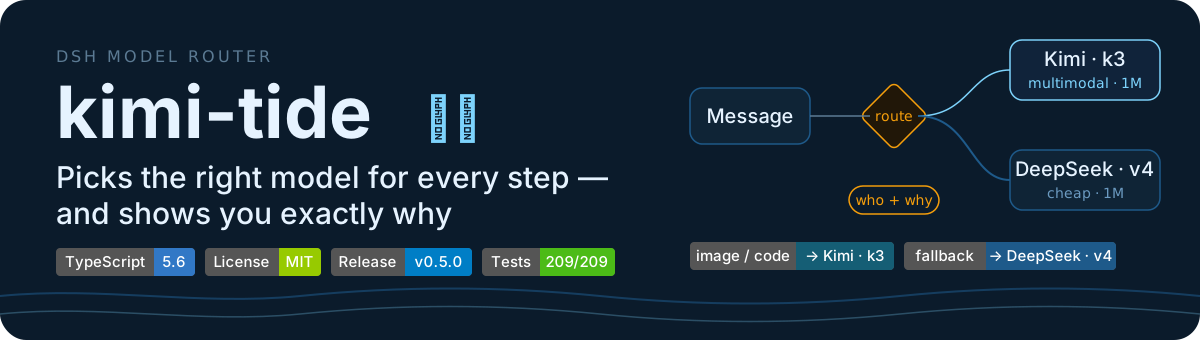
In DSH, a session sticks to one model from start to finish. But in reality: DeepSeek V4 is cheap and fast, but cannot see images; Kimi K3 is multimodal with a 1M context window and strong coding, but it costs quota and money. Mid-task you want to paste a screenshot — switch models by hand; then you forget to switch back and quota burns away. kimi-tide is the automatic traffic controller for that trade-off: you just do the work; it picks the route per step based on task type, budget, and each model's strengths — and shows you who it picked and why, right on the panel.
Architecture
Click for the full-size image; open
docs/assets/readme/kimi-tide-architecture.htmlin a browser for the interactive diagram (pan/zoom/search/export, light & dark themes).
The decision flow of one request:
flowchart LR
    A["💬 Your message<br>(new this turn)"] --> B{"Explicit @model?"}
    B -- "@kimi etc." --> H["🎯 Explicit directive<br>highest priority"]
    B -- no --> C["📏 Preset rule chain<br>image / keyword groups<br>first hit wins"]
    C -- hit --> D["🌙 Rule target<br>(skipped if unavailable)"]
    C -- miss --> E["💰 Preset default<br>(baseline)"]
    H --> J
    D --> F{"Image step on a<br>text-only target?"}
    E --> F
    F -- yes --> G["🖼️ Image guard<br>reroute to multimodal"]
    F -- no --> J["📋 dock trail<br>who + why"]
    G --> J
Features
- 🚦 Preset-based routing: built-in "saving" and "capability" presets, plus your own named presets, switched globally from the settings card; decisions are made per step, not per session.
- 🎯 Rule-driven routing (0.5.0): a rule is image-bearing or a named keyword group (built-in "code" and "chitchat", custom groups allowed); first hit in list order wins; a miss routes to the preset default (baseline), and unavailable rule targets are skipped automatically.
- 🌊 Collaboration flows (0.6.0): rule targets may point at a collaboration flow — the built-in image-transcribe flow (vision-exp reads images into text, eager/lazy timing, cache + timeout + no-retry-on-failure) and a review flow (P2 trigger); per-preset image fallback (latch/blind/transcribe-lazy);
llm/streamsmart projection lets text models pick up image context from the transcription. - 🖼️ Image guard: image-bearing steps reroute to multimodal candidates automatically; the per-image three-state table (native/transcribed/blind) prevents text-model crashes (
UNSUPPORTED_CONTENT) once images enter history. - 👁️ Observable decisions: the dock panel shows "who was picked and why" for every step, with session-log traceability — no black box.
- ⚙️ Official settings card: router config lives in DSH "Settings → 月汐", natively persisted with layered overrides and restart-safe storage.
- 🔌 Official access layer (0.4.x): Kimi models arrive via the pi-ai native
kimi-codingroute — one Console API key is all you need; no Kimi CLI login or token refresh anymore. - 📊 Official quota display: the dock polls the Kimi Code usage endpoint — weekly quota and 5h window at a glance.
- ⌨️
/kimi-tidecommand family:preset/show/set/export-config/import-config/refresh— export, back up, and restore your config.
Quick Start
The old OAuth form is retired; archived in
docs/legacy-setup.md.
1. Prerequisites
- Node.js ≥ 22
- DSH
@deepseek-ai/dsh@0.1.1-rc.2or newer (peer dependency since 0.6.0; the settings card needsdsh-settings) - A Kimi Code Console API key (from the Kimi console)
2. Configure the Kimi route (official Models page)
In DSH "Settings → Models", add provider kimi-coding, set apiKeyEnv to KIMI_API_KEY (or your own reference name), and paste your key into the credential area. The model catalog (k3 / k3-256k / kimi-for-coding / kimi-for-coding-highspeed) appears automatically — the secret lives in the DSH managed credential store, never in any plugin config file.
3. Install the plugin
cd packages/dsh-kimi-tide
npm install && npm run build && npm pack
dsh plugin --profile web add ./dsh-kimi-tide-<version>.tgz
4. Use it
Restart dsh web:
- Settings → 月汐: pick the "saving" or "capability" preset — the router is on duty;
- Type
@kimiin a message for an explicit pick, or let the built-in keyword groups (e.g. "code") reroute automatically; - The dock chip shows who was picked and why, for every step.
Release rule (important): a DSH plugin must declare
dsh.bundle.patch(pointing atcordis.patch.yml) to load as a profile layer. This plugin follows the official spec — do not remove the field when bumping versions.
Project Story
Why this plugin exists and where it is heading — three phases, three principles.
timeline
    title kimi-tide evolution
    0.1.x Access : Self-built OAuth adapter brings Kimi Code into DSH (it works)
    0.2.x Routing : Dual-model auto-routing + dock panel (it picks)
    0.3.0 Scoring : 6-dim capability engine + decision trails (picks with evidence)
    0.4.x Convergence : Official settings card + API-key direct; self-built access retired (no reinvented wheels)
    0.5.0 Rules : Rule-driven routing — named presets + keyword groups; scoring engine retired (simple to configure)
    0.5.x+ Transcription : Image transcription mode (pay for vision, not the body; redesigned for rc.8)
- Phase 1 (self-built access): DSH had no Kimi channel, so we built an OAuth adapter to bring the subscription in.
- Phase 2 (routing & scoring): once connected, the real pain became "which model should take which task" — hence the dual-model router, capability scoring, and the image guard.
- Phase 3 (convergence): host-platform research proved pi-ai natively ships the
kimi-codingroute (API key + subscription OAuth). The self-built access layer became a reinvented wheel and was retired — kimi-tide now does only what the official ecosystem lacks: routing, guarding, and observability. In 0.5.0 we went one step further: the six-dimension scoring engine is retired in favor of presets + rules you can read and edit.
Three principles:
- Official first: check the official ecosystem before writing code; never rebuild what it already provides (adapters / settings pages / model pickers).
- Transparent rules: routing decisions come from presets and keyword groups a human can read — no black-box scoring; every rule is editable, reorderable, deletable.
- Observable decisions: every automatic routing choice has a reason, a trail, and a replay path.
Router in Detail
Built-in Presets
| Preset | Default model (baseline) | Rules | Best for |
|---|---|---|---|
| Off | — | — | full manual control |
| Saving (省钱) | deepseek-v4-flash |
image → k3; code keywords → kimi-for-coding |
quota-sensitive daily work |
| Capability (能力) | k3 |
chitchat keywords → deepseek-v4-flash; code keywords → kimi-for-coding |
best output quality |
Presets are data: built-ins and custom presets share one shape — create/duplicate/delete named presets and edit rules and keyword groups in the settings card; activePreset switches globally in one click.
Rule Engine (0.5.0)
- Rule conditions:
image/ a named keyword group (built-in "code" and "chitchat"; editable word lists, custom groups allowed). - Decision flow: explicit
@provider(highest priority) → preset rule chain (list order, first hit with an available target wins) → baseline (preset default) — a miss is not "do nothing", it routes to the baseline. - Degradation: a rule target absent from the full enumeration pool is skipped automatically (fall through to later rules / baseline) and greyed out in the panel.
- Candidate enumeration: models are enumerated live from the
ctx.llmcatalog across all providers (no whitelist since 0.5.0), with modalities resolved; configured-but-unavailable models render greyed out and are skipped when routing.
Since 0.5.0 the capability scoring engine (six dimensions / score baselines / budget window) is fully retired — routing now follows "rules you wrote", not scores. v3 scoring configs auto-migrate into presets on upgrade (
.pre-v4backup); architecture details:packages/dsh-kimi-tide/docs/router.md.
Image Guard and Latching
- Per-step guard: an image step hitting a text-only route is rerouted to a multimodal candidate by modality (a correctness guard).
- Host admission claim (
agent/image-admission, with a host hotfix): on a fresh session whose default model is text-only, the router claims "will reroute" at the entry gate so the image step reaches the agent loop. - Session latching: once an image enters history, later turns are forced to be treated as image-bearing (image rules always hit + the guard reroutes to multimodal), preventing text-only serialization from crashing on image history.
Known Limitations
- Image-latch deadlock: after latching, the whole session runs on the multimodal model; if the Kimi quota/key fails, the session cannot switch back to a text model (history contains images) → open a new session. Root fix = images never enter the main history: the "image transcription mode" is being redesigned (the rc.2 host now ships the modality/admission machinery; subagent image outsourcing was dropped — official subagents are text-only).
Available Models (via the kimi-coding route)
| Model ID | Description | Context |
|---|---|---|
k3 |
Kimi K3 flagship (multimodal, 1M window) | 1M |
k3-256k |
Kimi K3 256K (multimodal) | 256K |
kimi-for-coding |
Kimi K2.7 Code (multimodal) | 256K |
kimi-for-coding-highspeed |
K2.7 Code high-speed (multimodal) | 256K |
Modalities: all 4 models declare
input: ["text", "image"]in the pi-ai catalog; the DeepSeek side (deepseek-v4-flash/deepseek-v4-pro) is text-only with a 1M window (catalog verified) — multimodality is the router's core gap to compensate.
Configuration
Router config (Settings → 月汐, namespace kimi-tide-router, v4)
| Key | Default | Description |
|---|---|---|
activePreset |
null |
active preset id (saving / capability / custom); null = off |
presets |
built-in saving/capability | preset table: display name + default model + ordered rules |
presets.<id>.default |
— | baseline model (route target when no rule hits) |
presets.<id>.rules |
— | rule table: condition (image / keyword group) + target model, first hit wins |
keywordGroups |
built-in code / chitchat |
named keyword-group word lists (user-editable) |
Persistence: settings namespace (base layer = deployment seed / user layer = edits, revision conflict detection) → sidecar fallback on hosts without a settings service → the old sidecar is archived as
.legacy-imported; on 0.4.x upgrade,kimi-tide/*names auto-migrate tokimi-coding/*with a.pre-v3backup; on 0.5.0 upgrade, v1-v3 scoring configs auto-migrate into the v4 preset/rule shape with a.pre-v4backup (scores/budget knobs are not migrated).
Plugin-level (cordis.patch.yml, greatly slimmed since 0.4.x)
| Key | Default | Description |
|---|---|---|
usagePollMs |
60000 |
dock quota poll period (ms) |
usagePollOnStart |
true |
poll quota at startup |
patchFile |
$DSH_HOME/profiles/web/cordis.patch.yml |
legacy static seed, base layer only |
sidecarFile |
<patch dir>/kimi-tide-router.yml |
fallback store without a settings service |
Documentation Index
docs/superpowers/specs/2026-08-20-api-key-direct-design.md: 0.4.x API-key direct-connection design (finalized).docs/host-platform-map.md: DSH host-platform contract research (the cognitive baseline for 0.4.x and the rc.2 upgrade).docs/positioning.md: project positioning & maintenance strategy.docs/development-plan-router.md: router development plan (M1-M7).packages/dsh-kimi-tide/docs/router.md: 0.5.0 rule-driven routing architecture (presets / rules / baseline / degradation / migration chain).docs/agent-collaboration-loop.md: the dual-model collaboration loop this project itself is built with.docs/legacy-setup.md: legacy access paths archive (superseded by the official route in 0.4.x).
Development & Testing
cd packages/dsh-kimi-tide
npm install
npm run typecheck   # tsc --noEmit
npm test            # vitest (currently 337/337 passing across 24 test files)
npm run build       # tsc host build + esbuild browser bundle
Quality bar: full test suite green + zero typecheck errors + successful build before committing. This repository practices an "implement → independent review (real Kimi) → fix → re-check" dual-model loop (see docs/agent-collaboration-loop.md).
Roadmap
Current version: v0.6.0 (released 2026-08-23) — collaboration flows. Release · Actions pipeline (tag-triggered, fully automated)
| Line | Status | Evidence |
|---|---|---|
| v0.1.3 | ✅ Released (credential gating + OAuth hardening only) | tag e2a2eb4, Release page |
| 0.2.x dual-model router | ✅ Shipped with v0.4.0 | 71b1d18 / 16a75d0 / fcbf421, M5 dual-probe + image roundtrip |
| 0.3.0 capability-scored routing | ✅ Shipped with v0.4.0 | 86da918 (203/203 green) |
| 0.4.0 settings migration + API-key direct | ✅ Released (2026-08-20) | tag v0.4.0, Release, 216/216 green |
| 0.5.0 rule-driven routing | ✅ Released (2026-08-21) | tag v0.5.0, Release, 209/209 green |
| 0.6.0 collaboration flows | ✅ Released (2026-08-23) | tag v0.6.0, Release, 337/337 green + typecheck 0 + build ok; 10-item live acceptance all passed (incl. T4 gate); acceptance fix e2d3c68 (rc.2 host model-selection override) |
- 0.1.x: native DSH Kimi provider, v0.1.3 (credential gating + OAuth hardening).
- 0.2.x: dual-model router + dock panel + usage display; failure-fix loop closed and M5 live verification ✅.
- 0.3.0: capability-scored routing (11 TDD tasks,
86da918), manual acceptance 7/7 ✅. - 0.4.0: settings migration (
bc31b69) plus API-key direct connection (pi-ai nativekimi-codingroute, self-built OAuth access retired, provider-rename auto-migration — design spec); GitHub Actions release pipeline ✅ (fully automatic on tag); slider step fix ✅ (a45d722). - 0.5.0: rule-driven routing — named presets (saving/capability/custom) + ordered rules (image / keyword groups) + baseline semantics + unavailable-target degradation, one-click global switch; the capability scoring engine is fully retired (scores/classify/budget window/score sliders all removed), the candidate pool is now a full enumeration, and v1-v3 stored configs auto-migrate with a
.pre-v4backup (design spec; release version: 209/209 green + typecheck 0 + build ok; live acceptance included a migration-defect fix). - 0.6.0: collaboration flows — rule targets generalize to "model | collaboration flow"; the built-in image-transcribe flow (vision-exp, eager/lazy) and review flow (P2 trigger) ship registered but unbound; the per-image three-state table retires the boolean latch; per-preset
imageFallback(latch/blind/transcribe-lazy);llm/streamsmart projection (transcribed blocks → transcription text); panel v6 gains the image-context line + flow events; v4 stored configs auto-migrate with a.pre-v5backup (design spec; release version: 337/337 green + typecheck 0 + build ok; 10-item live acceptance all passed incl. the T4 gate; fixed the rc.2 host model-selection override during acceptance —e2d3c68). - Planned: review-flow command trigger (P2,
/kimi-tide review), subagent transcription (P3, S2 contract GO); panel image-context client rendering (0.6.x pool).Mode presets(the existing settings card suffices — not planned),subagent image outsourcing(official subagents are text-only — dropped),kimi subagent backend(achieved via routing — closed).
FAQ
Q: Where did the OAuth access described in the old README go?
A: Retired. Host research proved pi-ai natively ships the kimi-coding route (API key + subscription OAuth), so the self-built access layer was a reinvented wheel — removed wholesale in 0.4.x (~740 lines). The plugin keeps only what the official ecosystem lacks: routing, guarding, observability. Legacy paths: docs/legacy-setup.md.
Q: Do I still need the Kimi CLI and kimi login?
A: Not since v0.4.0. One Console API key + the official Models page is all it takes.
Q: What are the image-session limitations?
A: Once an image enters history, the session latches onto the multimodal model; if the Kimi quota/key fails, the session cannot switch back → deadlock; open a new session. The root fix (image transcription mode, redesigned for rc.8) is planned; until then keep the Kimi quota healthy for important image tasks.
Q: Where did the capability scoring engine go in 0.5.0?
A: Retired. Rule-driven routing replaces six-dimension scoring: a preset (default model + ordered rules) plus keyword groups — a hit routes, a miss falls to the baseline, and every decision is readable and editable. v3 scoring configs auto-migrate into presets on upgrade (.pre-v4 backup); the score tables themselves are not migrated.
Q: Where is the router configuration stored?
A: In the DSH settings namespace kimi-tide-router (edited via Settings → 月汐); hosts without a settings service fall back to the sidecar file; on 0.4.x upgrade, kimi-tide/* names auto-migrate to kimi-coding/* (.pre-v3 backup), and on 0.5.0 upgrade configs auto-migrate into the v4 preset/rule shape (.pre-v4 backup).
License & Compliance
- kimi-tide itself: MIT (Copyright 2026 kimi-tide contributors)
- Third-party components:
@earendil-works/pi-ai(MIT),@deepseek-ai/dsh-llm-pi-ai(MIT, DeepSeek),schemastery(MIT),yaml(MIT),dsh-kimi-bridge(MIT) - Compliance: since 0.4.x the default path is the official Console API key, which is safe for personal use; Kimi Code subscription terms still apply as officially stated — no high-frequency batch calls or key sharing.
- This repository contains no credentials; never commit
~/.dsh/.credentials.yamlor any key from your environment.
相关推荐Related
- deepseek-ai/deepseek-harness DeepSeek Harness: Everything is a Plugin.
- deepseek-ai/deepseek-harness DeepSeek Harness (dsh) — 由 DeepSeek AI 开发的开源 agent harness(智能体框架)。一切皆插件:核心 + 插件 + 技能 = 可热插拔的 AI 编程工作台。DeepSeek Harness: …
-
 ruvnet/ruflo
🌊 The original agent meta-harness. Deploy intelligent multi-player swarms, coordinate autonomous workflows, and build c…
ruvnet/ruflo
🌊 The original agent meta-harness. Deploy intelligent multi-player swarms, coordinate autonomous workflows, and build c…
-
 amruthpillai/reactive-resume
A one-of-a-kind resume builder that keeps your privacy in mind. Completely secure, customizable, portable, open-source a…
amruthpillai/reactive-resume
A one-of-a-kind resume builder that keeps your privacy in mind. Completely secure, customizable, portable, open-source a…
-
 volcengine/OpenViking
Self-evolving Context Database for AI Agents. Unify Agent Memory, Knowledge RAG and Skills.
volcengine/OpenViking
Self-evolving Context Database for AI Agents. Unify Agent Memory, Knowledge RAG and Skills.
-
 Molunerfinn/PicGo
:rocket: The Ultimate Image Uploader for Efficient Creators. Supports Obsidian, Typora, VS Code etc. and 60+ image hosti…
Molunerfinn/PicGo
:rocket: The Ultimate Image Uploader for Efficient Creators. Supports Obsidian, Typora, VS Code etc. and 60+ image hosti…
-
 titanwings/colleague-skill
将冰冷的离别化为温暖的 Skill,欢迎加入数字生命1.0!Transforming cold farewells into warm skills? It's giving rebirth era. Welcome to Digital …
titanwings/colleague-skill
将冰冷的离别化为温暖的 Skill,欢迎加入数字生命1.0!Transforming cold farewells into warm skills? It's giving rebirth era. Welcome to Digital …
-
 nocobase/nocobase
NocoBase is an open-source AI + no-code platform for building business systems fast. Instead of generating everything fr…
nocobase/nocobase
NocoBase is an open-source AI + no-code platform for building business systems fast. Instead of generating everything fr…