tbxy09/dsh-replay-lab
用于DeepSeek Harness的受控请求面回放与回归工作台
项目介绍Project Overview
DSH Replay Lab 是 DeepSeek Harness 插件,用于请求面回放与 A/B 实验:冻结回合、隔离候选会话,对比请求面、轨迹与成本。适合复现长轨迹、工具循环及预设回归。注意:候选文件变更会在运行后恢复,源会话不被改写。
DSH Replay Lab is a DeepSeek Harness plugin for request-surface replay and A/B experiments. It freezes a completed turn, isolates a candidate session, and compares request surfaces, trajectories, costs, errors, and outcomes. Use it to reproduce long agent trajectories, tool-call loops, or preset-dependent regressions. Caveat: candidate file mutations are restored after the run; the source session is never rewritten.
请帮我了解并安装插件:【dsh-replay-lab】【https://github.com/tbxy09/dsh-replay-lab】把上面这条消息直接发给当前会话里的 DSH,让它帮你了解并安装。安装命令不一定准确,发给 DSH 更稳。Send this message to DSH in your current session. CLI install commands may not be accurate across systems — DSH will figure it out for you.
或使用命令行安装(适合开发者)Or use CLI install (for developers)
命令行安装CLI Install
dsh plugin --profile web add @webwalkerhq/dsh-replay-lab@0.1.5把 tbxy09/dsh-replay-lab 加入你的 DSH 配置(web profile)即可启用。
READMEREADME
English | 简体中文
DSH Replay Lab (ReplayLab)
DSH Replay Lab is a DeepSeek Harness plugin for request-surface replay and A/B experiments: freeze a turn, isolate the candidate session, and compare request surfaces, trajectories, and cost.
Replay the request surface, not just the prompt.
dsh-replay-lab is a DeepSeek Harness plugin for replaying completed agent
turns against different presets or plugins and comparing their request surfaces,
trajectories, costs, errors, and outcomes.
Use it to reproduce and debug long agent trajectories, repeated tool-call loops, no-progress turns, and preset- or plugin-dependent regressions.
Freeze a completed DeepSeek Harness turn, approve one isolated candidate, and compare outcome, trajectory, errors, cost, and the request surface that produced them. The source session and workspace are never rewritten or reverted. Candidate file mutations are restored to the replay checkpoint after the run, while durable session events and comparison evidence remain available.
Install · Verify · Security · DeepSeek Harness


Sandboxed evidence dashboard
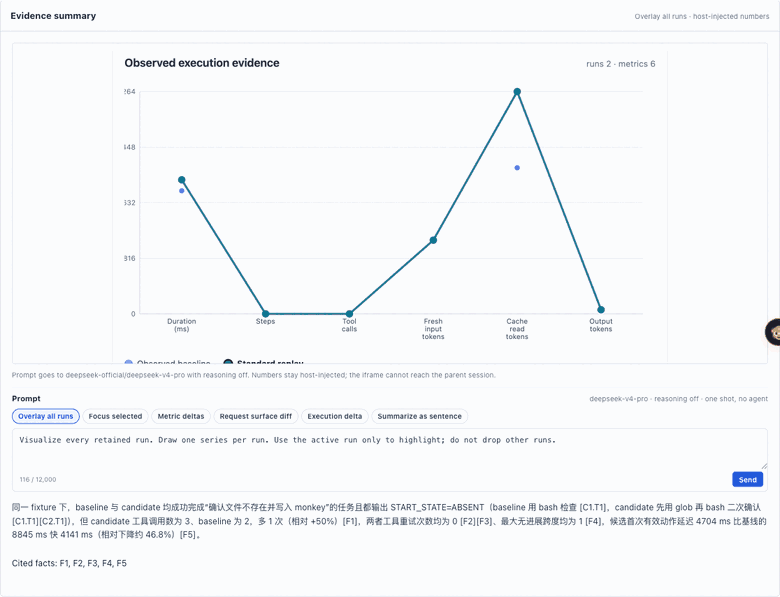
Open a retained replay, pick a prompt preset or type any prompt, then Send. The model returns HTML into an opaque-origin iframe; every number is host-injected from the replay payload. Presets are starters. You can ask for a radar, callouts, a diff, a table, or any other visualization the payload can support. Invalid HTML falls back to the host chart.
The GIF shows Send, the Prompt in flight overlay, then the redraw (Execution delta → Request surface diff).
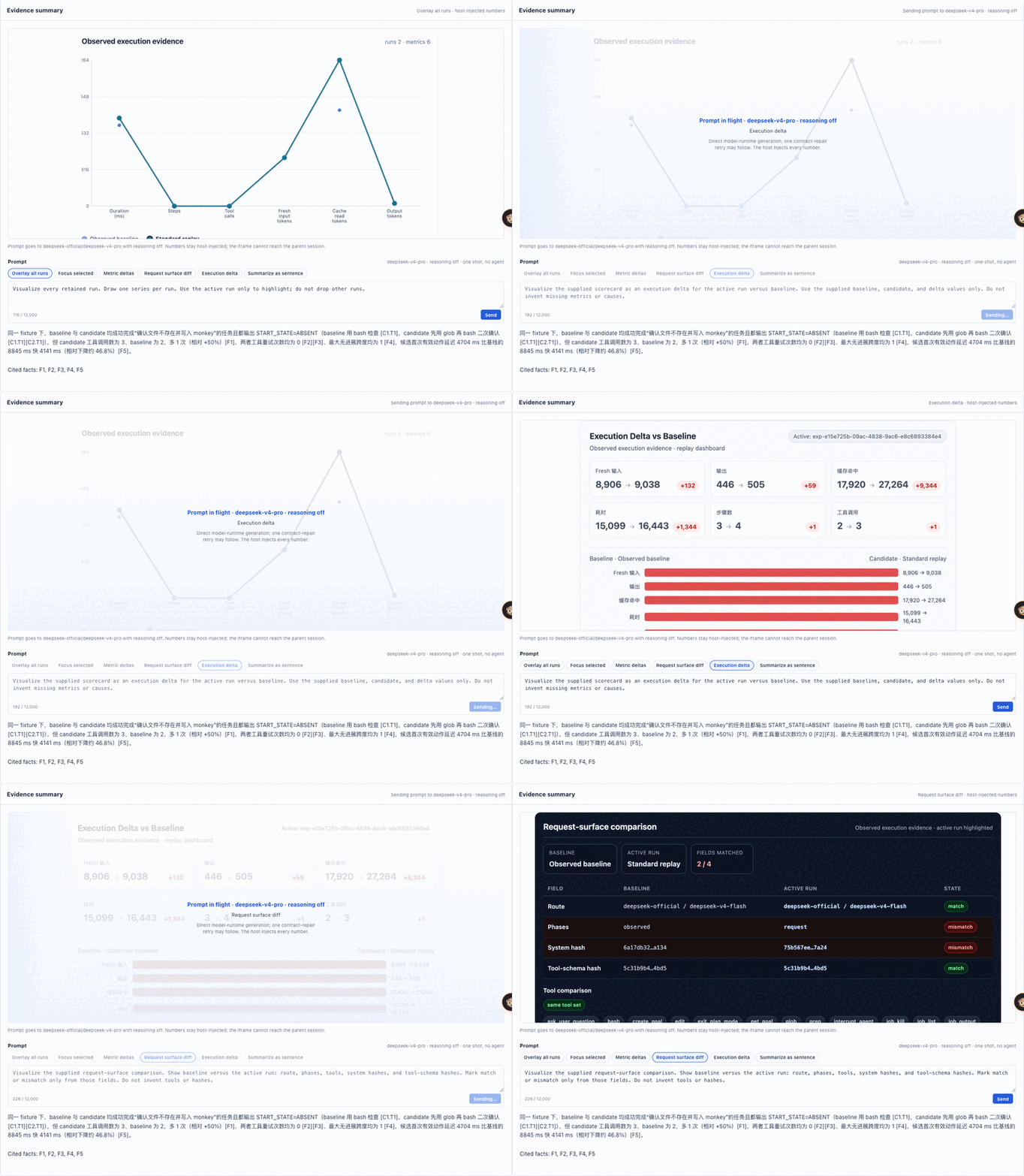
Any prompt, not only presets. This session (Generate table UI → Replay →
Turn 1 · Minimal) asked for a compact metric table instead of a chart. The
iframe rendered Metric / Baseline / Candidate / Delta with host-injected
numbers and highlighted the largest absolute delta.
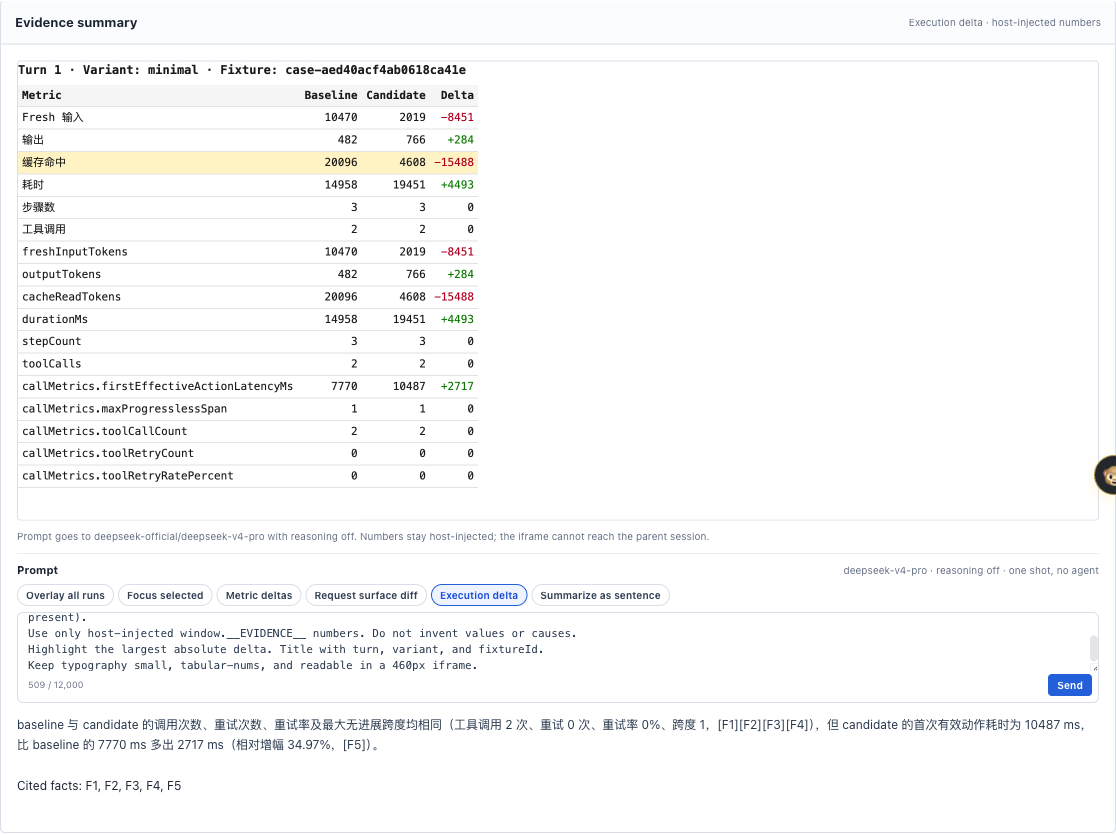
Custom numbered-capsule maze. Same Replay surface, no preset chip: Send a
dual-lane playhead prompt, wait through Prompt in flight, then looping
capsule playback (baseline blue / candidate gold, clip-fill from the left,
host-injected stepCount / toolCalls / durationMs). A maze is not the
expected Replay evidence view. Expected Replay is the presets below (overlay,
deltas, request surface, execution scorecard, cited sentence) or a compact
table of host-injected numbers. This GIF only shows that an arbitrary custom
prompt still Sends into the sandbox.
| Preset | What Send redraws |
|---|---|
| Overlay all runs | One series per retained run |
| Focus selected | Layout around the Saved-runs selection versus baseline |
| Metric deltas | Largest absolute deltas; no invented causes |
| Request surface diff | Route, phase, tools, hashes |
| Execution delta | Scorecard baseline / candidate / delta |
| Summarize as sentence | One cited Chinese sentence, not a chart |
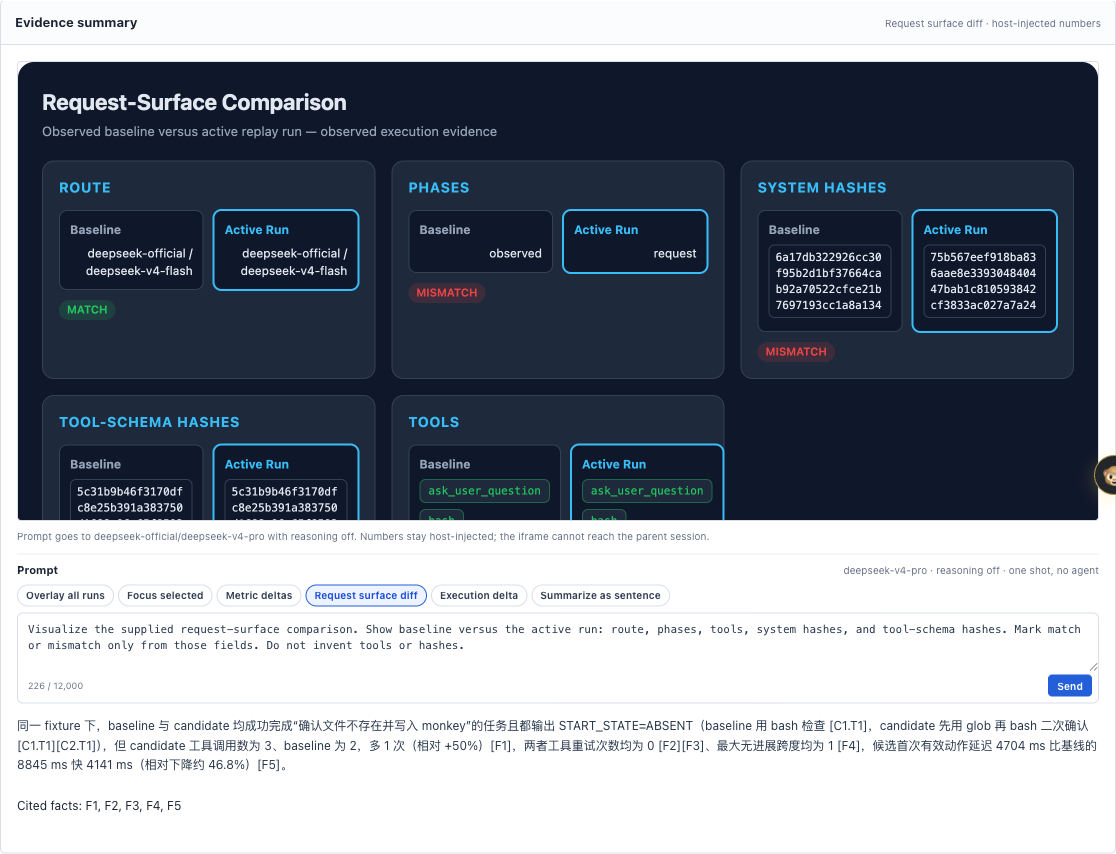
Request surface diff — route matches deepseek-official / deepseek-v4-flash;
phase, system hash, and tool list still differ.
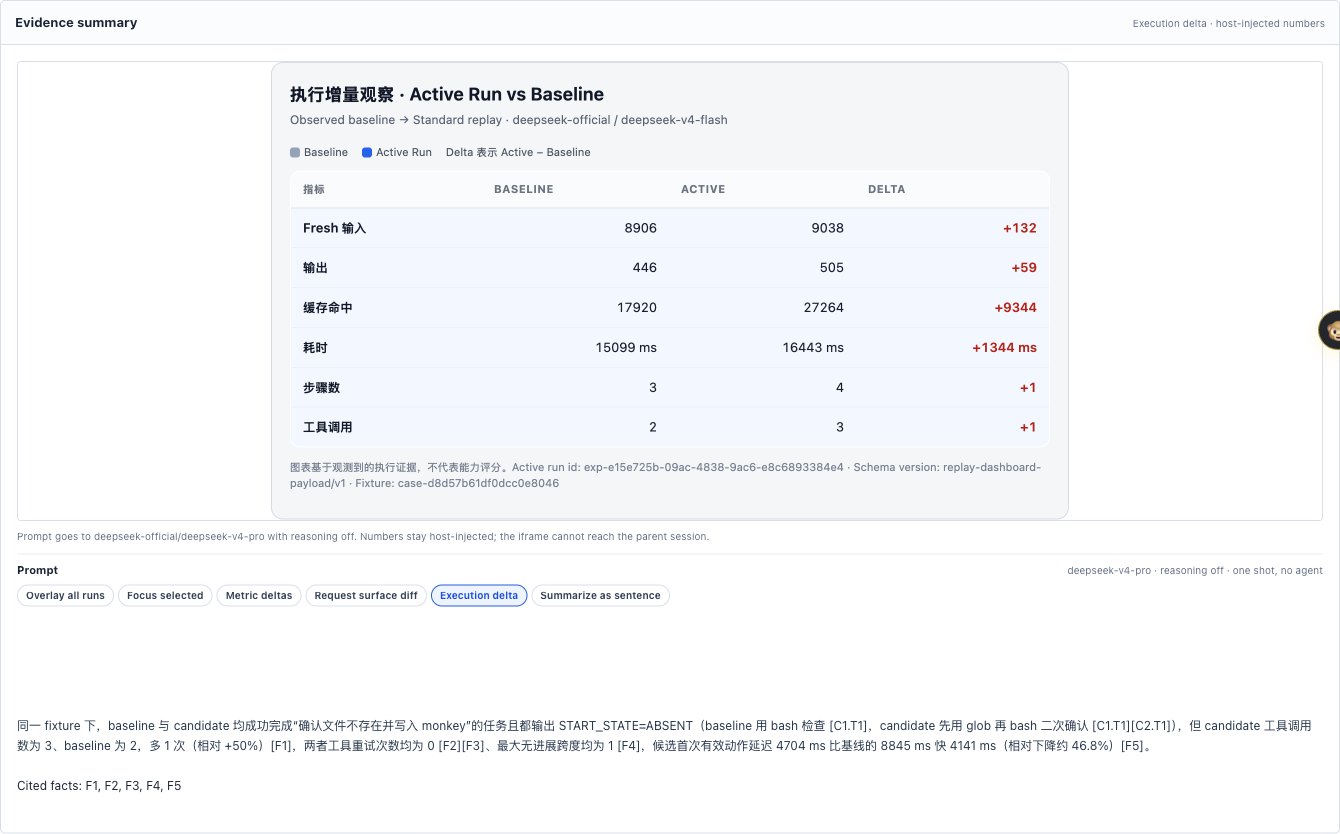
Why Execution delta? On this Standard replay the candidate used +132 fresh input tokens, +9,344 cache-read tokens, +1.3 s, and +1 tool call versus the observed baseline. Those are execution measurements, not a capability score.
Replay evidence, one function at a time
1. Workspace isolation and retained run

Source advanced from the pre-turn S0 without being reverted; the isolated candidate run and its evidence remain retained.
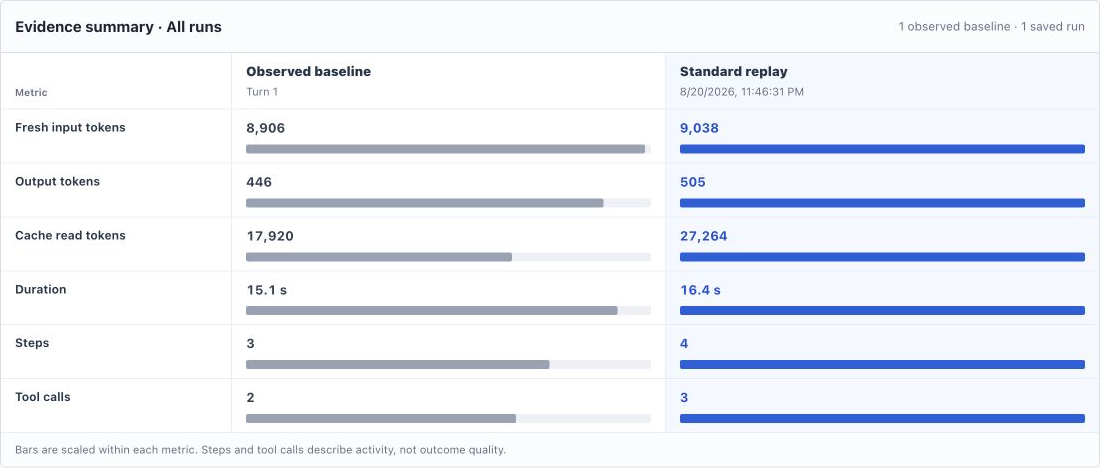
2. Baseline-versus-candidate run metrics
3. Request-surface differences
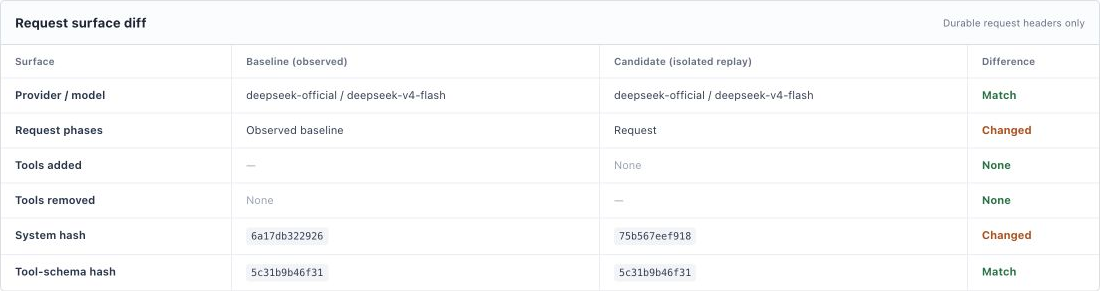
Provider/model, request phases, and durable request hashes are compared independently of execution cost.
4. Candidate-minus-baseline execution delta
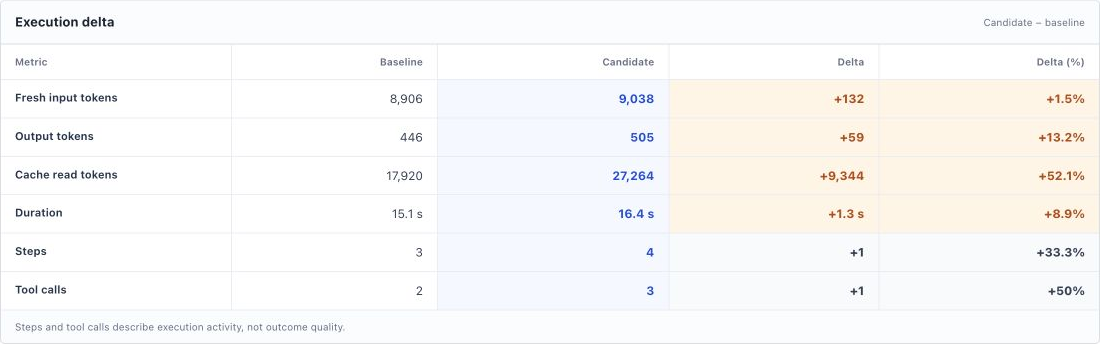
Tokens, duration, steps, and tool calls describe observed activity—not outcome quality.
5. Generated evidence narrative

The narrative comes from an explicit, one-shot direct model-runtime call—no agent is started. Its cited evidence IDs and raw evidence remain with the durable run; this is not shared agent or cross-session memory.
Why Replay Lab exists
Q: What was the original problem?
V4 Pro can exhibit materially different reasoning and execution trajectories under different harness request surfaces.
In some observed runs, the reasoning follows a reactive, exploratory pattern:
Let me check...
Let me try...
Let me inspect another file...
In others, it follows a more joint-planning pattern:
We need to locate...
We should verify...
We can test this assumption...
These phrases are useful descriptions of an observed trajectory. They are not
ability scores. we does not prove that a run is more intelligent, and let me does not prove that a model is degraded.
The important observation is narrower: a model carrying the same product label can take materially different paths when the surrounding harness constructs a different request.
Q: Do we know which variable causes the difference?
No. The available observations do not isolate one universal cause.
A harness can change several variables together:
- the system prompt and persona;
- which tool schemas the model can see;
- how verbose those schemas are;
- skills, repository instructions, and runtime context;
- conversation and tool-call history;
- reasoning configuration and output-token budget;
- the way the provider request is assembled.
Persona may matter. Tool exposure may matter. Their interaction may matter. Token budget or injected skills may also alter the trajectory. Different tasks, languages, model variants, and sample sizes add further uncertainty.
The useful working hypothesis is therefore not simply “the prompt changed” or “the model changed.” It is:
Observed agent behavior is produced by the Model × Harness combination.
Replay Lab is designed to investigate that combination without pretending that one comparison has already established the causal mechanism.
Q: What did xiaobright/modeltest find?
xiaobright/modeltest compared V4 Pro under different harness configurations and reported task-specific differences in trajectory style and results. That work helped turn an informal complaint about model behavior into a testable harness question.
It also exposed a practical DSH tradeoff:
| Approach | Request-surface strategy | Tradeoff |
|---|---|---|
| Minimal | Begin with a small persona and tool surface | Reduces the first-request surface but omits broader DSH capabilities |
| Standard | Expose the broader DSH surface immediately | Preserves the full capability set, but some observed runs were longer or more exploratory |
| Anchored Standard | Begin with a Minimal-like surface, then restore broader capabilities | Preserves a phased-exposure hypothesis, but introduces promotion timing and additional implementation variables |
The resulting Anchored Standard preset is a two-stage community workaround: it uses a narrow bootstrap request and later promotes the agent to a broader capability surface.
Anchored Standard is motivating evidence and a useful Replay Lab candidate. It is not proof that phased exposure always improves V4 Pro, that Standard is universally worse, or that one particular tool or persona caused the reported difference.
The comparisons retain important confounders, including maxTokens, skill
directory injection, persona, schema verbosity, task selection, small sample
sizes, and V4 Flash results that did not show the same outcome pattern.
Q: What is a Request Surface?
Step back from tools and presets for a moment and ask the simplest question:
What actually determines the model's behavior?
It is tempting to imagine an agent request like this:
user prompt → model → output
The actual request is closer to this:
user prompt
+ system prompt and persona
+ visible tool schemas
+ conversation and tool-call history
+ reasoning configuration
+ token budget
+ skills and runtime context injected by presets or plugins
───────────────────────────────────────────────────────────
= Request Surface
        ↓
      model
        ↓
  trajectory and output
Request Surface is everything the model actually receives before it starts generating.
The user prompt is one part of that surface, not the whole surface.
Q: How do presets, plugins, and configuration affect it?
A preset assembles an agent configuration, such as its persona, tools, and runtime behavior. A plugin can add tools, context, or request hooks. Configuration selects and parameterizes those components, including model settings and budgets.
Changing a preset or plugin can therefore produce a chain like this:
change preset or plugin
  → persona, tools, context, history, or budget may change
  → the effective Request Surface changes
  → the model may follow a different execution trajectory
  → checking only the user prompt may lead to an incomplete diagnosis
This is why a preset name such as Minimal, Standard, or Anchored Standard
is not sufficient experimental evidence. The name describes an intended
configuration; the effective request evidence describes what reached the
provider-bound request.
Q: Why are ordinary before-and-after comparisons difficult?
Two independently created sessions may differ in more than the preset being tested. The prompt may have changed slightly, the workspace may have moved on, the injected context may be different, or the provider settings and token budget may no longer match.
Without a shared case and provenance boundary, the comparison often becomes:
change preset
  → behavior changes
  → inspect two loosely related sessions
  → guess which difference mattered
That can generate a useful hypothesis, but it is a weak basis for causal claims.
Q: What does Replay Lab actually replay?
Replay Lab starts from one real, completed DSH turn. That completed source turn becomes the observed baseline; Replay Lab does not execute the baseline again.
For one approved experiment, it:
selects one completed DSH turn
  → freezes its replay case and provenance
  → uses its captured turn-start workspace checkpoint when available
  → selects one preset or agent-scoped plugin candidate
  → requires explicit approval
  → creates one isolated candidate session
  → reruns the completed turn's prompt in an isolated workspace copy
  → restores candidate files to their checkpoint at the terminal boundary
  → records effective candidate request evidence and execution metrics
  → compares the candidate with the observed baseline
This is a new candidate execution of the same completed task/turn, not playback of previously recorded text.
Q: What does “freeze” mean here?
Freeze does not mean that Replay Lab stores and resends a byte-for-byte copy of the old provider request.
It means Replay Lab creates a stable replay case containing the selected turn's
identity, prompt and prompt hash, provider, model, reasoning setting,
maxTokens, observed preset label, system and tool-schema fingerprints,
baseline evidence, source workspace path, and freeze-time workspace hash.
For live turns observed by the plugin, Replay Lab attempts to capture the
workspace at turn/start, including dirty and untracked files. Git sources use
an internal commit/tree and detached worktree; non-Git sources use a disjoint
file snapshot without running git init. The candidate is materialized from
that checkpoint. If no historical turn-start checkpoint is available, the
current implementation falls back to an isolated checkpoint of the current
source state and records its capture provenance; that run is a post-turn-state
rerun, not a strict S0 replay.
This wording matters: Replay Lab freezes the case and provenance, then records and compares observed request-surface evidence. It does not claim to freeze the entire old Request Surface as a reusable payload.
Q: Why require explicit approval and an isolated workspace?
Planning a candidate is read-only. Explicit approval is the boundary that authorizes one selected candidate experiment to call the model and execute its available tools.
The candidate runs in a validated workspace copy rather than rewriting the source session or working directly in the source workspace. Path-containment guards keep structured candidate and subagent file operations inside that copy. Success, failure, and abort preserve durable session evidence but restore candidate files to the checkpoint. The source workspace is never a rollback or cleanup target.
Several experiments can be retained for the same source turn, but each approval authorizes one candidate run.
Q: What evidence does Replay Lab compare?
Replay Lab preserves the completed source turn as independently observed
baseline evidence. For the candidate, it recovers provider-bound request
evidence from durable request/header events, including:
- provider, model, reasoning setting, and
maxTokenswhen present; - request phase;
- system-prompt fingerprint;
- tool-schema fingerprint;
- visible tool names;
- workspace source, execution, and drift provenance.
When both baseline and candidate contain complete, independent run evidence, Replay Lab produces a baseline/candidate/delta scorecard for:
- fresh input tokens;
- output tokens;
- cache-read tokens;
- duration;
- step count;
- tool-call count.
The scorecard measures recorded execution characteristics. It is not an intelligence score, a correctness evaluator, or currently a monetary-cost calculation.
Q: What can Replay Lab conclude?
Replay Lab can show:
- which completed turn served as the baseline;
- which candidate preset or plugin ran;
- whether the source workspace drifted;
- which effective candidate request evidence was recorded;
- how the independently recorded execution metrics differed;
- whether evidence was incomplete rather than silently filling gaps.
Replay Lab cannot prove from one rerun:
- which individual request-surface variable caused the difference;
- that wording such as
weorlet memeasures ability; - that V4 Pro is universally degraded under Standard;
- that Minimal or Anchored Standard universally improves intelligence;
- that one task generalizes across models, languages, providers, or harnesses;
- how the model's private internal routing or training mechanism works.
The goal is not to turn one workaround into a universal theory. The goal is to make Model × Harness comparisons narrower, repeatable, provenance-aware, and honest about what the available evidence can establish.
What it does
Completed DSH turn
  → freeze recorded request surface + workspace fixture
  → choose Standard / Minimal / Anchored / plugin candidate
  → explicit human approval
  → checkpoint → one isolated candidate session → restore candidate files
  → compare outcome, steps, tool calls, tokens, errors, and surface diff
- Adds one per-session Replay tab next to Conversation and Trajectory.
- Builds rows from durable session projections rather than paginated chat nodes.
- Freezes prompt, workspace hash, model, reasoning, max tokens, preset/plugin surface, system hash, and tool-schema hash.
- Captures live turn-start workspace state when the host event arrives, then keeps the observed source turn fixed; only the candidate executes.
- Runs candidates in validated workspace copies with path-containment guards; the source session and workspace are never rewritten or reverted.
- Restores candidate files at terminal boundaries while retaining durable events, checkpoint hashes, provenance, and comparison evidence.
- Recovers checkpointed durable candidate workspaces after restart and refuses cleanup when source/candidate boundaries are not disjoint.
- Falls back to a provenance-marked isolated current-state checkpoint when a historical turn-start checkpoint is unavailable; this is not strict S0 replay.
- Produces a scorecard only from independently recorded evidence.
- Rejects unsupported host-plane changes and incomplete variants.
Replay evidence
The run-detail screenshot above compares the observed baseline with every saved replay run. Each metric has its own scale and keeps the exact recorded value visible; steps and tool calls describe activity, not outcome quality. The following screenshots show language signals where they occur in the session chat's thinking rows, not as recreated count labels.
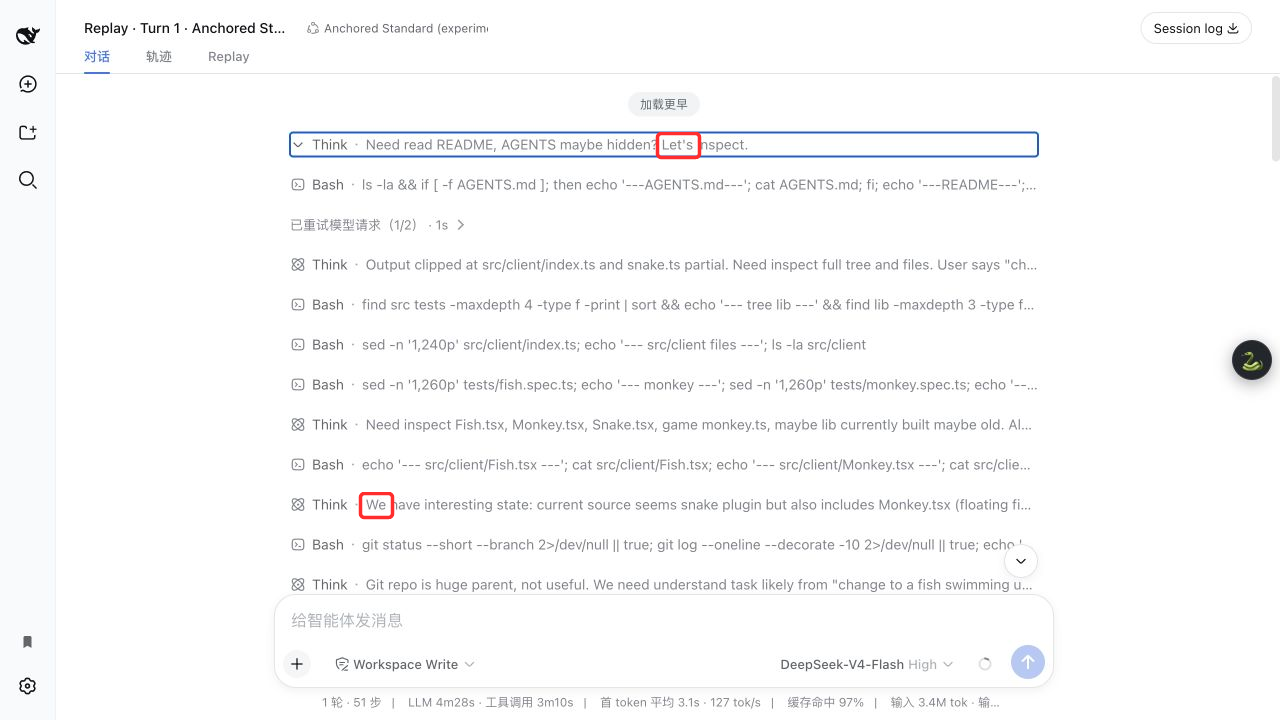
Anchored Standard: actual let's and we occurrences.
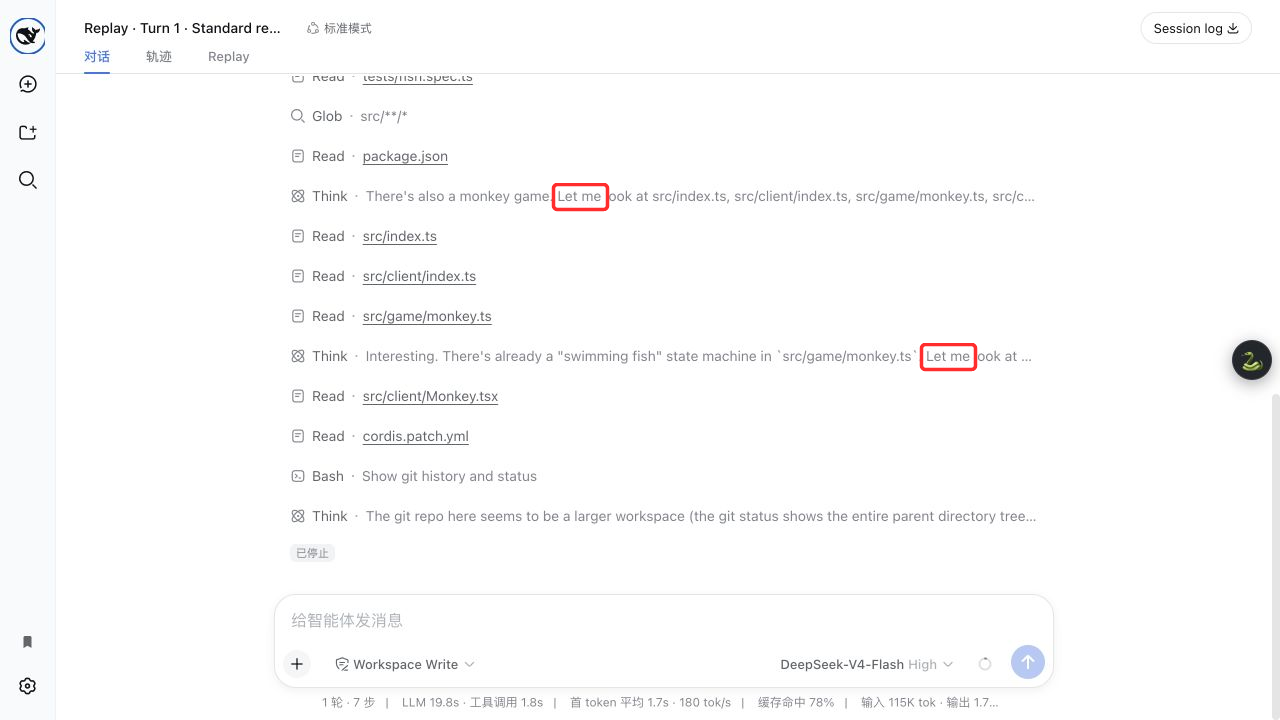
Standard replay: actual let me occurrences.
These phrases are trajectory descriptors, not ability measurements.
Install
Requires DeepSeek Harness 0.1.0-rc.6, Node.js 22.19+ or 24+, and pnpm.
Install the pinned v0.1.5 organization package from npm:
dsh plugin --profile web add @webwalkerhq/dsh-replay-lab@0.1.5
The matching immutable GitHub source tag is also available:
dsh plugin --profile web add github:tbxy09/dsh-replay-lab#v0.1.5
Restart the Web profile after installation:
dsh web
The bundle mounts @webwalkerhq/dsh-replay-lab at /replay-lab-dsh and injects
its client module into the Web profile.
Enable Anchored Standard
Anchored Standard is a
DSH preset, not a plugin package. Copy it under the same DSH_HOME used by
Replay Lab; do not install it with dsh plugin add.
git clone --depth 1 https://github.com/xiaobright/dsh-anchored-standard.git
dsh_home="${DSH_HOME:-$HOME/.dsh}"
mkdir -p "$dsh_home/.agent-presets"
test ! -e "$dsh_home/.agent-presets/anchored-standard"
cp -R dsh-anchored-standard/preset "$dsh_home/.agent-presets/anchored-standard"
Fully restart DSH, create a new blank session, and select
Anchored Standard (experimental). Do not switch an existing active session
from another preset. Replay Lab marks the Anchored candidate unavailable when
anchored-standard cannot be resolved.
Configuration
The installed bundle includes this baseline:
- insert:
    - id: replay-lab-dsh
      name: '@webwalkerhq/dsh-replay-lab'
      config:
        routeBase: /replay-lab-dsh
        historyFixture: ./node_modules/@webwalkerhq/dsh-replay-lab/fixtures/history-turns.json
        workspaceFixture: ./node_modules/@webwalkerhq/dsh-replay-lab/fixtures/workspace
        stateFile: ./.tmp/state.json
        artifactDirectory: ./.tmp/artifacts
        provider: replay-lab-fake
        fakeAdapter: false
Keep routeBase at /replay-lab-dsh for 0.1.x. Set fakeAdapter: true only
for deterministic offline verification; normal runs use the profile's provider.
License
相关推荐Related
-
 nexu-io/open-design
🎨 Best DeepSeek Harness Design Plugin. The open-source Claude Design alternative. 🖥️ Local-first desktop app. 🖼️ Your…
nexu-io/open-design
🎨 Best DeepSeek Harness Design Plugin. The open-source Claude Design alternative. 🖥️ Local-first desktop app. 🖼️ Your…
-
 freestylefly/awesome-gpt-image-2
Prompt as Code | GPT-Image2 工业级提示词引擎与模板库,530+ 个案例逆向工程,20+ 套工业级模板,并提炼出Skills,持续更新中
freestylefly/awesome-gpt-image-2
Prompt as Code | GPT-Image2 工业级提示词引擎与模板库,530+ 个案例逆向工程,20+ 套工业级模板,并提炼出Skills,持续更新中
-
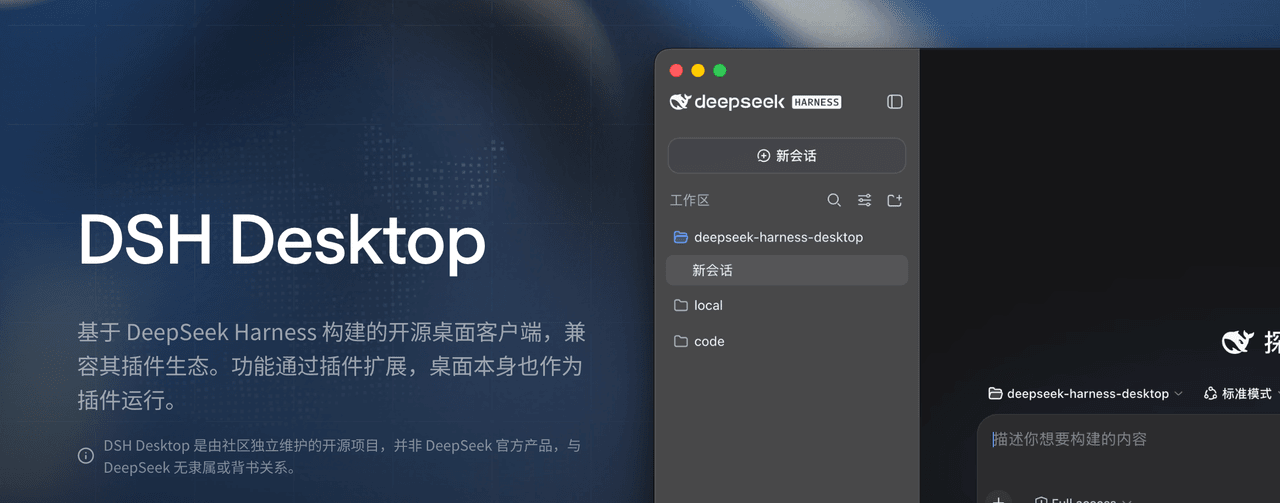 anywhere-labs/dsh-desktop
为 DeepSeek Harness (DSH) 插件生态打造的现代化桌面端解决方案。万物皆「插件」,桌面本身也是「插件」。
anywhere-labs/dsh-desktop
为 DeepSeek Harness (DSH) 插件生态打造的现代化桌面端解决方案。万物皆「插件」,桌面本身也是「插件」。
- Nagi-ovo/voyager Enhancement suite for Gemini, AI Studio, Claude & ChatGPT — plus a prompt manager for any web UI, DeepSeek Harness inclu…
-
 walkinglabs/learn-harness-engineering
Harness engineering beginner tutorial, from 0 to 1
walkinglabs/learn-harness-engineering
Harness engineering beginner tutorial, from 0 to 1
-
 awesome-dsh-plugin/awesome-dsh-plugin
A curated list of plugins for DeepSeek Harness (dsh) · DeepSeek Harness 插件精选列表
awesome-dsh-plugin/awesome-dsh-plugin
A curated list of plugins for DeepSeek Harness (dsh) · DeepSeek Harness 插件精选列表
-
 MemTensor/MemOS
Self-evolving memory OS for LLM & AI Agents: ultra-persistent memory, hybrid-retrieval, and cross-task skill reuse, with…
MemTensor/MemOS
Self-evolving memory OS for LLM & AI Agents: ultra-persistent memory, hybrid-retrieval, and cross-task skill reuse, with…
- yjh051108/dsh-routing-suite dsh-routing-suite — injector + router-standard kit: install the runtime injector first, then the task-aware reasoning-mo…