telagod/dsh-ledger-compact
dsh-plugin: OMP-style ingress shaping plus optional local /fast-compact for DeepSeek Harness
Project Overview项目介绍
This is a compaction plugin for DeepSeek Harness (DSH). It mechanically compacts large tool results before they reach the model, and can optionally replace DSH's default LLM-based compaction. Use it to cut LLM costs by compressing long context. It requires DSH ≥ v0.1.2-rc1, and you need to keep the original DSH LLM compaction plugin.
这是DeepSeek Harness(DSH)的压缩插件,可在工具结果进入模型前对超大结果做机械整理压缩,支持替换DSH默认的LLM压缩。适用于压缩长对话上下文、降低LLM调用成本的场景,需保留原DSH的LLM压缩插件,要求DSH版本≥0.1.2-rc1。
请帮我了解并安装插件:【dsh-ledger-compact】【https://github.com/telagod/dsh-ledger-compact】Send this message to DSH in your current session. CLI install commands may not be accurate across systems — DSH will figure it out for you.把上面这条消息直接发给当前会话里的 DSH,让它帮你了解并安装。安装命令不一定准确,发给 DSH 更稳。
Or use CLI install (for developers)或使用命令行安装(适合开发者)
CLI Install命令行安装
dsh plugin --profile web add github:telagod/dsh-ledger-compact把 telagod/dsh-ledger-compact 加入你的 DSH 配置(web profile)即可启用。
READMEREADME
dsh-ledger-compact
English · 中文
dsh-plugin for DeepSeek Harness. Large tool results are shaped before they reach the model. An optional local fold can replace DSH’s LLM /compact.


Why
Long agent turns dump huge tool_result blocks into the next request. DSH already has an excellent LLM compact (@deepseek-ai/dsh-compaction-basic), but it costs an extra model call and runs after pressure builds.
This plugin does two cheaper things first, and optionally a third:
- Ingress shaping — freeze oversized unsent tool results into a head/tail excerpt on the idle pre-step. Only the step that just finished is touched: its first request is the one being prepared, so a rewrite never invalidates a provider-cached prefix.
- Mechanical fold —
/fast-compactand the input-bar bolt collapse older history into a short ledger card. No model call. - Replace default compact (off) — reuse the official engine’s
summarizehook so/compact, auto-compaction, and overflow recovery also skip the LLM.
Keep dsh-compaction-basic mounted. This plugin does not replace the engine.
Install
Requires dsh ≥ 0.1.2-rc.1; verified on 0.1.5-rc.1. Both API renames in that range are handled: session.events → session.eventAt(seq) and the positional replace keys start/end → startSeq/endSeq.
dsh plugin --profile web add github:telagod/dsh-ledger-compact
Restart the web profile after install. The bundle patch inserts plugin id dsh-ledger-compact.
From a local checkout:
git clone https://github.com/telagod/dsh-ledger-compact.git
dsh plugin --profile web add ./dsh-ledger-compact
What you get
| Layer | When | Model call | What changes |
|---|---|---|---|
| Ingress shaping | Idle agent/pre-step |
No | Current unsent tool_result only |
Bolt / /fast-compact |
You click or type it | No | Older history → mechanical fold card |
| Replace default compact | /compact, auto, overflow |
No | Same official transaction; local summarizer |
Official /compact |
Default DSH path | Yes | LLM <compacted-summary> checkpoint |
The input-bar bolt is a context-pressure meter. By default it needs a second click before folding (can be turned off). After a fold, the chat shows an expandable row in the same style as the official compact line; the open view is a slim left-axis timeline, not a model essay.
Settings
Open Settings → 快速压缩. Changes write through to the Host document immediately. The page is tabbed:
- 入境 — the four shaping settings below.
- 折页 — fold confirmation, replace-default, and a live preview of the fold card.
- 诊断 — plugin version, the session-event accessor this DSH exposes, ingress counters and the last failure, and how many compaction engines are hooked (plus any engine that would silently fall back to a model call).
| Setting | Default | Meaning |
|---|---|---|
Ingress shaping (enabled) |
on | Excerpt large unsent tool_result blocks before the next request |
Allow dense PNG (snapImages) |
off | Attach a bitmap only when the main model lists image in inputModalities and the image is cheaper than the original |
Confirm before fold (confirmFold) |
on | Bolt requires a second click |
Replace default compact (replaceDefault) |
off | /compact, automatic pressure compaction, and overflow recovery use the mechanical summarizer |
Ingress threshold (minSnapTokens) |
3000 |
Approximate tokens before an excerpt (or PNG) is considered. Range 200–200000 |
PNG savings (savingsRatio) |
0.85 |
Excerpt + estimated image tokens must be ≤ this fraction of the original |
Turn Replace default compact off at any time to restore DSH’s LLM checkpoint. /fast-compact stays mechanical either way.
Commands
/fast-compact
/fast-compact status
There is no vision sidecar. /fast-compact vision … was removed.
/compact remains the official DSH command. With replace-default off, it still calls the model. With it on, the same command runs the mechanical fold through the existing engine.
/fast-compact status also reports health: ingress shaped/snapped/saved counters, the last ingress error when one is repeating, and any compaction engine that lacks a summarize hook (with replace-default on, such an engine would silently call the model).
Ingress excerpt
Default is text only — no PNG, no LLM. Only results from the immediately preceding step of the current turn are candidates; everything already sent stays byte-identical, which is what keeps the provider prefix cache intact. Already-shaped placeholders are not rewritten. skill and context tool results are skipped. If tokenMeter is missing, ingress is skipped so the plugin never replaces without writing compaction/prune.
[Snapcompact: N tokens → excerpt]
first 16 lines
… (K lines elided; see image if attached. To inspect or edit exact bytes, re-read with offset/limit) …
last 8 lines
A PNG is attached only when all of these hold:
- “Allow dense PNG” is on
- the routed model’s
inputModalitiesexplicitly includesimage(names likegpt-4oare never guessed) - excerpt + estimated image tokens ≤ original × savings ratio (default 15% cheaper)
- the text actually drawn into the image must be more expensive as text than the image itself (default: image ≤ text × 0.85). Three thousand lines of three characters each lose money as a PNG, so only the excerpt ships
Dense-image layout
The canvas is billed by area (512px tile bands — a full band and a blank one cost the same), so the layout has exactly one job: fill the canvas that has already been paid for.
- The canvas cap is tile-aligned: openai-family frames are
1024×2048, not1024×1540. Same 1445 tokens, 93 text rows instead of 70 (+33%) — the old height crossed into a paid band for four pixels. - Short lines pack into columns. The planner tries 1–24 columns and keeps the highest occupancy; a candidate is dropped as soon as more than 2% of its cells would wrap, so one-line-per-cell holds whenever it can, and only content wider than the whole canvas wraps inside a cell.
seq 1 3000becomes a 20-column numeric grid: 1860 source lines for the price of 93. - Line ruler: from 50 source lines up, the left gutter prints the source line number every 5 grid rows next to a faint rule. That makes the image addressable — a model that spots a bad row can
offset/limitits way back to exact bytes instead of guessing. - Layered ink: body
16, column rules205, ruler150, paper245. Hierarchy costs no tokens; it only costs pixels, and the pixels are already paid for. - The excerpt notice names the layout:
[Snapcompact: 3480 tokens → 1024x624 PNG ~434 tokens · 20 cols · line ruler], so the model never has to guess whether it is reading one column or twenty.
Cost and fidelity (deepseek-flash)
A dense image is billed as input tokens, at the published DeepSeek rates (api-docs.deepseek.com, read 2026-09-10):
| peak | off-peak | |
|---|---|---|
| input, cache hit /1M | $0.006 | $0.003 |
| input, cache miss /1M | $0.30 | $0.15 |
| output /1M | $1.20 | $0.60 |
Two things below are measured, not assumed:
- Draw inside the request pixel budget. The request pipeline resizes any frame above
640000px before dispatch, and the provider both bills and reads the resized image. Measured on identical content: drawing1024x2046(sent as566x1131) answered 1–2 of 10 questions; drawing1024x624(no resize) answered 8. DeepSeek routes therefore use the8on16-budget 1024x624geometry (39 rows). - The image-token curve is measured too:
≈ clamp(70 + 5.7e-4·px, 213, 1043)on the resized dimensions. The published "one image caps at 384 tokens" calculator does not match liveusage; this fit is within ~3% (est 434 vs measured 446, the gap being the prompt text). - Counting happens in text, not in the picture. The notice ends with
whole-file totals: PASS×1484 · FAIL×16 · …— the repeated values of the whole result, counted mechanically, 50 tokens, no model. Paired over 168 questions it takes structure accuracy from 35% to 78% (net +22, p=0.0007) and leaves exact-value reading unchanged (−1 of 114); a picture cannot count a 2000-line file, and neither can an excerpt. - A full frame costs about $0.00013; the same content as raw text costs $0.001–$0.014 — 10–100x more.
- Fidelity has a ceiling, and it is measured from both sides. From the image alone, exact-value questions are answered 70% of the time, and the misses are not a rate but a wall: a 5+ digit value, or a field at the end of a dense line, is 0/6 across every repeat — while matching a literal key and reading a short field beside it is 5-6/6. Adding the head/tail excerpt the plugin already sends lifts value accuracy to 91% (+21 points, net +12 of 57, p=0.002) for 1000 tokens per answer, still 3.5x cheaper than the same content as text. Six rendering fixes aimed at the same class — row shading, bolder digits, a bigger digit box, two kinds of digit grouping, and a 32-line excerpt window — moved nothing. Hence the design: the image carries bulk and structure, exact bytes travel as text, and the
re-read with offset/limitcontract recovers any byte from the source.
bench/report.md holds the raw run (fixtures × layout variants × checkable questions, answers and usage cached); bench/FINDINGS.md holds the method, the noise floor and a verdict per axis. In short:
Draw inside the request pixel budget: identical content answered 1–2 of 10 when the pipeline resized it, 8 of 10 drawn natively, for the same bill.
Packing carries ~20x more lines per frame at equal accuracy.
A source line number on every row lifted exact-value accuracy from 73% to 87% at no token or capacity cost — it aims straight at the dominant error class, reading the wrong line.
Colour was tried and rejected: four palettes, paired 3-repeat run over 60 samples each — grayscale 46/60, colour 44/60, value accuracy identical. The encoder (
encodePngPalette) and per-cell/per-digit ink stay in the library, off by default.The glyphs were tried both ways and neither matters: at a fixed 8x13 box, four atlases (X.org and TTF renders of DejaVu/JetBrains) came out 46/60 vs 46/60 paired; a larger box — 8x16 at the identical
1024x624/39-row geometry and 434-token bill, +56% ink per character — also came out 46/60 vs 46/60. Re-asking one unchanged variant three times scores 14, 15 and 17 out of 20: that is the size of every screening "lead" this axis has produced. Above the legibility floor, pixels buy capacity, not accuracy.tools/make-atlas.pystays (any box, any font FreeType can open,--showto eyeball a glyph).Accuracy follows effective pixels per glyph, not canvas size or token count: halving the resolution of identical content scored 9/20 against the control's 14/20, and downscaling then upscaling back to the same dimensions and the same bill still scored 12/20. Bigger canvases buy capacity, not accuracy; below ~5 px per glyph accuracy collapses.
Do not raise the request-image budget:
llm-deepseek'simagePixelBudget(640000 by default) is configurable, but 1.3M measured the same accuracy at twice the money and 2.1M collapsed to 33%. The plugin's 传图像素预算 setting only needs to follow the deployment's value — and must, if it is set to"low", or every frame gets resized into the 1–2/10 failure mode.Ceiling: about a quarter of exact-value questions are still misread in the best configuration. The image is an index, not a notary — exact bytes travel as text, in the fold card, or through
offset/limitre-reads.There is no compression ratio to trade: the frame is a fixed ~434-token bill and the excerpt is capped at 16 head + 8 tail lines, so the request does not grow with the file —
frame + 24 lines + the answer, against every line as text. That measures 15.5x cheaper per correct answer overall, from 6.0x (3001 four-character lines) to 25.4x (2000 hundred-byte lines): the ratio is a property of the input, not a dial. Every accuracy gain measured so far came from text — the excerpt (+21 points of value) and the digest (+43 points of structure) — and no pixel-side change moved accuracy above the legibility floor.The misses are a confabulation channel, not a noise channel (
bench/miss-audit.mjs, no model calls): of 53 wrong answers in 336, 52 are well-formed and plausible — 47 are values that occur verbatim in the file asked about and 51 have the same digit width as the truth (1001110→1001147,261→$268,29→42). Exactly one refutes itself with a shape or range check. A lossy codec garbles and announces it; this channel substitutes a real value and leaves no signal, so$/correctprices a wrong answer here below what it costs.The re-read the notice promises works, and nothing cheap makes the model take it (
read: truearms, paired 3-repeat, 84 answers per arm against the frozen control in the same run): with the read simply available the model asks on 8% of answers and scores 66/84 against the frozen 71/84; one extra notice line naming the coordinates — the gutter labels are source line numbers,read_result(offset=N)returns those bytes — triples the ask rate to 29% and still scores 69/84, for 41–83% more tokens. The reads themselves are good: 17 of 18 aimed reads were right, and the 7-digit id that is a wall from the image goes 0/3 → 2/3. The arm loses anyway, because the extra asking also lands on the counting questions, where a window of text is worse than the whole-file digest. The re-read itself is nearly free: 75–85% of the re-sent prefix comes back as a cache hit, so the extra rounds add 2–9%, not 41–83%.The bench's own scorer had three silent escaping bugs — a doubled backslash inside three regex literals, so the whitespace strip never fired, the number-prefix branch was dead, and the 5xx retry never retried on a 5xx. Re-deciding all 336 stored answers changes no verdict (the model happened to answer
52mswhere52mswas expected), but the matcher now lives inbench/match.mjsandbench/miss-audit.mjsrecomputes every verdict rather than trusting the stored flag.A written summary loses to the frame, and how it loses is the interesting part (
absorb/absorb-digestarms: blind chunked summarisation underacp-kernel's tier-1 rules, sent in place of the image — this is whatbillion-context'sabsorbleaves on the wire): 57/84 and 56/84 against the frame's 71/84, paired nets −14 (p=0.0066) and −15 (p=0.0007), carrying more tokens per later request (1250 / 1300 against 1097) and costing 3x. It wins where the file is rule-generated —seq-3000, the integers 1..3000, scores 15/15 against the frame's 14/15 for 230 tokens against 542 — and loses where the question names an arbitrary instance: ontest-logthe summary found the generator ("durations step by 13 ms") and then answered13mswhere the truth was52ms. It applies the rule instead of reading the row. Its misses are 27–28 against 13, with the same 100% silence — the image invents a value that was in the file, the summary invents one that was never anywhere.
Fold card
Mechanical, no model. Prior fold text is never nested, but it is not lost either: files, intents and errors recovered from an earlier [Snapcompact] card are carried forward into the new one (files only fill capacity the new span left over).
[Snapcompact] Fold ~N tok. Exact file bytes are not stored — re-read with offset/limit if a detail matters.
FILES
- [edit] path
- [read] path
INTENTS
- recent user goals
TOOLS
- read 4
COMMANDS
- …
ERRORS
- …
EXCERPT
[user] …
[tool] …
This is cheaper and more predictable than an LLM checkpoint. It also keeps less prose: paths, intents, tool counts, and a short excerpt — not a narrative of why.
Working with DSH compact
Do not unmount @deepseek-ai/dsh-compaction-basic.
- Pressure, range selection, shrink checks, and durable
compaction/*events stay on the official engine. - This plugin only wraps
summarize(). /fast-compactmarks the current agent for onecompactNow()so other sessions keep the LLM path.- Replace-default is a live setting: every hooked engine uses the mechanical summarizer until you turn it off (or unload the plugin).
On web, compaction lives in the preset isolate. Host code reads it with agentPresets.serviceFor(agent, "compaction"), not inject: ['compaction'].
Develop
node --test lib/ledger.test.js

# per-fixture layout economics: text vs image tokens, lines carried, canvas occupancy.
# Pure arithmetic, no model calls.
node bench/layout-bench.mjs

# fidelity + real billing: fixtures x layout variants x checkable questions, cached in bench/.cache
node bench/fidelity-bench.mjs

# what the misses are and what the money buys: re-reads the recorded run, no model calls
node bench/miss-audit.mjs

# the re-read arms: the model gets read_result(offset, limit), and the run records what it
# does with it, aimed where, and what the repeat rounds cost
node bench/fidelity-bench.mjs --variants excerpt-digest,reread-base,reread-address,reread-hint --repeats 3

# the competing channel: the model writes the summary that replaces the result, as
# billion-context's absorb does — measured head to head with the frame in one run
node bench/fidelity-bench.mjs --variants excerpt-digest,absorb,absorb-digest --repeats 3

# one test binds a real dsh-session; point it at the installed package to run it
DSH_SESSION_MODULE="$DSH/node_modules/@deepseek-ai/dsh-session/lib/index.js" \
DSH_SCHEMASTER_MODULE="$DSH/node_modules/@deepseek-ai/schemastery/lib/index.mjs" \
  node --test lib/ledger.test.js
| File | Role |
|---|---|
lib/ctx.js |
Optional service lookup + version-tolerant session event access |
lib/schema-envelope.js |
Canonical Schemastery {uid, refs} settings envelope |
lib/ingress.js |
Previous-step tool_result shaping (cache-safe by construction) |
lib/vision.js |
Dense PNG gated by inputModalities + settings |
lib/excerpt.js / lib/fold.js / lib/snapfont.js |
Excerpt, fold card, bitmap and grid raster |
lib/layout.js |
Dense-image layout: column packing, in-cell wrap, line ruler, occupancy |
lib/hook.js |
Mechanical summarize hook |
lib/resolve.js |
Find isolated compaction engines |
lib/index.js |
Command, settings, pre-step |
lib/client.js |
Bolt, fold row, settings page |
License
MIT. Bitmap fonts under lib/fonts/ are documented in lib/fonts/README.md.
Related相关推荐
-
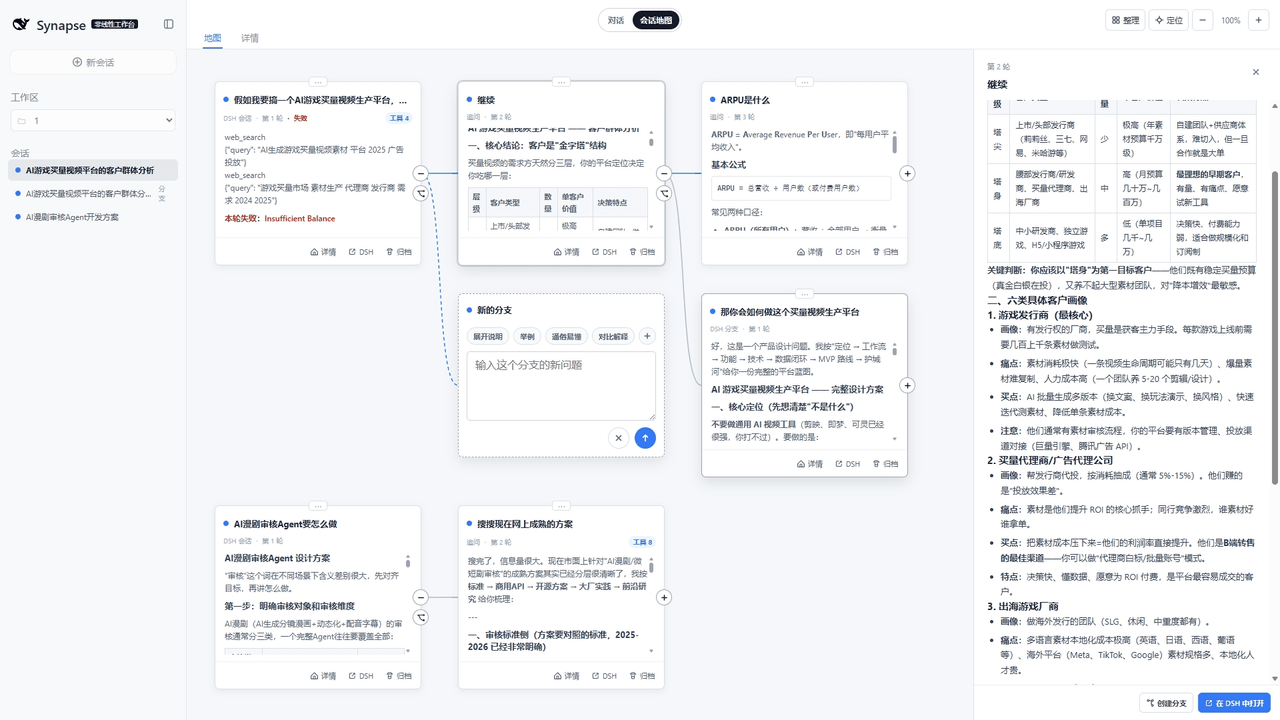 liangmianya/dsh-synapse
A visual, non-linear conversation workspace plugin for DeepSeek Harness ; A canvas-based session explorer and branching …
liangmianya/dsh-synapse
A visual, non-linear conversation workspace plugin for DeepSeek Harness ; A canvas-based session explorer and branching …
-
 alaliqing/claude-paper
📖 Cross-agent research paper toolkit for Claude Code, Codex, OpenCode, and DeepSeek Harness—quick summaries, deep study…
alaliqing/claude-paper
📖 Cross-agent research paper toolkit for Claude Code, Codex, OpenCode, and DeepSeek Harness—quick summaries, deep study…
-
 omdsh-dev/dsh-annotation
DSH Web 选中批注插件:选文字→批注→回车随消息发送;气泡隐藏批注块(零闪烁);回复按 Annotation N 逐条对照(可悬浮芯片)。官方 bundle,零核心改动
omdsh-dev/dsh-annotation
DSH Web 选中批注插件:选文字→批注→回车随消息发送;气泡隐藏批注块(零闪烁);回复按 Annotation N 逐条对照(可悬浮芯片)。官方 bundle,零核心改动
-
 Anionex/dsh-turn-rewind
deepseek harness对话和代码状态回退插件 | DSH — rewind conversation and workspace state, powered by a persistent Change Ledger
Anionex/dsh-turn-rewind
deepseek harness对话和代码状态回退插件 | DSH — rewind conversation and workspace state, powered by a persistent Change Ledger
-
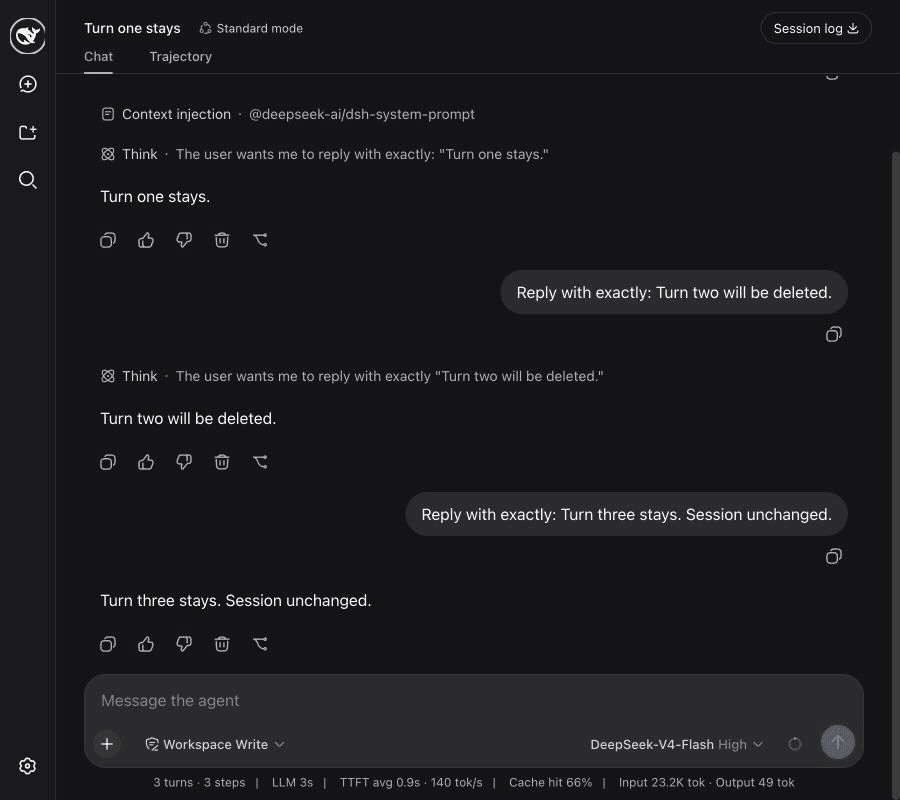 hanshenmesen/dsh-turn-delete
Delete one complete turn from a DeepSeek Harness session without deleting the session
hanshenmesen/dsh-turn-delete
Delete one complete turn from a DeepSeek Harness session without deleting the session
-
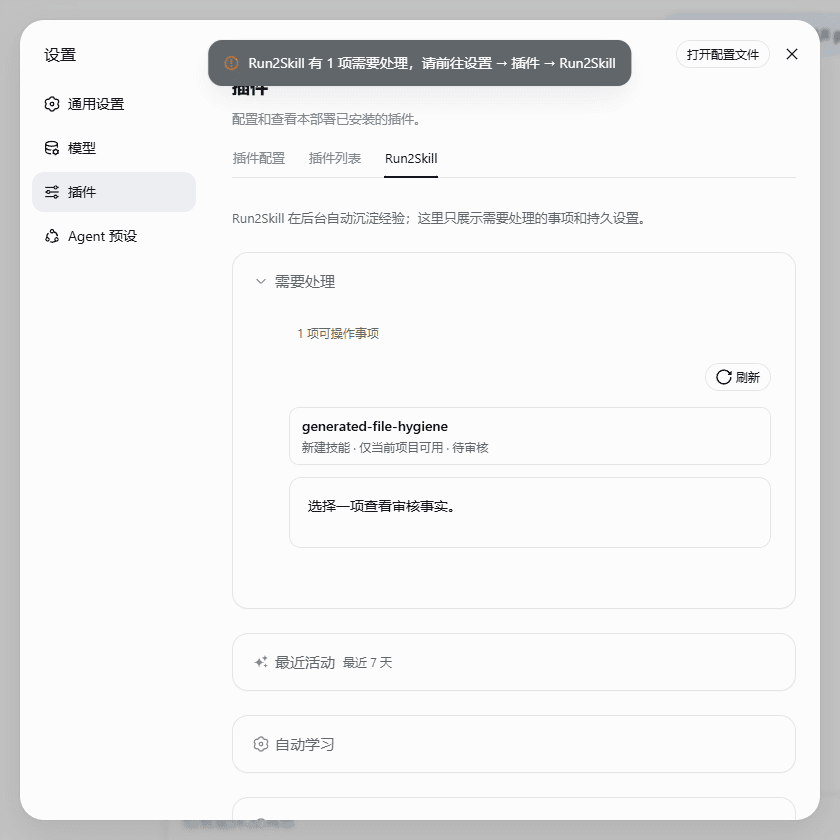 qkycir-123/dsh-run2skill
Automatically turn successful DeepSeek Harness sessions into reusable, reviewable Agent Skills.
qkycir-123/dsh-run2skill
Automatically turn successful DeepSeek Harness sessions into reusable, reviewable Agent Skills.
-
 Tyan66666/billion-context-dsh
Model-driven context management (Active Context Pruning / ACP) for the DeepSeek Harness — the model decides when and wha…
Tyan66666/billion-context-dsh
Model-driven context management (Active Context Pruning / ACP) for the DeepSeek Harness — the model decides when and wha…
-
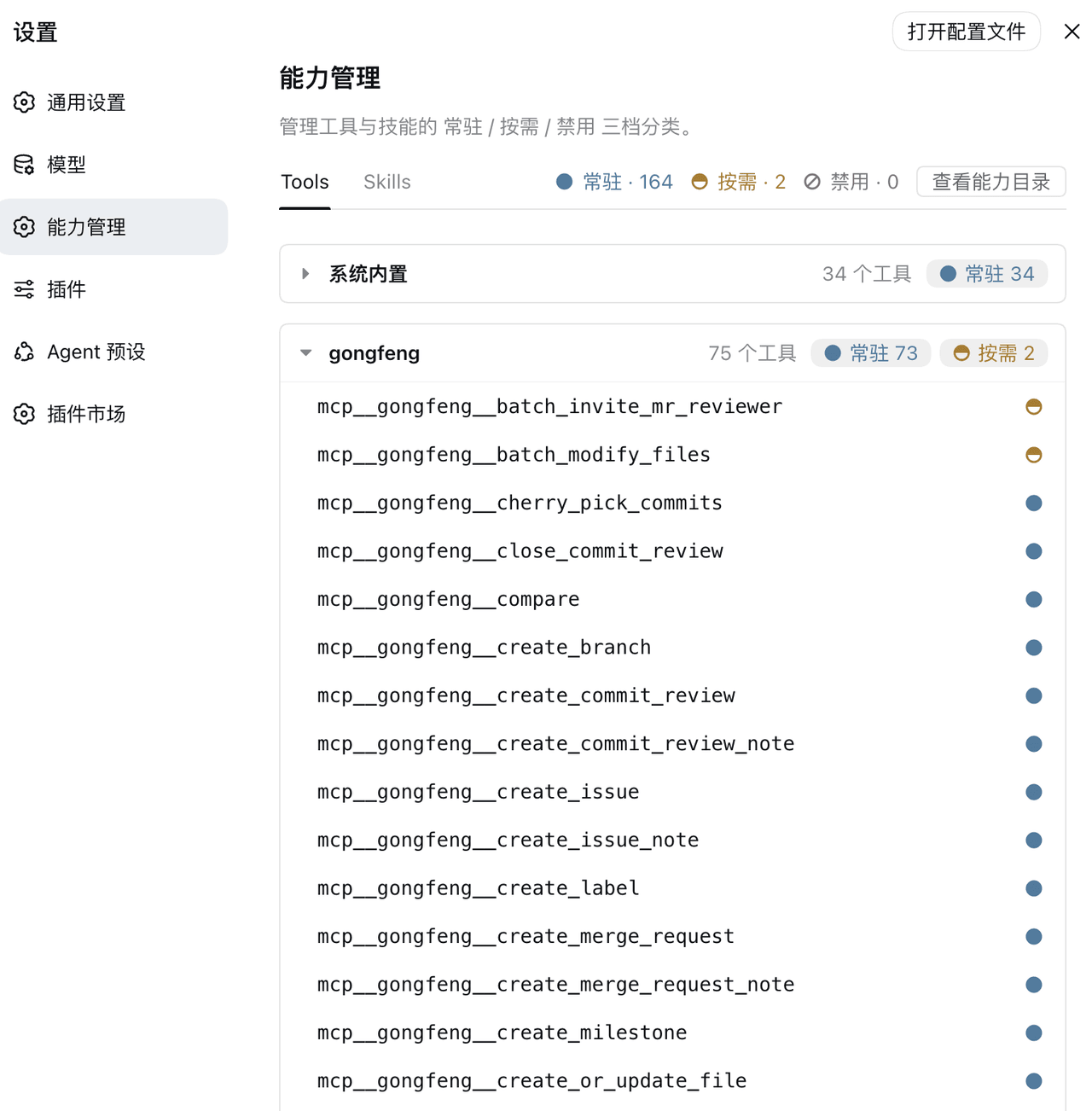 PKUfudawei/dsh-capability-menu
Unified capability menu for DeepSeek Harness: manage exposure level (context footprint) and execution mode of MCP tools …
PKUfudawei/dsh-capability-menu
Unified capability menu for DeepSeek Harness: manage exposure level (context footprint) and execution mode of MCP tools …