TtTRz/dsh-langfuse
Langfuse LLM 可观测性,适用于 DeepSeek Harness —— 每个代理会话对应一棵 OpenTelemetry 跟踪树,包含反馈分数和子代理谱系。
项目介绍Project Overview
dsh-langfuse 是 DeepSeek Harness 的 Langfuse 可观测插件,把每个 agent 会话导出为 OpenTelemetry 追踪树:轮次成 trace、模型步成 generation、工具调用成 span,并带 token、TTFT、反馈分与子代理血缘。适合需要会话追踪、用量统计或反馈分析时启用。默认 DISABLED,需配密钥;投递为至多一次,子代理跨重启血缘不保证。
dsh-langfuse is a Langfuse observability plugin for DeepSeek Harness. It exports each agent session as an OpenTelemetry trace tree: turns become traces, model steps become generations, and tool calls become spans, with token usage, TTFT, feedback scores, and same-process subagent lineage. Use it for session tracing, usage monitoring, or feedback analysis. It is DISABLED by default and requires keys; delivery is at-most-once, and cross-restart subagent lineage is not guaranteed.
请帮我了解并安装插件:【dsh-langfuse】【https://github.com/TtTRz/dsh-langfuse】把上面这条消息直接发给当前会话里的 DSH,让它帮你了解并安装。安装命令不一定准确,发给 DSH 更稳。Send this message to DSH in your current session. CLI install commands may not be accurate across systems — DSH will figure it out for you.
或使用命令行安装(适合开发者)Or use CLI install (for developers)
命令行安装CLI Install
dsh plugin --profile web add dsh-langfuse把 TtTRz/dsh-langfuse 加入你的 DSH 配置(web profile)即可启用。
READMEREADME
dsh-langfuse
Langfuse LLM observability for DeepSeek Harness — one OpenTelemetry trace tree per agent session, with feedback scores and subagent lineage.



Send every agent session to Langfuse as an OpenTelemetry trace tree — turn → trace, model step → generation, tool call → tool span — with GenAI semantic-convention attributes, token usage, time-to-first-token, and error statuses.
✨ Features
- 🧵 Full session tracing — every turn, generation, and tool call lands in Langfuse with model, provider, usage (incl. cache-read & reasoning tokens), and TTFT.
- 🚚 Content-Length transport — spans are delivered as a single write with an explicit
Content-Lengthheader, never chunked. Some Langfuse deployments sit behind gateways that mangle chunked POST bodies (400 Failed to parse OTel JSON Trace); this transport sidesteps that class of bugs entirely. - 👍 Feedback scores —
/feedbackrecords become TEXT scores on the session's latest turn trace. - 🔗 Subagent lineage — child-session turn traces link to the parent session's trace (same-process).
- 🎚️ Three sharing modes —
FULL(live),FEEDBACK_ONLY(export only when the user records feedback),DISABLED(default; nothing leaves the process). - 🔒 Opt-in inputs — generation input (system prompt / tools / prompt) is exported only when
includeGenerationInputis on. - 🛡️ Fail-loud config — bad URLs, missing keys, and invalid bounds throw at plugin load, before any transport exists.
🚀 Quick Start
dsh plugin --profile web add dsh-langfuse

export LANGFUSE_PUBLIC_KEY=pk-lf-...
export LANGFUSE_SECRET_KEY=sk-lf-...
# optional: self-hosted or non-EU region
export LANGFUSE_HOST=https://langfuse.example.com

dsh web   # restart the running instance, then take a turn
With a key present the backend runs in FULL mode; without one it is DISABLED. LANGFUSE_TELEMETRY_MODE=FEEDBACK_ONLY narrows sharing to feedback-gated release, and LANGFUSE_INCLUDE_GENERATION_INPUT=1 exports generation inputs.
The bundled patch disables the base profile's session-telemetry-otel row (the telemetry seam accepts exactly one backend per context) and mounts this one. dsh --profile web --dump-config shows the composed result without booting.
As an explicit cordis.yml row
- id: session-telemetry-langfuse
  name: dsh-langfuse
  config:
    mode: FULL                 # FULL | FEEDBACK_ONLY | DISABLED (default)
    exporter:
      url: https://cloud.langfuse.com/api/public/otel/v1/traces
    auth:
      publicKey: !!js process.env.LANGFUSE_PUBLIC_KEY
      secretKey: !!js process.env.LANGFUSE_SECRET_KEY
    processor: {}              # optional; passed verbatim to BatchSpanProcessor
    includeGenerationInput: false
⚙️ Configuration
| Field | Default | Meaning |
|---|---|---|
mode |
DISABLED |
FULL exports every session live; FEEDBACK_ONLY exports the canonical session log only when feedback is recorded; DISABLED constructs nothing. |
exporter.url |
— | Full OTLP traces endpoint (…/api/public/otel/v1/traces). Required unless DISABLED. |
exporter.timeoutMillis |
10000 |
Per-request timeout. |
auth.publicKey / auth.secretKey |
— | Langfuse project key pair (Basic auth). Required unless DISABLED. |
processor |
{} |
Passed verbatim to BatchSpanProcessor (scheduledDelayMillis, maxQueueSize, …). Retries (bounded backoff, 6 attempts) live in the exporter. |
includeGenerationInput |
false |
Export langfuse.observation.input (system prompt / tool schemas / model / user prompt). |
maxAttributeChars |
16384 |
Per-attribute payload ceiling; longer payloads are truncated with a …[truncated] marker (the canonical log keeps the full bytes). |
shutdownTimeoutMillis |
3000 |
Deadline on the SDK's shutdown drain. |
feedbackScoreName |
user-feedback |
Langfuse score name for /feedback pushes. |
🧭 What appears in Langfuse
| dsh session event | Langfuse concept |
|---|---|
turn/start / turn/end |
trace (turn N; error end reasons → ERROR status) |
step/start + request/header + assistant/message |
generation (step T.S) — model, provider, output, gen_ai.usage.* tokens |
first assistant/chunk of a step |
langfuse.observation.completion_start_time (TTFT) |
tool/call + tool/result |
tool span (arguments → input, result → output, isError → ERROR) |
user/message |
trace input |
feedback/record |
TEXT score on the session's latest turn trace |
| subagent session turns | trace links to the parent session's trace |
agent-error ops record |
exception event + ERROR status |
| every other event type (todo, plan, compaction, …) | span event on the open turn |
Correlation attributes use this package's own vocabulary (dsh.turn_idx, dsh.step_idx, dsh.event_seq, …) so multiple telemetry backends can share one Langfuse project without attribute collisions.
🏗️ How it works
- A telemetry-seam backend. The harness logs everything model-visible to the canonical session log; this plugin implements
SessionTelemetryBackend(@deepseek-ai/dsh-session-telemetry), so it captures every event — including ones it has never heard of — with the seam's consent semantics and redaction waterfall for free. - OTel SDK + custom exporter. Spans are built with
BasicTracerProvider+BatchSpanProcessor, serialized with@opentelemetry/otlp-transformer, and delivered by a customSpanExporterwithContent-Lengthand bounded retries. - A folding timeline.
SessionTimelinereplays the flat record stream into span trees keyed by(session.id, turn, step). Span boundaries always use the record's own timestamp — live capture and canonical-log replay produce identical trees. - At-most-once delivery (inherited from the seam): the loss window is the crash window; receivers correlate on
langfuse.session.id+dsh.turn_idx+dsh.event_seq.
🧪 Development
npm run check # biome + typecheck + vitest (unit & seam integration) + build
30 tests cover config validation, the folding timeline, the transport (Content-Length, no Transfer-Encoding, retry/backoff), score pushes, and a full seam integration that drives a real SessionTelemetryCoordinator and asserts the wire payload.
⚠️ Limitations
- One backend per context (the seam throws on duplicates — the bundled patch disables the official OTLP-logs row).
- Subagent lineage is same-process best-effort (a resumed parent's trace id is unknown across restarts).
- No durable delivery (at-most-once).
- Score pushes are fire-and-forget (failures only log).
📄 License
相关推荐Related
-
 nexu-io/open-design
🎨 Best DeepSeek Harness Design Plugin. The open-source Claude Design alternative. 🖥️ Local-first desktop app. 🖼️ Your…
nexu-io/open-design
🎨 Best DeepSeek Harness Design Plugin. The open-source Claude Design alternative. 🖥️ Local-first desktop app. 🖼️ Your…
-
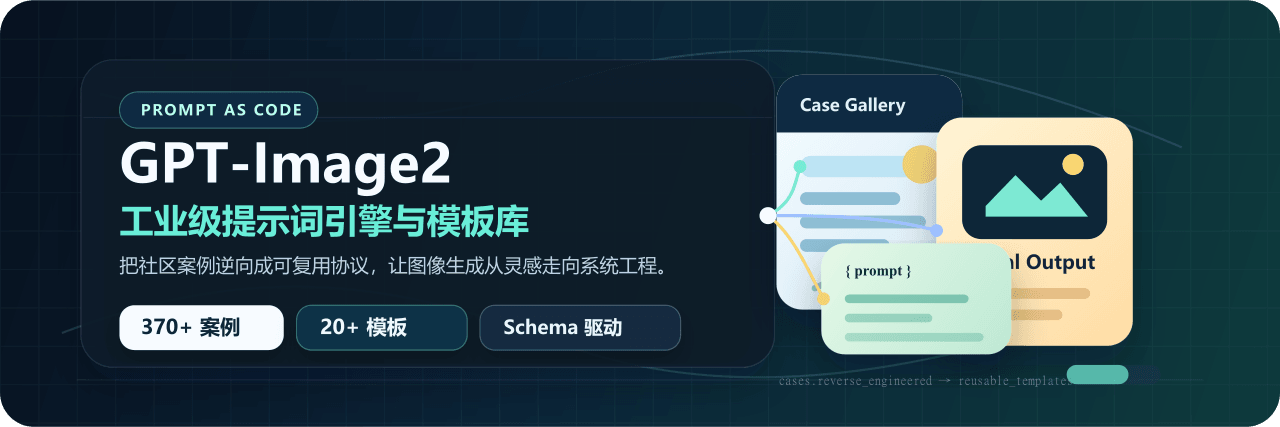 freestylefly/awesome-gpt-image-2
Prompt as Code | GPT-Image2 工业级提示词引擎与模板库,530+ 个案例逆向工程,20+ 套工业级模板,并提炼出Skills,持续更新中
freestylefly/awesome-gpt-image-2
Prompt as Code | GPT-Image2 工业级提示词引擎与模板库,530+ 个案例逆向工程,20+ 套工业级模板,并提炼出Skills,持续更新中
-
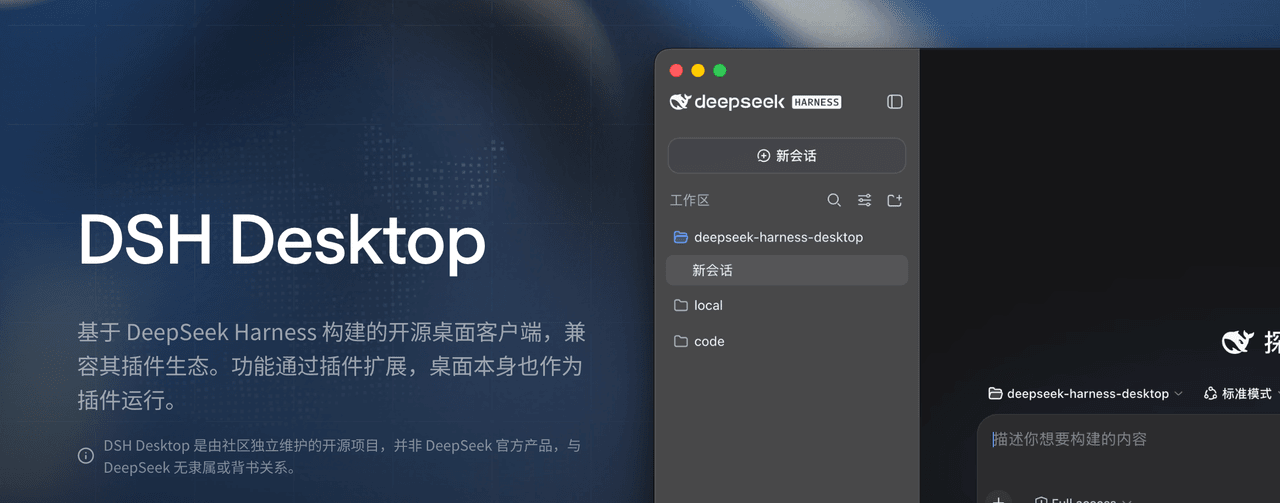 anywhere-labs/dsh-desktop
为 DeepSeek Harness (DSH) 插件生态打造的现代化桌面端解决方案。万物皆「插件」,桌面本身也是「插件」。
anywhere-labs/dsh-desktop
为 DeepSeek Harness (DSH) 插件生态打造的现代化桌面端解决方案。万物皆「插件」,桌面本身也是「插件」。
- Nagi-ovo/voyager Enhancement suite for Gemini, AI Studio, Claude & ChatGPT — plus a prompt manager for any web UI, DeepSeek Harness inclu…
-
 walkinglabs/learn-harness-engineering
Harness engineering beginner tutorial, from 0 to 1
walkinglabs/learn-harness-engineering
Harness engineering beginner tutorial, from 0 to 1
-
 awesome-dsh-plugin/awesome-dsh-plugin
A curated list of plugins for DeepSeek Harness (dsh) · DeepSeek Harness 插件精选列表
awesome-dsh-plugin/awesome-dsh-plugin
A curated list of plugins for DeepSeek Harness (dsh) · DeepSeek Harness 插件精选列表
-
 MemTensor/MemOS
Self-evolving memory OS for LLM & AI Agents: ultra-persistent memory, hybrid-retrieval, and cross-task skill reuse, with…
MemTensor/MemOS
Self-evolving memory OS for LLM & AI Agents: ultra-persistent memory, hybrid-retrieval, and cross-task skill reuse, with…
- yjh051108/dsh-routing-suite dsh-routing-suite — injector + router-standard kit: install the runtime injector first, then the task-aware reasoning-mo…