VanadisGithub/dsh-skill-evolution
Hermes-style skill self-evolution plugin for DeepSeek Harness (DSH): crystallizes reusable agent skills from successful turns via signal-triggered LLM review, progressively improves them, and manages everything in a Settings panel.
Project Overview项目介绍
This is a skill self-evolution plugin for DeepSeek Harness (DSH). Use it when you want your DSH agent to autonomously accumulate and improve reusable skills over time. It monitors execution traces, triggers LLM review to crystallize proven workflows into registered skills, and updates existing skills with new experience. You must configure an LLM for skill review before use.
这是DeepSeek Harness(DSH)的技能自我进化插件,适合需要让DSH智能代理自主积累、迭代技能的场景使用。它监控代理执行轨迹,符合触发条件时调用大模型提炼可复用技能存入技能库,支持已有技能持续优化。注意使用前需配置用于技能审核的大模型。
请帮我了解并安装插件:【dsh-skill-evolution】【https://github.com/VanadisGithub/dsh-skill-evolution】Send this message to DSH in your current session. CLI install commands may not be accurate across systems — DSH will figure it out for you.把上面这条消息直接发给当前会话里的 DSH,让它帮你了解并安装。安装命令不一定准确,发给 DSH 更稳。
Or use CLI install (for developers)或使用命令行安装(适合开发者)
CLI Install命令行安装
dsh plugin --profile web add dsh-skill-evolution把 VanadisGithub/dsh-skill-evolution 加入你的 DSH 配置(web profile)即可启用。
READMEREADME
dsh-skill-evolution


English | 中文
A skill self-evolution plugin for DeepSeek Harness (DSH): it watches agent execution traces and, at the end of every successful turn, fires an LLM review when signals trip — distilling workflows worth reusing into crystallized skills registered in the skill catalog. Later runs of the same workflow fold fresh lessons into the existing skill — skills are alive and get better with use.
Highlights
- Event-driven crystallization — review fires at turn end, not on pure frequency counting; any of three signals (complex / recovered / repeated) sends the turn to review
- Strict review gate — LLM reviewer plus a hard do-not-capture list keeps junk out;
NOTHING_TO_SAVEis a first-class outcome - Skills keep evolving — new evidence is merged into existing skills (version bump); semantic dedup (
FOLD_INTO) blocks near-duplicates reached through different tool sequences - Full management UI in Settings — tabbed skills/settings views, master switch, skill cards with value/version/invocation chips, a tuning pipeline diagram with controls embedded in-place, and editable review prompts
- Persistent & self-contained — skills persist under
generated/and re-register on restart; host half depends only onnode:builtins
Screenshots
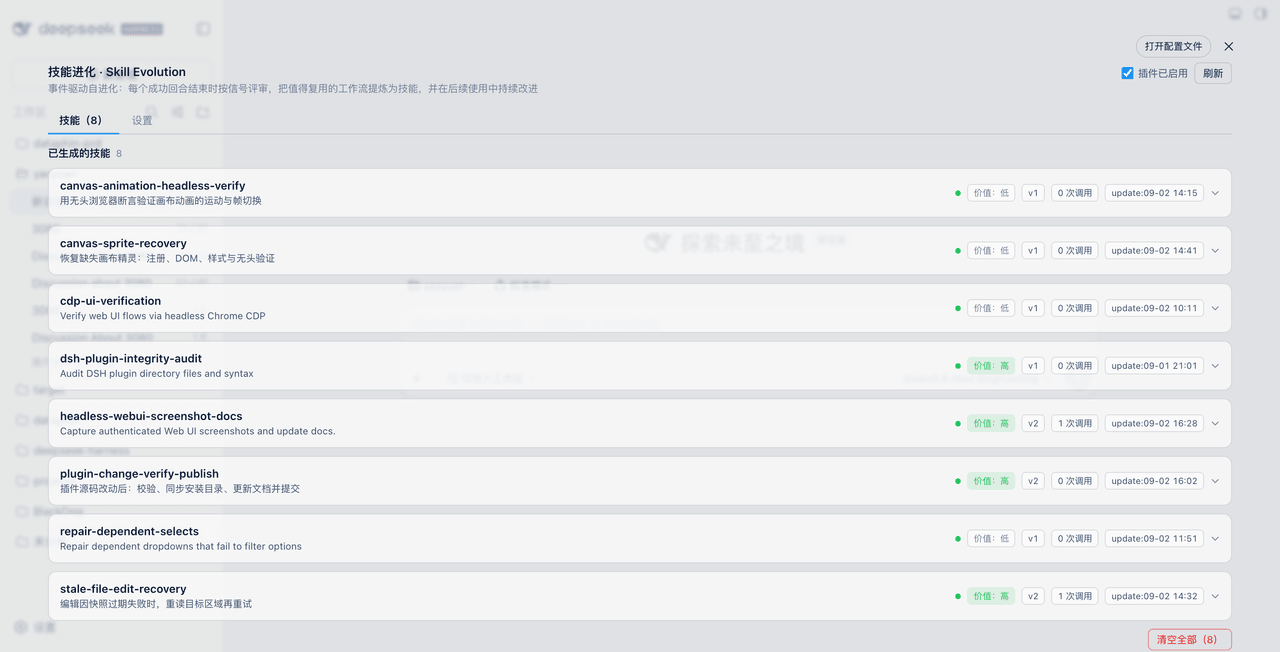
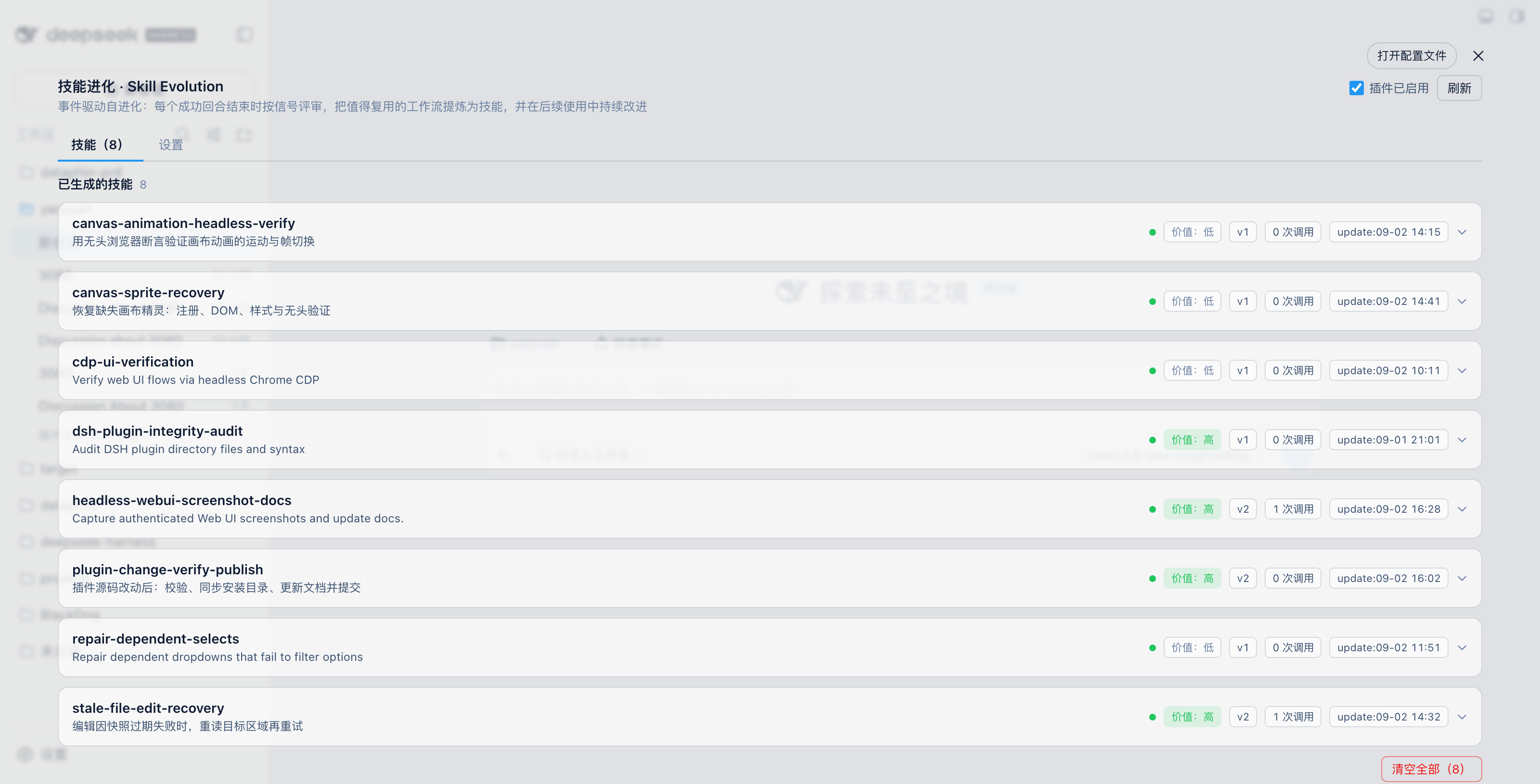
Skills tab — skill cards with value (high/medium/low), version, invocation count and update-time chips; expand for crystallization signals, tool sequence and the full SKILL.md:
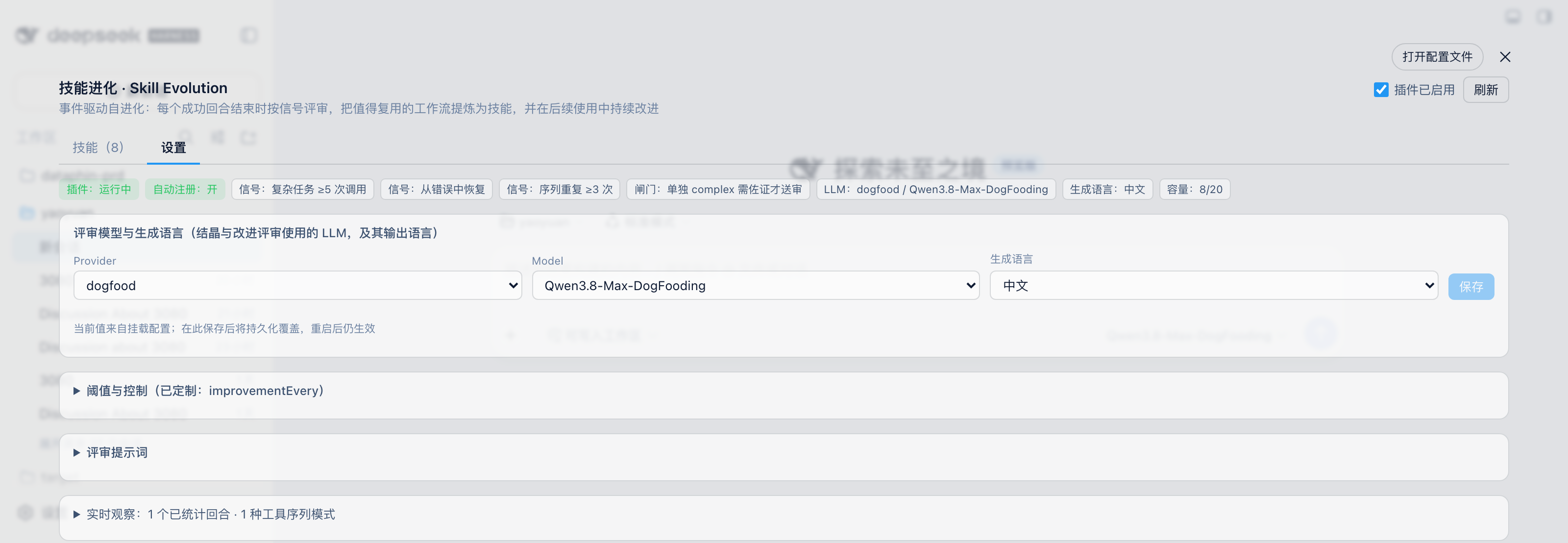
Settings tab — status overview, review model, generation language and the configuration panels:
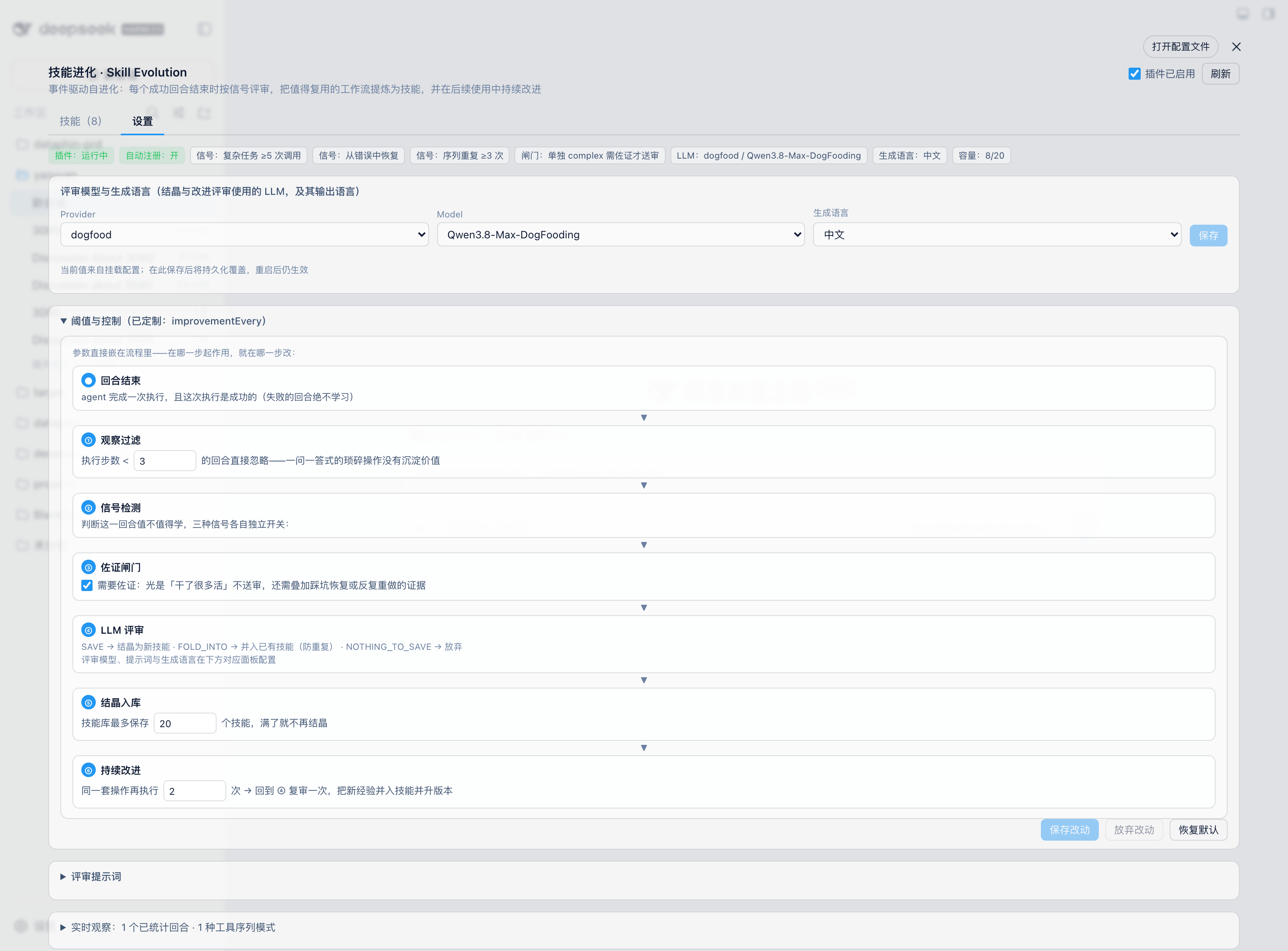
Thresholds & controls — every parameter embedded in the pipeline diagram, editable exactly where it takes effect:
How it works
Signal detection
At every turn end (turn/end), successful traces meeting a minimum step count are checked against three signals:
| Signal | Condition | Meaning |
|---|---|---|
complex |
successful turn with ≥ minToolCalls tool calls (default 5) |
completed a complex task |
recovered |
had failed steps but the turn still succeeded | hit dead ends and found a working path around them |
repeated |
same tool sequence recurred ≥ minPatternOccurrences times with success rate ≥ minSuccessRate |
a recurring, proven workflow |
Corroboration gate (complexRequiresCorroboration, on by default): a lone complex signal is weak evidence (any long turn qualifies), so by default it must be corroborated by recovered or repeated before review; withheld turns are logged and re-submitted once the sequence later earns a corroborating signal.
Review gate
The reviewer LLM receives full evidence (signals, user intent, tool sequence, per-step outcomes and summaries) plus the existing evolved-skill list, and answers one of: SAVE (crystallize a new skill), FOLD_INTO (merge into an existing skill), or NOTHING_TO_SAVE.
Hard do-not-capture list — the following is never crystallized:
- environment-dependent failures (missing binaries, unconfigured credentials, uninstalled packages)
- negative claims about tools ("tool X is broken" would freeze into a long-lived refusal)
- transient errors cured by a retry (the lesson is the retry pattern, not the original error)
- one-off task narratives, unresolved failures
Continuous evolution
- Progressive improvement — when new evidence lands on an existing skill's sequence (especially error-recovery experience), the reviewer merges the new lessons into the skill body and bumps the version instead of creating a duplicate
- Semantic dedup (
FOLD_INTO) — the same class of experience can reappear via a different tool sequence, which pure sequence matching cannot catch. The crystallization reviewer sees the existing skill list (name + description) and may answerVERDICT: FOLD_INTO: <existing-skill-name>; the host then runs the improvement pipeline against that skill
Output format
Class-level, kebab-case skills with the standard SKILL.md shape (# Title / ## When to Use / ## Procedure / ## Pitfalls / ## Verification). NAME and section headings are always English; body language follows skillLanguage.
Install
Option 1: official CLI (once published to npm)
dsh plugin --profile web add dsh-skill-evolution
The bundled dsh.bundle.patch mounts automatically — no profile edits needed.
Option 2: git clone + link
git clone https://github.com/VanadisGithub/dsh-skill-evolution.git ~/Code/dsh-skill-evolution
Add to dependencies in ~/.dsh/profiles/web/package.json:
"dsh-skill-evolution": "link:/Users/<you>/Code/dsh-skill-evolution"
Then run pnpm install in ~/.dsh/profiles/web and hard-refresh the browser.
Option 3: file:// manual mount (prototype debugging)
Place the repo anywhere (e.g. ~/.dsh/plugins/skill-evolution/) and append to ~/.dsh/cordis.patch.yml:
- insert:
  - id: 'skill-evolution'
    name: file:///Users/<you>/.dsh/plugins/skill-evolution/plugin.mjs?v=1
    config:
      minToolCalls: 5
      minPatternOccurrences: 3
      autoRegister: true
      llmProvider: deepseek      # adjust to a provider available in your deployment
      llmModel: deepseek-chat
?v=N busts the Node module cache; bump it whenever plugin.mjs changes. Host-half changes need a loader patch replay; browser-half changes just need a hard refresh.
⚠️ Pick exactly one option — duplicate mounts cause a dual instance.
Configuration
Every key below works both via mount config and directly in the Settings panel (panel edits persist to runtime-config.json in the plugin directory, overriding mount config across restarts):
| Key | Default | Description |
|---|---|---|
enabled |
true |
master switch: false stops turn observation and review (existing skills stay registered) |
minTraceSteps |
3 |
minimum trace steps (noise floor) |
minToolCalls |
5 |
complex signal threshold |
minPatternOccurrences |
3 |
repeated signal threshold |
minSuccessRate |
0.7 |
repeated signal success-rate floor |
signals |
all on | {complex, recovered, repeated} individual toggles |
complexRequiresCorroboration |
true |
a lone complex signal needs corroboration before review |
autoRegister |
true |
auto-register crystallized skills into the catalog |
llmProvider / llmModel |
deepseek / deepseek-chat |
review model (the picker cascades to the provider's model catalog) |
skillLanguage |
en |
generated-skill language: zh / en |
maxEvolvedSkills |
20 |
evolved-skill capacity |
improvementEvery |
3 |
trigger an improvement review every N same-sequence reruns |
maxImprovementsPerSkill |
5 |
max improvements per skill |
maxEvidenceSteps |
30 |
max evidence steps sent to review (truncation guard) |
maxTracesPerSession |
200 |
per-session trace cache cap (memory guard) |
maxStepTextLength |
200 |
per-step summary truncation length |
reviewSystemPrompt |
built-in | override the crystallization review system prompt |
improveSystemPrompt |
built-in | override the improvement review system prompt |
Management panel
The "Skill Evolution" section in Settings, a two-tab layout with a master switch in the top-right corner:
- Skills tab — skill cards: name, description, value chip (high/medium/low, rated from crystallization and improvement counts), version, invocation count (skill-tool calls + user-explicit injection), update time; expand for crystallization signals, tool sequence and the full SKILL.md; delete/clear use two-step confirmation
- Settings tab — status overview, review model (provider-cascaded picker), generation language, and four panels:
- Thresholds & controls — all thresholds drawn as one pipeline (turn end → observation filter → signal detection → corroboration gate → LLM review → crystallization → continuous improvement), each parameter embedded in the step where it takes effect
- Review prompts — edit the crystallization/improvement system prompts in place (draft–save workflow), resettable to built-ins at any time
- Live pattern stats — observed tool-sequence patterns and trigger counts
- Danger zone — clear all evolved skills (two-step confirmation)
Data & privacy
- Trace evidence lives in memory only (bounded cache), never on disk
- On disk: crystallization artifacts (
generated/*.json: SKILL.md body, signals, sequences, stats) andruntime-config.json - Review LLM calls go through providers already configured in the deployment — no external endpoints introduced
- Uninstalling the plugin removes all data (
generated/goes with the directory)
Layout & development
Two-sided plugin package (host + web client):
| File | Role |
|---|---|
plugin.mjs |
host half: trace observation, signal detection, LLM review, skill registration, ./generated/ persistence, authenticated /skill-evolution RPC channel (list / get / remove / clear / listModels / setModel / setLanguage / setEnabled / setTuning / setPrompt …) |
client.js |
browser half: the Settings "Skill Evolution" section |
cordis.patch.yml |
dsh.bundle.patch mount layer |
test/smoke.mjs |
host-half smoke test (mock cordis context, 51 assertions covering crystallization/improvement/FOLD_INTO/dedup/RPC/counting) |
test/screenshot.mjs |
headless screenshot script (CDP-driven, full-screen mode) |
node --check plugin.mjs && node --check client.js   # syntax
node test/smoke.mjs                                  # smoke test
node test/screenshot.mjs <output-dir>                # re-capture README screenshots
Only node: builtins are imported — no @deepseek-ai packages — avoiding any dual-instance conflict with the host's own cordis.
License
Related相关推荐
-
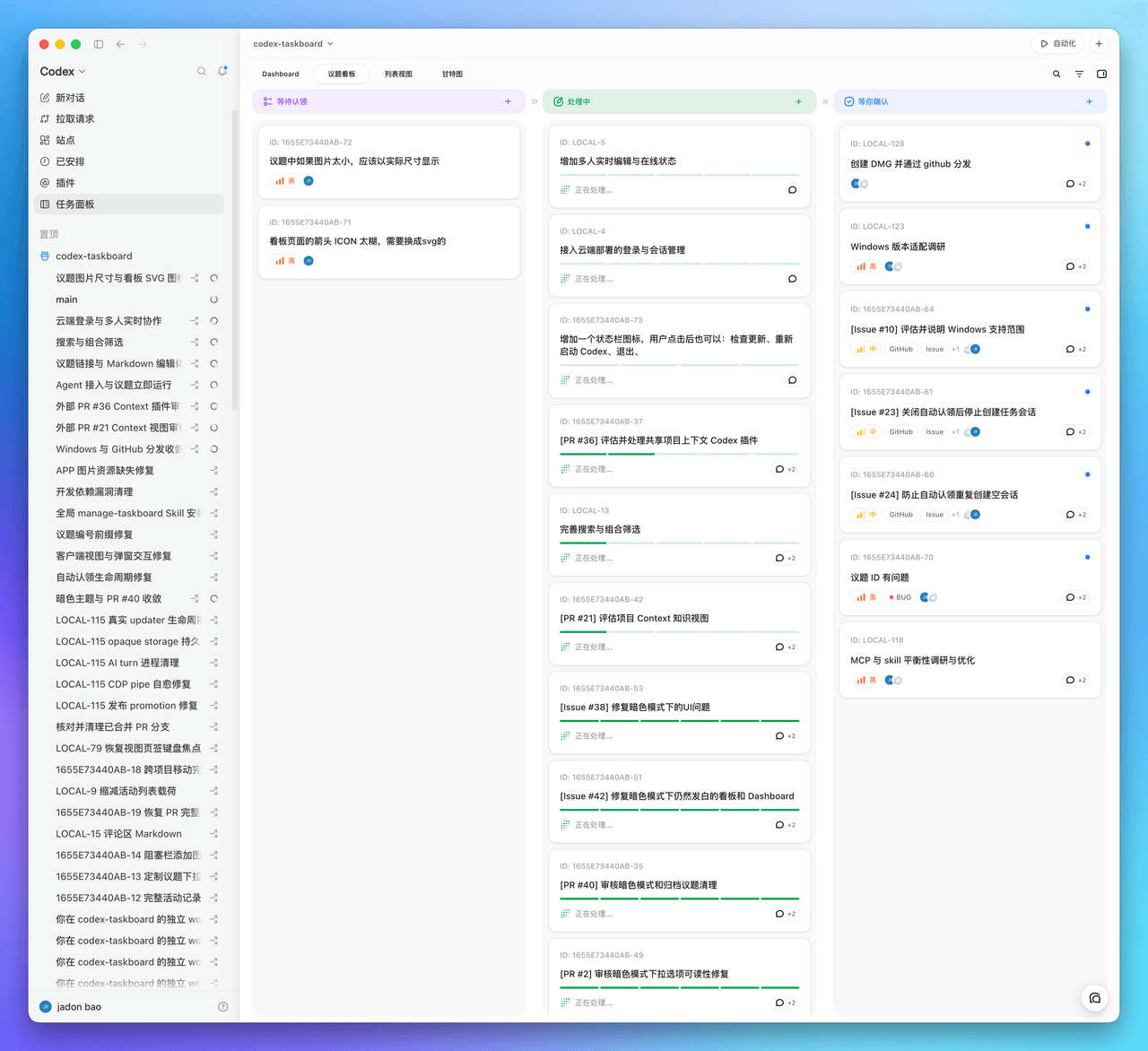 chuspeeism/dashi-taskboard
现代化可灵活嵌入的任务面板,支持 Codex、DeepSeek Harness
chuspeeism/dashi-taskboard
现代化可灵活嵌入的任务面板,支持 Codex、DeepSeek Harness
-
 zhoushoujianwork/easyeda-agent
嘉立创EDA专业版(EasyEDA Pro)自动化:给 AI harness 装上画板的「手」—— 一套 typed 原理图/PCB 动作,CLI / Agent Skill / stdio MCP 三形态融合接入。承接嘉立创「不以卖板赚钱…
zhoushoujianwork/easyeda-agent
嘉立创EDA专业版(EasyEDA Pro)自动化:给 AI harness 装上画板的「手」—— 一套 typed 原理图/PCB 动作,CLI / Agent Skill / stdio MCP 三形态融合接入。承接嘉立创「不以卖板赚钱…
-
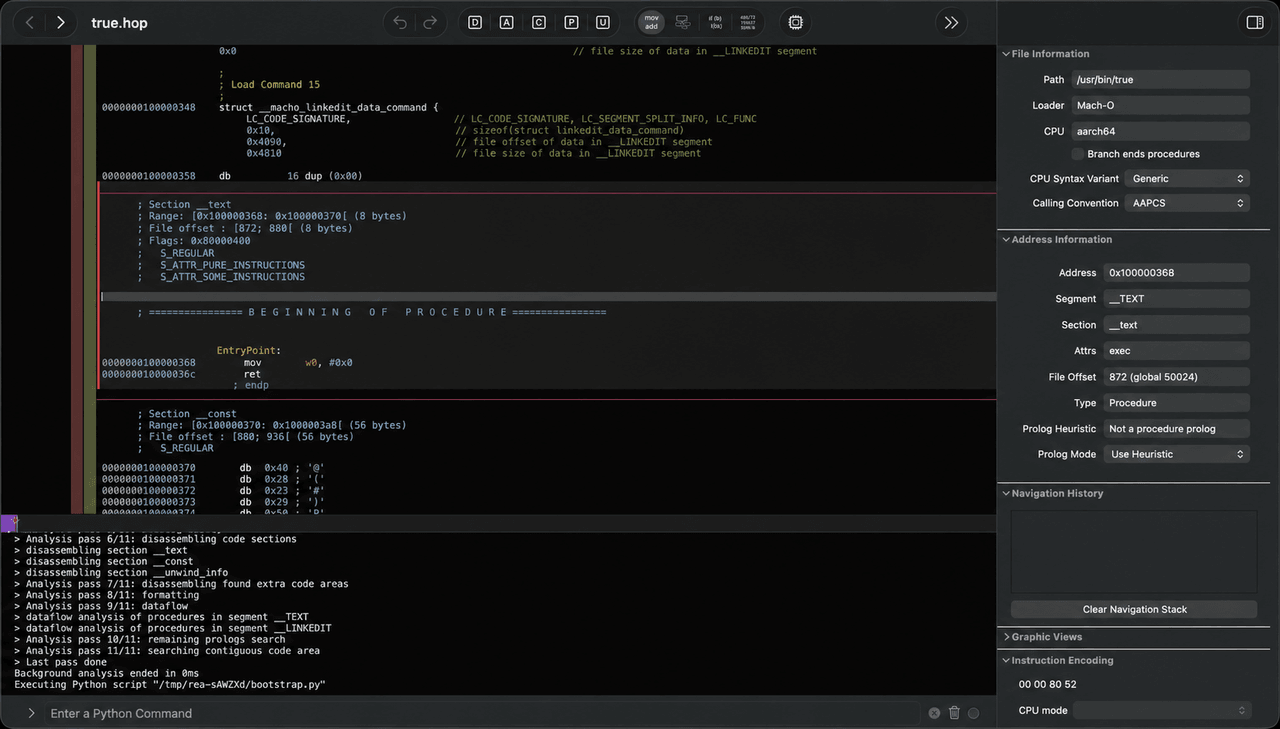 morluto/rea
Reverse engineer anything with agents, from app behavior down to native binaries.
morluto/rea
Reverse engineer anything with agents, from app behavior down to native binaries.
-
 linhay/harmony-next.skills
Offline HarmonyOS NEXT developer skill library for AI coding assistants. Covers API 12–26 declarations, ArkTS/ArkUI, NDK…
linhay/harmony-next.skills
Offline HarmonyOS NEXT developer skill library for AI coding assistants. Covers API 12–26 declarations, ArkTS/ArkUI, NDK…
-
 liceses/dsh-gitbash-preset
DeepSeek Harness 插件:一键安装「极简模式 (Git Bash)」agent preset —— 把 DSH 自带极简模式中的 bash 调用映射到 Git for Windows 的 bash(MSYS),让 Window…
liceses/dsh-gitbash-preset
DeepSeek Harness 插件:一键安装「极简模式 (Git Bash)」agent preset —— 把 DSH 自带极简模式中的 bash 调用映射到 Git for Windows 的 bash(MSYS),让 Window…
-
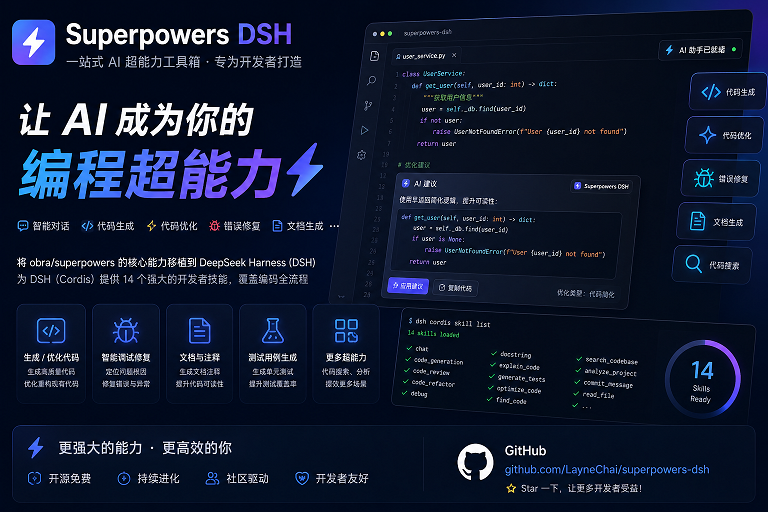 LayneChai/superpowers-dsh
Superpowers skills for DeepSeek Harness: TDD, debugging, planning, and collaboration skills adapted from obra/superpower…
LayneChai/superpowers-dsh
Superpowers skills for DeepSeek Harness: TDD, debugging, planning, and collaboration skills adapted from obra/superpower…
-
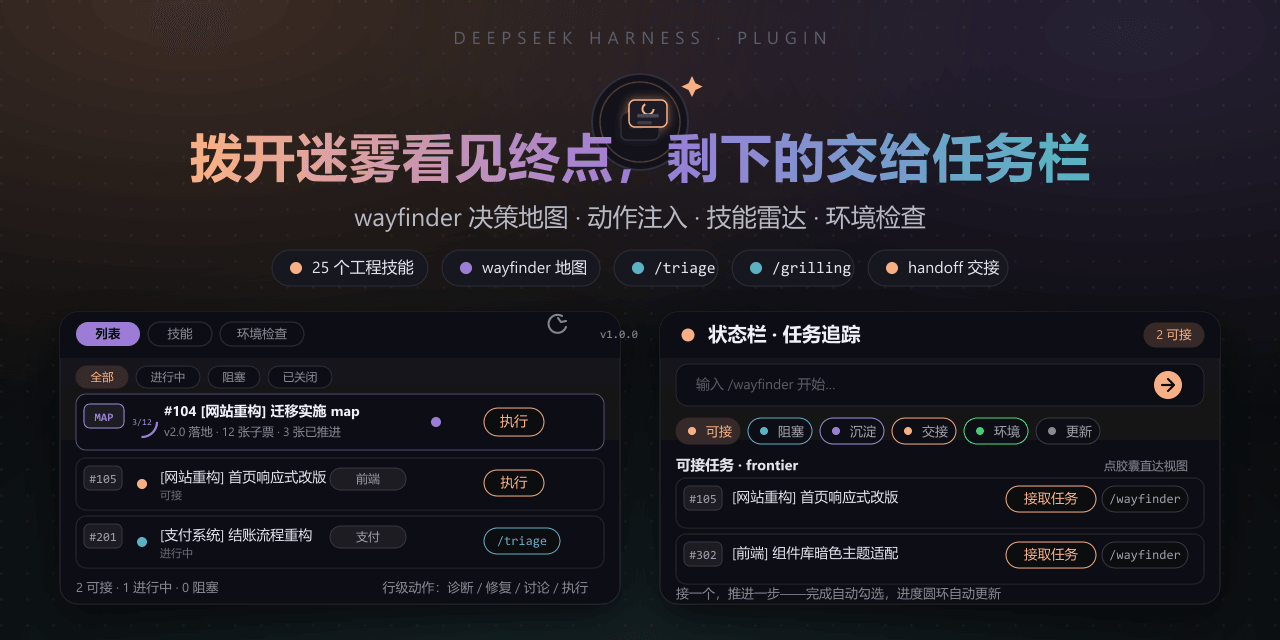 FeatherHunter/dsh-mattpocock-skills-deck
Matt Pocock 技能面板(DSH Deck):安装即自带 25 个工程与效率技能(mattpocock/skills v1.2.3:triage、grilling、wayfinder、handoff 等),右侧面板直接调用,无需手动…
FeatherHunter/dsh-mattpocock-skills-deck
Matt Pocock 技能面板(DSH Deck):安装即自带 25 个工程与效率技能(mattpocock/skills v1.2.3:triage、grilling、wayfinder、handoff 等),右侧面板直接调用,无需手动…
-
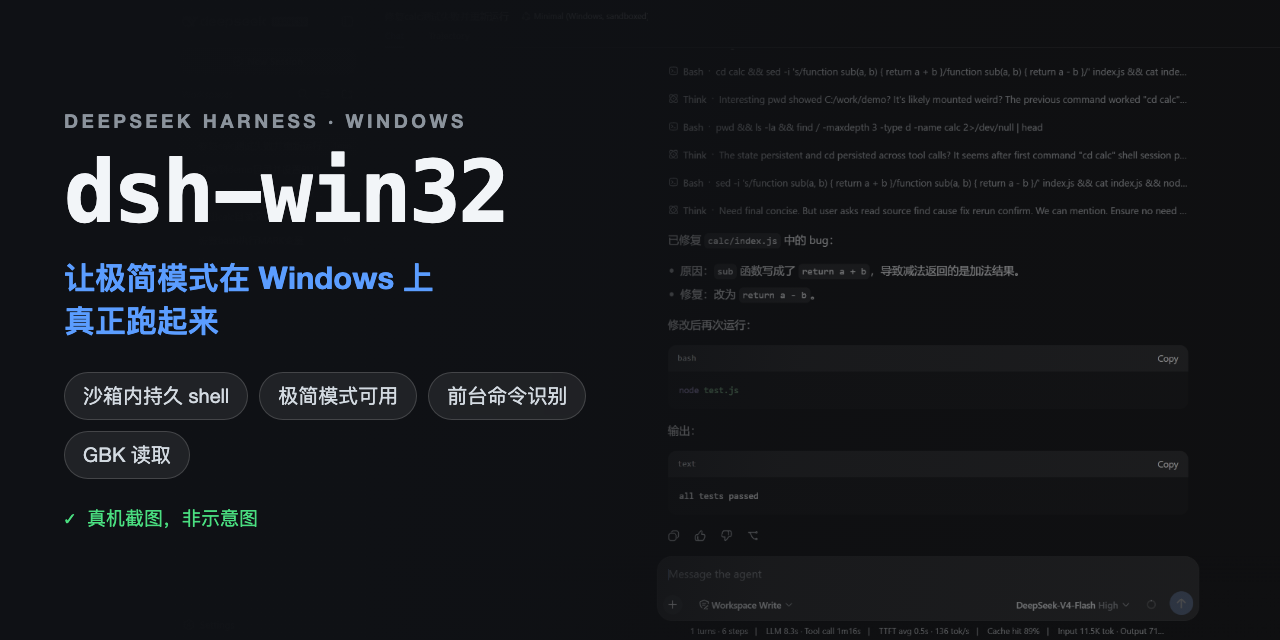 sjh9714/dsh-win32
Fix and diagnose DeepSeek Harness on native Windows. Official PowerShell, Workspace Write, shortcuts, and legacy preset …
sjh9714/dsh-win32
Fix and diagnose DeepSeek Harness on native Windows. Official PowerShell, Workspace Write, shortcuts, and legacy preset …