wulusai2333/mimo-vision
DeepSeek Harness (DSH) 原生插件——describe_image 工具:通过 ctx.fs / ctx.credentials 接缝实现的视觉桥梁(图像 → mimo-v2.5 → 文本描述)。
项目介绍Project Overview
mimo-vision 是 DSH 原生插件,注册 describe_image 工具,把图片发给 mimo-v2.5 多模态模型并返回文字描述,为无视觉输入的主模型充当视觉桥。支持 PNG/JPEG 等原生格式,SVG/HEIC 等在装有 ImageMagick 时自动转码。当主模型需要看图、识别图片内容时使用。注意:转码临时文件经 node:fs 写入系统临时目录,会绕过 fs 沙箱,用完即删。
mimo-vision is a native DSH plugin that registers a describe_image tool, sending an image to a mimo-v2.5 multimodal model and returning a text description—a vision bridge for main models lacking vision input. Native formats (PNG/JPEG/GIF/WebP/BMP) send directly; others (SVG/HEIC/TIFF…) auto-transcode via local ImageMagick. Use it when a text-only model needs to inspect or identify image content. Caveat: transcoding writes temp files via node:fs to the OS temp dir, bypassing the fs sandbox, though they are deleted immediately.
请帮我了解并安装插件:【mimo-vision】【https://github.com/wulusai2333/mimo-vision】把上面这条消息直接发给当前会话里的 DSH,让它帮你了解并安装。安装命令不一定准确,发给 DSH 更稳。Send this message to DSH in your current session. CLI install commands may not be accurate across systems — DSH will figure it out for you.
或使用命令行安装(适合开发者)Or use CLI install (for developers)
命令行安装CLI Install
dsh plugin --profile web add mimo-vision把 wulusai2333/mimo-vision 加入你的 DSH 配置(web profile)即可启用。
READMEREADME
mimo-vision · Native vision plugin for DSH
English | 中文
mimo-vision is a native plugin for DeepSeek Harness (DSH), package name mimo-vision. It registers a describe_image tool that sends an image to a mimo-v2.5-series multimodal model and returns the text description to the main model — a "vision bridge" built for main models (e.g. deepseek-v4-flash) that have no vision input of their own.
It is not a standalone process: it is a first-class citizen of DSH's "everything is a plugin" model. apply does exactly one thing — registers the capability as a first-class dsh tool. Dependencies, files, credentials, and subprocesses all go through dsh's defined capability seams; uninstalling cleans up cleanly.
Implementation paradigm: a direct landing of DSH's native plugin primitives
- Registration is reversible by construction:
apply(ctx)contains a singlectx.tools.register(defineTool(...)).register()returns a disposer; when the plugin fiber disposes, the tool is unregistered and its schema is automatically withdrawn from the system prompt. There is no leftover cleanup code — clean uninstall is a structural guarantee, not hand-written cleanup. injectdeclares dependencies:export const inject = ['tools', 'fs', 'credentials']follows the pure Cordis effect spec — activation only happens once the seams are in place.ctx.get('subprocess')intranscode.tsis an optional capability with a default fallback, used at execution time, not activation time. This is "declared dependencies", not "probed dependencies".- All capabilities go through dsh seams: file reads use
ctx.fs.resolve/stat/readBytes+ctx.emit('fs/observed'); credentials usectx.credentials.resolve(credentialRef(...))with no hand-rolled parsing; subprocess (transcoding) usesctx.subprocess. The one exception: transcode temp files are written vianode:fsto the system temp directory (see Known Limitations below). - Uninstallable / composable: uninstall is pure — the disposer runs and everything is reclaimed: no disk writes, no timers, no long-lived connections to manually wind down.
Tool
| Tool | Arguments | Description |
|---|---|---|
describe_image |
path (required), question (optional) |
Describes an image file and returns text |
Supported image formats:
- Sent natively: PNG / JPEG / GIF / WebP / BMP (all verified decodable by the vision model)
- Auto-transcoded: SVG / TIFF (
.tif) / HEIC (.heif) / PSD / ICO / EXR / JP2 / JXL / AVIF — when ImageMagick is installed locally, these are transcoded to PNG before sending, downscaled to a ≤2048px long edge (saves tokens) - Any other extension, or a transcode-format when ImageMagick is not installed, returns an explicit error (never sent silently)
Usage example (tell the model): Use describe_image to describe D:\photos\cat.png, focusing on what breed of cat it is.
How it works
- Key resolution:
ctx.credentials.resolvetakes the first non-empty ofOPENCODE_GO_API_KEY→OPENCODE_API_KEY(DSH credential layering: process env >~/.dsh/.credentials.yaml>.env). - Read the image:
ctx.fs.resolve(relative paths resolve against the session workspace cwd) →ctx.fs.readBytes(20 MiB cap); non-native formats (SVG/TIFF/HEIC…) are transcoded to PNG via ImageMagick (through thectx.subprocessseam) and downscaled to a 2048px long edge → base64. - Routing: the free Zen route (
mimo-v2.5-free) is tried first; on failure (non-2xx / timeout) it falls back to the paid Go route (mimo-v2.5) once per request;allowPaid: falsedisables the paid fallback.
Design decisions are documented in adr/0002-dsh-native-plugin.md (which supersedes the earlier MCP approach, ADR-0001).
Quick install (npm-installed DSH, recommended)
For
npx @deepseek-ai/dsh webor a globally installed DSH. The repo ships prebuilt artifacts (lib/index.js) — no build toolchain required.
Prerequisite: Node ^22.19 || >=24, and DSH already able to start.
Step 0 · Install and activate (one command)
mimo-vision declares dsh.bundle (see the dsh field in package.json), so dsh plugin add reconciles it as a bundle layer of the profile — installing the package, mounting the layer, and activating the tool happen in one step:
# from the npm registry (recommended once this package is published)
dsh plugin --profile web add mimo-vision

# from GitHub (source install, prebuilt lib/)
dsh plugin --profile web add github:wulusai2333/mimo-vision
If the repo is not on its default branch, use
github:wulusai2333/mimo-vision#<branch-or-tag>. This path relies on the dependency closure that DSH maintains in~/.dsh/profiles/node_modules(symlinking all@deepseek-ai/*seams to the dsh install tree), so the plugin's runtimeimport "@deepseek-ai/dsh-tools"etc. resolves to the same instance DSH uses — singleton-safe,register()/injectsemantics unchanged. GitHub-source installs require this repo to commit a prebuiltlib/(kept in sync withsrc/): pnpm installs the source withlib/included, no build runs, noallowBuildsneeded.
Offline / manual mount from source (fallback path when pnpm is unavailable)
Manually copy the artifacts into the profile's plugin resolution root, then mount the patch in the profile's cordis.patch.yml (equivalent to automatic bundle mounting, but two manual steps):
# Windows PowerShell
$dst = "$env:USERPROFILE\.dsh\profiles\node_modules\mimo-vision"
New-Item -ItemType Directory -Path $dst -Force | Out-Null
Copy-Item package.json -Destination $dst -Force
Copy-Item cordis.patch.yml -Destination $dst -Force
Copy-Item lib -Destination $dst -Recurse -Force
# macOS / Linux
dst="$HOME/.dsh/profiles/node_modules/mimo-vision"
mkdir -p "$dst"
cp package.json "$dst/"
cp cordis.patch.yml "$dst/"
cp -r lib "$dst/"
Then edit ~/.dsh/profiles/web/cordis.patch.yml and add:
- insert:
    - id: tool-vision
      name: 'mimo-vision'
      config:
        allowPaid: true
Step 1 · Configure the key
Put an opencode key in ~/.dsh/.credentials.yaml (OPENCODE_GO_API_KEY preferred, OPENCODE_API_KEY as fallback):
OPENCODE_GO_API_KEY: sk-...
You can also put it in the environment of the process that starts DSH (
OPENCODE_GO_API_KEY=... dsh web). Credential seam layering priority: process env >.credentials.yaml>.env.
Step 2 · Restart and verify
A restart is required on first integration (so the process imports the new package). After that, changes to this plugin's code or config such as allowPaid hot-reload without restart.
After restarting, verify: mimo-vision should appear in DSH's settings, with describe_image among the available tools; or just tell the model "use describe_image to describe some image" and try it.
Uninstall
dsh plugin remove takes the package name (the key in the profile's dependencies), not the install source:
dsh plugin --profile web remove mimo-vision
Passing
github:wulusai2333/mimo-visionerrors withERR_PNPM_CANNOT_REMOVE_MISSING_DEPS("no such dependency found") — the dependency is recorded by package namemimo-vision, soremoveneeds that key. The command removes both the dependency and the bundle layer.
Configuration (all optional, defaults provided)
| Field | Default | Description |
|---|---|---|
allowPaid |
true |
Whether to fall back to the paid route after the free route fails |
freeBaseUrl |
https://opencode.ai/zen/v1 |
Free route base URL |
freeModel |
mimo-v2.5-free |
Free route model |
paidBaseUrl |
https://opencode.ai/zen/go/v1 |
Paid route base URL |
paidModel |
mimo-v2.5 |
Paid route model |
A minimal registration only sets allowPaid; everything else uses the defaults:
- insert:
    - id: tool-vision
      name: 'mimo-vision'
      config:
        allowPaid: false
Building from source / development (DSH monorepo)
To modify the plugin source, put it into the DSH source tree and go through the repo gates:
# 1. Copy this repo as packages/vision/tool-vision
cp -r /path/to/mimo-vision <dsh>/deepseek-harness/packages/vision/tool-vision

# 2. Install and verify (tsc typecheck + vitest unit tests + oxlint)
cd <dsh>/deepseek-harness
pnpm install
npx tsc -b packages/vision/tool-vision   # typecheck
npx vitest run packages/vision/tool-vision   # unit tests
npx oxlint packages/vision/tool-vision       # lint

# 3. Produce lib/index.js (prebuilt artifacts)
cd packages/vision/tool-vision
pnpm run build
pnpm run buildrunstsc --buildfirst (emitting the intermediatelib/types/*.jsthat tsdown consumes) and then bundleslib/index.js/lib/invariant.js. Steps 2/3 can also be run inside the package withpnpm run test/pnpm run typecheck/pnpm run build(the scripts are inpackage.json).
Note: the
@deepseek-ai/dsh-*seams are versioned by the DSH dependency closure, not by this package. The peer dependencies are marked optional so a standalonenpm install mimo-visionsucceeds, but the plugin only runs inside DSH (where the closure provides those seams as a singleton). For development, either use the prebuilt artifacts from "Quick install" above, or run it from source inside the monorepo.
Failure semantics
Any failure (no key, unsupported format, both routes failing, file missing / not a regular file, over the limit, non-image response) is returned as a tool-level error: execute throws, the registry materializes isError, the process does not exit and the session does not break.
Known Limitations
- Transcode temp files bypass the
ctx.fssandbox: when non-native formats (SVG/TIFF/HEIC…) are transcoded via ImageMagick, the source bytes and the resulting PNG go throughnode:fsto the system temp directory (os.tmpdir()), becausectx.subprocessneeds real OS paths to feed the localmagick, whilectx.fs'sFsTargetmay be an abstract/remote/sandboxed path. This bypasses thedsh-fs-sandboxfile sandbox policy; the temp directory is deleted immediately after conversion. It only triggers when ImageMagick is installed locally and a transcode format is requested — native formats (PNG/JPEG/GIF/WebP/BMP) never take this path. - The prebuilt
lib/must stay in sync withsrc/: GitHub-source installs load the committedlib/index.jsdirectly and never build at install time. After changingsrc/, rebuild and commitlib/, or the deployed version loads stale artifacts.
Security
- The key is only read via
ctx.credentials.resolve— never printed, never written to disk, never directory-scanned; - The key is only used in the request header
Authorization: Bearer ...; - Images are read into memory via
ctx.fsand sent straight as base64, never written to disk (non-native formats are routed through the system temp dir during transcoding and deleted immediately after).
License
MIT
相关推荐Related
-
 nexu-io/open-design
🎨 Best DeepSeek Harness Design Plugin. The open-source Claude Design alternative. 🖥️ Local-first desktop app. 🖼️ Your…
nexu-io/open-design
🎨 Best DeepSeek Harness Design Plugin. The open-source Claude Design alternative. 🖥️ Local-first desktop app. 🖼️ Your…
-
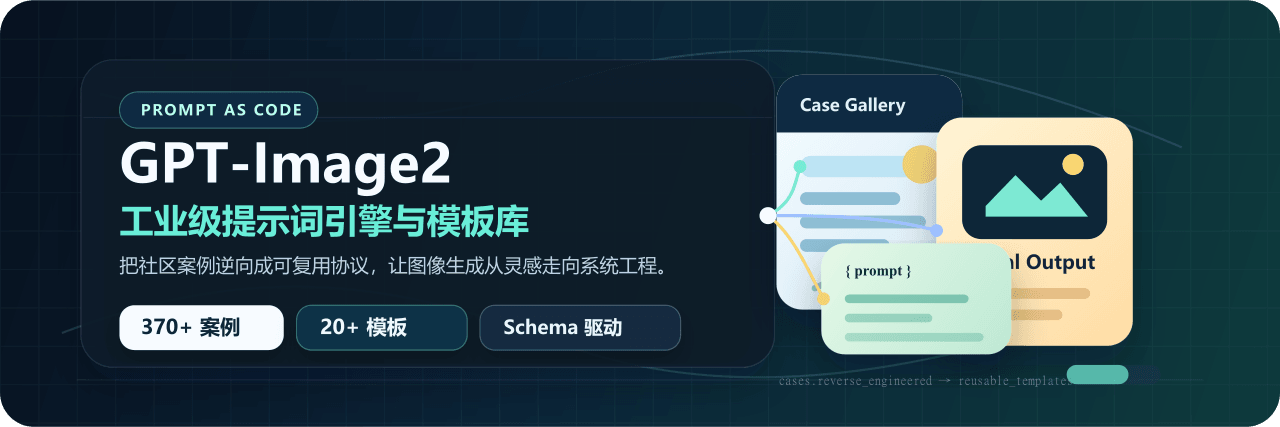 freestylefly/awesome-gpt-image-2
Prompt as Code | GPT-Image2 工业级提示词引擎与模板库,530+ 个案例逆向工程,20+ 套工业级模板,并提炼出Skills,持续更新中
freestylefly/awesome-gpt-image-2
Prompt as Code | GPT-Image2 工业级提示词引擎与模板库,530+ 个案例逆向工程,20+ 套工业级模板,并提炼出Skills,持续更新中
-
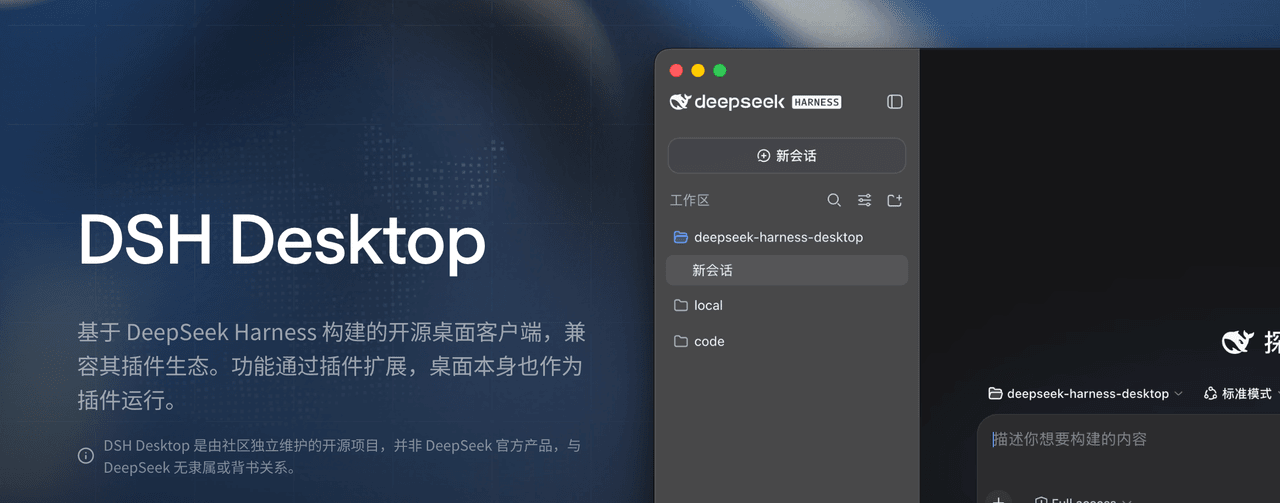 anywhere-labs/dsh-desktop
为 DeepSeek Harness (DSH) 插件生态打造的现代化桌面端解决方案。万物皆「插件」,桌面本身也是「插件」。
anywhere-labs/dsh-desktop
为 DeepSeek Harness (DSH) 插件生态打造的现代化桌面端解决方案。万物皆「插件」,桌面本身也是「插件」。
- Nagi-ovo/voyager Enhancement suite for Gemini, AI Studio, Claude & ChatGPT — plus a prompt manager for any web UI, DeepSeek Harness inclu…
-
 walkinglabs/learn-harness-engineering
Harness engineering beginner tutorial, from 0 to 1
walkinglabs/learn-harness-engineering
Harness engineering beginner tutorial, from 0 to 1
-
 awesome-dsh-plugin/awesome-dsh-plugin
A curated list of plugins for DeepSeek Harness (dsh) · DeepSeek Harness 插件精选列表
awesome-dsh-plugin/awesome-dsh-plugin
A curated list of plugins for DeepSeek Harness (dsh) · DeepSeek Harness 插件精选列表
-
 MemTensor/MemOS
Self-evolving memory OS for LLM & AI Agents: ultra-persistent memory, hybrid-retrieval, and cross-task skill reuse, with…
MemTensor/MemOS
Self-evolving memory OS for LLM & AI Agents: ultra-persistent memory, hybrid-retrieval, and cross-task skill reuse, with…
- yjh051108/dsh-routing-suite dsh-routing-suite — injector + router-standard kit: install the runtime injector first, then the task-aware reasoning-mo…