XJungit/omdp
仅我的DSH插件 — DeepSeek Harness插件捆绑包的单仓库
项目介绍Project Overview
omdp 是汇集多个 DeepSeek Harness 插件的单体仓库,每个子目录为可独立安装的 DSH 包。提供 MCP 与用户技能管理、API 密钥失败回退轮换、纯文本模型经多模态端点识图等能力。适合需要在 Web UI 配置 MCP/技能、增强密钥容灾或让文本模型处理图片时使用。注意 archive 内插件已停止维护,推荐用 npm 安装,本地 link 更适合开发。
omdp is a monorepo of independently installable DeepSeek Harness plugins. Its active bundles manage MCP servers and user skills from the Web UI, rotate pooled API keys on retryable auth or rate errors, and let text-only models process images through a configurable multimodal endpoint. Use it when configuring DSH extensions, improving key failover, or adding vision support. Note that archived plugins are unmaintained, and npm installation is preferred over GitHub or local-link setups.
请帮我了解并安装插件:【omdp】【https://github.com/XJungit/omdp】把上面这条消息直接发给当前会话里的 DSH,让它帮你了解并安装。安装命令不一定准确,发给 DSH 更稳。Send this message to DSH in your current session. CLI install commands may not be accurate across systems — DSH will figure it out for you.
或使用命令行安装(适合开发者)Or use CLI install (for developers)
命令行安装CLI Install
dsh plugin --profile web add github:XJungit/omdp#path:dsh-connector把 XJungit/omdp 加入你的 DSH 配置(web profile)即可启用。
READMEREADME
omdp — only my DSH plugins
A single GitHub repo that collects all of my DeepSeek Harness (DSH) plugins as a monorepo. Each plugin lives in its own subdirectory and is an independently installable DSH bundle.
Layout
omdp/
├── README.md            # this file
├── package.json         # root manifest — keeps bare-git installs functional (see below)
├── dsh-connector/       # unified MCP + Skills manager (Web UI settings tab)
│   ├── index.js         # host half
│   ├── client.js        # client half (Web UI)
│   ├── cordis.patch.yml # bundle activation row
│   ├── package.json
│   └── README.md
├── dsh-vision-bridge/   # vision bridge: let text-only models "see" via a configured multimodal endpoint
│   ├── index.js         # host half
│   ├── client.js        # client half (paste/drop → temp path)
│   ├── cordis.patch.yml # bundle activation row
│   ├── package.json
│   └── README.md
├── archive/             # archived plugins retained for historical reference
│   ├── dsh-gitbash-win/
│   └── resume-stream/
├── _skeleton-client/    # copy-paste template: client + host bundle (Web UI plugin)
├── _skeleton-host/      # copy-paste template: host-only bundle
├── docs/                # research notes, e.g. AI-DSH-plugin-quality.md (community findings)
└── <future plugins>/    # each its own subdirectory + package.json
Plugins
dsh-connector → npm name @omdp/dsh-connector
One settings tab ("Connector") that manages two things from the DSH Web UI:
- MCP servers — edits the MCP block in
cordis.patch.yml(stdio / streamable-http). Legacy SSE servers (e.g. Zhihu) are kept asmcp-remote --transport sse-onlystdio bridges; this plugin only manages that config text. - User skills — read / write / delete skills under
~/.dsh/skills/<name>/SKILL.md.
Install into a profile via a local link: dependency (see its README for the exact steps):
"@omdp/dsh-connector": "link:D:/WorkSpace/omdp/dsh-connector"
dsh-key-fallback → npm name @omdp/dsh-key-fallback
Minimal API key fallback: on a retryable request error (AUTH / 401 / key / rate / timeout → agent/request-error), silently marks the current key cooling and retries the same request with the next pooled key in one step. Ships an always-visible settings section (settings.section → API Key 回退) that shows 分nek key count / cursor / cooling / healthy (visibility-gated polling, no busy-loop).
Configure in ~/.dsh/settings.yaml:
keyFallback:
  providers:
    ninerouter:   # provider id (e.g. ninerouter / openrouter / a6api)
      env: NINEROUTER_API_KEY
      keys:
        - sk-xxx   # pooled keys
        - sk-yyy
      cooldownMs: 30000
How it works: llm-pi-ai providers (e.g. ninerouter) authenticate via the credentials domain — the host writes ctx.credentials.set(env, key) and process.env[env] so the retry actually reaches the model call and the UI settings.section + settings.plugin.item card show 分nek cooling/healthy. The rotation is per-turn bounded (turn:step → ≤ keys.length retries) and backed by a 30s-per-failure cooldown (up to 5×). See dsh-key-fallback/README.md for the full reference and dsh-vision-bridge’s index.js for the ESM bundle pattern.
Install into a profile via a local link: dependency or from npm:
"@omdp/dsh-key-fallback": "^1.0.7"
dsh-vision-bridge → npm name @omdp/dsh-vision-bridge
A zero-dependency plugin that gives text-only models vision: it auto-detects whether the
routed model supports images, and for text-only models forwards pasted / attached images to a
configurable OpenAI-compatible multimodal endpoint (default Agnes agnes-2.5-flash) and feeds the
returned text back as evidence. Ships a vision_bridge_read_image tool, a paste/drop → temp-path
browser handler, a wrapped (vision bridge) provider entry, and an agent/pre-step auto-read hook.
Install into a profile via a local link: dependency:
"@omdp/dsh-vision-bridge": "link:D:/WorkSpace/omdp/dsh-vision-bridge"
See its own README.md for the full config reference.
Archived plugins
The following plugins are retained under archive/ for historical reference and are no longer maintained or published by this repository:
@omdp/dsh-gitbash-win→archive/dsh-gitbash-win/@omdp/dsh-resume-stream→archive/resume-stream/
Existing npm versions remain available from npm. Archiving the source does not automatically uninstall an already-installed package from any DSH profile.
Remote installs from GitHub (alternative)
Each active plugin is a standalone npm package in its own subdirectory, so it can also be installed straight from GitHub without a local checkout:
dsh plugin --profile web add github:XJungit/omdp#path:dsh-connector
dsh plugin --profile web add github:XJungit/omdp#path:dsh-vision-bridge
安装命令前提:上面的
dsh plugin add需要dsh已在 PATH。若你是按官方文档用npx运行 dsh(没有全局dsh命令),上面这几行会报command not found: dsh—— 每行前面加npx @deepseek-ai/dsh即可(不要求dsh在 PATH)。
The #path:<subdir> selector tells pnpm which workspace subdirectory to install
(it resolves to that subpackage's package.json, not the repo root).
pnpm ≥10 build-script gate. A git install fetches sources, and pnpm refuses
to run a git dependency's prepare/build scripts until explicitly allowed — the
first add fails until you whitelist it in the profile's pnpm-workspace.yaml:
allowBuilds:
  '@omdp/dsh-connector': true
  '@omdp/dsh-vision-bridge': true
Then re-run the add. (These plugins are plain JavaScript with no build step,
so the whitelist is the only hurdle — no prepare script is needed. See the
official publish.md
for the full "build-script catch".) Treat the allowance as permission to run the
package's code at install time; for untrusted sources, pin a commit
(github:XJungit/omdp#<sha>&path:<subdir>).
The same monorepo layout is used by other DSH plugin collections, e.g. zhu1090093659/dsh-web-ui.
Installing from npm (recommended)
All three plugins are published to npm (@omdp/dsh-connector, @omdp/dsh-vision-bridge,
@omdp/dsh-key-fallback),
automatically by GitHub Actions on every v* tag. This is the preferred install
path — it avoids the git-#path: normalization, cross-resolution, and
allowBuilds friction that GitHub installs cause (see the history in
docs/npm-publish.md).
// ~/.dsh/profiles/<name>/package.json — you can use three or mix-and-match
"dependencies": {
  "@omdp/dsh-connector": "^0.2.5",
  "@omdp/dsh-vision-bridge": "^0.1.6",
  "@omdp/dsh-key-fallback": "^1.0.7"
}
cd ~/.dsh/profiles/<name>
pnpm install
Updating is a standard pnpm update:
cd ~/.dsh/profiles/<name>
pnpm update @omdp/dsh-connector @omdp/dsh-vision-bridge @omdp/dsh-key-fallback
No #path: spec, no allowBuilds gate, no one-shot repair script, no duplicate
loader-id pitfalls — npm packages install as clean bundles.
Releasing a new version (GitHub Actions)
- Bump
versionindsh-connector/package.json,dsh-vision-bridge/package.json, anddsh-key-fallback/package.json(or only the one(s) you touched). - Commit, then tag and push:
git tag v1.0.7 git push origin master && git push origin v1.0.7 .github/workflows/publish.ymlpublishes the three packages to npm with provenance (re-publishing an already-published version is a no-op — skip message is printed).- Update your profile:
pnpm update @omdp/dsh-connector @omdp/dsh-vision-bridge @omdp/dsh-key-fallback.
See docs/npm-publish.md for the full setup (npm token,
GitHub Secret, troubleshooting).
Historical: GitHub and local-link installs
GitHub installs (dsh plugin add github:XJungit/omdp#path:<plugin>) worked but hit
network/TLS friction (e.g. UNABLE_TO_VERIFY_LEAF_SIGNATURE) and pnpm's git-#path:
normalization on update (which dropped the #path: spec and could cross-resolve
both packages to the repo root). A one-shot repair script
(~/.dsh/profiles/web/update-omdp.ps1) handled those, but npm installs make all of
that unnecessary.
Local link: installs ("@omdp/<plugin>": "link:<abs-path>/omdp/<plugin>") still work:
pnpm install creates a junction so the running plugin is the repo source, and
updating = edit/pull + restart. They remain a good choice during active development.
Conventions
- Every plugin subdirectory is a standalone npm package with a
dsh.bundle(and optionallydsh.client) manifest. - Package names are scoped under
@omdp/to avoid colliding with upstreamdsh-*packages on npm. - Plugins in this repo are plain JavaScript (no build step), so both local-link and GitHub installs work without a compile stage.
- Installing locally is preferred: add
"@omdp/<plugin>": "link:<abs-path>/omdp/<plugin>"to the profile'sdependenciesand runpnpm install— the plugin loads straight from the repo and updates with a restart. GitHub installs remain possible viagithub:XJungit/omdp#path:<plugin>; the repository-rootpackage.jsonmirrors@omdp/dsh-connectorso a pnpm-canonicalized bare-git install ofdsh-connectorstill resolves (see above). _skeleton-client/and_skeleton-host/are copy-paste templates for new plugins; they are not installable bundles themselves.
相关推荐Related
-
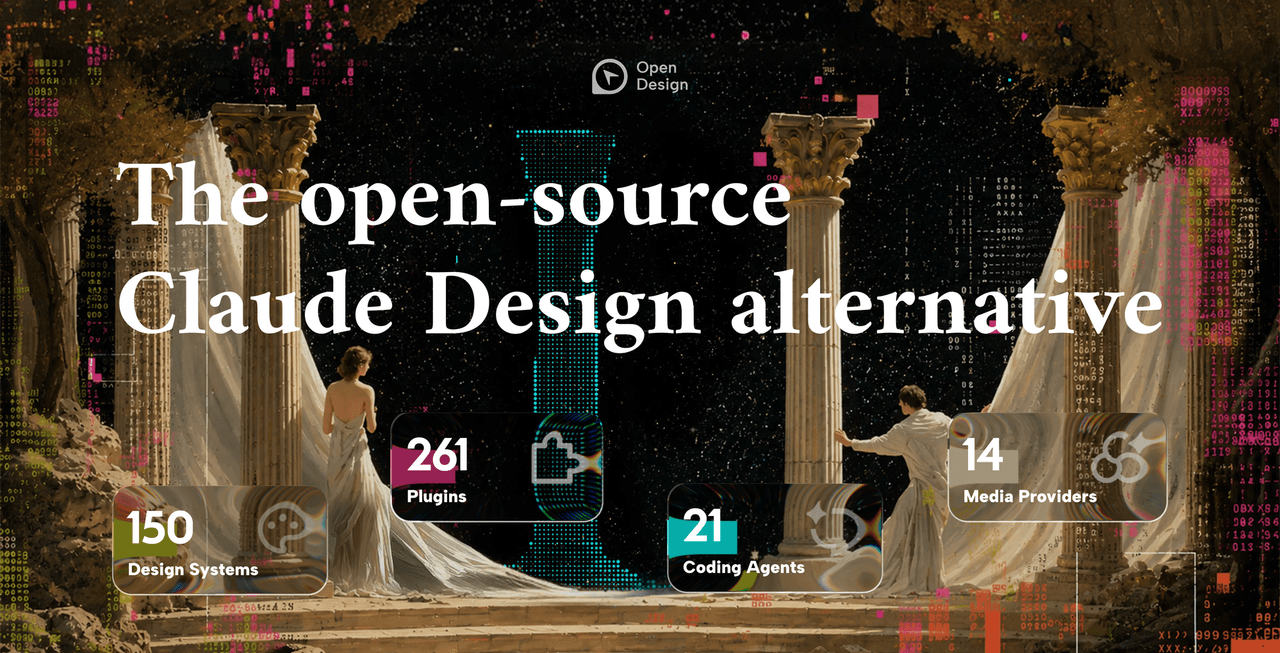 nexu-io/open-design
🎨 Best DeepSeek Harness Design Plugin. The open-source Claude Design alternative. 🖥️ Local-first desktop app. 🖼️ Your…
nexu-io/open-design
🎨 Best DeepSeek Harness Design Plugin. The open-source Claude Design alternative. 🖥️ Local-first desktop app. 🖼️ Your…
-
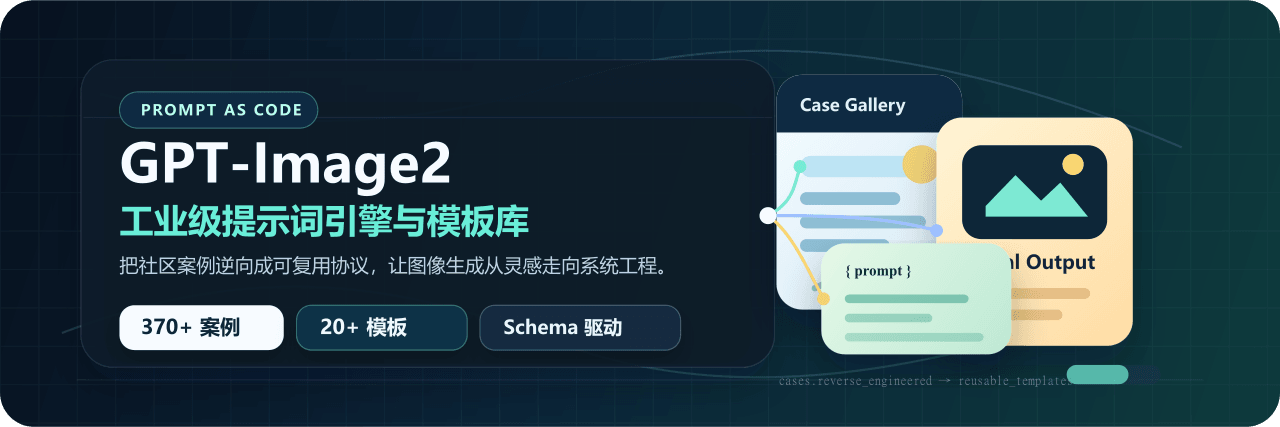 freestylefly/awesome-gpt-image-2
Prompt as Code | GPT-Image2 工业级提示词引擎与模板库,530+ 个案例逆向工程,20+ 套工业级模板,并提炼出Skills,持续更新中
freestylefly/awesome-gpt-image-2
Prompt as Code | GPT-Image2 工业级提示词引擎与模板库,530+ 个案例逆向工程,20+ 套工业级模板,并提炼出Skills,持续更新中
-
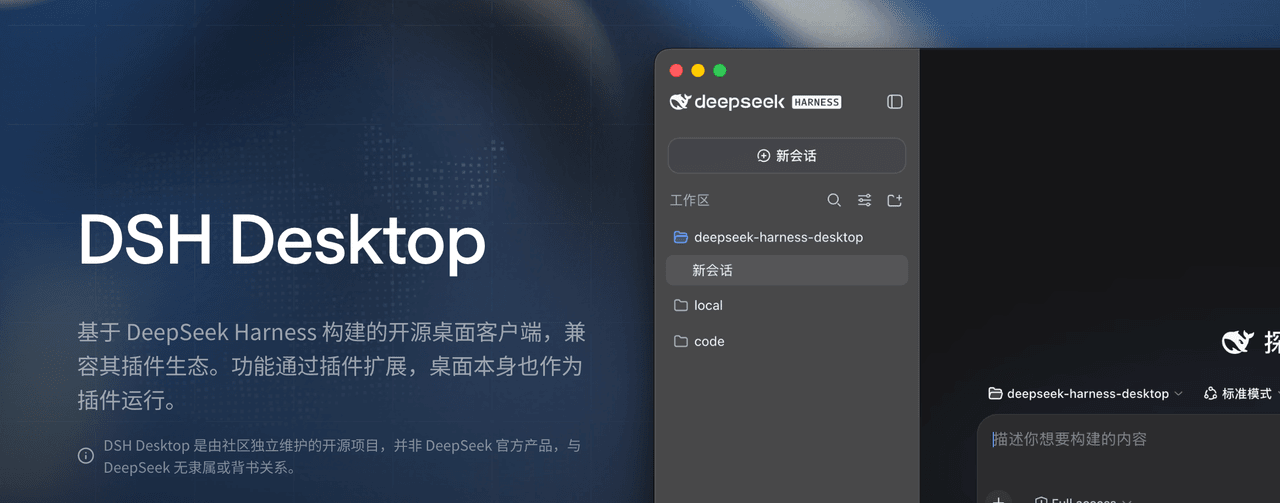 anywhere-labs/dsh-desktop
为 DeepSeek Harness (DSH) 插件生态打造的现代化桌面端解决方案。万物皆「插件」,桌面本身也是「插件」。
anywhere-labs/dsh-desktop
为 DeepSeek Harness (DSH) 插件生态打造的现代化桌面端解决方案。万物皆「插件」,桌面本身也是「插件」。
- Nagi-ovo/voyager Enhancement suite for Gemini, AI Studio, Claude & ChatGPT — plus a prompt manager for any web UI, DeepSeek Harness inclu…
-
 walkinglabs/learn-harness-engineering
Harness engineering beginner tutorial, from 0 to 1
walkinglabs/learn-harness-engineering
Harness engineering beginner tutorial, from 0 to 1
-
 awesome-dsh-plugin/awesome-dsh-plugin
A curated list of plugins for DeepSeek Harness (dsh) · DeepSeek Harness 插件精选列表
awesome-dsh-plugin/awesome-dsh-plugin
A curated list of plugins for DeepSeek Harness (dsh) · DeepSeek Harness 插件精选列表
-
 MemTensor/MemOS
Self-evolving memory OS for LLM & AI Agents: ultra-persistent memory, hybrid-retrieval, and cross-task skill reuse, with…
MemTensor/MemOS
Self-evolving memory OS for LLM & AI Agents: ultra-persistent memory, hybrid-retrieval, and cross-task skill reuse, with…
- yjh051108/dsh-routing-suite dsh-routing-suite — injector + router-standard kit: install the runtime injector first, then the task-aware reasoning-mo…