Xyanxhu/kilo-zen2dsh
Kilo Gateway free models for DeepSeek Harness (DSH)
Project Overview项目介绍
kilo-zen2dsh is a DSH native plugin that registers two independent OpenAI-compatible adapters: kilo2dsh for the keyless Kilo Gateway and opencode2dsh for OpenCode Zen, with dynamic discovery of free models and automatic filtering of tool-incapable entries. Use it to route DSH agent turns through Kilo and Zen free lanes without managing API keys locally. Caveat: Zen free models are promotional, may return 429 under gateway policy, and the Kilo catalog applies a compatibility ceiling for some model IDs, so avoid sending confidential data.
kilo-zen2dsh 是 DSH 原生插件,注册 Kilo Gateway(kilo2dsh)与 OpenCode Zen(opencode2dsh)两个独立 OpenAI 兼容适配器,动态发现免费模型并过滤无工具调用能力的项。适用于希望通过 DSH 代理或 Web 端使用 Kilo、Zen 免密钥免费模型进行代理对话的场景。提示:Zen 免费层为限时促销,可能因网关策略返回 429,且官方目录对 MiniMax-M3 存在上下文上限裁剪,请勿发送敏感数据。
请帮我了解并安装插件:【kilo-zen2dsh】【https://github.com/Xyanxhu/kilo-zen2dsh】Send this message to DSH in your current session. CLI install commands may not be accurate across systems — DSH will figure it out for you.把上面这条消息直接发给当前会话里的 DSH,让它帮你了解并安装。安装命令不一定准确,发给 DSH 更稳。
Or use CLI install (for developers)或使用命令行安装(适合开发者)
CLI Install命令行安装
dsh plugin --profile web add @huanx/kilo-zen2dsh把 Xyanxhu/kilo-zen2dsh 加入你的 DSH 配置(web profile)即可启用。
READMEREADME
kilo-zen2dsh
Kilo Gateway and OpenCode Zen free models, natively inside DSH (DeepSeek Harness).
Kilo's free lane is keyless. OpenCode Zen is an independent, compatibility lane whose anonymous availability is controlled by the Zen gateway.


English | 简体中文
kilo-zen2dsh registers native DSH LlmAdapters backed by two independent
OpenAI-compatible gateways:
kilo2dsh→ Kilo Gateway (/api/gateway/modelsand/api/gateway/chat/completions)opencode2dsh→ OpenCode Zen (/zen/v1/modelsand the model-specific/chat/completionsor/responsesendpoint)
Kilo requests are genuinely keyless: the plugin suppresses the generated
Authorization header on the wire. Zen's compatibility lane uses the public
Bearer public placeholder and OpenCode-compatible request markers by default;
the gateway may still require its own anonymous eligibility, quota, or a user
account. Neither provider is an authentication or billing bypass.
Highlights
- Native adapter, no child process or local port in the published package.
- Dynamic free-model discovery using Kilo's
isFree/is_freeflag, withkilo-auto/freeand:freesuffix compatibility fallbacks. - Independent OpenCode Zen catalog and adapter (
opencode2dsh) with the documented free model IDs, a separate cache, and Responses API routing formuse-spark-1.2-contributor-free. - Text-output and tool-capable models only, suitable for DSH agent turns.
- Startup retry, periodic refresh, seven-day disk cache, and a health snapshot.
- Optional authenticated Kilo or Zen token for compatible deployments; no account token is enabled by default.
Install
dsh plugin --profile web add @huanx/kilo-zen2dsh
When using this checkout before the npm package is published, build a local tarball instead:
cd packages/plugin
pnpm install
pnpm pack
dsh plugin --profile web add ./huanx-kilo-zen2dsh-0.3.0.tgz
Restart dsh web, open the model picker, and choose a model in either the
kilo2dsh (Kilo) or opencode2dsh (Zen) provider group. Node.js 20 or newer is
required.
Configuration
The defaults are keyless and point at the public Kilo gateway:
- id: kilo2dsh
  name: '@huanx/kilo-zen2dsh'
  config:
    mode: adapter
    providerId: kilo2dsh
    gatewayBaseUrl: https://api.kilo.ai/api/gateway
    refreshSeconds: 300
    requireTools: true
    zenEnabled: true
To use an authenticated gateway token, set upstreamApiKeyEnv explicitly.
Leaving it empty is intentional; the plugin will not pick up
KILO_API_KEY (or another ambient secret) by accident.
| Option | Default | Description |
|---|---|---|
mode |
adapter |
Native adapter. sidecar is an optional legacy Go bridge. |
providerId |
kilo2dsh |
DSH route name. |
gatewayBaseUrl |
https://api.kilo.ai/api/gateway |
Kilo-compatible gateway base URL. |
refreshSeconds |
300 |
Model catalog refresh interval. |
requireTools |
true |
Hide free models that do not advertise tools. |
upstreamApiKeyEnv |
empty | Environment variable to opt into an explicit token. |
anonymousKey |
empty | Optional token for a private compatible gateway; empty means no auth header. |
zenEnabled |
true |
Register the independent OpenCode Zen adapter in adapter mode. |
zenProviderId |
opencode2dsh |
DSH route name for Zen. |
zenBaseUrl |
https://opencode.ai/zen |
OpenCode Zen root URL. |
zenUserAgent |
empty | Optional compatibility User-Agent; empty derives the OpenCode format. |
zenApiKeyEnv |
empty | Optional Zen account-token environment variable. |
zenAnonymousKey |
public |
Zen anonymous placeholder; set empty for a header-less private deployment. |
Set zenEnabled: false when you only want Kilo, or when the Zen gateway is
returning an anonymous-lane 429. sidecar mode is the legacy Go bridge and
currently exposes Kilo only; the two-provider setup is implemented in native
adapter mode.
Wire behavior
Kilo:
  GET  https://api.kilo.ai/api/gateway/models
  POST https://api.kilo.ai/api/gateway/chat/completions
       (no Authorization header for the default free lane)

OpenCode Zen:
  GET  https://opencode.ai/zen/v1/models
  POST https://opencode.ai/zen/v1/chat/completions
       (Bearer public + OpenCode compatibility headers)
  POST https://opencode.ai/zen/v1/responses
       (used for Responses-only free models)
The Kilo adapter sends ordinary OpenAI-compatible JSON/SSE plus Kilo correlation
headers (X-KILOCODE-EDITORNAME, X-KILOCODE-TASKID, and
X-KILOCODE-PROJECTID). The Zen adapter sends the OpenCode compatibility
marker and correlation headers required by the current anonymous lane. This is
an upstream compatibility requirement, not a guarantee that Zen will accept
third-party clients.
The model filter is deliberately conservative:
isFreeoris_freeis authoritative when present.- If the flag is absent,
kilo-auto/free,openrouter/free, and IDs ending in:free/-freeare accepted. - Image-output models and models without advertised tool support are hidden by default.
Automatic context and output-limit reconciliation
Kilo model-directory records are not always internally consistent: a limit may
be present on the top-level record, top_provider, or a nested limit(s)
object, and compatible gateways use several spellings. The adapter merges
those declarations and uses the smallest positive context limit. It keeps the
advertised context window for prompt history, while calculating a separate
safe output budget.
The current gateway catalog advertises minimax/minimax-m3:free with a
943,718-token completion limit, but the backend rejects requests above
524,288. The adapter therefore applies a 524,288-token gateway compatibility
ceiling (or the smaller model-specific limit) to defaultMaxTokens and to
both max_tokens and max_completion_tokens immediately before the wire
request. An oversized default supplied by DSH is consequently reduced
automatically; callers do not need to edit their model configuration. This
keeps a 1M-token context declaration available for input while preventing the
400 error shown by MiniMax-M3. The compatibility ceiling is Kilo-specific;
OpenCode Zen keeps the limits reported by its own catalog.
For Zen, the public model directory currently contains minimal OpenAI records,
so the adapter accepts the documented big-pickle exception and IDs ending in
-free/:free, while treating an explicit future isFree/is_free flag as
authoritative. The live catalog replaces the bootstrap list after a successful
refresh.
Health and troubleshooting
Kilo adapter status is written to ~/.kilo2dsh/adapter-status.json; Zen status
is written to ~/.kilo2dsh/zen-adapter-status.json. Their caches are
kilo-models.json and zen-models.json respectively.
Kilo's anonymous free usage is controlled by Kilo and is rate-limited by IP (the current documentation describes 200 requests per hour per IP). A 429 or an unavailable model is an upstream service decision; wait, choose another free model, or configure an authenticated token.
Zen's free models are promotional and can be withdrawn or rate-limited. The
current OpenCode documentation describes them as limited-time models, and the
gateway has rejected non-OpenCode user agents with 429 FreeUsageLimitError in
some deployments. Treat Zen as best-effort, avoid sending confidential data to
free models, and use zenApiKeyEnv if your Zen account requires a token.
For the optional legacy bridge:
cd legacy
go build ./cmd/agent
go test ./...
It keeps a local authenticated /v1 endpoint for DSH, but its upstream Kilo
requests use the same keyless behavior and /api/gateway paths. Use native
adapter mode for the independent Zen provider.
Adaptation source
This project is adapted from the FishBottle7/opencode2dsh DSH/OpenCode integration prototype. The Kilo adapter is the migration target; the original Zen free-tier behavior is retained as a separate optional native adapter rather than being mixed into Kilo's keyless transport. The Kilo, Zen, and QwenPaw protocol references are listed below.
Development
cd packages/plugin
pnpm install
pnpm typecheck
pnpm test
pnpm build
References
- Kilo Gateway authentication
- Using Kilo for Free
- Kilo Gateway API reference
- OpenCode Zen documentation
- OpenCode provider source (
apiKey: publicfree lane) - OpenCode issue: anonymous Zen user-agent behavior
- QwenPaw Kilo provider
- @earendil-works/pi-ai
License
MIT © FishBottle7
Related相关推荐
-
 weijiafu14/pi2dsh
Bridge the Pi and DeepSeek Harness ecosystems: one Pi Host ABI runs unmodified Pi extensions as native DSH plugins. 打通 P…
weijiafu14/pi2dsh
Bridge the Pi and DeepSeek Harness ecosystems: one Pi Host ABI runs unmodified Pi extensions as native DSH plugins. 打通 P…
-
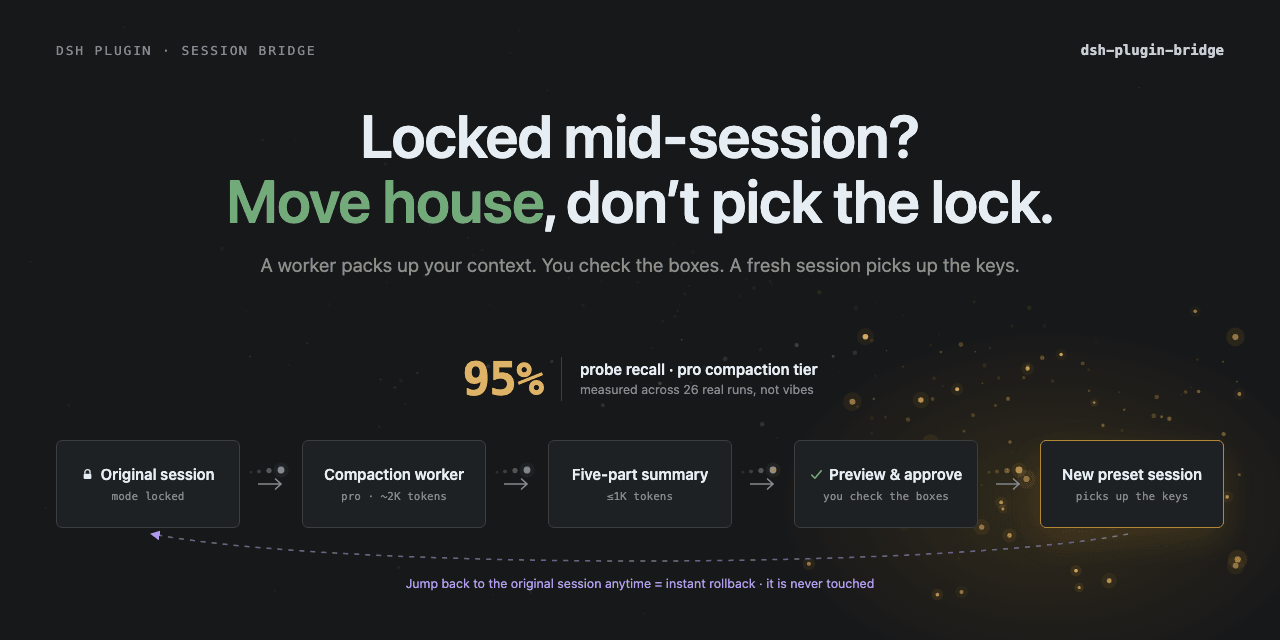 Totoro-qaq/dsh-plugin-bridge
DeepSeek Harness plugin for previewable cross-preset session migration. Fixed-schema handoffs preserve state, source-mod…
Totoro-qaq/dsh-plugin-bridge
DeepSeek Harness plugin for previewable cross-preset session migration. Fixed-schema handoffs preserve state, source-mod…
- Arborsm/dsh-plugin-devin-bridge Devin Connect 反代为 OpenAI Chat Completions 兼容协议的 dsh 插件,服务 glm-5.2 / swe-1.7
-
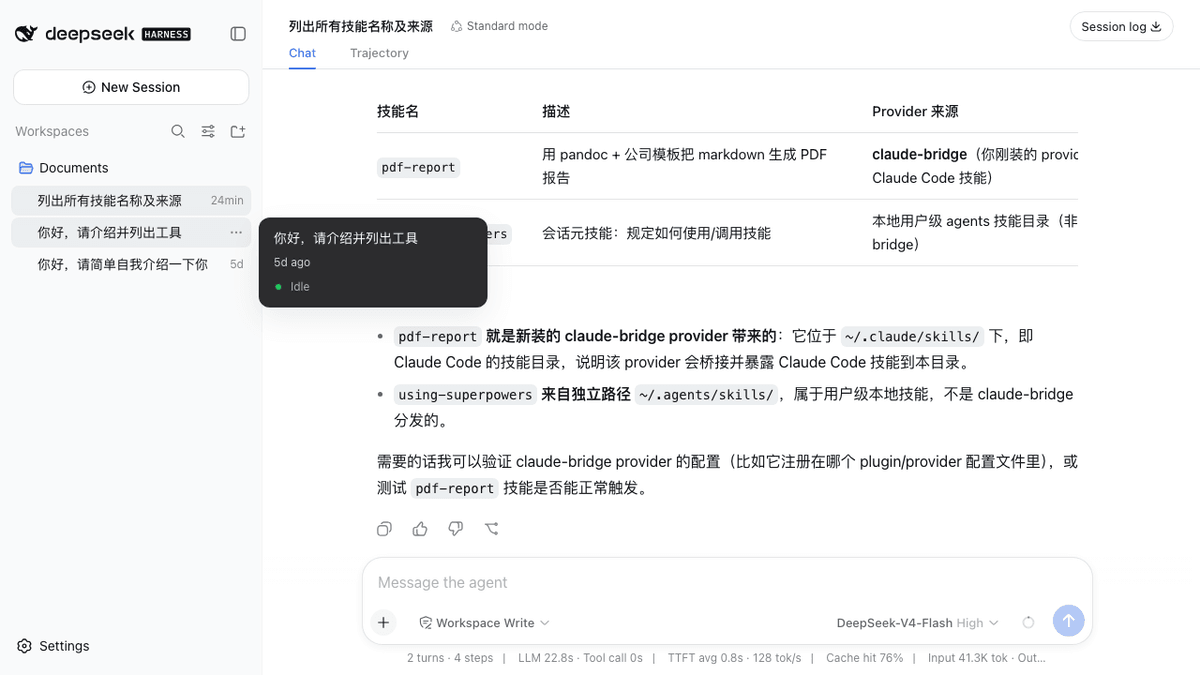 YTyangtao666/dsh-skills-bridge
Bring your Claude Code skills into DeepSeek Harness — zero migration, one plugin. 一个插件把 Claude Code 技能桥接进 DeepSeek Harne…
YTyangtao666/dsh-skills-bridge
Bring your Claude Code skills into DeepSeek Harness — zero migration, one plugin. 一个插件把 Claude Code 技能桥接进 DeepSeek Harne…
-
 Hilbert-beinghappy/seektty
面向 DeepSeek Harness 的 Claude Code 风格终端界面,支持 Windows、macOS 与 Linux,兼容透明终端、VS Code 主题和自定义配色。
Hilbert-beinghappy/seektty
面向 DeepSeek Harness 的 Claude Code 风格终端界面,支持 Windows、macOS 与 Linux,兼容透明终端、VS Code 主题和自定义配色。
-
 Renzic-Stone/DSH-EasyRewrite
DSH Web内目前最无感的消息撤回、重编辑插件,原版体验,兼容性强,功能简单可开关,设置丰富,现代化轻量ui框架。The most seamless message recall & re-edit plugin for DSH Web …
Renzic-Stone/DSH-EasyRewrite
DSH Web内目前最无感的消息撤回、重编辑插件,原版体验,兼容性强,功能简单可开关,设置丰富,现代化轻量ui框架。The most seamless message recall & re-edit plugin for DSH Web …
-
 xiajiajun516/dsh-config-manager
DeepSeek Harness (DSH) backup & restore plugin — export, import, migrate and sync your complete DSH configuration, plugi…
xiajiajun516/dsh-config-manager
DeepSeek Harness (DSH) backup & restore plugin — export, import, migrate and sync your complete DSH configuration, plugi…
-
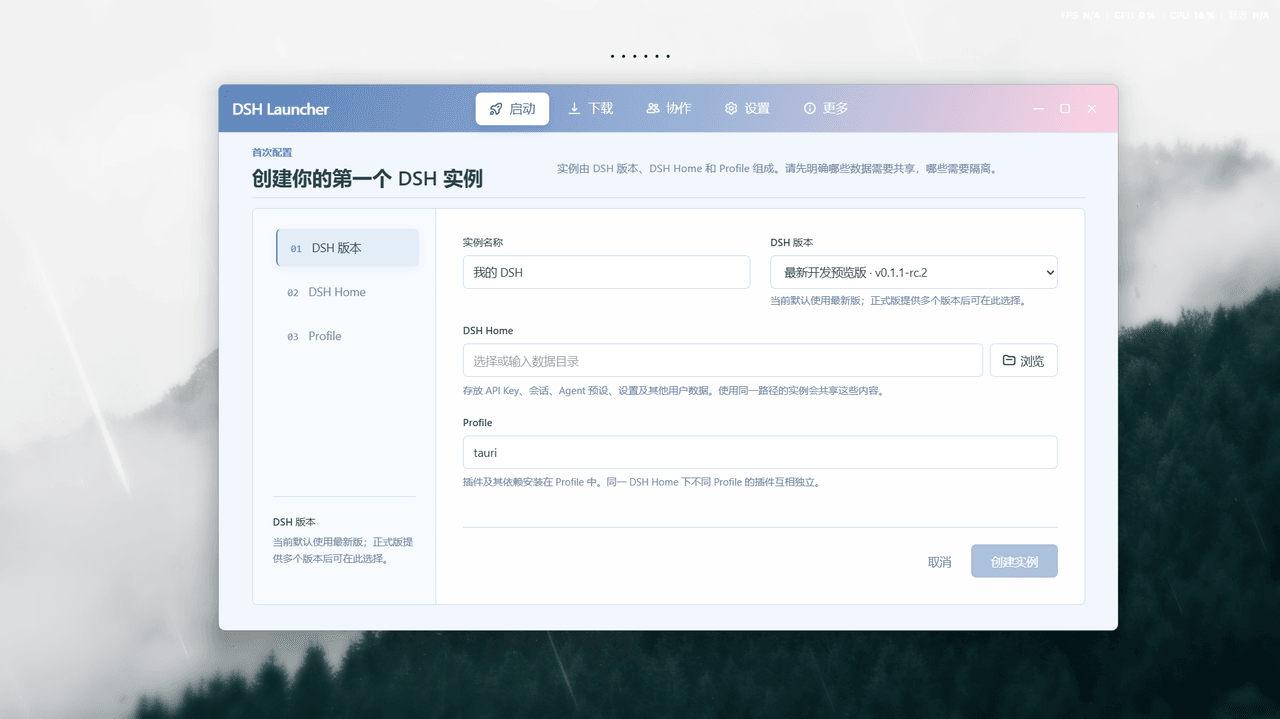 baihejiangnan/deepseek-harness-desktop
DeepSeek Harness 三端兼容桌面启动器:多实例完全隔离、并行协作,协作画布编排 Agent 工作流;便携版 Exe 一键启动、仅约 20M;双隔离机制让兼容性极强
baihejiangnan/deepseek-harness-desktop
DeepSeek Harness 三端兼容桌面启动器:多实例完全隔离、并行协作,协作画布编排 Agent 工作流;便携版 Exe 一键启动、仅约 20M;双隔离机制让兼容性极强