AI 聊天机器人内部发生了什么?一份新手说明What Happens Inside an AI Chatbot? A Beginner's Explanation
从你发出一句话,到看见回复,中间那段时间到底在发生什么?这里没有超自然的东西——技术本身相当有意思,也远比多数人以为的简单。现在就把幕布拉开。
What goes on in the gap between sending a message and seeing a reply? Nothing supernatural is at work — the technology is genuinely interesting, and far less complicated than most people assume. Time to open it up.
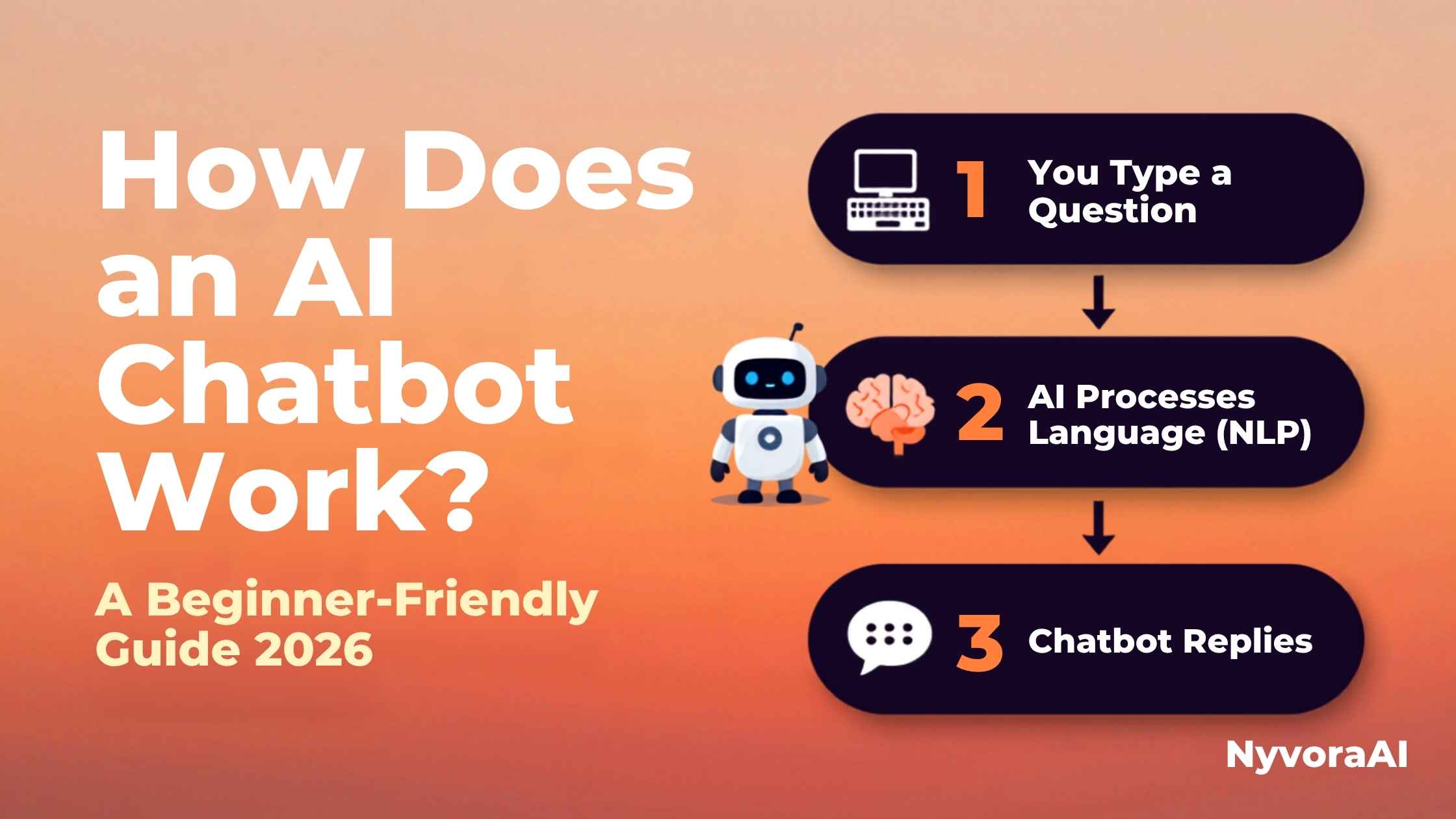
假设你坐在电脑前,或者手里拿着手机,敲进一个问题:「学西班牙语该从哪儿下手?」几秒钟后,聊天机器人给出一段考虑周全、细节充分的回答。那这几秒里到底发生了什么——一个新手又该怎么理解它?
不少人会把这种体验形容成对着一个「莫名其妙就是知道」的盒子说话,这种感受再正常不过。真实情况比想象中更简单,也更有意思。AI 聊天机器人内部并没有类似人的思考过程。意识、情绪、真正的理解,一样都不存在。你面对的是一台非常高级的模式匹配机器,它靠阅读海量人类对话训练而成。
下面把整个过程讲完,从你按下「发送」一直到回复出现在屏幕上,全程不假设你有计算机背景。想更完整地了解各类 AI 技术之间的差异,可以看我们这篇 AI 与机器学习的区别。
01简单说:一切都围绕模式
有一个概念能把整套解释串起来。想象你读完了互联网上的每一本书、每一篇文章、每一段对话。读到这个量级,规律就会自己冒出来。你会察觉「Good」后面常常接「morning」「afternoon」或「job」;你也会察觉,以「What's the best way to...」开头的问题,通常意味着对方想听建议。
把人类大脑换成一种叫神经网络的数学模型,原理完全不变。几十亿段对话从这些网络里流过,让它们对「哪些词常常跟在哪些词后面」有了感觉,并且能适应多种语境。向它提问时,并不存在斟酌的过程,发生的是一次计算:从模型吸收过的一切里,估算最可能的后续。
最贴近日常的类比是手机输入法的联想,只不过规模被放大了无数倍。手机是根据你个人的打字习惯猜下一个词;ChatGPT 则是根据几百万段对话里呈现的规律来猜。如果你想知道这件事到底难不难学会,可以读我们这篇 AI 对新手来说难学吗。
02从你发出消息到它给出回复,逐环节拆解
下面就是一次聊天过程中精确发生的事情,整个流程只占几秒钟:
03自己试一试:看这个过程跑起来
想知道不同类型的消息会被怎么处理吗?下面的互动演示值得一玩:
04NLP 详解:聊天机器人是在什么意义上「理解」你的
让聊天机器人能处理人类日常语言的技术,就是自然语言处理(NLP)。它实际做的事情如下:
- 1
分析句法
1 先给词性打上标签——名词、动词、形容词——再读句子的结构。「Dog bites man」和「Man bites dog」用的是同一批词,意思却完全不同。
- 2
把握语义
2 接下来瞄准含义。你说「I'm feeling blue」,模型知道重点不是颜色——这是一句表示情绪低落的习语。这类知识来自对几百万段对话的规律学习。
- 3
跟踪语境
3 同一轮对话里,你前面说过的话仍然可用。你问「Who is the president?」,接着追问「How old is he?」,它会明白「he」指的就是总统。
- 4
识别意图
4 你的目的会被识别出来。「What's the capital of France?」是在要一个事实;「Tell me about Paris」是要一份介绍。两种意图会把模型引向不同的回应方式。
整个过程都在毫秒级完成。这里没有思考,运行的是复杂的数学计算,而这些计算被反复调优到能逼真地模仿理解。准备开始动手尝试的人,可以用我们这篇 最容易上手的 AI 工具 直接把这些概念玩起来。
05它的能力从哪来:训练过程
在你和它对话之前很久,一整套繁复的训练流程早已跑完。它是这样学出来的:
| 阶段 | 发生了什么 | 所需时间 |
|---|---|---|
| 收集数据 | 从文章、网站、书籍和对话中抽取的几十亿条文本样本 | 数月 |
| 预训练 | 通过预测句子里缺失的词,让模型掌握基础语言规律 | 数周到数月 |
| 微调 | 由人工针对具体任务训练模型,并随时纠正它的错误 | 数周 |
| RLHF | 基于人类反馈的强化学习——由人对回复排序,教会模型什么才算有用 | 数周 |
| 安全训练 | 教会模型拒绝有害请求、避开危险话题 | 持续进行 |
这就是聊天机器人偶尔出错、或者显得信息落后的原因。它的知识边界就是训练数据。你若问起训练截止日期之后发生的事,它不会知道——除非接入了实时的互联网数据。
06误区与事实:聊天机器人实际在做什么
关于聊天机器人的运作方式,有几个流传很广的误解值得澄清:
07聊天机器人的几种类型,由粗到精
聊天机器人并非只有一种设计,谱系大致是这样:
- 1
基于规则的聊天机器人
1 逻辑就是简单的「如果—那么」。你发一个「hello」,它就回一句固定的问候。能力有限,但完全可预测,这也是客服处理基础 FAQ 常用它的原因。
- 2
靠检索取答案的聊天机器人
2 这类机器人背后存着一批写好的回复。你的问题会和这个库比对,找出最接近的一条,然后原样返回。比基于规则的进了一步,但仍然跳不出预先写好的内容。
- 3
生成式 AI 聊天机器人
3 ChatGPT 和 Claude 都属于这一类。神经网络让它们从零开始逐词构建回复。灵活、有创造力,同时也容易出错。
08聊天机器人还做不到的事
了解它的能力边界,和了解它的本领同样重要:
09读者常问的问题
聊天机器人是怎么看懂我打的字的?
它真的有思考过,或者记得我们聊过什么吗?
聊天机器人和 AI 有什么区别?
它为什么回复得这么快?
这类系统会出错或者撒谎吗?
用聊天机器人需要会编程吗?
第一次用该从哪里开始?
Say you are at a desk, or holding a phone, and a question goes in — "How should I go about learning Spanish?" A considered, detailed answer lands within seconds. So what is going on during those few seconds — and how would a beginner make sense of it?
Plenty of people describe the experience as chatting with a box that somehow just knows things, and that reaction is entirely normal. Reality turns out to be simpler than expected, and more intriguing too. There is no thought process inside an AI chatbot resembling a person's. Consciousness, emotion, genuine comprehension — none of it is present. What you are dealing with is a very advanced machine for matching patterns, trained by reading an enormous quantity of human conversation.
Everything is covered below, tracing the path from your press of "send" through to the reply appearing on screen, and none of it assumes a computer science background. Readers wanting a fuller picture of how AI technologies differ from one another should look at our guide to the AI vs machine learning difference.
01The Short Version: Everything Hinges on Patterns
One idea holds the whole explanation together. Picture having read every book, every article and every conversation the internet contains. At that volume, regularities would start jumping out at you. You would sense that "Good" tends to run into "morning," "afternoon" or "job." You would sense that a question beginning "What's the best way to..." usually signals that advice is being sought.
Substitute a mathematical model — a neural network — for the human brain and the principle is unchanged. Billions of conversations have passed through such networks, leaving them with a sense of which words tend to trail which other words, across many different contexts. Put a question to one and no deliberation takes place; a calculation does, estimating the likeliest continuation from everything the model has absorbed.
Your phone's autocomplete is the closest everyday comparison, scaled up enormously. Phones guess the coming word from how you personally type. ChatGPT guesses from regularities found across millions of conversations. Anyone wondering whether all this is genuinely hard to pick up should read our guide on whether AI is hard to learn for beginners.
02From Your Message to Their Reply, Stage by Stage
Here is precisely what unfolds during an exchange with a chatbot. The whole sequence occupies only a few seconds:
03Have a Go: Watch the Process Happen
Curious how assorted kinds of messages get handled? The interactive demo beneath this line is worth a try:
04NLP Explained: In What Sense Chatbots "Understand"
The technology that lets a chatbot handle ordinary human language is Natural Language Processing (NLP). What it does in practice is this:
- 1
Analysing Syntax
1 Parts of speech get labelled — noun, verb, adjective — and the structure of the sentence is read. "Dog bites man" carries a different meaning from "Man bites dog," despite using identical words.
- 2
Grasping Meaning
2 Meaning is the next target. Tell it "I'm feeling blue" and the model knows colour is not the subject — this is an idiom for low spirits. Pattern learning across millions of conversations is where that knowledge comes from.
- 3
Tracking Context
3 Whatever you said earlier in the session stays available. Ask "Who is the president?" and then "How old is he?", and "he" is understood to point at the president.
- 4
Spotting Intent
4 Your goal gets identified. "What's the capital of France?" seeks a fact; "Tell me about Paris" asks to be briefed. The two lead the model down different response paths.
Milliseconds cover the whole of it. No thinking occurs; elaborate mathematical calculations run instead, tuned until they imitate comprehension convincingly. Anyone ready to begin experimenting can explore these ideas directly with our guide to the easiest AI tools to start with.
05Where the Ability Comes From: Training
Long before any conversation with you takes place, an elaborate training process has already run its course. It works like this:
| Stage | What Takes Place | Time Needed |
|---|---|---|
| Gathering Data | Billions of text examples drawn from articles, websites, books, and conversations | Months |
| Pre-training | Basic language patterns are absorbed by predicting which words are missing from sentences | Weeks to months |
| Fine-tuning | People drill the model on particular tasks and correct errors as they appear | Weeks |
| RLHF | Reinforcement Learning from Human Feedback — responses are ranked by people so the model learns what counts as helpful | Weeks |
| Safety Training | The model is taught to turn down harmful requests and steer clear of dangerous subjects | Ongoing |
Here lies the reason a chatbot occasionally errs or sounds behind the times. Its knowledge is bounded by whatever went into training. Ask about something that happened after the training cutoff date and it will draw a blank — unless live internet access has been wired in.
06Myths and Reality: What a Chatbot Really Does
Several widespread misconceptions about chatbot behaviour are worth clearing up:
07A Range of Chatbots, From Crude to Sophisticated
Chatbots are not built to one design. The range looks like this:
- 1
Chatbots Built on Rules
1 The logic is plain if-then. Send in the word "hello" and a fixed greeting comes back. Capable of little, but utterly predictable, which is why basic FAQs in customer service rely on them.
- 2
Chatbots That Retrieve Answers
2 A store of ready-written replies sits behind these. Your question is compared against that store, the nearest entry is located, and it is handed back. An improvement on the rule-based variety, though nothing exists outside the pre-written material.
- 3
Chatbots That Generate Text
3 ChatGPT and Claude belong here. Neural networks let them build replies from scratch, a word at a time. Flexible and inventive, and liable to get things wrong.
08Things a Chatbot Still Cannot Do
Knowing the limits matters every bit as much as knowing the abilities: