AI 是怎么从照片里认出人脸的?How Does AI Pick a Face Out of a Photo?
手机看你一眼就解锁了,Facebook 在你动手之前就给朋友标好了名字。这些背后是同一项技术:人脸识别 AI。下面用大白话把它讲清楚。
Your phone opens the moment it sees you. Facebook puts a name on your friends before you do. Both rest on the same thing: facial recognition AI. Here is how that technology works, in plain English.
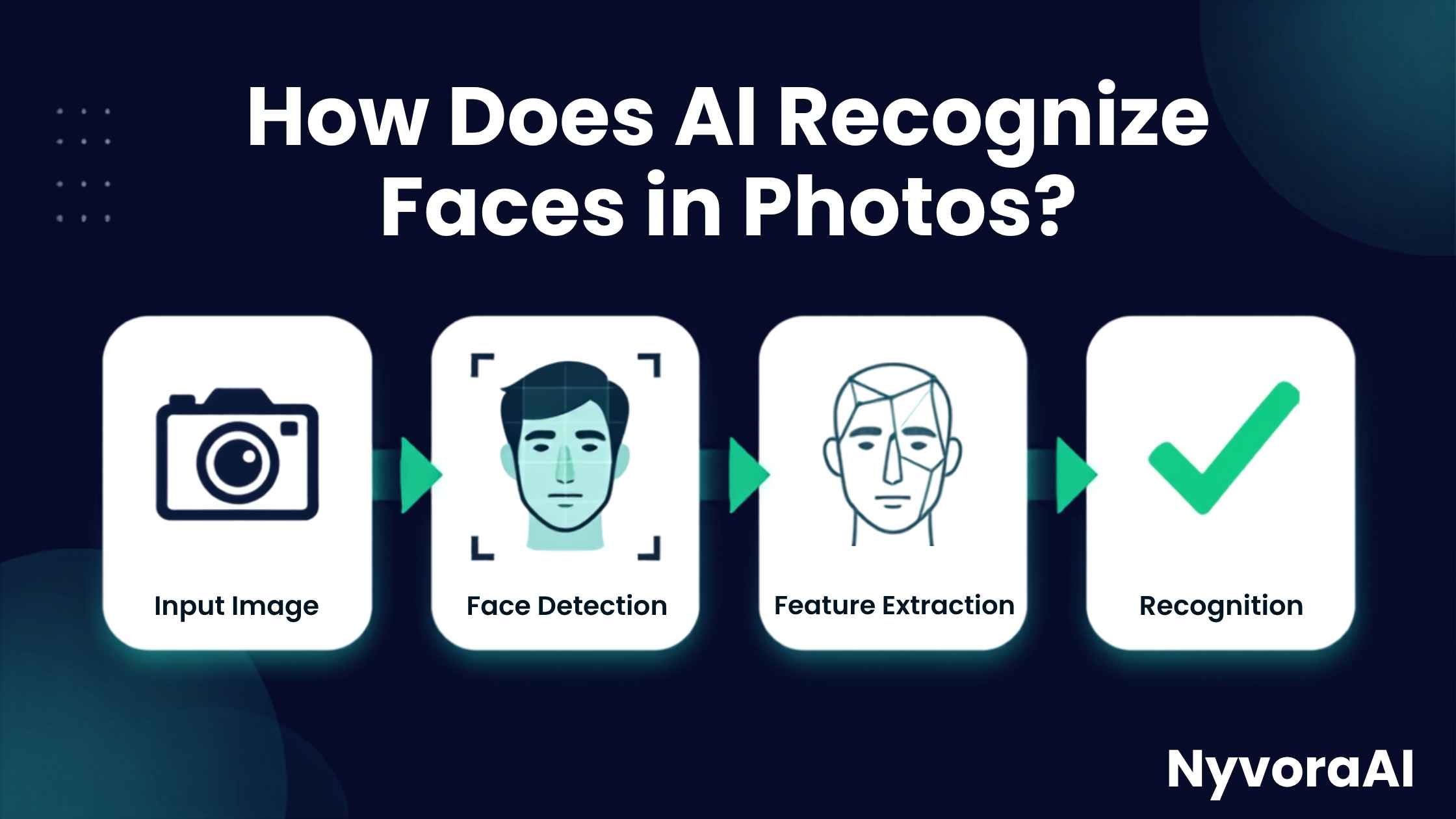
看一眼手机就解锁了;Facebook 上的照片会自动提示该给哪位朋友加标签;机场安检会扫过你的脸。场景各不相同,背后却是同一套引擎:人脸识别 AI。真正该问的是它内部到底做了什么——机器怎么能看一眼照片,就报出一个名字?
答案既比你想的简单,也比你想的复杂。下文会把完整流程走一遍,但不会用术语把你淹掉:先在一张拥挤的画面里定位一张脸,再拿它与数百万个身份逐一比对。全程用日常语言说明。
想了解底层的技术?驱动当代人脸识别系统的架构之一,我们在 什么是 Transformer 模型 这篇里讲过。
01朴素答案:靠的全是模式
说到底,这套机制的底层是算术:你的脸被转成一组数字。真的是数字。两眼间距多少、颧骨形状如何、嘴唇弧度怎样——每一项都会被表述成某种数学关系。
可以拿你向别人描述某个人时的说法作比:「蓝眼睛、尖鼻子、卷头发」。机器做的事与之类似,只不过形容词换成了精确的测量值和数值关系。把这些汇总起来,就是你的「faceprint」——一份独特程度不亚于指尖纹路的数字签名。
这一切还建立在一个更基础的问题上:AI 最初是怎么处理原始信息的。我们在 什么是 AI 中的分词(tokenization) 里讲过,不同类型的数据是如何被转换成机器可处理的格式。
02从照片到身份:一步步来看
下面把这条从照片到身份的路径逐段拆开:
03互动演示:亲眼看看人脸识别怎么跑
想看看关键点检测实际跑起来是什么样?点击下面的按钮,可以逐项看到机器「看」一张脸的方式:
04幕后的大脑:神经网络
这种识别人脸的能力最初从哪来?答案是深度学习神经网络——一种在设计上对人类大脑作了松散借鉴的计算系统。
训练过程是这样的。工程师把数百万张标注好的人脸照片摆到系统面前:「这张是 John。这张是 Sarah。这张是 Michael。」网络逐个研究样本、搜寻规律,可能会注意到 John 的下颌更宽、Sarah 的两眼靠得更近、Michael 的鼻子有独特的形状。
渐渐地,它摸清了在需要区分两个人时,哪些特征最重要。你自己的经验其实也差不多:你认得出朋友,并不是拿尺子量过他们的脸,而是见得足够多之后,大脑自动抓住了他们身上独有的东西。
让这一切成为可能的是数据量。我们在 AI 训练为什么需要这么多数据 里专门讨论了这一前提。
| 部件 | 它做什么 | 日常类比 |
|---|---|---|
| 卷积层 | 提取面部的边缘、形状与纹理 | 好比你会注意到某人的颧骨很立体 |
| 池化层 | 削减复杂度,让重要特征凸显出来 | 好比记住一张脸的整体轮廓,而不是每个毛孔 |
| 全连接层 | 把所有特征汇总起来,得出最终身份判断 | 好比你综合所有特征后脱口而出「那是 Sarah!」 |
| 激活函数 | 判断哪些特征足够重要、值得保留 | 好比大脑屏蔽背景噪声,把注意力放在一张脸上 |
05你每天都在遇到的人脸识别
这门技术并不只存在于科幻里。它比你意识到的更深地织进了你的日常:
手机解锁
照片整理
银行与支付
机场安检
门禁出入
零售与营销
这项技术的运作方式,与 AI 处理语言的方式有相通之处。我们在 AI 翻译是怎么工作的 里,讲了同一套模式匹配思路用在文字上的样子。
06准确率有多高?又在什么情况下失灵?
在理想条件下,如今的系统准确率高得惊人:最强的一批在标准基准测试上能跑到 99.8%。这句话里真正起作用的前提,是「理想条件」。
容易让它犯难的情况:
- ✗
光线不佳
✗ 特征被阴影吞掉,关键点就很难定位。逆光强烈时情况最糟。
- ✗
角度极端
✗ 正面或略微侧转的脸效果最好。纯侧面视角,或上下俯仰超过 30 度,都会让准确率明显下滑。
- ✗
面部遮挡
✗ 口罩、墨镜、浓妆,甚至浓密的胡须,都可能遮掉系统赖以判断的关键点。
- ✗
分辨率过低
✗ 画面里的人脸如果模糊、像素化或过于小,细节不足,特征就无法被正确提取。
- ✗
外貌变化
✗ 体重明显变化、衰老、整容,甚至只是换了个发型,都可能让一个用旧照片训练出来的系统判断失准。
有一点要分清楚:人脸识别和一般意义上的自动化并不是一回事。想了解 AI 能力的整体版图,可以看 AI 与自动化的区别。
07隐私之争:我们该担心吗?
这项技术附带着严肃的隐私与伦理问题,而社会至今还没找到答案:
监管正在跟上。越来越多的城市和国家开始限制、甚至全面禁止在公共场所使用人脸识别;欧盟的《人工智能法案》(EU's AI Act)以及美国各州陆续出台的法律,都在试图在安全收益与隐私权之间取得平衡。
08常见问题
AI 是如何在照片里识别出人脸的?
人脸检测和人脸识别之间有什么区别?
人脸识别 AI 的准确率可靠吗?
人脸识别在日常生活中的用途有哪些?
AI 能识别老旧或低画质照片里的人脸吗?
人脸识别有可能被骗过吗?
完全黑暗的环境下人脸识别还能用吗?
AI 一次最多能识别多少张人脸?
A glance opens your phone. A photo on Facebook arrives with your friend's name already suggested. Security at the airport sweeps your face. Different moments, one underlying engine: facial recognition AI. The obvious question is what happens inside it, how does a machine glance at a picture and come back with a name?
The truth sits somewhere between simple and surprisingly involved. What follows traces the whole path without burying you in jargon: spotting a single face inside a crowded frame, then testing it against millions of other identities. Everyday language throughout.
Curious about the machinery underneath? One of the architectures that drives today's facial recognition systems is covered in our piece on what a transformer model actually is.
01The Plain Answer: Everything Comes Down to Patterns
Strip it to the core and the mechanism is arithmetic: your face becomes a set of numbers. Literally numbers. Eyes spaced a certain way, cheekbones shaped a certain way, lips curving a certain way, each of those gets expressed as a mathematical relationship.
Compare it to the way you describe a person out loud: "blue eyes, a pointed nose, curly hair." The machine does a comparable job, except that adjectives give way to exact measurements and numeric relations. Assemble all of them and you have your "faceprint", a digital signature no less distinctive than the ridges on your fingertip.
All of this sits on top of something more basic: how AI handles raw information in the first place. Our guide to what tokenization means in AI covers how different kinds of data get turned into a format the machine can work with.
02Photo to Identity, One Step at a Time
Here is that journey laid out stage by stage:
03Try It: Watch Facial Recognition Happen
Curious what landmark detection looks like as it runs? The buttons below will show you, one aspect at a time, the way a machine "sees" a face:
04Under the Hood: Neural Networks
Where does the ability to recognise a face come from in the first place? From deep learning neural networks, computing systems whose design takes loose inspiration from the human brain.
The training routine goes like this. Engineers put millions of labelled face photos in front of the system: "This one is John. This one is Sarah. This one is Michael." The network studies each example hunting for patterns, and may register that John's jaw is broader, that Sarah's eyes sit closer together, that Michael's nose has a shape of its own.
Gradually it works out which features carry the most weight when two people have to be told apart. Your own experience is not so different: you recognise your friends not by running a ruler across their faces, but from having seen them often enough that your brain latches onto what makes them distinctive.
Data volume is what makes this possible. Our article on why AI training demands so much data digs into that requirement.
| Layer | What It Does | A Human Comparison |
|---|---|---|
| Convolutional Layers | Picks out edges, shapes and textures across the face | Comparable to noticing that someone's cheekbones are sharp |
| Pooling Layers | Strips away complexity so the important features stand out | Comparable to recalling a face's overall shape rather than every pore |
| Fully Connected Layers | Pulls every feature together to reach the final identification | Comparable to assembling all the features and concluding "That's Sarah!" |
| Activation Functions | Determine which features matter enough to be retained | Comparable to your brain tuning out background noise to focus on a face |
05Facial Recognition You Already Meet Every Day
This is not the stuff of science fiction. It is threaded through your ordinary day far more than you probably notice:
Unlocking Your Phone
Sorting Your Photos
Banking and Payments
Border Control
Door and Building Access
Retail and Marketing
There is a family resemblance between the way this technology works and the way AI handles language. Our guide to how AI translation works looks at the same pattern-matching ideas applied to words.
06How Accurate, and Where Does It Break Down?
Give today's systems ideal conditions and their accuracy is startling: the strongest ones post 99.8% on standard benchmarks. The qualifier doing all the work in that sentence is "ideal conditions."
Conditions That Trip It Up:
- ✗
Bad Light
✗ Features get swallowed by shadow, so landmarks become hard to pin down. Strong backlighting is the worst offender.
- ✗
Awkward Angles
✗ Frontal or slightly turned faces give the best results. A profile view, or a tilt beyond 30 degrees up or down, drags accuracy down sharply.
- ✗
Things in the Way
✗ Key landmarks the system depends on can disappear behind masks, sunglasses, heavy makeup, or a substantial beard.
- ✗
Low Detail
✗ Faces that are blurred, pixelated or simply too small in the frame carry too little detail for features to be extracted properly.
- ✗
Changed Appearance
✗ Substantial weight change, ageing, surgery, or merely a different hairstyle can throw a system that was trained on older pictures.
Worth keeping straight: facial recognition and general automation are not the same thing. For the wider picture of what AI can and cannot do, see how AI differs from automation.
07Privacy: How Concerned Should You Be?
Serious questions about privacy and ethics come attached to this technology, and society has yet to settle them:
Regulation is arriving. Cities and countries are increasingly restricting or outright banning the use of facial recognition in public spaces, and frameworks such as the EU's AI Act, alongside a patchwork of US state laws, are being built to reconcile security gains with privacy rights.