Perplexity AI 适合做研究吗?Does Perplexity AI Actually Help With Research?
Perplexity AI 自称「答案引擎」,放话要让所有认真查资料的人从此告别 Google。这口号不小,而 AI 工具的大话,真相往往落在比噱头平淡却更实用的位置。过去几个月,从快速核事实到正经研究项目我都在用 Perplexity,下面是不掺水的版本:它真正擅长的活、悄悄掉链子的地方,以及 2026 年你的研究流程里值不值得给它留座。
Marketed as an "answer engine," Perplexity AI claims it will take Google's place for anyone serious about finding answers. That's a bold promise, and bold promises about AI tools usually land somewhere less exciting but more useful than the hype. Over the past few months I've leaned on Perplexity for everything from rapid fact-checks to full research projects, so here's the unvarnished version: the jobs it does well, the spots where it quietly breaks down, and whether your 2026 research workflow should include it.
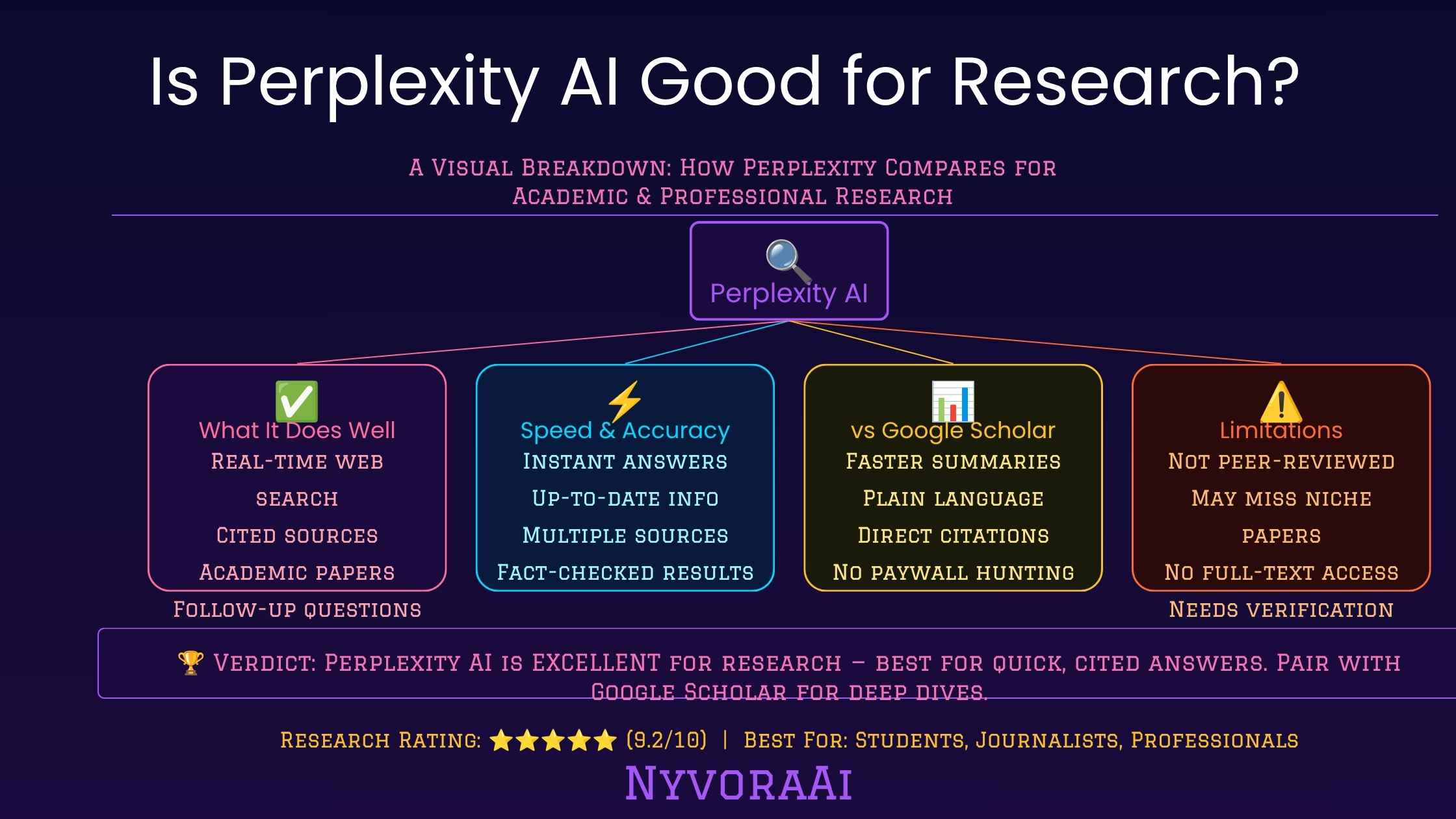
多数人想先听短结论,那就先给:Perplexity AI 做研究确实好用,但仅限特定一类。快速、附出处的通用事实检索是它的强项;它顶不了真正的学术文献综述,挂个来源链接也不代表每个细微差错都能被逮到。界线划在哪,下文逐一说清,你不必靠猜。
如果 Perplexity 只是你正在权衡的几款 AI 工具之一,看看它怎样与写作型助手搭配会很有用。我们另外写过Claude AI 与 ChatGPT 在写作上谁更强;当研究只是你想让 AI 帮忙的一环时,这篇是合适的配套读物。
01Perplexity AI 到底是个什么东西?
把 Perplexity AI 叫「答案引擎」算得上贴切。传统搜索引擎甩给你一整页蓝色链接,它则当场扫读若干实时来源,直接整理出回答,并标清每条信息的出处——通常是能点开原页的小号编号引注。开十个标签页、逐页快扫、再在脑内缝合答案,这整套动作正是它想替你省掉的。
驱动它的并不是某一个模型。问题会被分发给公司自研的「Sonar」模型;按套餐不同,遇到更吃重的推理还可调取其他大语言模型。这一点对研究格外要紧,因为最终答案靠两个环节同时撑住:底层模型的推理功力,以及检索环节能不能先捞出相关、时新、可信的来源。
它起步时只是个小玩家,到 2026 年已长成真正主流的研究帮手——一来搜索驱动的 AI 成了人们查证的默认姿势,二来它确实解决了一个烦人的问题:聊天机器人答得头头是道,却藏起推导过程。
02把研究问题丢给 Perplexity 后发生了什么
你在 Perplexity 敲进问题,答案并不只从模型早已「知道」的内容里挤出来。工具先对全网做一轮实时搜索,拉进一批相关页面通读,随后才以这些页面的真实内容为依托起草回答。凡借用某一页面的句子都带一枚小引注,让你把每个说法追溯到源头。
这道检索工序,正是它与「凭记忆开口」的标准聊天机器人最鲜明的差别。没有实时来源的模型,可能对过时、错误乃至纯属虚构的内容同样底气十足。以当下网页为依托,并不能让 Perplexity 永不犯错,却让答案可以查验——而可查验恰是研究活儿真正依赖的属性。
它还提供 Focus 聚焦模式,把搜索收紧到某一类来源。Academic 学术模式把结果限定在学术、研究导向的材料上,想彻底甩开营销博客和内容农场时是真好用。另有 Writing 写作模式,减少联网、更多倚重模型自身推理,以及其他用途的若干模式。留意自己处在哪种模式,比多数用户意识到的更要紧,因为喂进答案的来源会随之改变。
03Perplexity 真正帮到研究者的地方
实时且带来源的回答
Academic 学术聚焦模式
Spaces 与 Collections
多模型可用
04Perplexity 的短板
以上种种并不意味着它是完美的研究工具,这些缺口值得直说。最要命的是付费墙:严肃学术成果有很大一部分锁在期刊门槛之后,Perplexity 根本读不到,于是它的「Academic」回答常常建立在摘要、概述和开放获取论文之上,而非全文。真做文献综述时,这是个实打实的限制。
第二个问题是整合出错。它要把多个来源压进一段回答,细节偶尔会被揉成任何单一来源都不完全支持的样子,尤其是来源之间本来就打架的时候。引注或许没错,可铺在引注之上的综述仍可能跑偏。
来源质量还随问题而变。问个被充分报道的话题,你能拿到扎实、权威的页面;问冷门或刚发表的内容,它可能只能倚仗单薄的材料——更好的页面要么还没被收录,要么压根不公开存在。答案的成色,取决于开放网络此刻对那个具体问题存有多少货。
另外,免费档对更强模型有用量上限,而一些真正强力的研究功能——不限次的 Pro 搜索、更大的文件上传——要靠付费订阅才能用。重度用户或许觉得这笔交易公道,但在把工作流搭建在这些未必能永久免费用的功能上之前,心里有数总没错。
05Perplexity 对决 Google、ChatGPT、Google Scholar
想明白这件事,最有用的角度不是「它能不能干掉 Google」,而是「每款工具究竟为什么活而生」。单论研究场景,对比是这样的。
Perplexity AI
Google 搜索
ChatGPT
Google Scholar
现实里,很多研究者、学生和写作者是把这些工具搭配着用,而不是只选一个:Perplexity 负责快速定方位,Scholar 负责真正的引文,写作型助手负责把发现变成草稿。想知道 AI 在草稿那一半表现如何?我们的Claude AI 与 ChatGPT 写作对比详细讲了这条流水线的另一半。
06Perplexity AI 最适合的研究场景
学生
记者
营销人员
开发者
学术前期工作
日常好奇
07用 AI 搜索做研究时常犯的错
08看看 Perplexity 是否合你的研究风格
回答三个小问题,就能得到一份直白建议:Perplexity 该不该、以及该怎样放进你的研究流程。之后还是没底?联系 DSH Plugin Hub 团队,我们帮你指路。
09常见问题
Perplexity AI 对研究有帮助吗?
Perplexity AI 的准确度如何?
做研究它比 Google 强吗?
它能用来写学术研究论文吗?
有免费版本吗?
10收尾
那么,Perplexity AI 适合研究吗?老实说,适合——前提是你对眼前是哪一类研究心里透亮。想对一个通用问题拿到时新、带来源的整合回答,没几条路比它更快;而引注优先的做法,也让它远比只凭记忆作答的聊天机器人可信。但它不是、也无意成为 Google Scholar、高校数据库的替身;在利害攸关时,更代替不了你亲自细读原始文献。
2026 年把 Perplexity 用到极致的人,并不拿它当唯一工具。它只是两分钟的定方位环节——过去这要花二十分钟;真正需要严谨时,更专门的工具才登场。这么用,它在严肃研究流程里站得住脚;若把它当成任何要事的唯一权威,迟早会让你失望——换作任何单一工具,结果都一样。
如果你要搭建的不止于研究、而是更完整的 AI 工具箱,也值得看看这些产品在创意和视觉活儿上的表现,我们的2026 年顶尖 AI 图像生成器指南谈的正是这块。这个领域变化飞快,模型更新、新功能以及影响研究表现的种种变动,我们都记在DSH Plugin Hub 新闻栏目里。
Most readers want the short version up front, so: Perplexity AI does help with research, but only a particular kind. Fast, general fact-finding that comes with sources is where it shines. It won't replace a genuine academic literature review, and a source link doesn't mean every subtle mistake gets caught. The line between those two cases is what the rest of this guide maps out, so you don't have to guess.
If Perplexity is one of several AI tools you're weighing, it helps to see how it pairs with assistants built for writing. We've separately looked at Claude AI versus ChatGPT on writing tasks, a handy companion when research is just one slice of what you want AI help with.
01So What Exactly Is Perplexity AI?
Calling Perplexity AI an "answer engine" is fair enough. Where a classic search engine hands back a page of blue links, this one scans several live sources on the spot, compiles a direct response, and labels precisely where each piece came from — usually tiny numbered references that open the underlying page. The ten open tabs, the quick skim of each, the mental stitching job: that whole step is what it tries to delete.
There's no single model powering it. Queries get routed through the company's own "Sonar" models and, depending on the plan, other large language models when heavier reasoning is required. That detail matters for research because the finished response rests on two pieces performing together: the reasoning strength of the model underneath, and the retrieval step's ability to surface sources that are relevant, fresh, and trustworthy before anything is written.
It began as a minor contender, but by 2026 it has become a genuinely mainstream research aid — partly because search-driven AI has turned into the default way people look things up, and partly because it fixed an irritating problem: chatbots handing down confident answers while hiding how they got them.
02What Happens When You Ask Perplexity a Research Question
A question typed into Perplexity isn't answered purely from what a model already "knows." The tool first runs a live sweep of the web, gathers a batch of relevant pages, reads them, and only then drafts a response anchored in their actual contents. Any sentence that borrows from a particular page carries a small reference marker, letting you trace the statement to its origin.
That retrieval step is the sharpest contrast with a standard chatbot answering from memory. Without live sources, a model can sound utterly certain about content that is stale, false, or wholly fabricated. Grounding in today's web doesn't render Perplexity error-proof, but it renders its answers verifiable — and verifiability is the trait research work actually depends on.
Focus modes also let you tighten the search around one source type. Academic mode narrows results to scholarly, research-oriented material, which genuinely helps when you'd rather skip marketing blogs and content farms altogether. A Writing mode pulls back on web search and leans on the model's reasoning, with a few other modes for other goals. Being aware of the active mode matters more than users tend to think, since the sources feeding your answer change with it.
03Where Perplexity Truly Serves Researchers
Sourced Answers in Real Time
Academic Focus Mode
Spaces and Collections
Access to Multiple Models
04Where Perplexity Comes Up Short
None of that makes it a flawless research aid, and the gaps deserve a straight description. Paywall access is the biggest. A large share of serious scholarly work lives behind journal gates Perplexity cannot open, so its "Academic" responses frequently rest on abstracts, summaries, and open-access papers instead of full texts — a real constraint when you're doing a genuine literature review.
Synthesis errors are the next concern. Folding several pages into one answer means details occasionally blend in ways no single source quite supports, above all when the sources genuinely clash. The reference marker may be accurate while the synthesis layered over it drifts.
Source quality also shifts with the query. A heavily covered topic pulls strong, reputable pages; something niche or freshly published may get thin material, either because better pages aren't indexed yet or because none exist publicly. The answers are only as solid as what the open web currently holds on that exact question.
On top of that, no-cost users hit a ceiling with the strongest models, and a paid subscription is what unlocks a few genuinely powerful research features — unlimited Pro searches, larger file uploads. Heavy users may find that trade-off fair, but it's worth knowing before a workflow comes to depend on features that may not stay free.
05Perplexity Against Google, ChatGPT, and Google Scholar
The framing that helps isn't "does it beat Google" but "which job was each tool designed to do." On research specifically, the comparison looks like this.
Perplexity AI
Google Search
ChatGPT
Google Scholar
In day-to-day reality, plenty of researchers, students, and writers run these tools in tandem rather than crowning one: the quick orientation sweep goes to Perplexity, the real citations come from Scholar, and a writing-focused assistant is what turns the findings into a draft. Curious how AI compares on the drafting side? Our Claude AI versus ChatGPT writing guide walks through that half of the pipeline.
06Research Scenarios Where Perplexity Fits Best
Students
Journalists
Marketers
Developers
Early academic work
Everyday curiosity
07Common Research Mistakes With AI Search
08See Whether Perplexity Matches How You Research
Answer three quick questions for a frank recommendation on where Perplexity should or shouldn't sit in your research process. Still uncertain afterward? Reach the DSH Plugin Hub team and we'll help point the way.
09Frequently Asked Questions
Does Perplexity AI help with research?
How accurate is Perplexity AI?
Does it beat Google for research?
Can it support academic research papers?
Is there a free version?
10Wrapping Up
So — is Perplexity AI good for research? Honestly, yes, provided you're clear-eyed about the kind of research in front of you. Few routes are faster to a current, sourced synthesis on a general question, and the citation-first design makes it markedly more trustworthy than a memory-only chatbot. It is not, and does not aim to be, a stand-in for Google Scholar or a university database; and once the stakes run high, sitting with the primary source yourself is something nothing can replace.
The researchers getting the most from it in 2026 don't treat it as their only tool. It's the two-minute orientation pass where they used to spend twenty; specialized tools come in once real rigor is required. In that role it earns a place in a serious workflow. Treated as the lone authority on anything important, it will eventually fail you — as any single tool would.
If you're assembling a broader AI toolkit, it pays to look beyond research at how these products handle creative and visual work; our guide to the top AI image generators in 2026 does exactly that. The field shifts fast, so the DSH Plugin Hub news section is where we log model updates, fresh features, and changes that affect research performance.