一步步教你核查 AI 生成内容How to Fact-Check AI-Generated Content, Step by Step
AI 几分钟就能写完一整篇文章,也能同样毫不犹豫、信心十足地说出一件完全虚假的事。在 AI 生成的内容送到读者或客户面前之前,先用下面这套流程过一遍——它专门用来揪出 AI 自己绝不会提示的错误。
Minutes are all an AI needs to draft a full article — and all it needs to assert something entirely untrue, without a flicker of doubt. Before an AI-generated piece reaches your readers or your clients, run it through this process, designed to surface the mistakes the model itself will never point out.
一句话可以既漂亮又笃定,同时还是错的,而要分辨这两者比看上去难得多。语言模型被训练出来的本事是流畅,准确与否完全是另一回事,跟句子读起来顺不顺毫无关系。编造的统计数字、张冠李戴的引语、根本不存在的研究——模型写这些东西时的文笔,和它写对的地方一样有说服力。
在 AI 辅助写作的种种风险里,这一条最大,却也最好解决。核查不该是你工作流上后加的一道又慢又痛苦的工序。把它做成一套紧凑、可重复的常规动作,它花掉的时间只是写作的一个零头。下面讲的就是每次都该怎么做好它,又不让它成为卡点。
01为什么 AI 写的东西也需要核查
弄清楚模型在写句子时到底在做什么,这些问题就更容易想明白。它并不是像搜索引擎调出网页那样,从某个知识库里取出一条已核实的事实;它做的是预测——根据训练中学到的模式,选出统计上最可能出现的下一个词。由于这些模式大多是对的,输出通常也是对的。但模型内部并没有任何机制,能把“这确实是真的”和“这听起来像是真的”区分开。
这种生成机制,和以检测为目标的系统几乎不是一回事——比如 AI 如何识别垃圾邮件 里讲的那类,它的训练目标是拿收到的内容去比对已知的有害模式。写作模型的存在意义是产出看似合理的新文本,而不是去证实文本;我们那篇 生成式 AI 与判别式 AI 对这层区别讲得更细。想明白这一点,模型偶尔自信地说错话就不再令人意外,而只是你需要提前设计好去应对的一个变量。
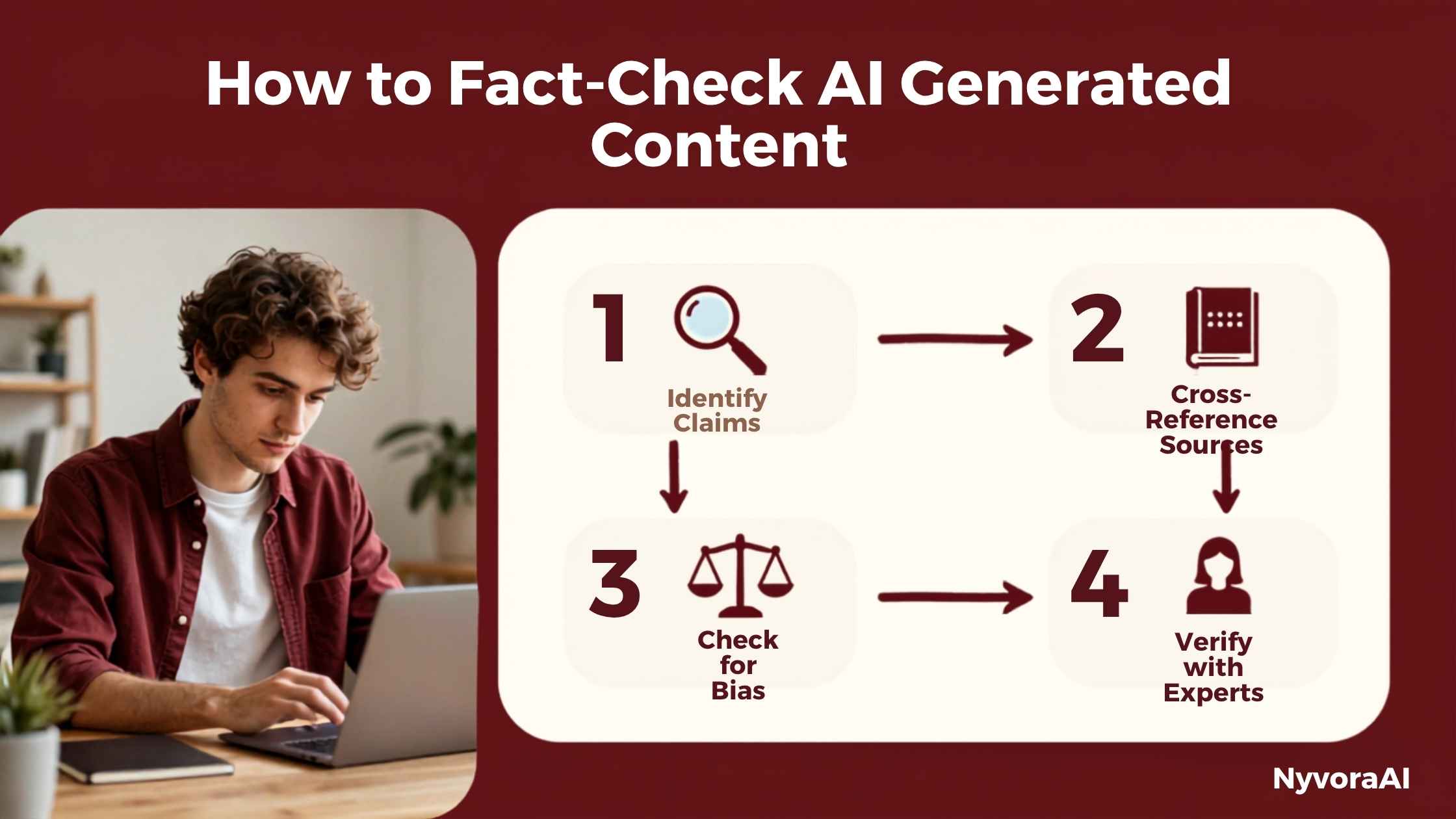
02六步核查流程
不管是随手一句提示词生成的稿子,还是走了一整套更复杂流程(比如 如何用 AI 更快地写博客文章 里讲的那种)产出的稿子,只要还没到发布那一步,都按下面这套流程走一遍。
- 1
把每一条具体主张标出来
1 通读全稿,把所有以事实形式出现的内容标出来:数字、日期、人名、引语、引用的来源。笼统的观点和描写不用管,具体信息必须标。
- 2
逐条回溯到独立的来源
2 自己动手去查这条说法,别回头问写出它的那个 AI。这一步的全部意义,就是引入一个与前者无关的第二来源。
- 3
确认来源里真的是这么说的
3 模型可能引用了一个真实来源,却曲解了它实际说了什么。把来源打开,核对两者是否一致——光有一条引注本身说明不了任何问题。
- 4
核对日期,找出过时信息
4 训练数据有截止时间,即便出处扎实的信息也可能已经过时。凡是时效敏感的说法,都要按今天的实际情况再确认一遍。
- 5
把引语逐字重读一遍
5 只要把话安在具体的人或机构名下,就必须一字不差。措辞一旦走样,本来基本准确的转述就变成了凭空捏造的引语。
- 6
凡是核实不了的都标出来,然后删掉或改写
6 如果一条说法在合理的检索量内始终无法证实,就不要把它当事实发布。要么改写成笼统的表述,要么直接删掉。
03幻觉在现实中长什么样
幻觉指的是:生成出来的内容读起来可信、说得笃定,实际上要么不成立、要么根本不存在。一旦知道它们长什么样,几种反复出现的模式就很容易认出来。
- 凭空造出的统计数字:精确得可疑,比如“73.4% 的营销人员”,背后查不到任何出处。
- 不存在的引用:某个研究或报告的名字听起来非常学术可信,一搜却发现根本没有。
- 引语张冠李戴:话听着合理、甚至确有出处,却被安在了从没说过它的人或机构头上。
- 把旧事实当成现状:曾经成立、后来已经变化的信息,却毫无保留地写出来。
- 细节被混在一起:两个各自真实的独立事实,被揉成一条不准确的合成说法。
以上这些,模型自己不会给出任何提示。它们夹在文中的样子,与旁边的正确句子毫无区别——所以每一稿都需要一次专门为核查而做的通读,而不是随手扫一遍。
04让错误更快现形的习惯与工具
有几个习惯能大幅缩短核查时间,而不会牺牲彻底性。其一,让 AI 逐条列出说法背后的出处——不是为了直接相信它,而是给自己一个可以独立查证的起点。其二,把疑似引语中的原句加上引号丢进搜索框,判断引语真假没有比这更快的办法。其三,写作过程中随手把“待核实”的条目记成清单,而不是最后凭记忆回想,这样就不会有东西被漏掉。
再进一步,是弄清哪一类 AI 工具容易犯哪一类错。写作模型捏造事实,和一个被训练来 作曲 的模型写出听上去成调、细究却不通的东西,本质是一回事:两者都在产出由模式驱动的流畅文本,而不是经过核实的结构化真相。
05准确性在 SEO、GEO 和 AEO 里的价值
核查不只是质量问题,它直接决定你的内容在搜索引擎、AI 搜索助手和答案框里的表现。Google 的 helpful content 指南明确偏好真实的专业性和准确性;而只要有一处明显错误,读者对页面其余内容的信任就会动摇,进而拉低长期影响排名的互动信号。
具体到 AI 搜索曝光,风险更高。那些负责总结或引用网页内容的 AI 助手,明显更愿意呈现把事实讲清楚、出处标注到位、不绕弯子的页面。因此在下一代搜索工具决定引用或指向谁时,准确且出处扎实的内容确实更有优势。
搜索排名
被 AI 引用
答案准确度
读者信任
降低风险
品牌可信度
06核查时常见的错误
07核查精力该重点投在哪里
AI 生成的内容并不承担同等的风险;把核查精力放在该放的地方,整个流程才能既高效又不至于把人拖垮。
- 统计数字与数据点:永远回溯原始来源,而不是照单全收 AI 转述的那个数字。
- 医疗、法律或金融类说法:现实后果最重,核查标准也必须最严。
- 直接引用与出处归属:任何加引号发布的内容,先确认措辞准确、说话人无误。
- 历史日期与事件:很容易出现细微错误,而有一定了解的读者同样很容易发现。
- 产品或公司的具体信息:名称、价格、功能变动频繁,必须按当下的情况核对一遍。
下一篇 AI 辅助完成的稿子,发布前不妨用下面这份在线清单快速过一遍。
08常见问题
核查 AI 生成内容的正确做法是什么?
AI 为什么会生成虚假信息?
AI 幻觉到底指什么?
AI 能核查自己产出的内容吗?
哪一类 AI 内容最需要核查?
一条判断该查多细的简单法则
一篇稿子里并非每句话都值得同等审视,把同样的力度平摊到全文,是让核查迅速变得令人疲惫的最快方式。一个实用的简化办法是:对每一条具体说法问一句——万一是错的,会怎样?轻松向博客里一个数字写错,只是尴尬;健康类文章里剂量写错,或者理财指南里的数据有误,却可能造成真实伤害。让这个后果来决定每条说法该投入多少核查精力,有限的时间自然就用在最关键的地方。
还有一个习惯值得养成:把 AI 工具当成研究助理,而不是研究来源。助理负责搜集线索、起草摘要、帮你省时间,但在署上自己的名字之前,你仍然会复核他的成果。光是心里保持这个定位,发布习惯就会明显变得更谨慎,而且不会把每一稿都拖成好几个小时的苦工。
09结语
核查 AI 生成的内容,并不是不信任 AI 这个写作工具,而是清楚知道它擅长什么、哪些责任仍然在你身上。模型能给你速度和结构,给不了你确定性;把这两者混为一谈,正是那些听起来很笃定的错误最终摆到真实读者面前的原因。每一篇 AI 辅助完成的稿子都走一遍上面那六步,具体信息用外部来源逐条核实,你发布的内容就能既写得快,又真正经得起信任。
写得更快,从来都不该以准确性为代价。只要把真正的核查流程纳入日常,这两件事就不必二选一。
A sentence can be polished and self-assured while still being wrong, and telling the two apart is harder than it looks. Fluency is what language models are engineered to deliver; accuracy is a separate matter entirely, unaffected by how smoothly a line reads. Invented figures, quotes pinned on the wrong speaker, research that never existed — a model will turn out any of these in prose every bit as persuasive as the passages where it happened to be correct.
Of all the dangers in publishing AI-assisted writing, this one looms largest — and it is also the easiest to neutralise. Verification need not be a slow, grudging addition tacked onto your process. Done as a tight, repeatable routine, it consumes a small share of the time the drafting already took. What follows shows how to do it right on every occasion, without letting it stall your output.
01Why AI Writing Needs Verification in the First Place
Knowing what a model is really doing as it composes a sentence makes all of this easier to reason about. There is no lookup of a checked fact from a store of knowledge, the way a search engine returns a page. What happens instead is prediction: the next words are chosen because the training patterns make them statistically probable. Because the bulk of those patterns were sound, the output is usually sound too. Yet nothing inside the model separates “this is actually so” from “this merely has the ring of truth.”
That generative mechanism bears little resemblance to a system built for detection — the sort discussed in how AI detects spam emails, whose training is aimed at sorting incoming material against patterns of known harm. A writing model exists to produce plausible new prose, not to authenticate it; our article on generative vs. discriminative AI unpacks that split in more depth. Grasp the difference and the model's occasional confident errors lose their power to surprise you — they simply become a factor you design around.
02A Six-Step Verification Workflow
Apply the following to every AI-generated draft while it is still far from publication, regardless of whether a single quick prompt produced it or a more elaborate pipeline of the kind described in writing blog posts faster with AI.
- 1
Mark up every concrete claim
1 Read the draft through and mark each item presented as fact — figures, dates, names, quotations, cited sources. Opinions and general description can be left alone; the specifics cannot.
- 2
Trace each one back to a source that is independent
2 Look the claim up yourself; do not put the question back to the AI that produced it. The entire purpose here is to bring in a second source that owes nothing to the first.
- 3
Confirm the source genuinely makes that statement
3 A model may name a genuine source and still distort its contents. Open the source itself and check that the two line up — the mere presence of a citation proves nothing.
- 4
Check dates, and hunt down anything stale
4 Training data stops at a fixed point, so even properly sourced material can have gone out of date. Any claim whose truth depends on timing needs re-confirming against today.
- 5
Read quotations again, word by word
5 When words are placed in the mouth of a named person or publication, they must match precisely. A paraphrase that is basically right becomes a manufactured quotation as soon as the wording drifts.
- 6
Flag whatever resists verification, then cut it or rewrite it
6 Should a claim survive no reasonable amount of searching, do not print it as fact. Either turn it into a general remark or take it out.
03What a Hallucination Looks Like in Practice
A hallucination is generated material that reads as credible, is delivered with assurance, and yet is either untrue or simply does not exist. Once you know the shapes they take, a handful of recurring patterns become easy to spot.
- Statistics conjured from nothing: a figure precise to the decimal — “73.4% of marketers” — that traces back to no source at all.
- Citations that do not exist: a study or report title with an authoritative academic ring, which vanishes the moment you search for it.
- Quotations given to the wrong source: wording that is plausible and even genuine, but pinned on a person or outlet that never said it.
- Stale facts dressed as current ones: something that used to hold true and no longer does, offered up with no caveat.
- Details fused together: two facts that are each real but distinct, melted into a single claim that is wrong.
The model raises no warning about any of them. They sit in the text looking no different from the correct sentences beside them — and that is why every draft needs a purpose-built verification pass, not a relaxed skim.
04Habits and Tools That Speed Up Error Catching
A handful of routines can cut verification time sharply while leaving thoroughness intact. One is to make the AI list the sources behind each claim — not because the list is trustworthy on its own, but because it gives you somewhere to begin checking independently. Another is to drop an exact phrase from a supposed quotation into a search box inside quotation marks; few methods settle a quote's authenticity faster. And jotting each “claim to verify” onto a running list while you draft, instead of relying on memory later, keeps items from slipping past unnoticed.
Knowing which kinds of AI tool tend toward which kinds of mistake is a further advantage. Factual invention comes as naturally to a writing model as it does to one trained to compose music, which may turn out passages that hold together musically yet collapse under technical scrutiny. Both are generating fluent output driven by patterns — neither is producing checked, structured truth.
05What Accuracy Buys You in SEO, GEO, and AEO
Verification is not merely a matter of quality; it shapes how your pages fare in search engines, in AI search assistants, and inside answer boxes. Google's helpful content guidance openly rewards genuine expertise and accuracy, and one glaring error is enough to shake a reader's confidence in every other line on the page — denting the engagement signals that feed into rankings over time.
Where AI search visibility is concerned, the stakes climb further. Assistants that summarise or cite pages online gravitate toward material that states its facts plainly, credits them properly, and steers clear of evasive waffle. Accurate, well-attributed writing therefore holds a genuine edge when the coming generation of search tools decides what to quote or point to.
Search Ranking
Citation by AI
Answer Correctness
Trust From Readers
Lower Risk
Brand Credibility
06Mistakes People Make When Verifying
07Where Verification Effort Pays Off Most
AI-generated material does not carry uniform risk, and directing your checking where it counts keeps the whole exercise sustainable rather than draining.
- Numbers and data points: go back to the original source every time, not the digit as the AI restated it.
- Health, legal, or money-related claims: real-world consequences are greatest here, so the bar for verification is highest.
- Verbatim quotations and who said them: settle the exact wording and the right speaker before anything goes out inside quotation marks.
- Dates and events from history: slight errors creep in easily, and a well-read audience spots them just as easily.
- Details about a product or company: names, prices, and features shift constantly, so they need a check against how things stand right now.
Run the interactive checklist below against your next AI-assisted draft as a quick gut check before it goes out.
08Questions We Get Asked
What is the right way to fact-check AI-generated content?
What makes AI produce false information?
How would you define an AI hallucination?
Is AI able to fact-check its own output?
Which parts of AI content demand the most verification?
A Simple Rule for Deciding How Much to Verify
Every sentence in a draft does not warrant identical scrutiny, and applying the same intensity across the board is a quick route to verification fatigue. A handy shortcut: for each specific claim, ask what the consequences would be if it proved false. A miscounted statistic in a light-hearted blog post is merely awkward. A wrong dosage in a health piece, or a mistaken figure in a money guide, can do genuine damage. Let that downside set the level of effort each claim earns, and your limited hours go where they matter most.
Another habit worth cultivating is to file AI tools under research assistant, never under research source. An assistant collects leads, produces draft summaries, and buys you time — yet you would still review their work before putting your name to it. Holding that frame in mind alone tends to make publishing habits markedly more careful, and it does so without turning each draft into an hours-long slog.
09The Bottom Line
Checking AI-generated writing is not an expression of distrust toward AI as a tool; it is a clear-eyed account of what the tool does well and which duties remain yours. Speed and structure are what a model supplies. Certainty is not among them, and confusing the two is exactly how assured-sounding mistakes reach a real audience. Put the six-step workflow above through every AI-assisted draft, confirm the specifics against outside sources, and what you publish will be quick to produce and safe to stand behind.
Writing faster was never supposed to come at the cost of being right. Once a genuine verification process is part of the routine, the two stop being a trade-off.