athif23/dsh-context-rollover
A DeepSeek Harness bundle for model-driven context self-management: the model can deliberately end one working context window and continue in a fresh one while preserving durable state — with no summarization.
catalog descriptioncatalog 简介 / catalog description:Model-driven context-window rollover bundle for the DeepSeek Harness: fresh working context, durable notes, verbatim recent tail, no summarization
Project Overview项目介绍
This is a context management plugin for DeepSeek Harness (DSH) that enables model-driven context rollover without summarization. It lets models end old context windows and start new ones while preserving durable state, supporting multiple trigger modes to avoid context overflow. Notes are only stored within the current session, with no cross-session sync.
这是DeepSeek Harness(DSH)的上下文管理插件,提供模型驱动的无摘要上下文自管理能力,可在保留持久状态的同时结束旧上下文、开启新窗口,支持模型主动、自动和手动触发,解决上下文窗口溢出问题。注意:笔记仅保存在当前会话内,不支持跨会话同步。
请帮我了解并安装插件:【dsh-context-rollover】【https://github.com/athif23/dsh-context-rollover】Send this message to DSH in your current session. CLI install commands may not be accurate across systems — DSH will figure it out for you.把上面这条消息直接发给当前会话里的 DSH,让它帮你了解并安装。安装命令不一定准确,发给 DSH 更稳。
Or use CLI install (for developers)或使用命令行安装(适合开发者)
CLI Install命令行安装
dsh plugin --profile web add dsh-context-rollover把 athif23/dsh-context-rollover 加入你的 DSH 配置(web profile)即可启用。
READMEREADME
dsh-context-rollover
A DeepSeek Harness bundle for model-driven context self-management: the model can deliberately end one working context window and continue in a fresh one while preserving durable state — with no summarization.
fresh working context + durable model-managed notes + small recent raw tail + recoverable full history
Inspired by the context-management architecture in openai/codex (the
new_context tool, token-budget compaction without a summarizer, history/notes
separation) and pi-posthorse. Codex is the architectural reference; DSH is the
implementation authority — everything runs through DSH's own surface-replace
protocol and compaction transaction.
How it works
The plugin provides the active ctx.compaction engine (it disables
dsh-compaction-basic in its bundle patch). On the Web profile the engine
must additionally live in the session's agent preset — see
Web profiles below. A rollover is a real DSH
compaction: compaction/start → compaction/summary → one replacement
user/message with full source provenance → compaction/end — but the
"summary" is a deterministic checkpoint (durable notes plus an optional
handoff), never an LLM call. Raw session events stay persisted; a
token-budgeted recent tail stays verbatim on the surface; deriveMessages()
rebuilds automatically.
Responsibilities stay split (the Codex lesson):
| Concern | Owner |
|---|---|
| Request a boundary | new_context tool (records a pending request only) |
| Cross the boundary | agent/pre-step (before the next model request) and agent/turn-stopping |
| Track windows | rollover count + summary seqs read from the durable log |
| Measure pressure | ctx.tokenMeter + the routed model's context window |
| Replace the surface | commitRollover inside DSH's compaction transaction |
| Preserve selected state | notes tool (markdown files per session) |
| Recover old details | history tool (search/read over shadowed surface events) |
Model-facing tools
new_context({ handoff? })— request a context boundary at the next safe point. The handoff (bounded) becomes part of the new window's checkpoint. The boundary is crossed at a safe lifecycle point, never mid-tool-batch.get_context_remaining()— honest headroom: tokens left before the hard window and before the automatic rollover, or "not measured yet".notes—list | read | write | append | searchover per-session markdown files under<dsh home>/notes/<session id>/. Nothing is written automatically; the model decides what survives.history—search | readover conversation that left the active surface. Targeted recovery, not wholesale reconstruction.
Rollover paths
- Model-driven (preferred): the model saves notes, calls
new_contextwith a short handoff at a phase boundary (research → implementation, etc.). - Pressure (safety net): above
thresholdRatioof the window the engine rolls over automatically with durable notes and the recent verbatim tail. Below that, a one-per-window checkpoint reminder suggests saving notes and rolling over. - Overflow: a provider-confirmed
CONTEXT_WINDOW_EXCEEDEDforces a rollover with the same notes + tail checkpoint and retries the request. - Manual:
/compactkeeps working — it performs the same standalone notes + tail rollover on an idle agent.
Only the model-driven path carries a handoff. The engine never writes one for pressure, overflow, or manual rollovers: producing a handoff itself would mean either an LLM summarization call or copying older user messages into the fresh window, and the second option revives stale requests. Those paths preserve intent through notes and the recent verbatim tail instead.
What this plugin touches
- Registers four model-facing tools (
new_context,get_context_remaining,notes,history) and one system-prompt section — on headless profiles in every session; on the Web profile only insidestandard-rolloversessions (other presets stay exactly as shipped). - Writes files in exactly one place: markdown notes under
<dsh home>/notes/<sessionId>/. Nothing else on disk is written; no network calls, no telemetry. - Replaces the active compaction backend (
compaction-basicis disabled by the bundle patch). Session logs stay fully compatible in both directions. - No credentials, no cloud services, no data leaves the machine.
Host version compatibility
The plugin typechecks against both host lines: the development checkout and
its installed profiles (0.1.5-rc.1, via generated tsconfig paths) and the
newest packages published to public npm (0.0.1-rc.1, the
pnpm typecheck:compat probe against compat/node_modules). Runtime
differences are bridged in src/compat.ts:
- the session log as
snapshotEvents()(newer line) orevents(published); eventAt(seq)versus indexing that array;- per-node pricing as
heuristicTokens(newer line) ortokens; - the replacement operation as
{ startSeq, endSeq }(newer line) or{ start, end }, probed once per process because each line rejects the other's field names.
Note the published @deepseek-ai/dsh-* packages are a partial mirror: some
of their peers reference packages that were never published publicly, so a
standalone npm-only host graph cannot be assembled. That is expected — the
plugin's peers resolve from the running dsh host's installation closure, and
installing the plugin itself into a profile fetches only this package.
Install
From npm (recommended):
dsh plugin --profile <profile> add dsh-context-rollover
# or, without the dsh CLI:
pnpm --dir "$DSH_HOME/profiles/<profile>" add dsh-context-rollover
A custom profile initializes with just dsh-base; the bundle's patch applies
automatically because the package declares dsh.bundle.patch. After the first
install (a bundle-membership change is a boot-time composition), start the
profile once — the plugin's peer packages resolve from the running host's
installation closure, never from npm.
From GitHub instead of npm:
dsh plugin --profile <profile> add github:athif23/dsh-context-rollover
From a local checkout (development, see the HMR section below):
dsh plugin --profile <profile> add D:/path/to/dsh-context-rollover
Windows note: if the plugin loads but its @deepseek-ai/* imports fail at
runtime after an install from Git Bash, pnpm may have materialized broken
link: junctions (a Git Bash/Windows path-mangling bug). Recreate them with
cmd /c mklink /J as described in the HMR section below — the same fix
applies to any linked sibling package in the profile.
The bundle's cordis.patch.yml disables dsh-compaction-basic and mounts the
context-rollover engine itself. command-compact, the token meter, and the
compaction invariant companions need no changes — they depend only on
ctx.compaction.
Web profiles (preset sessions)
Headless and other base-only profiles are done after the install above: the
host engine is the session's engine, no roster exists, and nothing stands
down. The Web profile is different — its sessions compose compaction from
their agent preset, not from the host — so the bundle additionally
registers a shipped standard-rollover preset ("Standard + rollover
(experimental)" in the picker) beside the deployment's own set. Restart the
host once after install, then open new sessions on it to try the
experiment; standard stays the default. Existing sessions stay on whatever
they started with.
No commands, no profile edits. Two behaviors make that hold:
- The host engine defers to any preset-owned backend: on a
standardsession the shipped summarizer runs alone (previously the two backends raced each pressure signal); onstandard-rolloverthe preset's rollover engine runs alone; headless sessions keep the host engine. - The preset's engine row sets
modelSurface: 'always', so it is the only source of rollover tools and guidance in its sessions. On preset deployments the host row (modelSurface: 'auto') registers neither, sostandardandminimalsessions never see rollover-framed instructions.
Custom thresholds belong to your own preset copy (the supported customization
flow: copy standard-rollover in the picker and edit the context-rollover
row) — the shipped preset carries the defaults below. If a deployment
restates the whole agent-presets config in a later patch layer, that layer
wins and hides the shipped preset; re-adding the bundle's root there
restores it. Uninstalling the bundle removes the preset: sessions already on
it keep running, new ones must pick another preset.
Maintainers: presets/standard-rollover/ is generated, not authored —
re-run pnpm preset:sync after harness updates and commit the refresh. The
sync keeps everything else byte-identical and fails loud when the shipped
standard shape drifts.
Configuration (cordis.yml config on the plugin row):
- insert:
    - id: context-rollover
      name: dsh-context-rollover
      config:
        thresholdRatio: 0.9          # automatic rollover point (fraction of window)
        reminderThresholdRatio: 0.75 # one-time checkpoint reminder point
        retainRatio: 0.1             # recent verbatim tail (fraction of window)
        retainTokens: null           # absolute tail budget; overrides retainRatio
        handoffMaxChars: 20000
        notesEnabled: true
        historyEnabled: true
        notesDir: null               # base dir override; default <dsh home>/notes
        modelSurface: auto           # auto (host rows) | always (preset rows)
Local development with HMR
The fast loop runs DSH from your checkout with the plugin linked from this directory and Cordis HMR watching the source:
Create a dedicated profile and link this package
dsh plugin --profile rollover-dev add D:/path/to/dsh-context-rollover(A custom profile initializes with just
dsh-base; the bundle's patch applies automatically because the package declaresdsh.bundle.patch.)Enable the
hmrrow in$DSH_HOME/profiles/rollover-dev/cordis.patch.yml(patch rows replace whole configs, so restateroot):- id: hmr config: root: ['.', 'D:/path/to/dsh-context-rollover/src'] debounce: 100The base bundle mounts
hmrdisabled by default; thetimerrow it needs is already active.Run DSH from source
cd /path/to/deepseek-harness
pnpm run build          # once; Typert host artifacts are required
pnpm dsh --profile rollover-dev
Source launch runs through tsx (
node --import tsx/esm), which is what makes hot reload of TypeScript plugin sources work.Edit
src/*.tsin this package — the affected plugin reloads in place; registrations (tools, system-prompt sections, event listeners) unwind and reapply through Cordis effects. Profile patch edits also recompose live (patchReload: liveis the default for custom profiles).Restart is still required for: initial bundle installation, bundle membership changes (
dsh.plugin add/remove), framework-level dependency changes (Cordis falls back toloader.exit()), and anything HMR cannot safely swap.
Windows: link: junctions and Git Bash
pnpm install in a profile run from Git Bash mangles link:D:/...
specifiers into junctions with invalid targets (the drive colon is treated
as relative). If a profile's linked plugins fail to load after an install,
recreate the junctions with the real targets:
cmd /c mklink /J "%DSH_HOME%\profiles\web\node_modules\dsh-context-rollover" "D:\path\to\dsh-context-rollover"
(or run the install from PowerShell/cmd). This package's own runtime peers
are junctions into the shared installation closure at
$DSH_HOME/profiles/node_modules/@deepseek-ai/*. That is what lets the
engine share the host's module instances: a service plugin that extends
CompactionEngine must import the exact classes the host loaded, so
resolving its @deepseek-ai/* imports through the same closure as the host
is load-bearing, not an optimization.
Tests and typecheck (no DSH build needed)
The sibling DSH checkout is the source of truth: tsconfig.base.json paths are
generated into tsconfig.dsh-paths.json and vitest aliases execute everything
from TypeScript source — the same source plane DSH's own suites use. Vendored
packages typecheck against their built declarations so skipLibCheck absorbs
their relaxed strictness.
pnpm install
pnpm test        # surface, notes, history, engine integration, tool rendering
pnpm typecheck
Tests mount the real session store, token meter, tool runtime, agent loop, and
the compaction invariant companions, so every committed rollover is
validated against DSH's own invariants. The integration test proves the
semantic experiment end to end: the model researches, calls new_context
mid-turn, and the fresh window carries notes + handoff + recent tail while the
turn continues.
Scope and limits
- A rollover checkpoint contains durable notes, the model's handoff when it supplied one, and the retained verbatim tail that sits outside the checkpoint. No older user prompts are copied into it.
- Notes survive context rollovers within a session; no cross-session sync, embeddings, or cloud storage.
- Notes are files, not session events:
Session.appendcannot mark a plugin's custom event typesignorable, so unknown plugin events on a session log would make that log unreadable by any DSH build without the plugin. Only known event types (compaction/*,user/message) are written. - The generic
<compaction>checkpoint provenance is reused, so transcript UIs recognize rollover checkpoints like any compaction. - No DSH core was forked or patched; the plugin only consumes public seams.
License
MIT
Related相关推荐
-
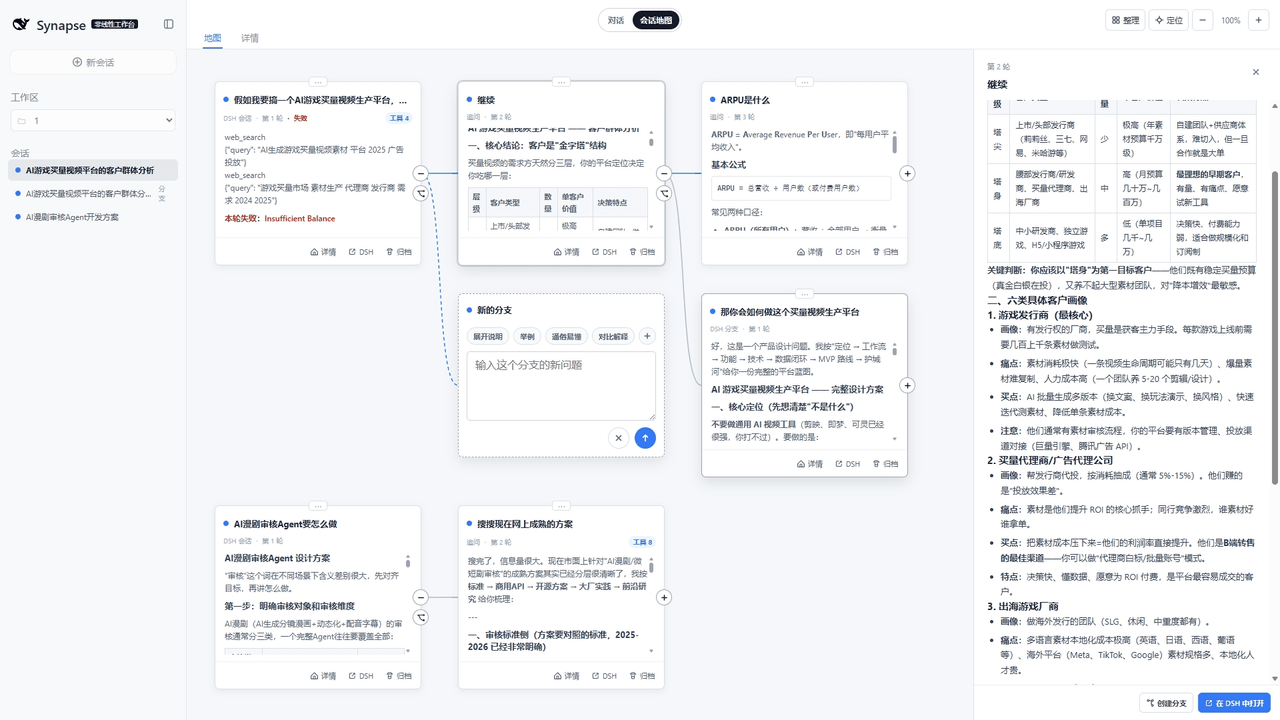 liangmianya/dsh-synapse
A visual, non-linear conversation workspace plugin for DeepSeek Harness ; A canvas-based session explorer and branching …
liangmianya/dsh-synapse
A visual, non-linear conversation workspace plugin for DeepSeek Harness ; A canvas-based session explorer and branching …
-
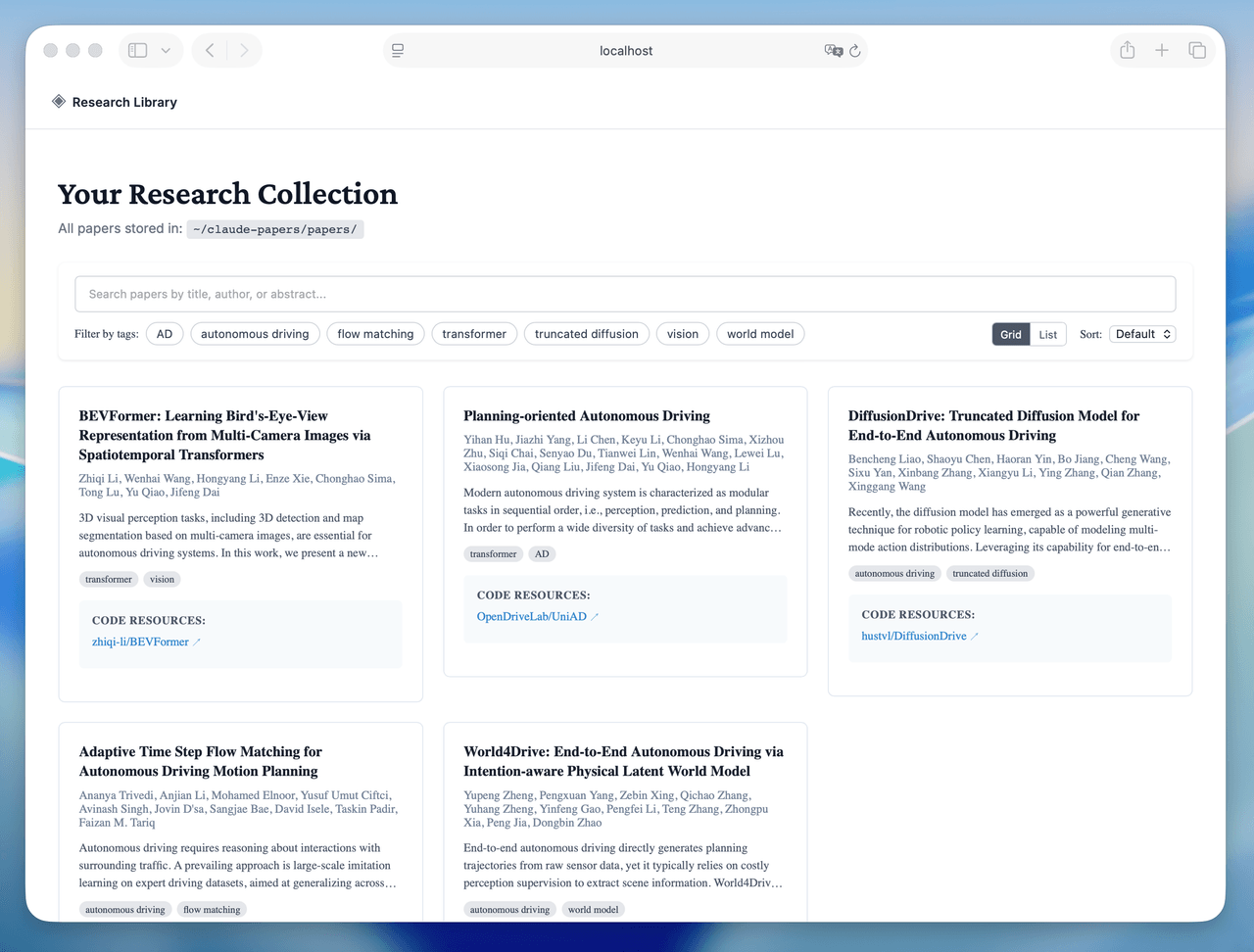 alaliqing/claude-paper
📖 Cross-agent research paper toolkit for Claude Code, Codex, OpenCode, and DeepSeek Harness—quick summaries, deep study…
alaliqing/claude-paper
📖 Cross-agent research paper toolkit for Claude Code, Codex, OpenCode, and DeepSeek Harness—quick summaries, deep study…
-
 omdsh-dev/dsh-annotation
DSH Web 选中批注插件:选文字→批注→回车随消息发送;气泡隐藏批注块(零闪烁);回复按 Annotation N 逐条对照(可悬浮芯片)。官方 bundle,零核心改动
omdsh-dev/dsh-annotation
DSH Web 选中批注插件:选文字→批注→回车随消息发送;气泡隐藏批注块(零闪烁);回复按 Annotation N 逐条对照(可悬浮芯片)。官方 bundle,零核心改动
-
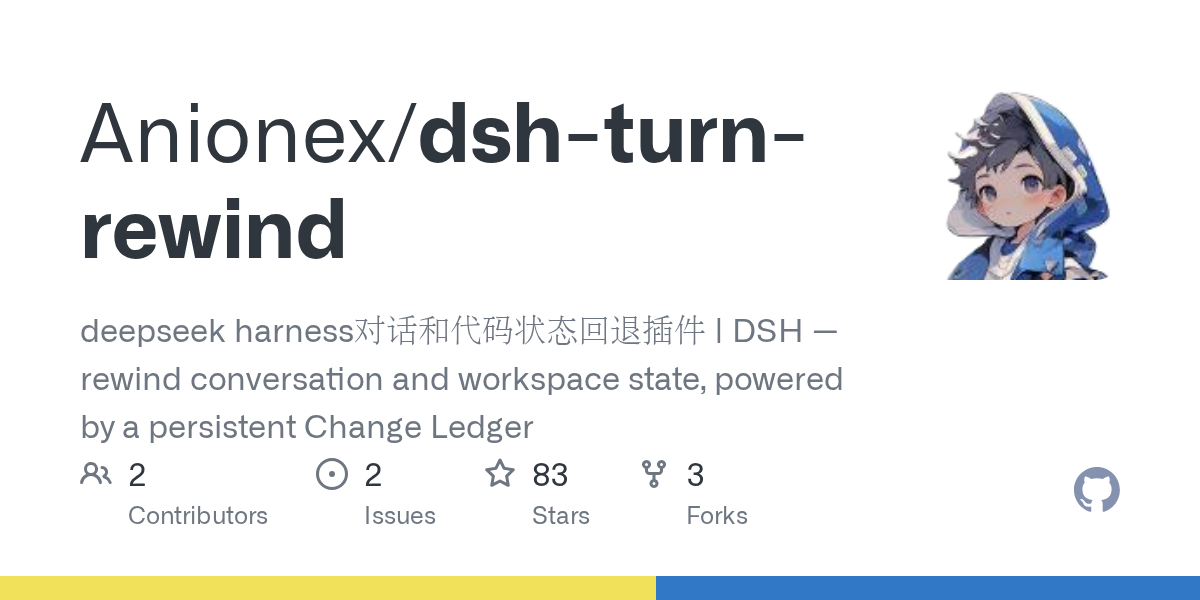 Anionex/dsh-turn-rewind
deepseek harness对话和代码状态回退插件 | DSH — rewind conversation and workspace state, powered by a persistent Change Ledger
Anionex/dsh-turn-rewind
deepseek harness对话和代码状态回退插件 | DSH — rewind conversation and workspace state, powered by a persistent Change Ledger
-
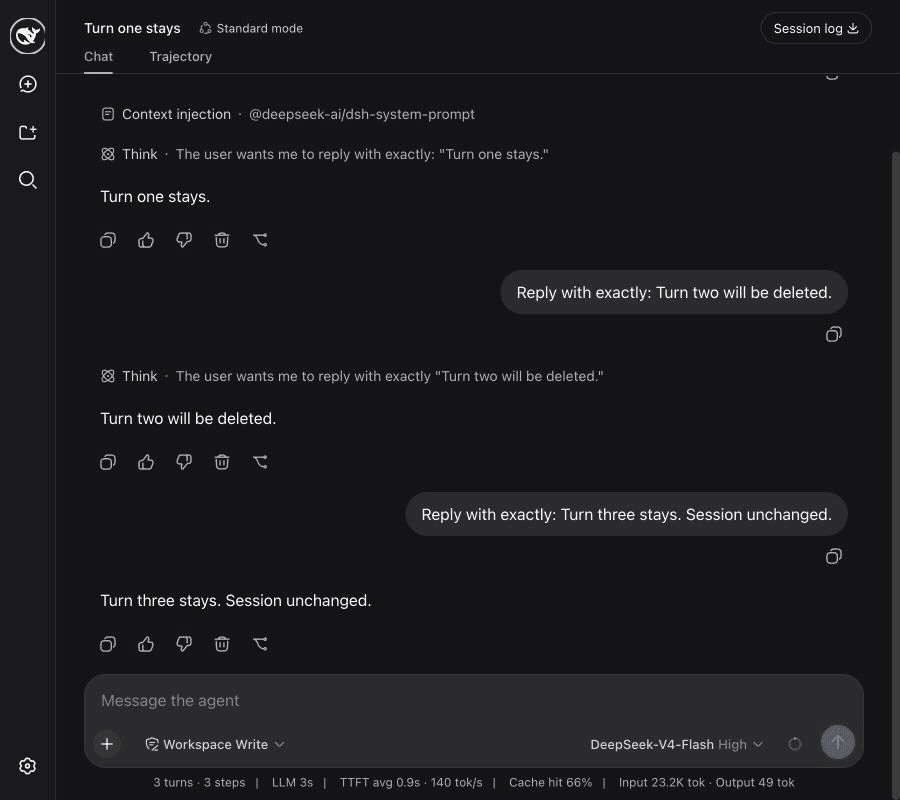 hanshenmesen/dsh-turn-delete
Delete one complete turn from a DeepSeek Harness session without deleting the session
hanshenmesen/dsh-turn-delete
Delete one complete turn from a DeepSeek Harness session without deleting the session
-
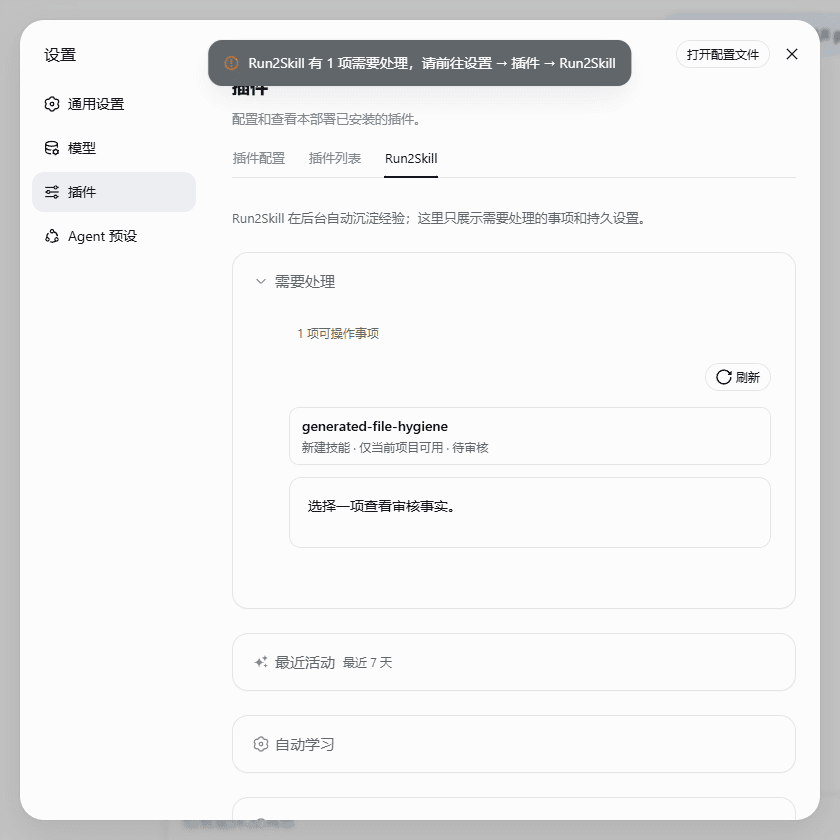 qkycir-123/dsh-run2skill
Automatically turn successful DeepSeek Harness sessions into reusable, reviewable Agent Skills.
qkycir-123/dsh-run2skill
Automatically turn successful DeepSeek Harness sessions into reusable, reviewable Agent Skills.
-
 Tyan66666/billion-context-dsh
Model-driven context management (Active Context Pruning / ACP) for the DeepSeek Harness — the model decides when and wha…
Tyan66666/billion-context-dsh
Model-driven context management (Active Context Pruning / ACP) for the DeepSeek Harness — the model decides when and wha…
-
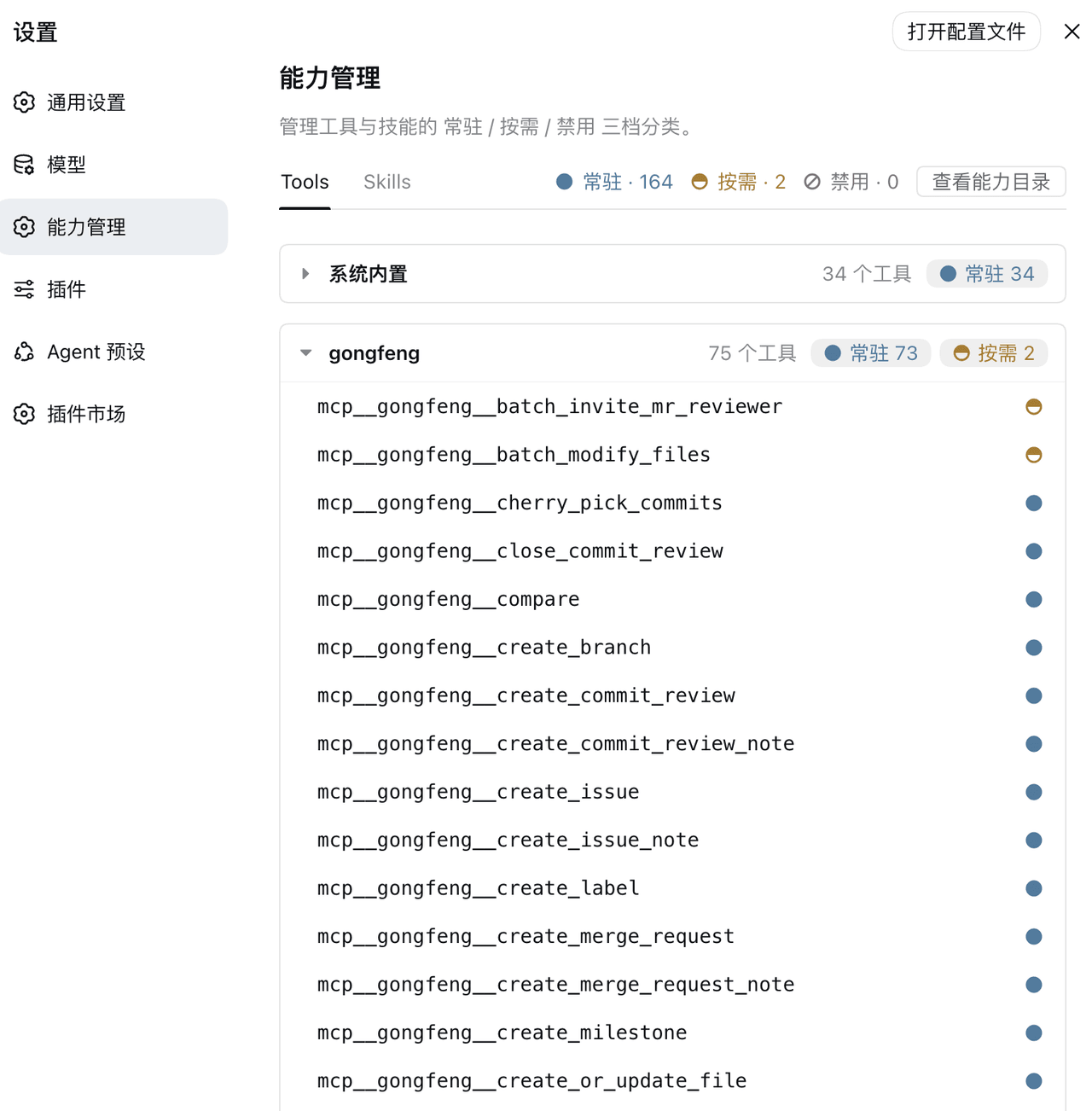 PKUfudawei/dsh-capability-menu
Unified capability menu for DeepSeek Harness: manage exposure level (context footprint) and execution mode of MCP tools …
PKUfudawei/dsh-capability-menu
Unified capability menu for DeepSeek Harness: manage exposure level (context footprint) and execution mode of MCP tools …