ayahunter/dsh-plugin-clinic
DeepSeek Harness 已安装插件的只读健康检查工具:加载器健康、依赖完整性、版本兼容性、安装脚本风险、重复项和补丁完整性 — 模型工具 + Web 仪表板 + JSON 报告。
项目介绍Project Overview
dsh-plugin-clinic 是 DSH 插件集的只读体检插件,检查加载健康、依赖完整性、版本兼容、安装脚本风险、重复项与补丁完整性,提供 plugin_health 工具、Web 体检页和 JSON 报告。适合排查插件环境异常或在 CI 中校验配置。注意:它只诊断不修复,且完全离线,不检测 npm 弃用或更新。
dsh-plugin-clinic is a read-only health-check plugin for installed DeepSeek Harness plugins. It runs eight offline checks covering loader health, dependency and version compatibility, install-script risk, duplicates, and patch integrity, exposing a plugin_health tool, a web dashboard, and JSON reports. Use it to diagnose plugin environments or validate setups in CI. Caveat: it only reports issues—it does not repair them—and performs no online npm checks.
请帮我了解并安装插件:【dsh-plugin-clinic】【https://github.com/ayahunter/dsh-plugin-clinic】把上面这条消息直接发给当前会话里的 DSH,让它帮你了解并安装。安装命令不一定准确,发给 DSH 更稳。Send this message to DSH in your current session. CLI install commands may not be accurate across systems — DSH will figure it out for you.
或使用命令行安装(适合开发者)Or use CLI install (for developers)
命令行安装CLI Install
dsh plugin --profile web add dsh-plugin-clinic把 ayahunter/dsh-plugin-clinic 加入你的 DSH 配置(web profile)即可启用。
READMEREADME
dsh-plugin-clinic
Plugin Clinic — read-only health checks for the installed DeepSeek Harness plugin set.
DeepSeek Harness is "everything is a plugin", which spreads stability risk across a
freely-composable configuration layer — yet nothing tells you whether your installed set
is healthy. dsh-plugin-clinic closes that gap: it inspects every profile under the
Harness home and reports loader health, dependency integrity, version compatibility,
install-script risk, duplicates, and patch integrity, with no writes and no external
state.
Features
- Model tool
plugin_health— the agent can diagnose its own environment in-session and turn findings into concrete fix advice. - Web dashboard — a "体检" (Clinic) tab in Settings → Plugins, one entry per profile with severity-colored plugin cards.
- JSON reports — a stable
schemaVersion: 1contract for CI and scripts. - 8 read-only checks — see docs/checks.md:
load-health,bundle-manifest,peer-deps,runtime-compat,install-scripts,duplicate,patch-health,provenance. - One row install — a single npm bundle patch mounts both the Host engine and the browser dashboard.
Screenshots
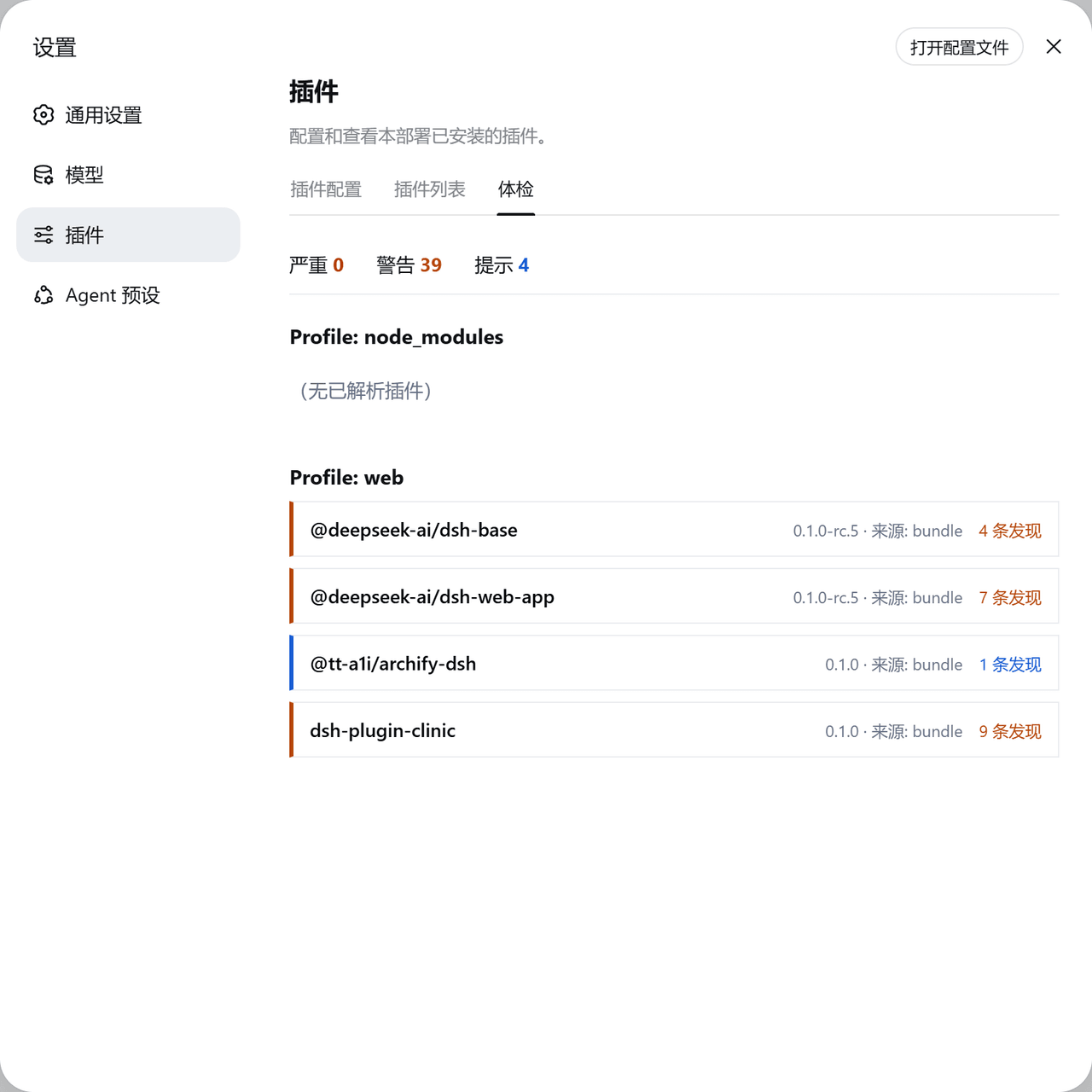
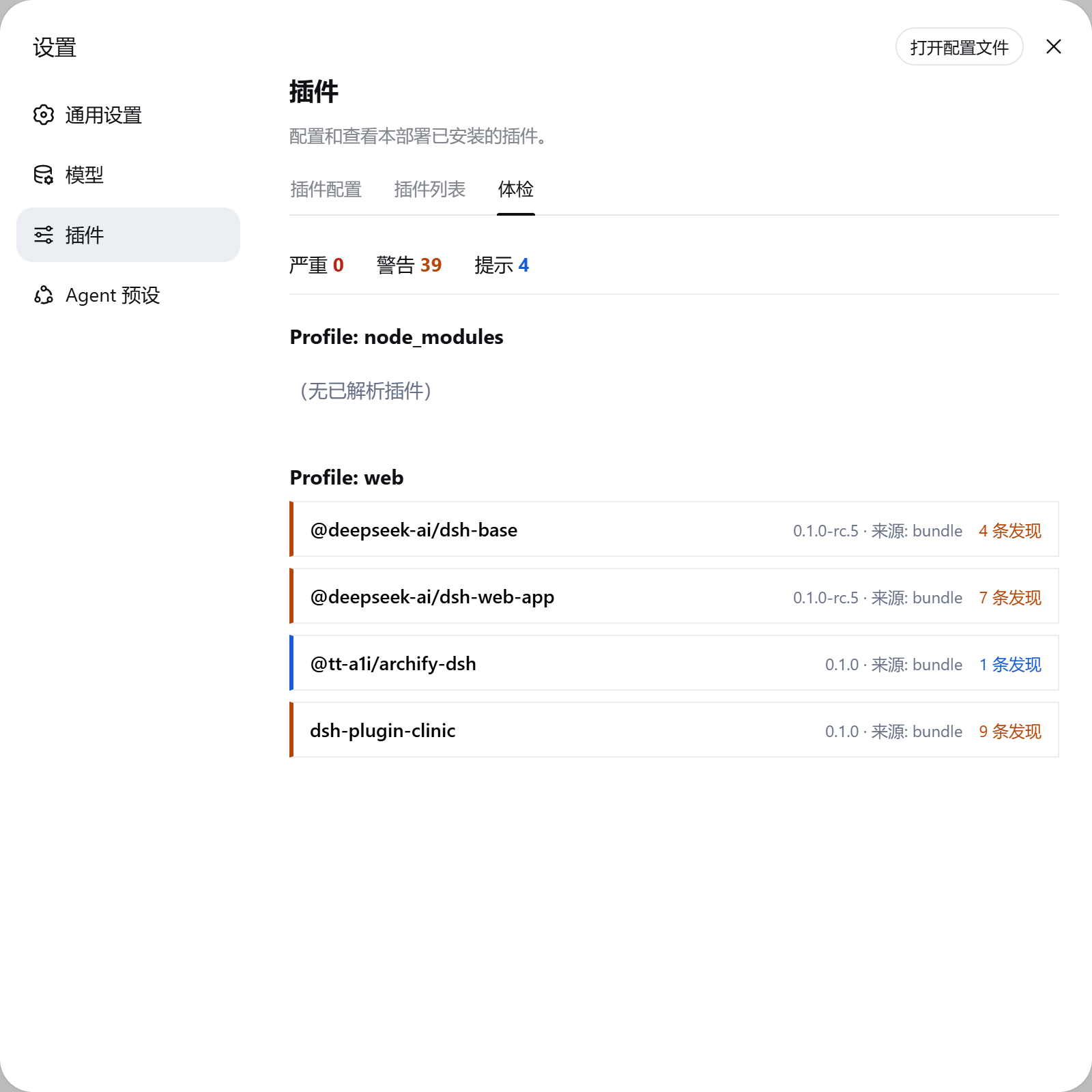
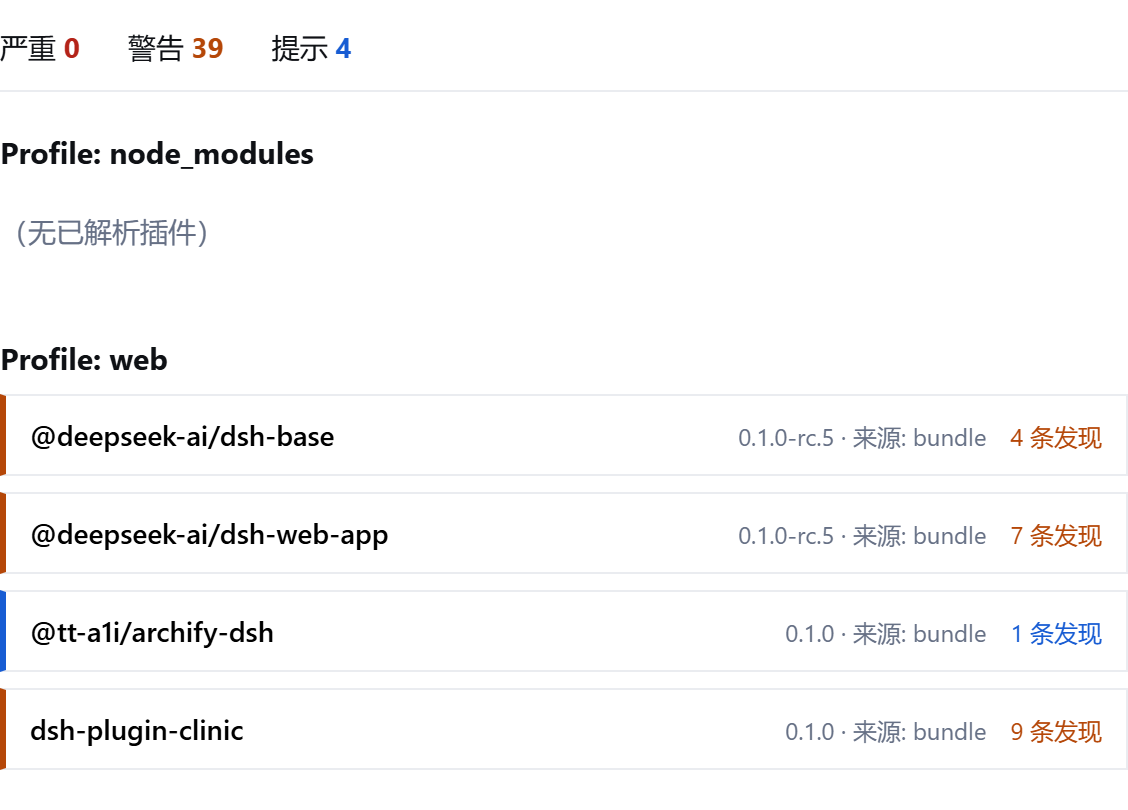
The Clinic dashboard inside the official Web GUI — Settings → Plugins → 体检. Per-profile plugin cards carry severity-colored status lines, expandable findings, and the summary bar counts critical/warning/info findings across every profile:
Install
# from npm (prebuilt lib/)
dsh plugin --profile web add dsh-plugin-clinic

# or straight from GitHub (sources; the prepare script builds them, pnpm asks you to
# allow the build once — see the official publish guide for the allowBuilds semantics)
dsh plugin --profile web add github:ayahunter/dsh-plugin-clinic
Restart the profile. The Settings → Plugins section gains a Clinic tab; the session gains
the plugin_health tool.
Update
# upgrades within the saved semver range (^0.1.0 → latest 0.1.x)
dsh plugin --profile web update dsh-plugin-clinic
Upgrades are never applied automatically; restart the profile afterwards.
Quick start
In any session on a profile where the plugin is installed:
体检一下我的插件
or call the tool directly with {"details": true} for per-finding evidence. In the Web
GUI, open Settings → Plugins → 体检 to see every profile's health at a glance.
Configuration
Edit the bundle row in the profile's cordis.patch.yml:
- id: clinic
  name: 'dsh-plugin-clinic'
  config:
    profiles: []            # profile directory names to diagnose; empty = all
    enableTool: true        # register the plugin_health tool
    enableWebRoute: true    # register /clinic HTTP routes when a webServer exists
    webRoutePrefix: '/clinic'
    includeHomePatches: true
HTTP endpoints
| Endpoint | Returns |
|---|---|
GET /clinic/health |
full ClinicReport |
GET /clinic/health/summary |
summary projection for the dashboard |
Routes require a loopback Host header (DNS-rebinding defense, same spirit as the
official /api fence); they are not authentication.
Architecture
One npm package, two halves. The Host half owns a pure diagnostic engine
(src/engine/, no I/O, no ctx), the plugin_health tool, and the /clinic routes.
The browser half registers the Clinic tab into the official settings.plugins.tab
extension point and fetches the same report the tool returns. Design rationale is
documented in the repository's internal working docs (not shipped with the package).
Model Experience
Request context and condition
What the model sees
One tool schema: plugin_health with profiles, severity, and details parameters.
The tool is registered on ctx.tools like any model-facing tool, so its schema flows
into the system-prompt assembly of every agent in a profile that loads this plugin.
Token effect
Fixed at registration: one tool schema entry per agent. The execution result is a
ClinicReport JSON document whose size scales with the number of diagnosed plugins;
details: false (the default) returns counts only, keeping the model-visible payload
bounded regardless of how many plugins are installed.
KV Cache effect
The tool schema is part of the fixed prompt prefix and does not invalidate reuse. The execution result is a per-turn tool result, not part of any later request prefix.
Known Limitations and Deferred Work
- Diagnosis only, no fixes — v1 reports; repair is agent/user action. A dry-run fix proposal surface is planned for a later milestone.
- No npm online checks —
deprecatedflags and update availability are v2 (configurable- cached); v1 is fully offline.
- Current profile is not detectable — DSH exposes no API for the running profile name,
so v1 diagnoses every profile (config can narrow the list).
--profileextraction from argv is best-effort UI highlighting only, never authoritative. - Browser-first dashboard — the Clinic tab is verified against the official Web GUI; Electron desktop shells carry fetch over an IPC bridge and are not yet validated.
- Loader-only plugins — entries not in a profile manifest have no package.json, so peer/runtime/script checks do not apply to them; only load-health and provenance do.
- No source-level security scan — that is
dsh-plugin-doctor's job; optional integration of its CLI is deferred to v2. - Report is a point-in-time snapshot — no cache, history, or subscription (intentionally; the same trade-off the official plugin inventory makes).
Documentation
- docs/usage.md — install, configuration, tool and dashboard usage
- docs/development.md — build, test, publish, contribute
- docs/checks.md — the 8 check rules in detail
License
MIT — see LICENSE.
相关推荐Related
-
 nexu-io/open-design
🎨 Best DeepSeek Harness Design Plugin. The open-source Claude Design alternative. 🖥️ Local-first desktop app. 🖼️ Your…
nexu-io/open-design
🎨 Best DeepSeek Harness Design Plugin. The open-source Claude Design alternative. 🖥️ Local-first desktop app. 🖼️ Your…
-
 freestylefly/awesome-gpt-image-2
Prompt as Code | GPT-Image2 工业级提示词引擎与模板库,530+ 个案例逆向工程,20+ 套工业级模板,并提炼出Skills,持续更新中
freestylefly/awesome-gpt-image-2
Prompt as Code | GPT-Image2 工业级提示词引擎与模板库,530+ 个案例逆向工程,20+ 套工业级模板,并提炼出Skills,持续更新中
-
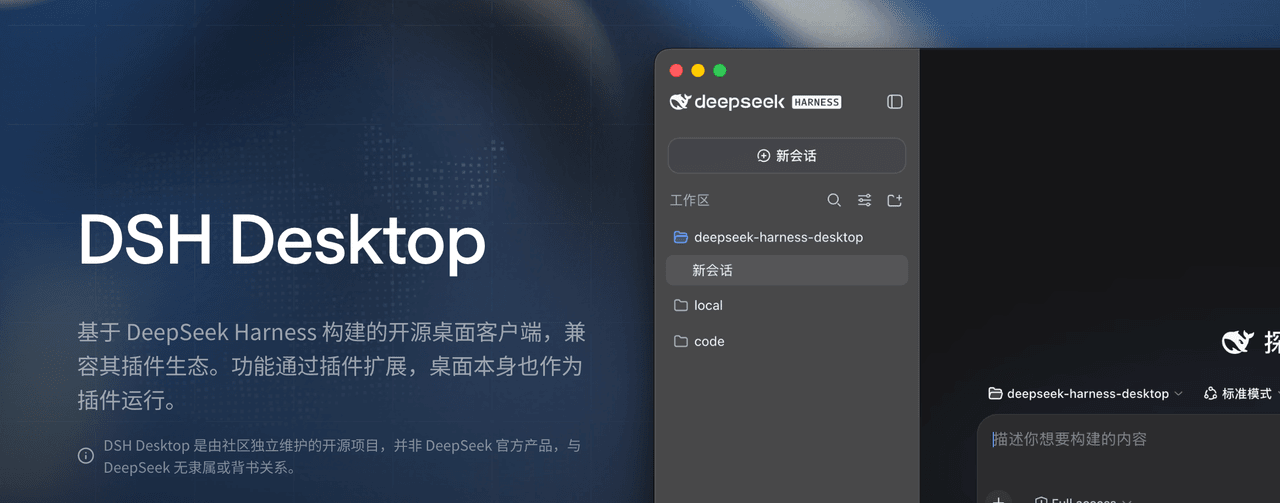 anywhere-labs/dsh-desktop
为 DeepSeek Harness (DSH) 插件生态打造的现代化桌面端解决方案。万物皆「插件」,桌面本身也是「插件」。
anywhere-labs/dsh-desktop
为 DeepSeek Harness (DSH) 插件生态打造的现代化桌面端解决方案。万物皆「插件」,桌面本身也是「插件」。
- Nagi-ovo/voyager Enhancement suite for Gemini, AI Studio, Claude & ChatGPT — plus a prompt manager for any web UI, DeepSeek Harness inclu…
-
 walkinglabs/learn-harness-engineering
Harness engineering beginner tutorial, from 0 to 1
walkinglabs/learn-harness-engineering
Harness engineering beginner tutorial, from 0 to 1
-
 awesome-dsh-plugin/awesome-dsh-plugin
A curated list of plugins for DeepSeek Harness (dsh) · DeepSeek Harness 插件精选列表
awesome-dsh-plugin/awesome-dsh-plugin
A curated list of plugins for DeepSeek Harness (dsh) · DeepSeek Harness 插件精选列表
-
 MemTensor/MemOS
Self-evolving memory OS for LLM & AI Agents: ultra-persistent memory, hybrid-retrieval, and cross-task skill reuse, with…
MemTensor/MemOS
Self-evolving memory OS for LLM & AI Agents: ultra-persistent memory, hybrid-retrieval, and cross-task skill reuse, with…
- yjh051108/dsh-routing-suite dsh-routing-suite — injector + router-standard kit: install the runtime injector first, then the task-aware reasoning-mo…