edusrez/dsh-tool-web-enhanced
DeepSeek Harness 的模块化搜索工具:将 SearXNG、RAG 及自定义模块附加到原生 web_search 中。
项目介绍Project Overview
这是 DSH 内置 web_search 工具的直接替代插件,保留原生搜索结果为首段,并可按模块追加 SearXNG、本地 Markdown RAG、Parallel 等独立结果段,支持 sources 选择与失败静默降级。需要在网页搜索中同时接入本地搜索引擎、知识库或自定义来源时使用。未配置模块时行为与原版一致;附加模块需自行准备服务、API 密钥或索引。
This plugin is a drop-in replacement for DSH's stock web_search tool. It keeps native search results as the first section and can add modular sections such as SearXNG, local Markdown RAG databases, and Parallel search. Use it when web search must combine built-in results with local engines, knowledge bases, or custom sources. Modules are optional and unavailable ones are omitted; external services, API keys, or RAG indexing must be configured separately.
请帮我了解并安装插件:【dsh-tool-web-enhanced】【https://github.com/edusrez/dsh-tool-web-enhanced】把上面这条消息直接发给当前会话里的 DSH,让它帮你了解并安装。安装命令不一定准确,发给 DSH 更稳。Send this message to DSH in your current session. CLI install commands may not be accurate across systems — DSH will figure it out for you.
或使用命令行安装(适合开发者)Or use CLI install (for developers)
命令行安装CLI Install
dsh plugin --profile web add github:edusrez/dsh-tool-web-enhanced把 edusrez/dsh-tool-web-enhanced 加入你的 DSH 配置(web profile)即可启用。
READMEREADME
dsh-tool-web-enhanced
English | 中文
A drop-in replacement for the stock web_search tool that is modular by sections: the native search results stay as the first section, and you attach additional search modules — each contributing its own section — such as a local SearXNG instance and RAG databases (local markdown sources). The native behaviour is unchanged; everything else is optional.





What it is
dsh-tool-web-enhanced is a drop-in replacement for DeepSeek Harness' stock web_search tool. When no modules are configured, web_search behaves exactly like stock: the native results are the only section. Turn on a module and it contributes its own section to the same search response:
- the native DeepSeek search results remain the first section, unchanged;
- you can attach additional search modules, each rendered as its own section — a local SearXNG instance, RAG databases (local markdown sources), and more;
- the extension point is a clean module interface (
SearchSection) plus a config surface (sections:), so adding a new section type is a small, documented, code-level step (fork or PR the repo).
Everything is optional: with no modules configured, web_search is exactly stock.
Features
- Modular per-section architecture — each search source is a
SearchSectionregistered undersections:. Native results stay first; every additional module renders as its own section. - Built-in modules — a SearXNG section (rendered as
SearXNG results), a RAG section over local markdown databases (oneRAG — <dbName>block per database), and a Parallel section (Parallel Web Systems Search API, rendered asParallel results). - Alternative
web_fetchprovider — an opt-inparallel-extractfetch provider (Parallel Web Systems Extract API) that returns a URL's full document as markdown. Registered intoctx.web; selected by the deployment profile'sfetchProvider: 'parallel-extract'. - Optional
topicandsourcesparameters —topicforwards a vertical hint to modules that support it;sourcespicks any combination of native / SearXNG / RAG / Parallel (native,searxng,rag,parallel, orall). - Silent degradation — a module that is absent, disabled, or unreachable is simply omitted, never an error; results degrade to the remaining sections.
- Self-contained drop-in — the bundle registers the enhanced tools and disables the stock
tool-webrow automatically on install.
Install
npm install dsh-tool-web-enhanced
This is a DSH bundle: package.json carries dsh.bundle.patch = ./cordis.patch.yml, which inserts the enhanced plugin row and disables the stock tool-web row in one install. Installing the package is the whole swap for CLI profiles — no manual profile edit required. For preset-realm web surfaces, the preset still disables its own tool-web row.
# cordis.patch.yml (bundled with this package)
- insert:
    - id: tool-web-enhanced
      name: dsh-tool-web-enhanced
      config:
        search: true
        fetch: true
        sections:
          searxng:
            enabled: true
            url: 'http://127.0.0.1:8080'
          parallel:
            enabled: true
            apiKeyEnv: PARALLEL_API_KEY
            apiKey: ''
          rag:
            enabled: true
            storePath: ''
            embeddings:
              provider: auto
              apiKeyEnv: EMBEDDING_API_KEY
              apiKey: ''
            databases: []
          # Parallel Extract fetch provider — OPT-IN (enabled: false by default).
          parallelExtract:
            enabled: false
            apiKeyEnv: PARALLEL_API_KEY
            apiKey: ''
            extractMode: full
            timeoutMs: 60000

- id: tool-web
  disabled: true
Installing self-disables the stock tool-web row, so this package is the entire web-search swap.
Configuration
The enhanced behaviour lives under one unified sections: container. Keys are neutral parameter names. Stock search / fetch keys keep their existing names and defaults.
| Key | Type | Default | Description |
|---|---|---|---|
search |
boolean | true |
Register web_search. |
fetch |
boolean | true |
Register web_fetch (unchanged). |
sections.searxng.enabled |
boolean | true |
Enable the SearXNG section. |
sections.searxng.url |
string | http://127.0.0.1:8080 |
Base URL of the local SearXNG JSON API. |
sections.parallel.enabled |
boolean | true |
Enable the Parallel (Parallel Web Systems Search API) section. |
sections.parallel.apiKeyEnv |
string | PARALLEL_API_KEY |
Env var holding the Parallel API key. |
sections.parallel.apiKey |
string | '' |
Literal Parallel API key (wins over apiKeyEnv). |
sections.parallel.mode |
string | fast |
Parallel search mode: turbo / fast / basic / advanced. |
sections.parallel.maxResults |
number | 10 |
Max results returned by the section (≤10, no pagination). |
sections.rag.enabled |
boolean | true |
Enable the RAG section + rag_index tool. |
sections.rag.storePath |
string | '' (auto) |
Search-index store path; empty → a default under the data home. |
sections.rag.embeddings.provider |
string | auto |
Embedding selection: auto / local / remote. auto → remote when a key is set, else local. |
sections.rag.embeddings.apiKeyEnv |
string | EMBEDDING_API_KEY |
Env var holding the remote provider's key. |
sections.rag.embeddings.apiKey |
string | '' |
Literal remote provider key (wins over apiKeyEnv). |
sections.rag.embeddings.model |
string | (a multilingual embedding model) |
Remote embedding model. |
sections.rag.embeddings.baseURL |
string | (your embeddings endpoint) |
Remote embeddings API base URL (embeddings-API-compatible). |
sections.rag.embeddings.localModel |
string | (a small local embedding model) |
Local embedding model (downloaded on first use). |
sections.rag.databases[].name |
string | — | Database (section) name. |
sections.rag.databases[].path |
string | — | Directory of markdown files to index. |
sections.rag.databases[].topK |
number | 5 |
Results returned per database. |
parallelExtract.enabled |
boolean | false |
Register the Parallel Extract fetch provider (ctx.web). OPT-IN. |
parallelExtract.apiKeyEnv |
string | PARALLEL_API_KEY |
Env var holding the Parallel API key (same key as sections.parallel). |
parallelExtract.apiKey |
string | '' |
Literal Parallel API key (wins over apiKeyEnv). |
parallelExtract.extractMode |
string | full |
full → the complete markdown document; snippets → excerpts only. |
parallelExtract.timeoutMs |
number | 60000 |
Per-call timeout (ms); the Extract API is slow (1–20s). |
The stock search / fetch keys are kept unchanged for drop-in compatibility.
Usage
web_search accepts the stock query plus two optional parameters:
| Param | Required | Description |
|---|---|---|
query |
yes | The search query. |
topic |
no | Vertical hint, forwarded to sections that support it (e.g. SearXNG categories): general, news, science, it, files, social media, images, videos, map, music. |
sources |
no | Comma-separated tokens — native plus each enabled section id. Default all. Examples: native,searxng, searxng,rag, or searxng,parallel. |
The output shape carries the native results plus a sections array — one entry per module that returned results:
{
  "content": "...",                 // optional native answer
  "sources": [ { "url": "...", "title": "...", "snippet": "..." } ],  // native
  "truncated": false,
  "sections": [
    {
      "name": "SearXNG results",
      "sources": [ { "url": "...", "title": "...", "snippet": "...", "score": 0.9 } ]
    },
    {
      "name": "RAG — my-docs",
      "sources": [ { "url": "...", "title": "...", "path": "...", "score": 0.72 } ]
    },
    {
      "name": "Parallel results",
      "sources": [ { "url": "...", "title": "...", "snippet": "..." } ]
    }
  ]
}
Connecting SearXNG
The SearXNG section is optional, and the plugin only talks to a SearXNG instance over its local JSON API (format=json). Point sections.searxng.url at the base URL of any instance that exposes JSON output:
GET {sections.searxng.url}/search?q=<query>&format=json[&categories=<topic>]
The simplest way to stand one up is a Docker Compose service exposing the JSON API on a local port. Having no running instance is fine: the SearXNG section is silently omitted when it is disabled, unreachable, or empty.
Guarantee: when a module is absent, disabled, or unreachable,
web_searchnever errors — the section is simply omitted and results degrade to whatever remains (down to native-only, exactly stock).
Parallel section
The Parallel section queries the Parallel Web Systems Search API (a declarative-semantic web search built for AI agents) and renders the sources as a Parallel results block under the native results. It calls POST https://api.parallel.ai/v1/search with an x-api-key header (not a bearer token) and a body of { objective, search_queries, mode }:
POST {https://api.parallel.ai/v1/search}
Headers: x-api-key: <key>
Body: { "objective": "<query>", "search_queries": ["<query>"], "mode": "fast" }
The section needs a key to do anything — set sections.parallel.apiKeyEnv to an env var (default PARALLEL_API_KEY) or sections.parallel.apiKey to a literal key. With no resolvable key the section is silently inert (returns undefined and never calls the API). It is thus entirely opt-in: shipping the default config enables it, but nothing is fetched or sent until a key is present in the environment. The key is never committed to any repo file.
By default it requests the fast (mode: fast) tier and caps results at sections.parallel.maxResults (default 10, the API's per-call maximum — the API has no pagination). Failures (network, timeout, non-2xx, malformed response) degrade silently to undefined, exactly like the SearXNG section.
Parallel Extract fetch provider
The web_fetch tool retrieves a URL through a provider selected by the web seam's fetchProvider config (default: the stock HTTP provider). This package registers an opt-in alternative: parallel-extract, backed by the Parallel Web Systems Extract API. It calls POST https://api.parallel.ai/v1/extract with an x-api-key header and a body of { urls: [<url>], advanced_settings: { full_content: <bool> } }, and maps the returned document to the fetch result's markdown text body.
POST https://api.parallel.ai/v1/extract
Headers: x-api-key: <key>, Content-Type: application/json
Body: { "urls": ["<url>"], "advanced_settings": { "full_content": true } }
It is fully opt-in and inert by default: parallelExtract.enabled defaults to false, so the provider is never registered and the stock web_fetch is never displaced. To use it:
- Enable the provider:
parallelExtract.enabled: true(withapiKeyEnvdefaulting toPARALLEL_API_KEY, or a literalapiKey). - Pin the web seam to it in the deployment profile (this package does not, and must not, set the seam config):
fetchProvider: 'parallel-extract'(or$DSH_WEB_FETCH_PROVIDER=parallel-extract).
Without a resolvable key the provider reports itself unavailable (its available() is false) and a direct call fails cleanly with a structured WebError. Failures (non-2xx, malformed response, no result / errors[], timeout) also surface as clean WebErrors following the other fetch providers' contract — never a misleading result.
parallelExtract.extractMode controls what comes back:
full(default): requestsadvanced_settings.full_content = trueand returns the complete markdown document (results[].full_content), falling back to the joined excerpts when the API returnsnull.snippets: leavesfull_contentoff and returns the joinedresults[].excerpts— cheaper and faster if you only need fragments.
The API accepts up to 20 URLs per request and charges $1 per 1000 URLs; the provider sends one URL per web_fetch call, enforcing the per-request cap in buildParallelExtractBody.
RAG section
The RAG module indexes local markdown databases into an on-machine store and, on every search, retrieves the most similar chunks per database — one RAG — <dbName> section per configured database.
The embedding step is used in two places: to index each chunk, and to embed the query on every search. With the local path (no key configured) indexing and query data stay on the machine; a remote provider is used only if you configure one — nothing is sent unless a provider is configured.
When RAG is enabled with at least one database, a rag_index tool is registered. It rebuilds the local RAG index for all configured databases and returns the number of chunks indexed per database. The index is also built automatically (async, non-blocking) on startup.
Adding your own section
The whole point of this package is that web_search is modular by sections. To add a new search source you write a small, self-contained module — no changes to the core tool:
- Define a
SearchSection— give it anid(used as asourcestoken), anenabledflag, and arun(query, ctx)method that returns the section's result blocks (SectionBlock[]). - Add its config slice under
sections:incordis.patch.yml— any parameters the module needs. - Wire it into
buildSections— register the new module alongside the built-in ones so it is instantiated when enabled.
That's it — roughly fifteen lines. The module contract lives in src/modules.ts (the SearchSection interface and buildSections composition point). Because modules are an isolated list, the package is fork/PR-friendly: a new section type is a small, documented, code-level addition that composes with the native-first output shape and the sources selection.
Output shape
See Usage above: web_search returns the canonical stock fields (content, sources for native, truncated) plus a sections[] array — one entry per module that returned results, each with a name and its own sources[]. A module with no results is omitted entirely.
Development
npm run build— compilessrc/tolib/withtsc(NodeNext).node --test— runs the unit tests intest/against the builtlib/.Smoke-test in a DSH profile — install the local checkout into an isolated development profile, then inspect the composed configuration:
dsh plugin --profile dev add /path/to/dsh-tool-web-enhanced
dsh --profile dev --dump-config
The dumped tree must show the
tool-web-enhancedrow plus the disabledtool-webrow. Exerciseweb_searchend-to-end in that profile afterward.
License
MIT
相关推荐Related
-
 nexu-io/open-design
🎨 Best DeepSeek Harness Design Plugin. The open-source Claude Design alternative. 🖥️ Local-first desktop app. 🖼️ Your…
nexu-io/open-design
🎨 Best DeepSeek Harness Design Plugin. The open-source Claude Design alternative. 🖥️ Local-first desktop app. 🖼️ Your…
-
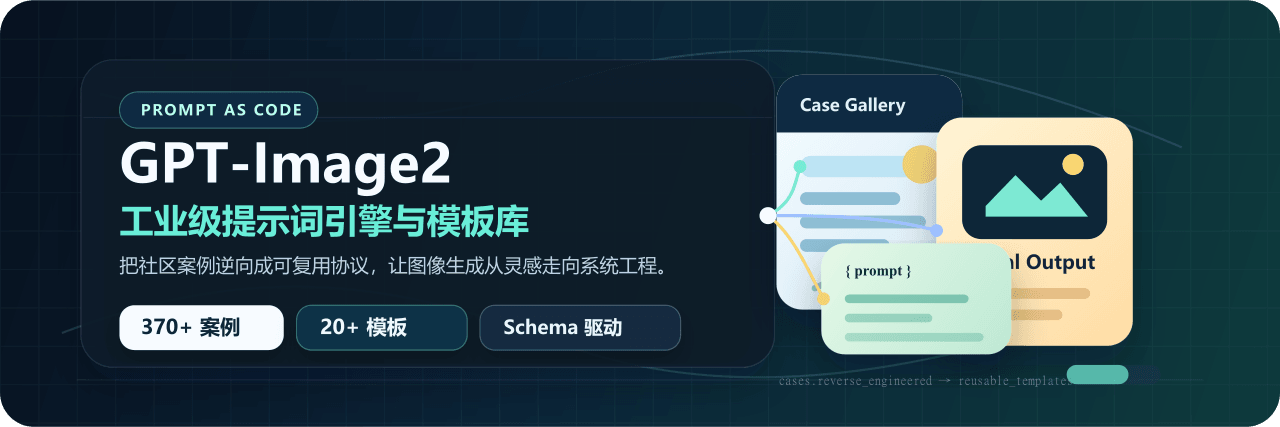 freestylefly/awesome-gpt-image-2
Prompt as Code | GPT-Image2 工业级提示词引擎与模板库,530+ 个案例逆向工程,20+ 套工业级模板,并提炼出Skills,持续更新中
freestylefly/awesome-gpt-image-2
Prompt as Code | GPT-Image2 工业级提示词引擎与模板库,530+ 个案例逆向工程,20+ 套工业级模板,并提炼出Skills,持续更新中
-
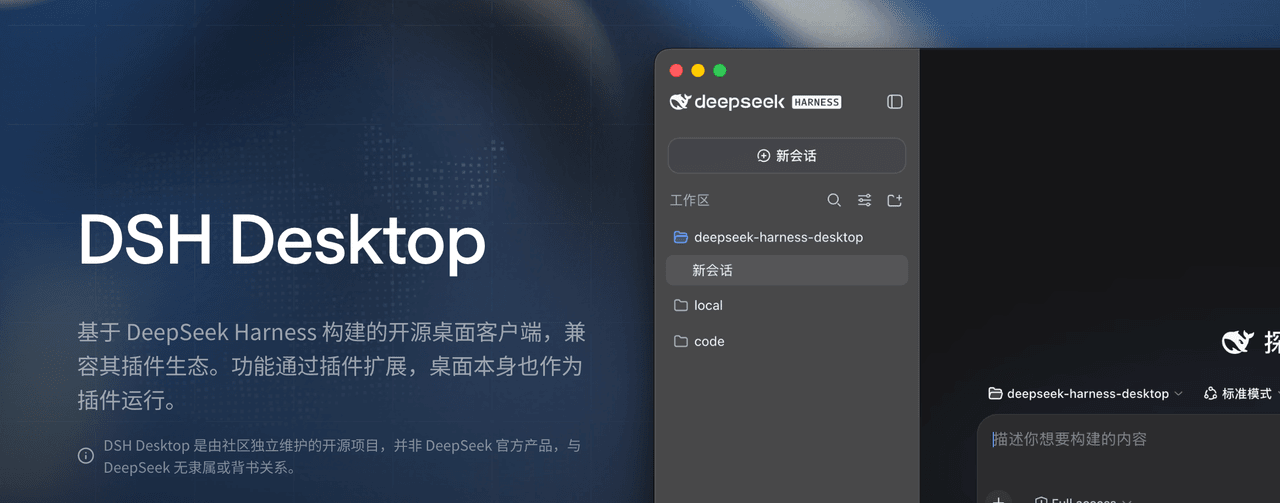 anywhere-labs/dsh-desktop
为 DeepSeek Harness (DSH) 插件生态打造的现代化桌面端解决方案。万物皆「插件」,桌面本身也是「插件」。
anywhere-labs/dsh-desktop
为 DeepSeek Harness (DSH) 插件生态打造的现代化桌面端解决方案。万物皆「插件」,桌面本身也是「插件」。
- Nagi-ovo/voyager Enhancement suite for Gemini, AI Studio, Claude & ChatGPT — plus a prompt manager for any web UI, DeepSeek Harness inclu…
-
 walkinglabs/learn-harness-engineering
Harness engineering beginner tutorial, from 0 to 1
walkinglabs/learn-harness-engineering
Harness engineering beginner tutorial, from 0 to 1
-
 awesome-dsh-plugin/awesome-dsh-plugin
A curated list of plugins for DeepSeek Harness (dsh) · DeepSeek Harness 插件精选列表
awesome-dsh-plugin/awesome-dsh-plugin
A curated list of plugins for DeepSeek Harness (dsh) · DeepSeek Harness 插件精选列表
-
 MemTensor/MemOS
Self-evolving memory OS for LLM & AI Agents: ultra-persistent memory, hybrid-retrieval, and cross-task skill reuse, with…
MemTensor/MemOS
Self-evolving memory OS for LLM & AI Agents: ultra-persistent memory, hybrid-retrieval, and cross-task skill reuse, with…
- yjh051108/dsh-routing-suite dsh-routing-suite — injector + router-standard kit: install the runtime injector first, then the task-aware reasoning-mo…