falling-ts/dsh-force-compact
Aggressive context compaction for local-first agents. Runs Qwen3.8‑27B on self‑hosted llama.cpp at low context, shrinking history so the live prompt stays small, fast, and private—delivering a big‑window experience without API cost or data egress. 面向本地的激进上下文压缩插件。自托管 llama.cpp 低上下文运行 Qwen3.8‑27B,不断收缩历史、保持常驻 prompt 小而快,兼顾隐私与大窗口体验,零 API 成本、数据不出本机。
Project Overview项目介绍
A DSH Cordis plugin that aggressively compacts an agent's working context for local llama.cpp inference. It gates each request by projected tokens (the same figure shown in the UI corner) and shrinks the conversation instead of enlarging the window, keeping the live prompt small while deep memory lives in the compressed head. A builtin engine transparently takes over when the official compaction service is unreachable. Use it on low-context local models; caveat: keep autoThresholdTokens and retainLatestTokens comfortably below the served context to avoid stalls.
DSH Cordis 插件,专注本地优先的上下文压缩。在 llama.cpp 自托管场景下,替代“撑大窗口”,主动收缩会话,保留最新片段、深记忆藏于压缩头。通过 projectedTokens(UI 角标同源)做阈值门控,避免低阈值死循环;内置与官方两套压缩引擎自动切换。提供 /force-compact 手动命令、idle 触发与每请求拦截三种入口。需注意:阈值与 retainLatestTokens 应低于服务端上下文,参数改动下次请求即生效。
请帮我了解并安装插件:【dsh-force-compact】【https://github.com/falling-ts/dsh-force-compact】Send this message to DSH in your current session. CLI install commands may not be accurate across systems — DSH will figure it out for you.把上面这条消息直接发给当前会话里的 DSH,让它帮你了解并安装。安装命令不一定准确,发给 DSH 更稳。
Or use CLI install (for developers)或使用命令行安装(适合开发者)
CLI Install命令行安装
dsh plugin --profile web add github:falling-ts/dsh-force-compact把 falling-ts/dsh-force-compact 加入你的 DSH 配置(web profile)即可启用。
READMEREADME
dsh-force-compact
Aggressive, local-first context compaction for DeepSeek Harness agents.
A DSH Cordis function plugin that keeps the agent's working context lean by design: serve
Qwen3.8‑27B on a self-hosted llama.cpp with a modest context, and the plugin shrinks the
conversation itself — a large-window feel with no API cost and no data egress.
Why
- Self-hosted inference — the agent talks to a local OpenAI-compatible llama.cpp server through the standard DeepSeek adapter; no separate adapter needed.
- Low context, high signal — instead of fighting a small cap, the plugin shrinks the conversation, so the agent reasons over a tight prompt while keeping deep memory in the compressed head.
- Think off for compactions, passthrough everywhere else —
disableThinking: true(default) turns thinking off on this plugin's own compaction summarization call only; every other model request rides the machine's configuration unchanged. - Private & free — no per-token billing, no egress.
What it does
Two compaction engines coexist behind one facade (resolveCompaction), transparent to callers:
| Engine | Used when | Notes |
|---|---|---|
| Official | the compaction service resolves in the agent realm |
Preferred; delegates to compaction/basic. |
| Builtin | automatic fallback (typical standard preset isolates the service) | Self-contained persistent transaction on ctx.sessions / ctx.llm.stream / ctx.tokenMeter; reuses the official compaction/* event vocabulary, so it replays safely across builds. |
No toggling — official wins when reachable, builtin takes over otherwise.
Trigger points
- Per-request guard (
agent/pre-step) — reads the session's projected context tokens (the exact number the harness renders bottom-right). AtautoThresholdTokensit rejects the outgoing request and compacts the head instead, retaining the latestretainLatestTokensverbatim. Below the threshold the request proceeds. - Turn end / idle (
agent/status→idle) — when the agent quiesces, optionally compacts viacompactNow(gate:turnEndForceCompactionEnabled). - Manual
/force-compact— immediatecompactNowwhen idle; when busy it queues a process-local flag consumed at the next model step. Loaded lazily — see "Command availability" under Install. session/flush— the awaited durability checkpoint.
Every path funnels into the single "compaction result landed in the session" boundary — the same point where the LiveUI signal fires.
Decision key is projectedTokens (provider-anchored, same figure as the UI corner), so the
plugin never drifts from what you see; the threshold-aware shrink gate skips summarizer calls
that provably cannot pull the session below the threshold (kills the low-threshold dead loop).
The builtin transaction bills shadowedTokenCount from the same tokenMeter.measure
per-node prices the official engine uses, so the meter's collapse protocol settles the drop
correctly — the bottom-right counter goes down after compaction.
Thinking control: scoped to compactions
Since the 2026-08 semantics revision, disableThinking controls one thing: whether this
plugin's own summarization call (engine/builtin.js → engine/summarizer.js →
ctx.llm.stream) carries reasoningEffort:'off'. Everything else is untouched:
| Call site | With disableThinking: true |
|---|---|
| Builtin-engine summarization call | Carries reasoningEffort:'off' |
| Every other model request (business, sub-agents, tools, other plugins) | Machine's LlmCallConfig unchanged |
Official compaction service calls |
Not routed through any plugin seam — unaffected |
When the target is a llama.cpp / OpenAI-compatible endpoint, the
thinking: { type: 'disabled' } field the adapter emits is silently ignored there — so the
summarizer ALSO stamps the llama.cpp-native top-level reasoning_effort: "none", gated on
the exact same condition. One options object carries BOTH fields:
| Endpoint family | Reads | Result |
|---|---|---|
| Real DeepSeek API | reasoningEffort:'off' → thinking:{type:'disabled'} |
Thinking off ✅ |
| llama.cpp / OAI-compatible | reasoning_effort:"none" (top-level) |
enable_thinking=false ✅ |
Each family tolerates-and-ignores the foreign key, so emitting both is harmless. The field is
stamped in src/engine/summarizer.js (immediately before llm.stream(options)), NOT in the
llm/stream waterfall — a prior draft injected there but proved ineffective structurally
(middle-layer returns are discarded; in-place seed mutation crashes the host); see the
src/hooks/wire-rewrite.js module header for the write-up. That hook now serves only the
LiveUI watermark role.
Need thinking off on business calls too? Set your provider's reasoningEffort at the
request-header level — the plugin deliberately stays out of that decision.
Observability: per-attempt audit lines
Every summarization attempt logs two lines (visible at the default debug: true) — the
durable proof of the scoping decision and its wire fields, without capturing traffic:
[force-compact] <sessionId>: compaction thinking-policy — settings.disableThinking=true → extra.reasoningEffort='off' (this summarization call carries thinking-OFF)
[force-compact] <sessionId>: summarization wire-fields → <provider>/<model>: reasoningEffort='off' + reasoning_effort="none" (llama.cpp-native wire field)
- Line 1 (
engine/builtin.js) records wheredisableThinkingis read and routed into the call options; with the setting off it records machine default. - Line 2 (
engine/summarizer.js) records both wire fields exactly as they leave the options object, plus resolved provider/model; unstamped fields are labeled(absent…).
Empirically grounded: probed against a local llama.cpp endpoint, a baseline request returned
populated reasoning_content (the model thinks by default), while the same request with
top-level reasoning_effort:"none" returned none at all — the field genuinely disables
thinking there, and business calls (which omit it) keep thinking.
LiveUI status
A tiny host→client messenger (the liveUi settings field mirrored live to the browser) pins a
badge beside the turn:
- Red "compressing" — just before a compaction commits (screen text is Chinese);
- Green "done" — the instant a compaction lands; 3 s later a fresh random working line takes over;
- Blue "working" — otherwise a rotating playful one-liner;
- Cleared at conversation end — when the agent goes
idle(the turn is fully done), an empty text (isImportant) is pushed: the badge text is wiped and the phase color removed, restoring the official look. Replaces the former conversation-START forced working-pair override (removed 2026-09).
Publishers are fail-safe: a messenger glitch can never disturb the actual compaction.
How it works
agent/request(payload, next)              # every model request
    return await next()                  # pure pass-through (thinking-off scopes
                                          # ONLY to the plugin's own summarizer)

agent/pre-step(payload, next)             # before each model step
    projectedTokens >= autoThresholdTokens?
        no  -> next()                     # let the request proceed
        yes -> compactRegion(head-before-retainLatestTokens, signal)
               return { kind: "reject" }  # no model request this step

agent/status({ agent, status })          # lifecycle transition
    status === "idle" && turnEndForceCompactionEnabled?
        -> compactNow(agent, freshSignal) # turn-end compaction

session/flush(session)                   # durability checkpoint
    select region -> project messages -> preview + shrink gate
    -> compaction.compactRegion(start, end, agent, signal)
Supporting modules:
src/hooks/guard.js—agent/requestpure pass-through +pre-stepthreshold gate + process-local force flag (thinkingDisabledsurvives only as a legacy predicate).src/hooks/command.js— the/force-compactcommand (lazily registered).src/hooks/idle.js— turn-end forced compaction.src/hooks/wire-rewrite.js— thellm/streamLiveUI watermark hook (no wire manipulation; historical note in the module header).src/engine/region.js— head/tail-anchored region selection (with the official pairing ledger).src/engine/summarizer.js— the one-shot LLM summarizer, fully aligned with officialcompaction-basic(target resolution, prefix-cache alignment,purpose:'compaction'tag, fail-closed finish classification, usage capture).src/engine/builtin.js— the builtin persistent transaction (officialcompaction/*vocab).src/engine/checkpoint.js— preview + shrink gate + delegation to the compaction service.src/core/projected.js— provider-anchoredprojectedTokens.src/core/ui-signal.js— the LiveUI messenger.
Install
As an installable package (recommended):
# from npm (published):
npm install @falling-ts/dsh-force-compact
# from git:
dsh plugin --profile web add github:falling-ts/dsh-force-compact
# from a local checkout:
dsh plugin --profile web add ./dsh-force-compact
Or, from a local checkout, as a --patch overlay without installing:
dsh web --patch dsh-force-compact/cordis.patch.yml
The plugin is loaded iff ~/.dsh/logs/dsh-force-compact.log gains:
[force-compact] debug logging enabled — writing [force-compact] lines to <absolute path>
Command availability — /force-compact loads lazily
The commands service arrives with the agent-presets plane, after the plugin's boot-time
apply, so registration happens at the first guarded-listener activation
(agent/request / agent/pre-step / agent/status / session/flush), settling
permanently on the first success. Practical effect: after (re)starting the instance, a
fresh session's / picker does NOT show /force-compact until that session makes its first
model request — send any one message, then the command is registered process-wide.
- Success:
[force-compact] /force-compact command registered (deferred) commandspermanently absent: one… still UNREGISTERED 10 min …warn explains the empty picker. Until registered, the rest of the plugin works — degradation, not an install failure.
Verify a compaction happened:
idle compaction (builtin) shadowed N nodes (~M tokens)
builtin compaction OK — replaced span seq[A..B] (N nodes, ~K tokens) with a P-char checkpoint
compaction thinking-policy — settings.disableThinking=true → extra.reasoningEffort='off' (…)
summarization wire-fields → <provider>/<model>: reasoningEffort='off' + reasoning_effort="none" (…)
(The last two lines are the per-attempt audit pair described under "Observability".)
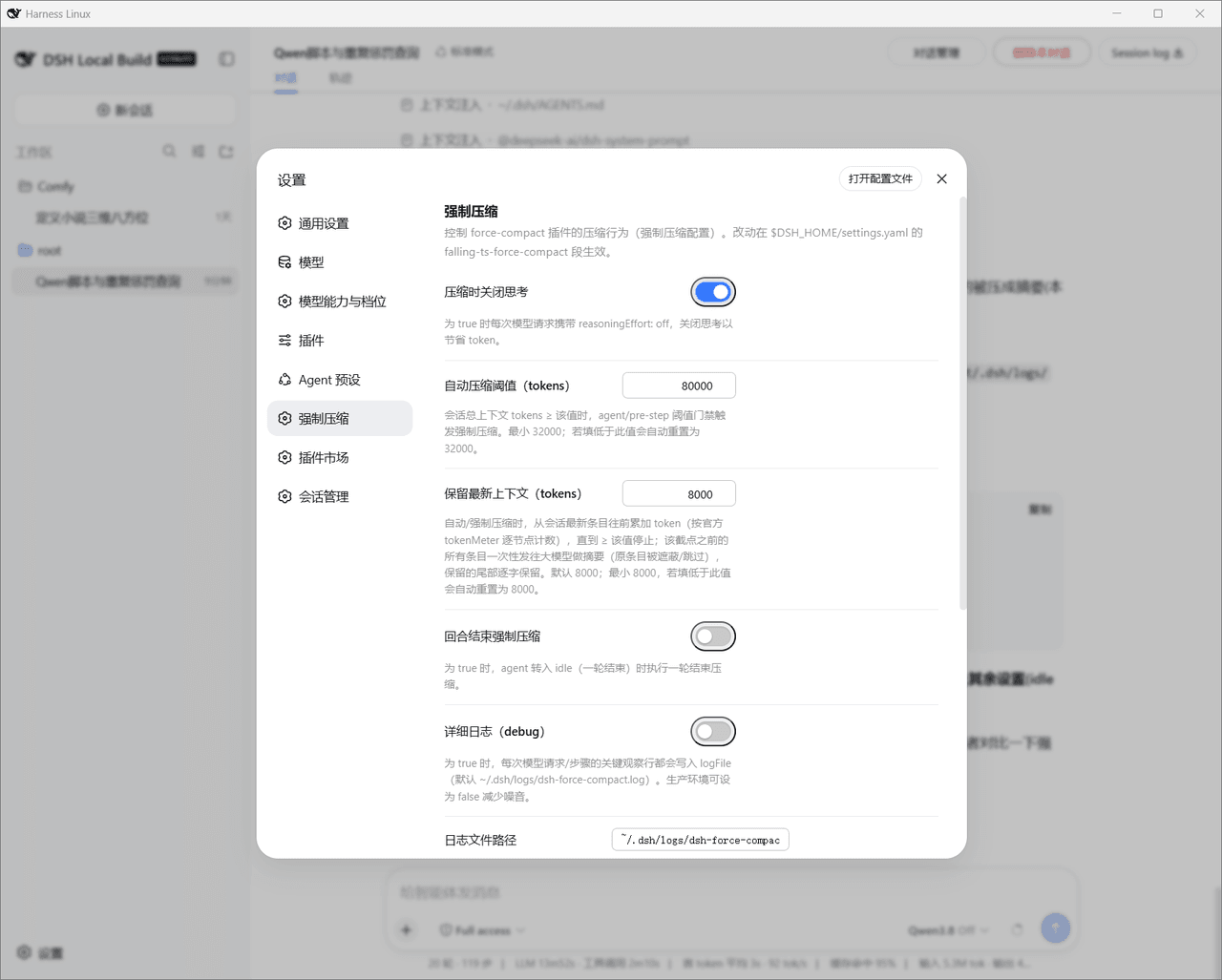
Settings
$DSH_HOME/settings.yaml, namespace falling-ts-force-compact:
| key | type | default | meaning |
|---|---|---|---|
disableThinking |
boolean | true |
Only the plugin's own summarization call carries reasoningEffort:'off'; everything else unchanged. |
autoThresholdTokens |
number ≥ 32000 | 32000 |
Projected-token trigger for the gate. Floor 32000 (clamps back up at read time). |
retainLatestTokens |
positive int ≥ 8000 | 8000 |
Retain the latest N tokens verbatim; older history is summarized in one batch. Floor 8000. Drives both the auto gate and /force-compact. |
turnEndForceCompactionEnabled |
boolean | true |
Compact on the agent's idle transition. |
debug |
boolean | true |
Emit [force-compact] diagnostics to the plugin log. |
logFile |
string | ~/.dsh/logs/dsh-force-compact.log |
Diagnostics destination (~ expands to home dir). |
compactionMode |
'realm' | 'global' |
'realm' |
Official-service resolution strategy (priority-1 path). |
builtinEnabled |
boolean | true |
Gate for the builtin engine fallback. |
maxSummaryTokens |
integer (1024–200000) | 1024 |
Cap on the summarizer LLM maxTokens. |
Example — an aggressive local profile:
falling-ts-force-compact:
  disableThinking: true
  autoThresholdTokens: 40000   # compact sooner ⇒ keep the live prompt small
  retainLatestTokens: 8000
  turnEndForceCompactionEnabled: true
Without the settings service the plugin falls back to the same defaults and still compacts —
the namespace is optional, never a hard dependency.
Tuning for low-context llama.cpp
Keep autoThresholdTokens comfortably below the served context: the live prompt stays
small and latency flat, while the agent keeps deep memory through the compressed head.
Pressure is measured in projected tokens (provider-anchored), so the threshold maps
predictably onto the UI figure.
Behavior notes
- Runtime dependency: the
compactionservice (preset planeagent-presets:compaction-basic), read live viactx.get('compaction'); unreachable → the builtin engine takes over (or the request proceeds). - Optional dependencies:
settings/tokenMeter/commands/llm/agentsare read viactx.get(...)with guards — a missing one degrades gracefully. - Per-request settings read: parameters are read every model request, so edits take effect on the next request without a restart.
- Signals:
agent/*Waterfalls forward the current turn's signal; thesession/flushcheckpoint and theagent/statusidle listener each mint a freshAbortController. - Persistence: durable output is the
compaction/*bracket events + asurfaceOp:replaceuser/messagecheckpoint, replay-safe across builds. - Client half:
web/client.jsadds the settings section "Force Compact" (localized labels), live-editable without restart (uSES-safe mirror). - One intentional timer: the 3 s
publishDonefallback (presentation-only, documented deviation). Otherwise the plugin is pure listeners + a process-localMapforce flag.
Screenshots
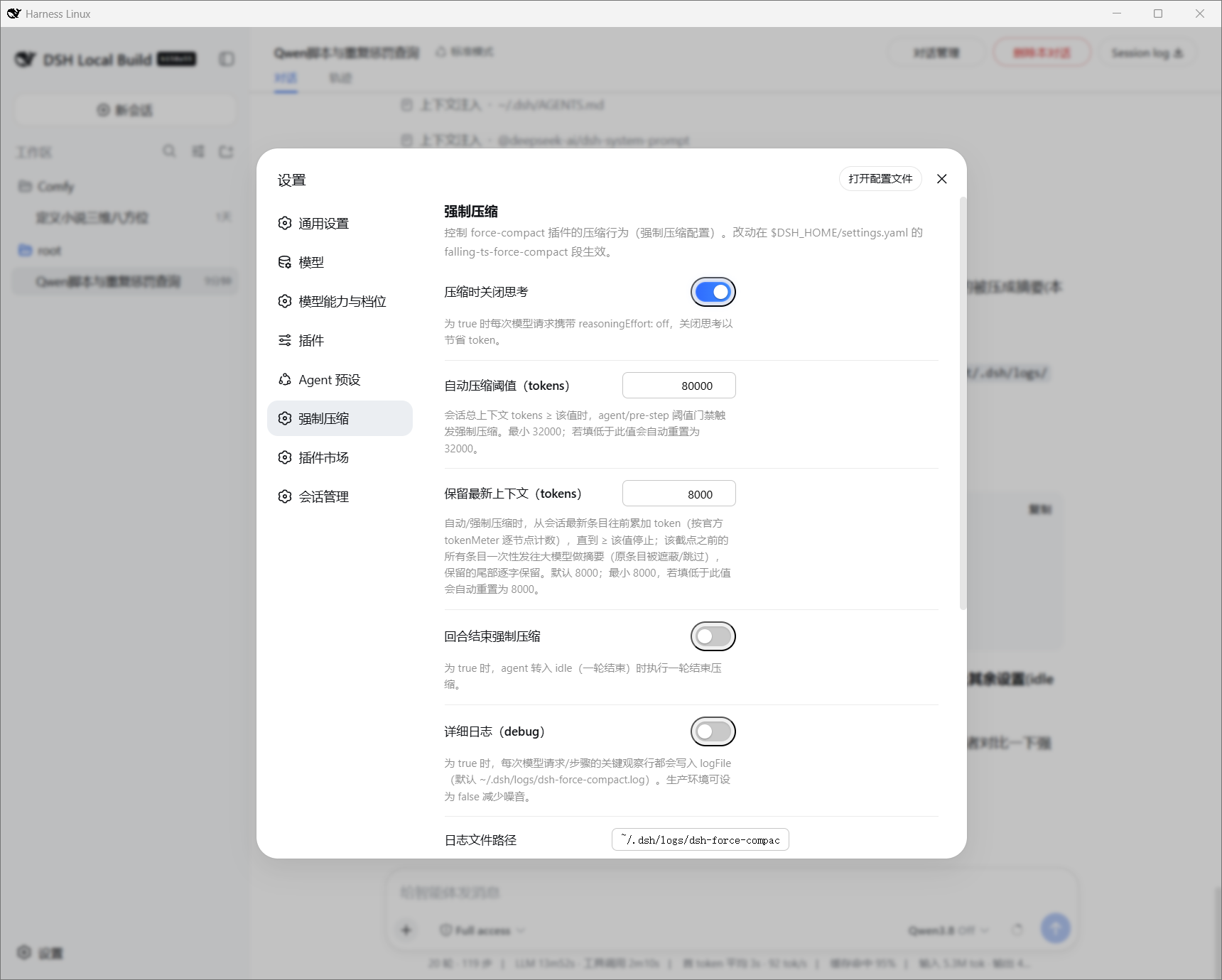
Settings page — the Force Compact section; all nine fields above are editable live without a restart.

Conversation page — the LiveUI signal paints three states (red: compressing / green: done / blue: working); the green banner fades after about 3 s back to a random working line; at conversation end the badge is cleared (empty text) back to the official look.
License
MIT (see LICENSE).
Related相关推荐
-
 wssfk12138/dsh-damage-pulse
DeepSeek Harness Token 余额监控插件:鲸鱼娘待机/扣费/复苏动画、峰谷计费、连续扣费飘字与会话费用统计。
wssfk12138/dsh-damage-pulse
DeepSeek Harness Token 余额监控插件:鲸鱼娘待机/扣费/复苏动画、峰谷计费、连续扣费飘字与会话费用统计。
-
 OK-wx/dsh-ocgo-lite
OpenCode Go 用量常驻条:套餐余量圆环 + token/花费实时统计(本次会话/全部范围 + 按模型联动,官方实时定价),一键复制 API Key。OpenCode Go usage bar for DeepSeek Harnes…
OK-wx/dsh-ocgo-lite
OpenCode Go 用量常驻条:套餐余量圆环 + token/花费实时统计(本次会话/全部范围 + 按模型联动,官方实时定价),一键复制 API Key。OpenCode Go usage bar for DeepSeek Harnes…
-
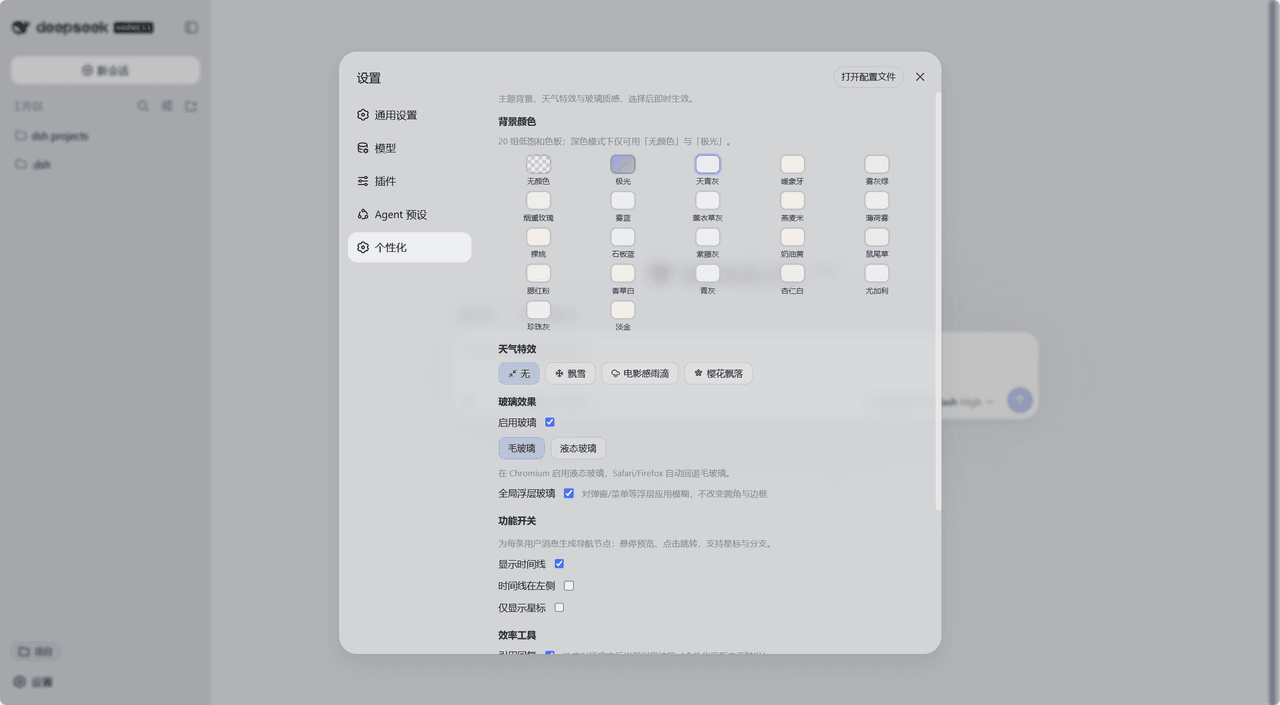 AlexPeng07/dsh-custom-plugin
dsh-custom-plugin是一个为 DeepSeek Harness (DSH) Web GUI 打造的增强插件。提供:背景天气特效/玻璃拟态、时间线轨道、项目文件夹、提示词库、对话导出、Mermaid 图表渲染、引用回复、余额查询…
AlexPeng07/dsh-custom-plugin
dsh-custom-plugin是一个为 DeepSeek Harness (DSH) Web GUI 打造的增强插件。提供:背景天气特效/玻璃拟态、时间线轨道、项目文件夹、提示词库、对话导出、Mermaid 图表渲染、引用回复、余额查询…
-
 Andrew111888/dsh-plugin-balance
DSH 插件:DeepSeek / OpenCode Go 额度悬浮窗 + DSH 会话 token 用量统计与官方峰谷价费用估算
Andrew111888/dsh-plugin-balance
DSH 插件:DeepSeek / OpenCode Go 额度悬浮窗 + DSH 会话 token 用量统计与官方峰谷价费用估算
- Guyao146/dsh-activity-tracker DSH 活动统计:彩色时间线看什么时候在干活/改代码,每日 token 消耗按项目/日期/小时查看。
- Way2LOose4/dsh-agent-pricing Real-time session cost preview for DeepSeek Harness: live cost readout, today usage chart, price_estimate/session_cost t…
-
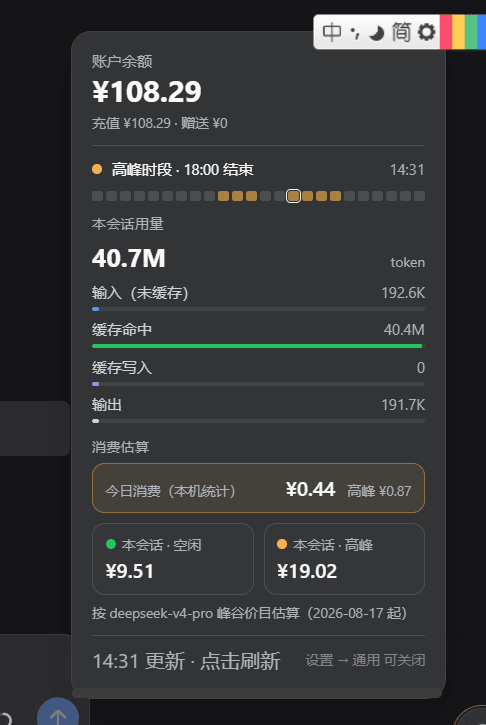 1514100951/dsh-usage-footer
DSH web 用量/费用悬浮按钮插件:账户余额、峰谷时段、今日/本会话消费估算与 token 统计(含设置开关)
1514100951/dsh-usage-footer
DSH web 用量/费用悬浮按钮插件:账户余额、峰谷时段、今日/本会话消费估算与 token 统计(含设置开关)
-
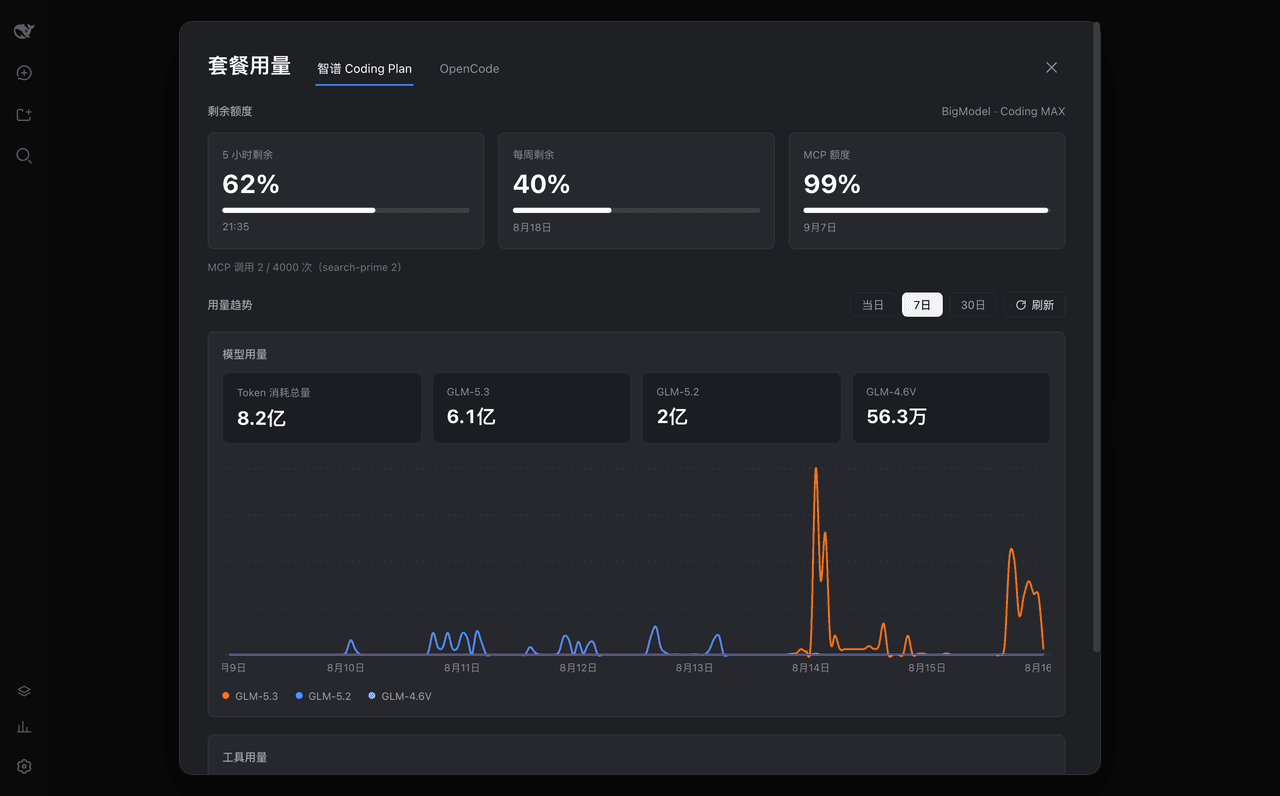 AnnanRen/dsh-usage-suite
DeepSeek Harness 用量可视化套件:ZCode 风格用量统计与套餐用量弹窗 + 会话状态栏(智谱 Coding Plan / OpenCode GO 实时额度)
AnnanRen/dsh-usage-suite
DeepSeek Harness 用量可视化套件:ZCode 风格用量统计与套餐用量弹窗 + 会话状态栏(智谱 Coding Plan / OpenCode GO 实时额度)