kaixinbaba/dsh-vision-recognizer
DeepSeek Harness 识图插件:保持 DeepSeek 对话,15+ 供应商视觉模型把图片转译为文字,可在 设置→插件 配置
项目介绍Project Overview
DSH 视觉识别插件:保留 DeepSeek 作为对话主模型,在模型选择器中以 DeepSeek + 智能识图 路由接入图片。自适应识别所选模型是否原生支持图像:是则直接透传;否则调用在 设置 → 插件 → 视觉 中配置的转译服务转为文本。支持 15+ 国内外厂商,OpenAI 兼容与 Anthropic 双协议,含本地 Ollama、失败冷却、链式回退与内容哈希缓存。注意:仅在该路由被选中时生效;rc8 公共装饰器尚不能为其他现有路由统一挂载回退。
A DSH vision plugin that wraps the DeepSeek conversation provider behind a vision-recognizer route (DeepSeek + 智能识图). It inspects the selected model: native multimodal models receive image blocks directly, while text-only or unknown-capability models get text transcribed by a vision provider configured in Settings → Plugins → Vision. It supports 15+ domestic and international providers over OpenAI-compatible and Anthropic protocols, with Ollama auto-detection, a fallback chain, content-hash caching, 20s hard timeout, and 60s cooldown on failure. Caveat: adaptive fallback only activates while the wrapper route is selected; rc8 exposes no public decorator hook to attach it to other existing routes.
请帮我了解并安装插件:【dsh-vision-recognizer】【https://github.com/kaixinbaba/dsh-vision-recognizer】把上面这条消息直接发给当前会话里的 DSH,让它帮你了解并安装。安装命令不一定准确,发给 DSH 更稳。Send this message to DSH in your current session. CLI install commands may not be accurate across systems — DSH will figure it out for you.
或使用命令行安装(适合开发者)Or use CLI install (for developers)
命令行安装CLI Install
dsh plugin --profile web add dsh-vision-recognizer把 kaixinbaba/dsh-vision-recognizer 加入你的 DSH 配置(web profile)即可启用。
READMEREADME
dsh-vision-recognizer
English | 简体中文
Keep DeepSeek as the conversation brain, attach images anyway, and switch the image-recognition provider any time from Settings → Plugins. A vision plugin for DeepSeek Harness.
It registers an adaptive provider route (default vision-recognizer, shown as DeepSeek + 智能识图 in the model picker) that wraps the configured conversation provider. The wrapper always admits image attachments, then resolves the exact selected model: models declaring native image input receive the original image blocks directly; text-only or unknown-capability models receive text transcribed by the vision model you configure. DeepSeek remains the default wrapped conversation provider.
attached image ──▶ vision-recognizer route ──▶ selected model supports image? ── yes ─▶ native image request
                                                      │
                                                      no
                                                      ▼
                                  configured vision transcription ──▶ text-only selected model
Features
- Adaptive routing: native multimodal models receive images unchanged; only text-only or unknown-capability models invoke the configured transcription fallback.
- One-click install:
dsh plugin --profile web add dsh-vision-recognizer— no build scripts, nosharpapproval (no native dependencies at all). - Configure from Settings → Plugins → Vision: pick a provider, enter an API key, override model / endpoint / token cap / timeout / marker. Saved changes take effect immediately, no restart.
- 15+ providers, domestic and international: OpenAI, Anthropic Claude, Google Gemini, OpenRouter, Azure OpenAI, Ollama (local), plus Alibaba DashScope, QwenCloud (Intl), Zhipu GLM, Baidu Qianfan, iFlytek Spark, Moonshot Kimi, Tencent Hunyuan, Volcengine Doubao, SiliconFlow. Any OpenAI-compatible endpoint works via the custom provider.
- Two wire protocols: OpenAI-compatible (
/chat/completions) and native Anthropic Messages — Claude works out of the box. - No hangs: local/anonymous endpoints get a hard 20s timeout cap, HTTP 429 fails fast, failed endpoints cool down for 60s; without a key and without local Ollama it fails fast with actionable guidance.
- Fallback chain: after the primary model fails, each
fallbackModelsentry is tried in order (each may target a different vendor); only after all fail does the request fail, listing every attempt. - Content-hash cache: the same image is transcribed at most once per process (in-process, capped at 200).
- Zero-config local path:
autoLocalOllama(default on) probeshttp://localhost:11434and prepends a running Ollama to the chain — images never leave your machine.
Quick start
dsh plugin --profile web add dsh-vision-recognizer
Slow npm registry?
dsh plugin --profile web add dsh-vision-recognizer --registry=https://registry.npmmirror.com
Install from a local checkout (development):
dsh plugin --profile web add file:/path/to/dsh-vision-recognizer
Use the
file:prefix (copies the package intonode_modules). A bareadd .oradd link:…makes pnpm symlink the package, in which case the plugin'sschemasterydependency resolves from the source checkout and is not found — a general pnpm symlink-install gotcha, not a bug in the plugin.
Restart dsh web, then:
- Pick DeepSeek + 智能识图 in the model selector;
- Open Settings → Plugins → Vision, choose the fallback vision provider, enter an API key, save;
- Paste an image into a conversation. A native multimodal selected model receives it directly; a text-only selected model receives the
[图片转译]result.
With a native multimodal selected model, no fallback key is required. With a text-only model and no key or local Ollama, the turn fails fast with guidance instead of hanging.
Scope: adaptive fallback applies while the DeepSeek + 智能识图 wrapper route is selected. Selecting another provider route calls that route directly. rc8 does not expose a public decorator hook that can add fallback behavior to every existing provider route.
Supported providers
| Provider | baseURL | Default model | Key env var | Protocol |
|---|---|---|---|---|
| OpenAI | https://api.openai.com/v1 |
gpt-4o-mini |
OPENAI_API_KEY |
OpenAI |
| Anthropic Claude | https://api.anthropic.com/v1 |
claude-3-5-sonnet-latest |
ANTHROPIC_API_KEY |
Anthropic |
| Google Gemini | https://generativelanguage.googleapis.com/v1beta/openai |
gemini-2.0-flash |
GEMINI_API_KEY |
OpenAI |
| OpenRouter | https://openrouter.ai/api/v1 |
qwen/qwen-2.5-vl-72b-instruct |
OPENROUTER_API_KEY |
OpenAI |
| Azure OpenAI | user-supplied (…/openai/deployments/<deployment>) |
gpt-4o-mini |
AZURE_OPENAI_API_KEY |
OpenAI |
| Ollama (local) | http://localhost:11434/v1 |
auto-detected | none | OpenAI |
| Alibaba DashScope | https://dashscope.aliyuncs.com/compatible-mode/v1 |
qwen-vl-max |
DASHSCOPE_API_KEY |
OpenAI |
| QwenCloud (Intl) | https://dashscope-intl.aliyuncs.com/compatible-mode/v1 |
qwen-vl-plus |
DASHSCOPE_API_KEY |
OpenAI |
| Zhipu GLM | https://open.bigmodel.cn/api/paas/v4 |
glm-4v-flash |
ZHIPU_API_KEY |
OpenAI |
| Baidu Qianfan | https://qianfan.baidubce.com/v2 |
ernie-4.5-vl-8k |
QIANFAN_API_KEY |
OpenAI |
| iFlytek Spark | https://spark-api-open.xf-yun.com/v1 |
generalv3.5 |
SPARK_API_KEY |
OpenAI |
| Moonshot Kimi | https://api.moonshot.cn/v1 |
moonshot-v1-8k-vision-preview |
MOONSHOT_API_KEY |
OpenAI |
| Tencent Hunyuan | https://api.hunyuan.cloud.tencent.com/v1 |
hunyuan-vision |
HUNYUAN_API_KEY |
OpenAI |
| Volcengine Doubao | https://ark.cn-beijing.volces.com/api/v3 |
doubao-1.5-vision-pro-32k-250115 |
ARK_API_KEY |
OpenAI |
| SiliconFlow | https://api.siliconflow.cn/v1 |
Qwen/Qwen2.5-VL-72B-Instruct |
SILICONFLOW_API_KEY |
OpenAI |
Model ids drift over time; the defaults are starting points — override
Modelin the settings UI. Key resolution order: key entered in the UI → the provider env var →$VISION_API_KEY/$DASHSCOPE_API_KEY.
Configuration storage
Config saved from the UI is written to $DSH_HOME/vision-recognizer.json and merged over the bundle defaults at startup. cordis.patch.yml only carries factory defaults; a user cordis.patch.yml override still works as the composition-time fallback.
⚠️ patch semantics: the bundle's
- insert:appends this row to the entry list. Writing a second- insert:with the same id in your owncordis.patch.ymlwould register the adapter twice (undefined behavior). To override individual keys, write a single top-level- id: dsh-vision-recognizerentry; better yet, use the Settings UI.
Implementation notes (for plugin authors)
The adaptive wrapper uses rc8 public interfaces only:
ctx.llm.listModels(innerProvider)andresolveModelInfo(innerProvider, model)inspect the exact target model and rebind its metadata to the wrapper route;ctx.llm.prepareCall(...)delegates to the configured target provider without depending on private adapter registrations;- proxy
resolveModeladvertises['text', 'image']so the wrapper admits images, while proxystreamuses the target's original modality declaration to choose native pass-through or transcription; - transcription clones request messages and replaces image blocks only in the delegated request; durable session history keeps the original image references;
- the settings UI rides the
settings.plugins.tabslot plus customwebServerroutes, persisting config to its own JSON file.
rc8 limitations
Capability lookup and prepared target dispatch are separate public operations in rc8. A target adapter replaced by HMR in that tiny interval can race the routing decision. Nested target delegation also enters the llm/stream waterfall a second time, and DSH may strip provider-private replay metadata when wrapper and target adapters differ. Ordinary text/image history is preserved; provider-specific replay signatures may lose their optimization or fidelity until DSH exposes an atomic delegation handle.
Privacy
Native multimodal routing sends image bytes to the selected conversation provider. The text-only fallback instead sends them (base64, normally HTTPS) to the vision endpoint you configure. In either mode, image data leaves your machine unless that endpoint is local. Nothing beyond the harness's own attachment storage persists an image.
License
MIT
相关推荐Related
-
 ZSeven-W/dsh-ios
DeepSeek Harness (DSH) plugin: a live iOS Simulator — and a USB-connected iPhone — inside the conversation. 22 agent too…
ZSeven-W/dsh-ios
DeepSeek Harness (DSH) plugin: a live iOS Simulator — and a USB-connected iPhone — inside the conversation. 22 agent too…
-
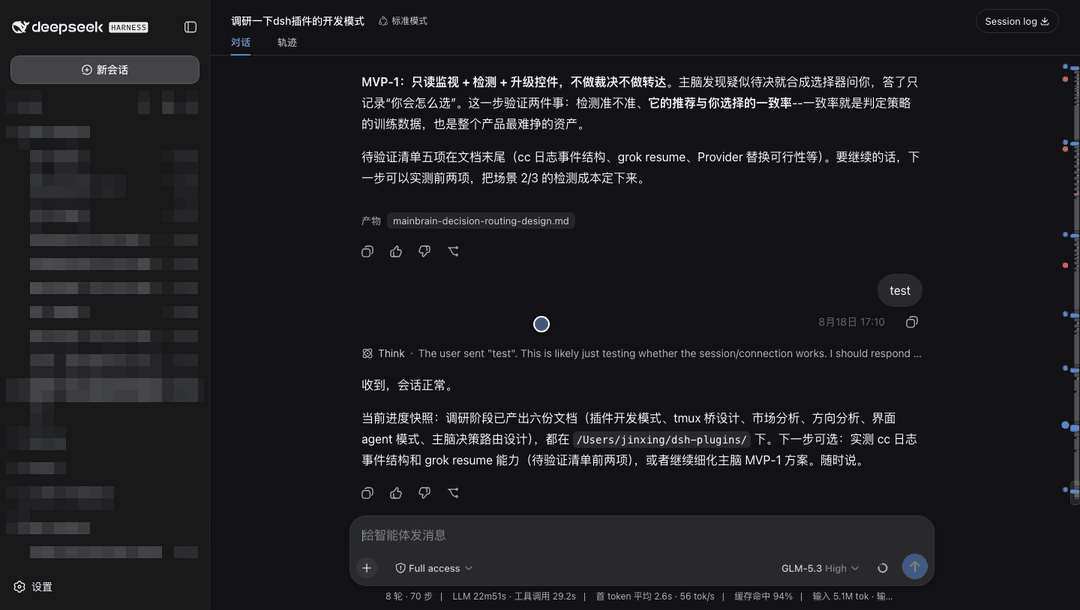 jsdvjx/dsh-strata
Session strata for the DeepSeek Harness Web GUI: the transcript's scrollbar becomes a to-scale, colour-coded map of the …
jsdvjx/dsh-strata
Session strata for the DeepSeek Harness Web GUI: the transcript's scrollbar becomes a to-scale, colour-coded map of the …
-
 hellodigua/dsh-share
DSH 对话分享插件,分享单轮或多轮对话,可导出为图片或 Markdown。Share DSH Q&As or selected conversation groups as PNG or Markdown.
hellodigua/dsh-share
DSH 对话分享插件,分享单轮或多轮对话,可导出为图片或 Markdown。Share DSH Q&As or selected conversation groups as PNG or Markdown.
-
 Tkingxiao/dsh-any-background
Deepseek Harness 自定义主题插件,支持自定义图片/视频壁纸,对话框,侧边栏等透明度模糊度调整,全局主题色的色轮调整插件
Tkingxiao/dsh-any-background
Deepseek Harness 自定义主题插件,支持自定义图片/视频壁纸,对话框,侧边栏等透明度模糊度调整,全局主题色的色轮调整插件
-
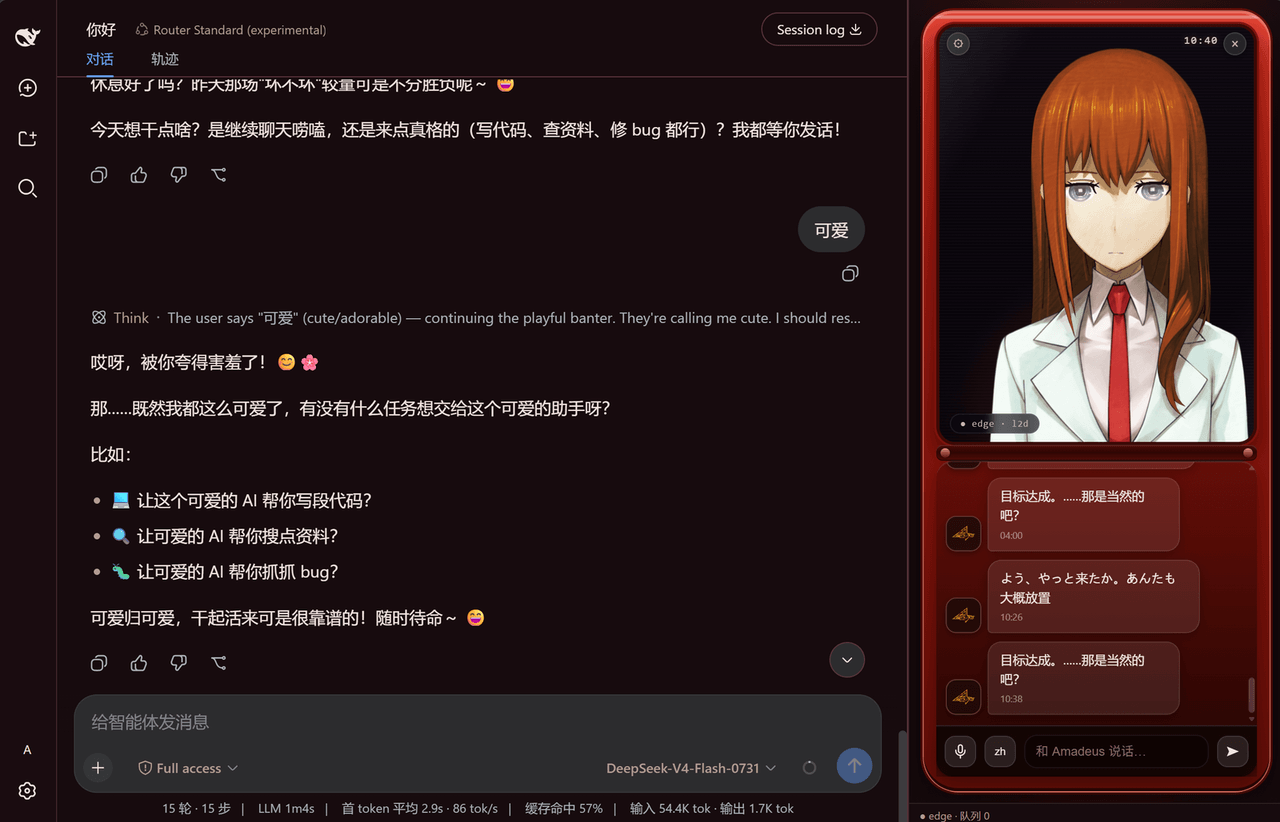 yyxcnasd/amadeus-for-dsh
Amadeus (AI assistant from Steins;Gate 0) for DeepSeek Harness
yyxcnasd/amadeus-for-dsh
Amadeus (AI assistant from Steins;Gate 0) for DeepSeek Harness
-
 a903067276-rgb/dsh-file-upload
One upload button plus drag-and-drop files into the conversation as local paths: save to project uploads/, path text int…
a903067276-rgb/dsh-file-upload
One upload button plus drag-and-drop files into the conversation as local paths: save to project uploads/, path text int…
-
 LeemanCheung/dsh-whale-animation
Persistent closed-loop whale-dive animation for DeepSeek Harness Web turn status
LeemanCheung/dsh-whale-animation
Persistent closed-loop whale-dive animation for DeepSeek Harness Web turn status
-
 tianji-qingtian/dsh-composer-polish
DeepSeek Harness plugin: one-click ✨ polish for composer drafts — flash rewrite, auto fill-back · DeepSeek Harness 插件:输入…
tianji-qingtian/dsh-composer-polish
DeepSeek Harness plugin: one-click ✨ polish for composer drafts — flash rewrite, auto fill-back · DeepSeek Harness 插件:输入…