kfirsch/dsh-hebrew-rtl
Hebrew RTL support for the DeepSeek Harness web UI: dominant-script block direction, bidi-safe input fields, and RTL-aware line navigation.
Project Overview项目介绍
This is a plugin for DeepSeek Harness (DSH) web GUI that corrects Hebrew right-to-left (RTL) rendering. It sets per-block direction based on dominant script, fixes bidi input fields, and corrects Cmd-arrow navigation for RTL lines. Use it when working with Hebrew in DSH web. It currently only supports Hebrew; other RTL scripts are not included.
这是DeepSeek Harness(DSH)网页GUI的希伯来语RTL(从右到左)显示修正插件。核心功能包括按文本中占多数的脚本自动设置块级方向,修复双向输入框问题,修正RTL行的方向键导航逻辑。适用于需要在DSH中正常读写希伯来语的场景,目前仅支持希伯来语。
请帮我了解并安装插件:【dsh-hebrew-rtl】【https://github.com/kfirsch/dsh-hebrew-rtl】Send this message to DSH in your current session. CLI install commands may not be accurate across systems — DSH will figure it out for you.把上面这条消息直接发给当前会话里的 DSH,让它帮你了解并安装。安装命令不一定准确,发给 DSH 更稳。
Or use CLI install (for developers)或使用命令行安装(适合开发者)
CLI Install命令行安装
dsh plugin --profile web add github:kfirsch/dsh-hebrew-rtl把 kfirsch/dsh-hebrew-rtl 加入你的 DSH 配置(web profile)即可启用。
READMEREADME
dsh-hebrew-rtl
English | עברית
Correct Hebrew RTL rendering for the DeepSeek Harness web GUI: per-block direction by dominant script, bidi-safe input fields, and RTL-aware Cmd+←/→ line navigation.
The problem
The GUI renders every block left-to-right. For Hebrew that produces three distinct failures:
- Whole paragraphs read backwards. A Hebrew sentence is laid out as an LTR paragraph, so its lines start on the wrong side and punctuation lands at the wrong end.
- Typing into a field runs the wrong way. The
ask_user_questioncustom-answer field inherits the page direction, so Hebrew typed into it flows left-to-right. Cmd+←/→feel inverted. These shortcuts are logical in every browser:←goes to the line's logical start, which on an RTL line sits at the visual right edge. Pressing←jumps the caret to the far right.
The obvious CSS answer — unicode-bidi: plaintext — fixes only the easy half. It picks a block's direction from its first strong directional character, so a Hebrew sentence that opens with a Latin product name, a list number, or an emoji is still rendered LTR and still reads garbled.
What this plugin does
Per-block direction by dominant script
For each block element (p, ul/ol, h1–h6, blockquote, table) it drops code-like tokens from the block's text, then counts Hebrew-majority words against Latin-majority words in what remains:
| Content | Result |
|---|---|
| No Hebrew prose | No override — unicode-bidi: plaintext stays in charge |
| Hebrew words > Latin words | direction: rtl + text-align: right |
| Latin words > Hebrew words | direction: ltr + text-align: left |
| Equal (both present) | direction: rtl — a block with as much Hebrew as Latin is Hebrew text quoting English |
Forced blocks get unicode-bidi: isolate, so the Unicode Bidi algorithm still lays out the minority-script runs correctly inside the chosen paragraph direction:
היום בדקנו את הפלאגין החדש עם DSH והכול עבד מצוין.
→ RTL, and "DSH" stays in place, unreversed

This is a test sentence with שלום in the middle.
→ LTR, and "שלום" stays in place, mid-sentence
Dominance is the rule because both simpler alternatives fail in an obvious way. First-strong alone mis-renders any Hebrew paragraph that does not begin in Hebrew. "Any Hebrew character forces RTL" over-corrects in the other direction: an English sentence carrying one Hebrew word flips to RTL and its English runs come out reversed.
Why words, and why code tokens are excluded. Counting raw letters breaks on technical Hebrew prose. A single identifier can outweigh a whole paragraph — git+https://git@github.com:kfirsch/...#<sha> contributes 44 Latin letters by itself, and a commit sha another 40 — so a Hebrew sentence that merely cites a URL was rendered LTR. Identifiers, URLs, paths, shas and 15/15-style ratios are therefore stripped before counting; they are still laid out normally, they just no longer vote on the paragraph's direction. Counting whole words rather than letters follows from the same reasoning: a three-letter Hebrew word says as much about the sentence's language as credential does. The stripping is deliberately conservative — an ordinary Latin word standing alone is never treated as code, so genuine English prose still counts in full.
The heuristic is not infallible on a block that is genuinely half-and-half after stripping (a short line of mostly commit hashes with two Hebrew words, say). Those fall back to first-strong rather than guessing.
Composite elements are judged whole, never by their parts. This one rule was learned three times over:
- Tables. Judging each
tdseparately gave a six-row status table three different verdicts — Hebrew label cells went RTL while theHEADandCommitscells beside them stayed LTR — so the label column changed edges from row to row. Column order is a property of the table rather than the cell, so per-cell directions also fight the column order itself. - Lists. The same failure one level down. In a Hebrew numbered list, a short all-Latin item such as
pushhas no Hebrew to weigh, so it got no verdict at all, fell back to the page's LTR, and jumped to the opposite margin from its RTL siblings — breaking the numbering column. - Formulas. KaTeX renders a formula as hundreds of nested
<span>s whose horizontal positions it computes itself. Letting each one pick its own direction tore formulas apart:(idle + rightsizing)and$870/monthcame out reordered into nonsense..katexand its whole subtree are excluded — KaTeX handles bidi itself.
So the direction is decided once per composite, from its whole text, and every part inherits it. unicode-bidi: isolate still lays out each part's own content correctly within that direction.
Blocks are re-evaluated through a MutationObserver as text streams in, coalesced with requestAnimationFrame so streaming does not trigger a scan per character.
Bidi-safe input fields
The composer and the ask_user_question custom-answer field are each a two-layer stack: a visible or measuring mirror layer plus a real <textarea> sharing one grid cell. Both layers must carry identical bidi metrics, or their computed heights and wrapping diverge and the field mis-sizes or the caret drifts away from the glyphs.
Both layers therefore receive unicode-bidi: plaintext together — never the textarea alone — so each line's direction follows what is actually typed into it.
RTL-aware line navigation
A capture-phase keydown listener intercepts Cmd+←/→ only when the caret's current line is RTL, and swaps them so each arrow points where the caret visually goes. Lines that are not RTL are left completely untouched. Shift-extension and selection direction are preserved.
Install
dsh plugin --profile web add github:kfirsch/dsh-hebrew-rtl
Then restart dsh web and hard-refresh the browser tab.
To pin an exact commit (recommended — a later push then cannot silently change what runs):
dsh plugin --profile web add github:kfirsch/dsh-hebrew-rtl#<commit-sha>
The package ships plain hand-written JavaScript in lib/ with no build step, so installing from GitHub needs no allowBuilds approval.
Uninstall
dsh plugin --profile web remove dsh-hebrew-rtl
Scope: Hebrew only, deliberately
The direction rule generalises cleanly to every RTL script — Arabic and its languages, Syriac, Thaana, N'Ko, Adlam — and that version was written and passed a 16-case script matrix. It was then reverted on purpose: neither the author nor a reviewer can proof-read those scripts, and shipping text-direction handling that nobody involved can verify is worse than not shipping it. The package name says what it actually supports.
A pull request adding another script is welcome from someone who reads it and can confirm the rendering by eye.
Compatibility
- Surface: the
webprofile (dsh web). No host service, no configuration, no network access. - What it never touches:
contenteditableregions and code blocks — code stays LTR regardless of its content. - Tested against dsh
0.1.1-rc.2.
License
MIT © Kfir Schneider
For reviewers: why there is no build step
lib/ is not build output — it is the hand-written source, in the exact wire
format the DSH client module system loads. There is deliberately no src/, no
scripts.build and no scripts.prepack, so a clean checkout is already the
artifact and a GitHub install needs no allowBuilds approval.
plugin_check flags all three of those as warnings on the assumption that a
plugin is compiled; they are inapplicable here rather than unaddressed. The
package passes with no errors.
Run the checks yourself:
npm test # smoke-tests the direction rule and the caret swap
Related相关推荐
- xiaozhe7772222/dsh-opencode-zen 0 元接入 6 个免费大模型:OpenCode Zen 免费档模型零配置接入 DeepSeek Harness,免注册免充值,内置 6 个免费模型,多 Key 轮换与限流退避。
-
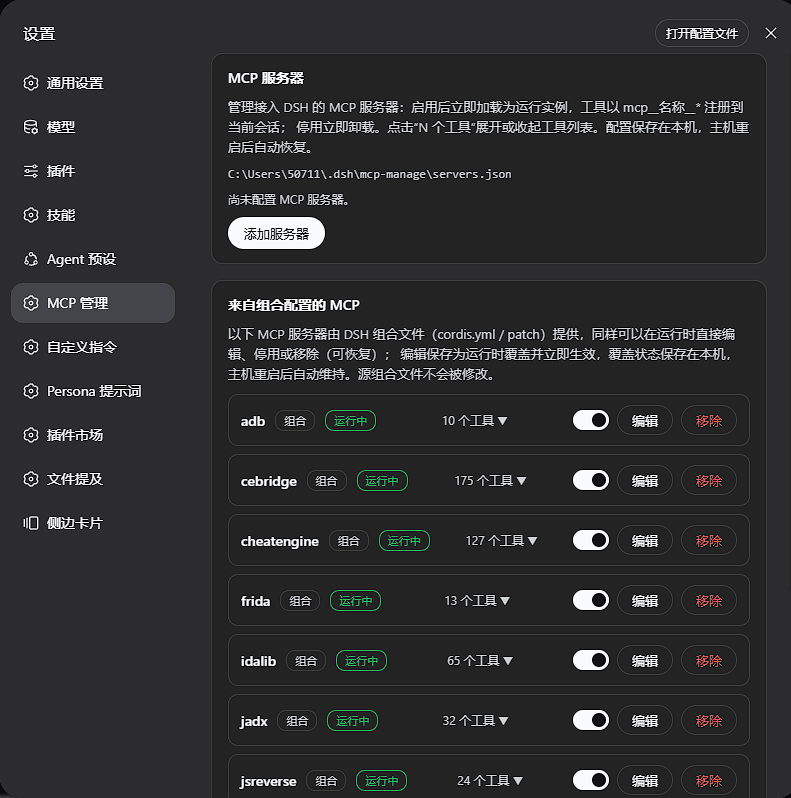 null119/dsh-mcp-manage
DSH(DeepSeek Harness)Web GUI 插件:在设置页管理 MCP 服务器——列出已安装工具,添加/编辑/删除、启用/停用;组合配置提供的 MCP 同样可在运行时直接编辑、停用、移除并恢复,无需重启宿主。
null119/dsh-mcp-manage
DSH(DeepSeek Harness)Web GUI 插件:在设置页管理 MCP 服务器——列出已安装工具,添加/编辑/删除、启用/停用;组合配置提供的 MCP 同样可在运行时直接编辑、停用、移除并恢复,无需重启宿主。
-
 HuanLinOTO/dsh-plugin-sleep
向模型暴露 sleep 工具,按指定毫秒暂停执行后返回,支持取消/clamp | Exposes a sleep tool that pauses for specified ms then returns, with cancellati…
HuanLinOTO/dsh-plugin-sleep
向模型暴露 sleep 工具,按指定毫秒暂停执行后返回,支持取消/clamp | Exposes a sleep tool that pauses for specified ms then returns, with cancellati…
- xx-hub/dsh-craft-your-textbook
-
 Apageoflove/DSH-changeproof
变更证明(ChangeProof)— DeepSeek Harness 插件:代码改动后确认改动的行真的被测试覆盖到
Apageoflove/DSH-changeproof
变更证明(ChangeProof)— DeepSeek Harness 插件:代码改动后确认改动的行真的被测试覆盖到
- xiaozhe7772222/dsh-api-key-pool API Key rotation pool for DeepSeek Harness: multi-key round-robin, failover on 401/403/429, cooldown & recovery, Web UI …
-
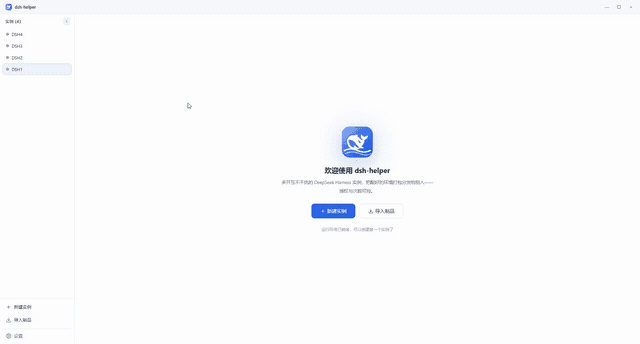 x102201/dsh-helper
🖥️ 一台电脑并行无限 DeepSeek Harness 实例 · 🔀 每个 dsh 一个专职实例 · 🪟 同一工作区并行 · 📦 .dshpack 配置交付
x102201/dsh-helper
🖥️ 一台电脑并行无限 DeepSeek Harness 实例 · 🔀 每个 dsh 一个专职实例 · 🪟 同一工作区并行 · 📦 .dshpack 配置交付
-
 kairoz9/dsh-mcp-admin
dsh plugin for MCP status inspection and server management | dsh 的 MCP状态查看与服务管理插件
kairoz9/dsh-mcp-admin
dsh plugin for MCP status inspection and server management | dsh 的 MCP状态查看与服务管理插件