
LaplaceYoung/dsh-of-your-own
/fuck — migrates your Claude Code & Codex habits into DeepSeek Harness. One command, parallel scan, boot-time recall.
项目介绍Project Overview
dsh-of-your-own 是 DSH 插件,可并行扫描 Claude Code、Codex、pi、omp 等历史会话与记忆文件,提炼工具习惯、回复语言、斜杠命令和偏好,写入 ~/.dsh/AGENTS.md 托管块并支持会话续接。适合想把旧代理使用习惯迁移到 DSH、避免重复配置时使用。注意:它会读取本机历史记录,迁移内容应先核对。
dsh-of-your-own is a DSH plugin that scans local transcripts and memory files from Claude Code, Codex, pi, omp, and related tools. It extracts tool habits, reply language, slash commands, and preferences, then writes them into ~/.dsh/AGENTS.md for native DSH recall, with session resume support. Use it when migrating established agent habits into DSH. Caveat: it reads local history, so review migrated preferences before relying on them.
请帮我了解并安装插件:【dsh-of-your-own】【https://github.com/LaplaceYoung/dsh-of-your-own】把上面这条消息直接发给当前会话里的 DSH,让它帮你了解并安装。安装命令不一定准确,发给 DSH 更稳。Send this message to DSH in your current session. CLI install commands may not be accurate across systems — DSH will figure it out for you.
或使用命令行安装(适合开发者)Or use CLI install (for developers)
命令行安装CLI Install
dsh plugin --profile web add github:LaplaceYoung/dsh-of-your-own把 LaplaceYoung/dsh-of-your-own 加入你的 DSH 配置(web profile)即可启用。
READMEREADME


[!IMPORTANT] Yes, the command is literally
/fuck.You spent six months teaching Claude Code that you like Chinese replies, short answers, and
rgovergrep. You trained Codex to never touchpackage-lock.jsonunprompted. You gave pi its own AGENTS.md. Then you open DeepSeek Harness, and it greets you like a stranger at a bus stop.That's when you type
/fuck. We named it after the moment.
The Problem
Every agent starts with amnesia. You re-teach the same preferences, the same tool habits, the same "please stop writing essays" — to every new harness, forever. Your conversation history is a biography nobody reads.
dsh-of-your-own reads it. All of it. In parallel. Then it moves you in — natively.
/fuck
  │
  ├─ parallel scan ── ~/.claude/projects/**        (Claude Code transcripts)
  │                   ~/.claude/history.jsonl      (global prompt log: slash-command gold mine)
  │                   ~/.codex/sessions/**         (Codex rollouts)
  │                   ~/.pi/agent/sessions/**      (pi transcripts)
  │                   ~/.omp/agent/sessions/**     (omp transcripts)
  │
  ├─ memory files ─── ~/.claude/CLAUDE.md          (your explicit rules)
  │                   ~/.codex/AGENTS.md           (your Codex operating manual)
  │                   ~/.gemini/GEMINI.md          (Gemini CLI context)
  │                   ~/.cursor/rules/*.mdc        (Cursor rules, frontmatter stripped)
  │                   ~/.cursor/agents/*.md        (Cursor agent markdown)
  │
  ├─ analyze ───── tool habits (case-merged) · slash commands · working dirs · reply language
  │
  ├─ synthesize ─── LLM preference summary (or a deterministic fallback — no key needed)
  │
  └─ migrate natively
      1. Managed block → ~/.dsh/AGENTS.md   ← DSH auto-loads this EVERY session. No plugin needed afterwards.
      2. profile.json  → ~/.dsh/of-your-own/
      3. systemPrompt.section() injection  ← remembered this session too
The migration is native. Your preferences land in ~/.dsh/AGENTS.md — the user-global instruction file DSH's workspace-context reads on boot, the same mechanism every other instruction file uses. Uninstall the plugin tomorrow; the memory stays.
TL;DR
| You want | Run | What happens |
|---|---|---|
| The whole thing | install, then /fuck in a DSH session |
~/.dsh/AGENTS.md managed block + profile.json + command stubs + prompt injection |
| See what it learned | ask the agent to run my_profile |
the full preference section, on demand |
| Re-learn you | my_profile with { refresh: true } |
fresh scan, fresh profile, upserted block — no duplicates |
| List migrated commands | ask for my_commands |
every slash habit it found elsewhere |
| Find unfinished work | /sessions |
numbered catalog of every session across all harnesses, newest first |
| Take over a task | /resume 3 (or id, or a title fragment) |
handoff brief injected — this agent continues the foreign task |
| Get judged | it's automatic | after /fuck, a tsundere verdict report appraises your entire agent history |
| Get un-haunted | /forget |
strips the managed block and deletes the profile — a clean exit door |
Installation
Requires DeepSeek Harness >=0.1.1-rc.2 (the package declares dsh.bundle so dsh plugin add actually joins the layer stack).
# from a local checkout
git clone https://github.com/LaplaceYoung/dsh-of-your-own.git
cd dsh-of-your-own
pnpm install
pnpm build
dsh plugin --profile web add "$(pwd)"
# or straight from GitHub (pnpm ≥10 must allow the prepare/build script)
dsh plugin --profile web add github:LaplaceYoung/dsh-of-your-own
If the git install is refused, copy the package key pnpm printed into that profile's pnpm-workspace.yaml:
allowBuilds:
  '@dsh-external/dsh-of-your-own': true
and re-run the add. Then confirm the layer is in the composed tree:
dsh --profile web --dump-config # look for "# == @dsh-external/dsh-of-your-own"
Override knobs from the profile's own cordis.patch.yml (later layers replace the whole row — restate every key you still want):
- id: dsh-of-your-own
  name: '@dsh-external/dsh-of-your-own'
  config:
    provider: deepseek-official   # LLM preference synthesis (optional — template fallback otherwise)
    model: deepseek-v4-flash
    maxFilesPerSource: 50         # newest N transcripts scanned per harness
    agentsMdPath: ~/.dsh/AGENTS.md  # native landing zone
Usage
/fuck                  # full migration: parallel scan → analyze → native migrate
/sessions              # catalog every resumable session from all harnesses, newest first
/resume <#|id|title>   # hand that foreign task over to this agent, context included
/forget                # erase everything this plugin wrote (managed block + store), idempotent
Real screenshots from the actual DSH web UI, with the plugin mounted — /fuck migrates
everything and appends the tsundere verdict (rank, tool school, activity rhythm,
battlegrounds, and a closing line that's hash-picked from four variants — or written by your
LLM when one is configured — so the same history always gets the same lecture):

/sessions catalogs every resumable session across all harnesses, newest first:
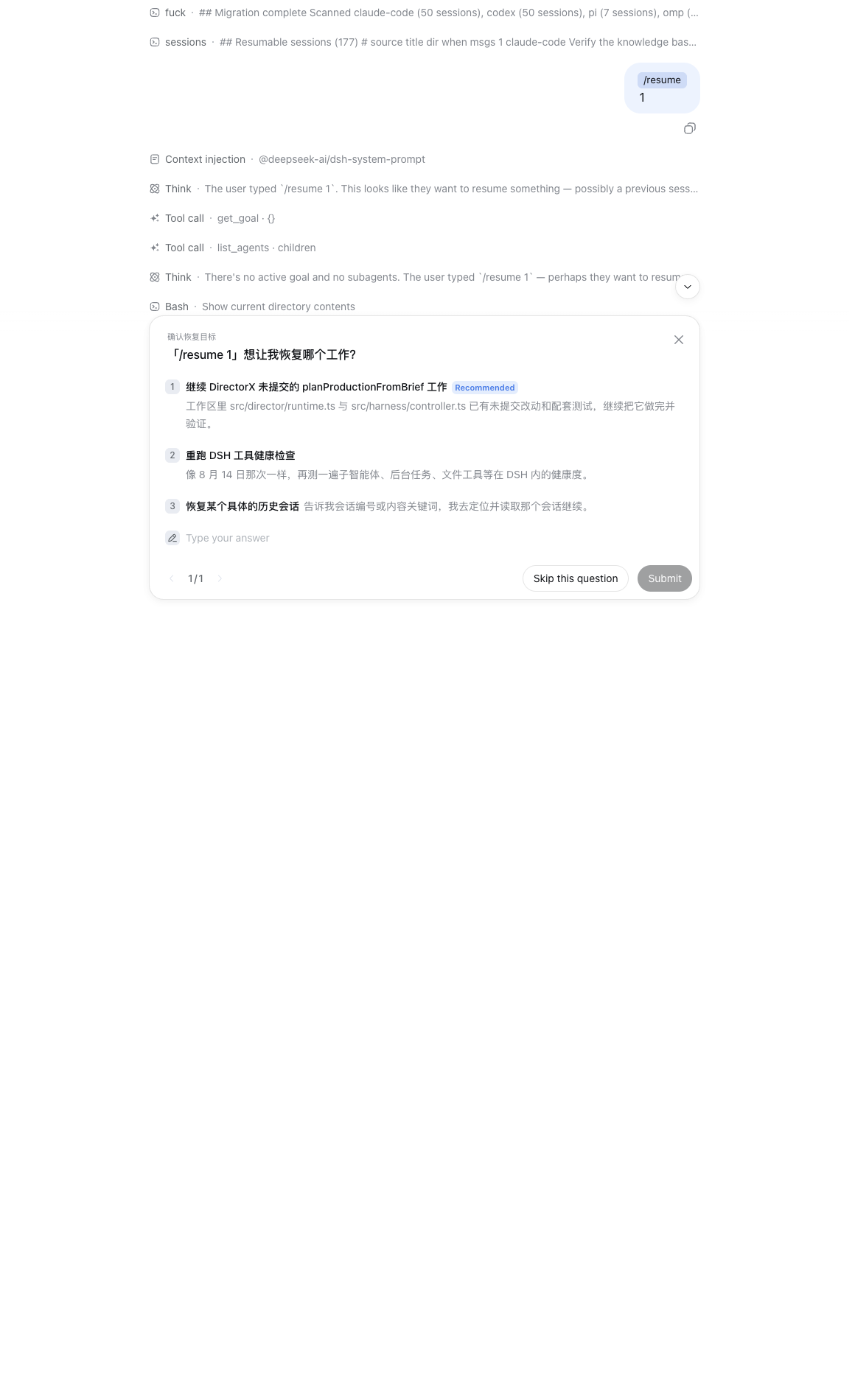
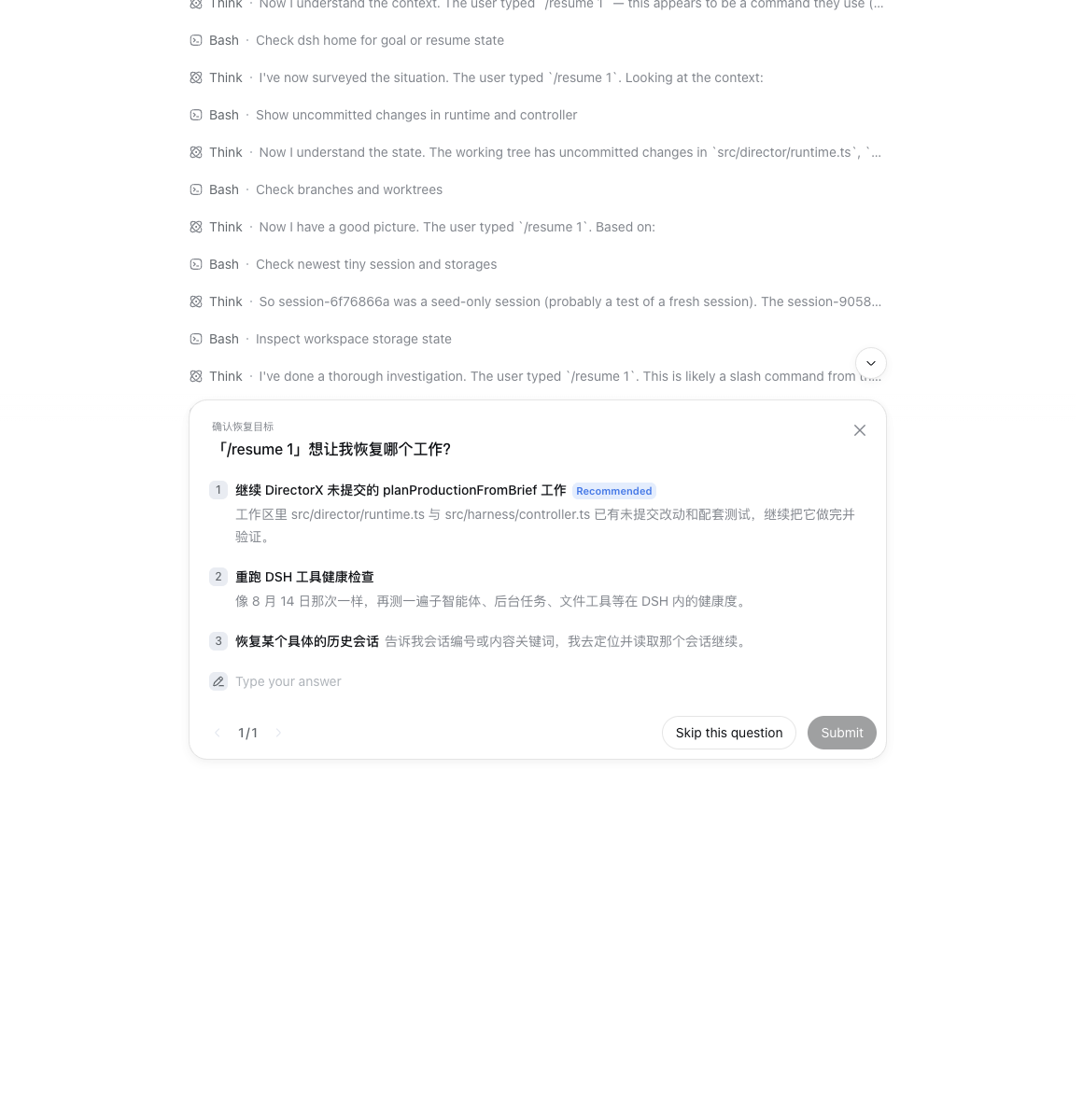
/resume <#|id|title> rebuilds one foreign session into a handoff brief and injects it, so
this agent picks the task up where it stopped (invoke it through the command surface, then
follow the prompt). And when you want out, /forget strips the managed block and deletes
the store — idempotent:
Two inspection tools (the model can call them; so can you, by asking):
| tool | does |
|---|---|
my_profile |
show the learned preferences; { refresh: true } re-scans and rebuilds |
my_commands |
list every slash command migrated from your other harnesses, with observation counts |
Session takeover — your unfinished work, continued here
/sessions reads every transcript directory in parallel and renders one numbered catalog
(see the screenshot above — 177 live sessions on this laptop).
/resume matches by list number, session-id prefix, or a fragment of the title. It rebuilds the
session into a handoff brief — original task, working directory, most recent direction, where it
stopped, tools used — and injects it into the system prompt, so this agent picks up the task and
continues it right away. The brief is also echoed back to you, so you can correct the course before
it runs.
Highlights
| Feature | What it does | |
|---|---|---|
| 🤬 | /fuck |
One command. Five harnesses scanned in parallel. You come pre-configured. |
| 🎫 | Tsundere verdict | After the scan: rank, cheating record, tool school, weapon of choice, activity histogram, battlegrounds, night-owl verdict — then it declares that no matter who you used before, from now on there is only DSH. |
| 🧹 | /forget |
One command erases every trace this plugin left: managed block stripped, store deleted. Idempotent. Privacy door included. |
| 🪂 | /sessions + /resume |
Catalog every foreign session, then hand one over with a full handoff brief. Unfinished work, finished here. |
| 🏠 | Native landing zone | Writes into ~/.dsh/AGENTS.md — the file DSH loads on every boot. Survives uninstall. |
| 🔁 | Idempotent upsert | Managed block between HTML markers. Re-run all you like; user content outside stays untouched. |
| 📚 | Reads your rule files | CLAUDE.md, Codex AGENTS.md, GEMINI.md, Cursor .mdc rules — your explicit words, not just stats. |
| 🔀 | Actually parallel | All sources, all files, all memory reads, concurrently. ~1.6s for 88 sessions on a laptop. |
| 🔧 | Tool habit census | Case-merged across harnesses: read×353, not read×326 + Read×27. Your biography, quantified. |
| 🪄 | Command migration | /compact used in Claude Code? It becomes a migrated stub in DSH. Your muscle memory survives. |
| 🌏 | Language detection | Writes Chinese prompts? DSH learns to reply in Chinese. Slash commands don't skew the vote. |
| 🔌 | LLM optional | No model configured? Deterministic template fallback. Works fully offline, no API key. |
| 🏗️ | Seams, not surgery | ctx.commands + ctx.tools + ctx.systemPrompt + ctx.llm + ctx.fs. Zero agent-loop edits. |
| 🔒 | Local everything | Transcripts read on your machine, profile stored on your machine. Nothing leaves the laptop. |
Reviews
"I typed
/fuckat my new agent and it already knew I hate verbose answers. Spooky." — a user, probably
"My DSH now prefers
rgovergrepand I never told it that. It learned from my mistakes." — another user, also probably
"Finally, an agent that inherits my trauma." — everyone who has re-typed their preferences into a fourth harness
Skip This README
We're past the era of reading docs. Just paste this into your agent:
Read https://raw.githubusercontent.com/LaplaceYoung/dsh-of-your-own/main/README.md
then install it and run /fuck on my machine.
The Serious Part
- Native, not bolt-on — the migration target is
$DSH_HOME/AGENTS.md, the user-global instruction file DSH's workspace-context package loads every session. No plugin mounted, memory still there. - Idempotent & respectful — the managed block is fenced by
<!-- dsh-of-your-own:begin/end -->markers; re-runs replace the block in place, and anything you wrote outside it is never touched. - Seams, not surgery — documented cordis extension points only:
ctx.commands,ctx.tools,ctx.systemPrompt.section()(falls back tocontext()), optionalctx.llm/ctx.fs. No skeleton patches, no hot-path tax. - No key required — preference synthesis degrades to a deterministic template; the deterministic layer (frequencies, language, migration) never needs an LLM.
- Privacy — your transcripts are read locally and reduced to statistics + a preference summary on disk. Nothing is uploaded anywhere.
Development
pnpm test        # 103 tests across 7 specs — parsers, sessions, report, analysis, persistence, plugin integration, DSH manifest
pnpm typecheck   # tsc --noEmit
pnpm build       # tsc → lib/
src/
  sources.ts   # adapters: Claude Code / Codex / pi / omp transcripts, history.jsonl,
               #           plus native memory files (CLAUDE.md, AGENTS.md, GEMINI.md, Cursor rules)
  analyze.ts   # frequency stats (case-merged) + LLM preference synthesis + profile assembly
  store.ts     # profile persistence + ~/.dsh/AGENTS.md managed-block upsert
  sessions.ts  # session takeover: transcript → resumable records + handoff briefs
  report.ts    # the tsundere verdict: ranks, tool schools, rhythm histogram, LLM-written closer
  index.ts     # plugin entry: /fuck, /sessions, /resume, my_profile, my_commands, boot-time recall
tests/         # vitest: parsers, sessions, report, analyze, store, plugin integration, DSH manifest
License
MIT — see LICENSE.
相关推荐Related
-
 nexu-io/open-design
🎨 Best DeepSeek Harness Design Plugin. The open-source Claude Design alternative. 🖥️ Local-first desktop app. 🖼️ Your…
nexu-io/open-design
🎨 Best DeepSeek Harness Design Plugin. The open-source Claude Design alternative. 🖥️ Local-first desktop app. 🖼️ Your…
-
 freestylefly/awesome-gpt-image-2
Prompt as Code | GPT-Image2 工业级提示词引擎与模板库,530+ 个案例逆向工程,20+ 套工业级模板,并提炼出Skills,持续更新中
freestylefly/awesome-gpt-image-2
Prompt as Code | GPT-Image2 工业级提示词引擎与模板库,530+ 个案例逆向工程,20+ 套工业级模板,并提炼出Skills,持续更新中
-
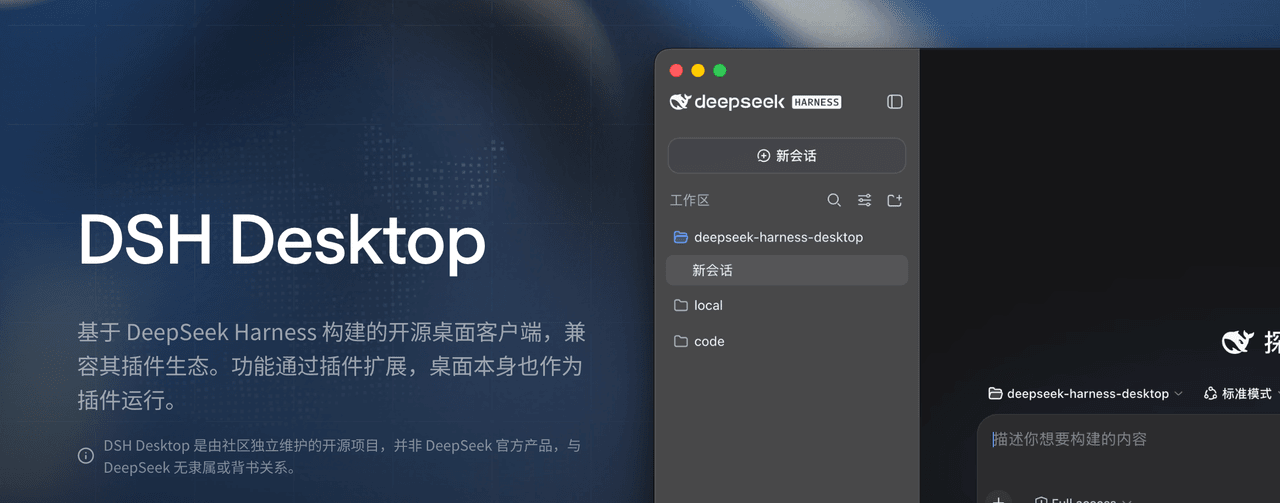 anywhere-labs/dsh-desktop
为 DeepSeek Harness (DSH) 插件生态打造的现代化桌面端解决方案。万物皆「插件」,桌面本身也是「插件」。
anywhere-labs/dsh-desktop
为 DeepSeek Harness (DSH) 插件生态打造的现代化桌面端解决方案。万物皆「插件」,桌面本身也是「插件」。
- Nagi-ovo/voyager Enhancement suite for Gemini, AI Studio, Claude & ChatGPT — plus a prompt manager for any web UI, DeepSeek Harness inclu…
-
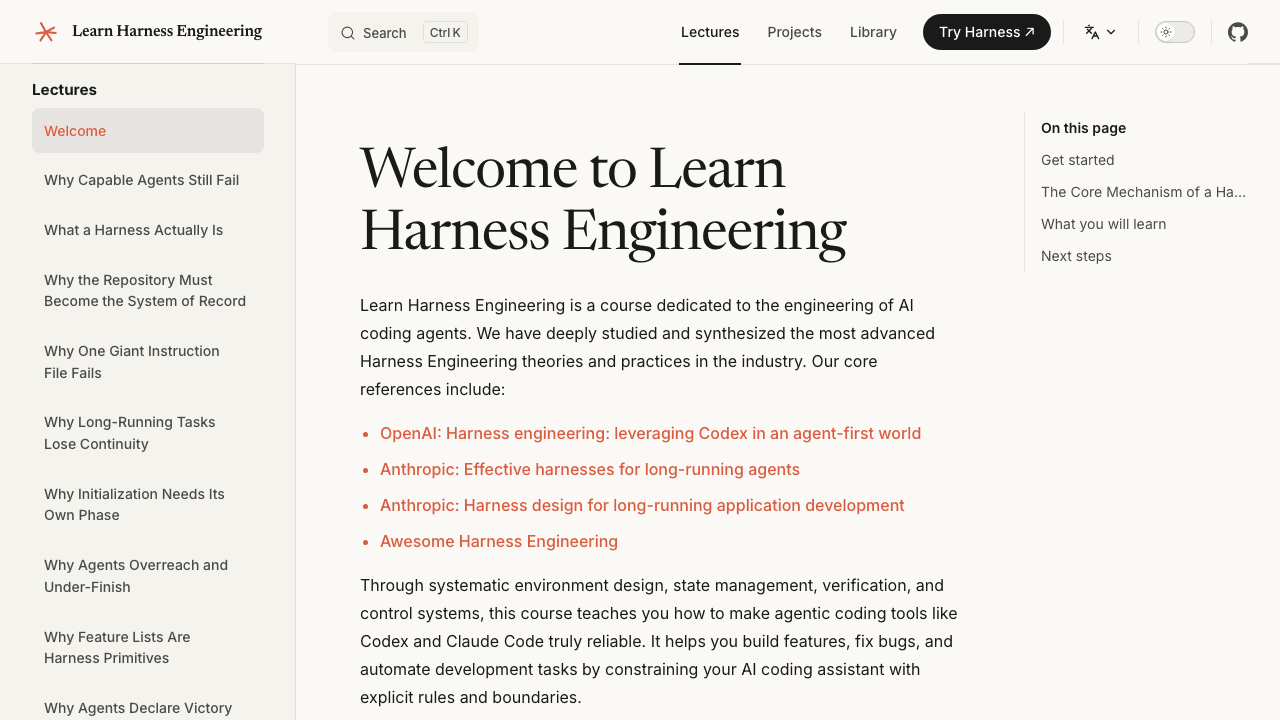 walkinglabs/learn-harness-engineering
Harness engineering beginner tutorial, from 0 to 1
walkinglabs/learn-harness-engineering
Harness engineering beginner tutorial, from 0 to 1
-
 awesome-dsh-plugin/awesome-dsh-plugin
A curated list of plugins for DeepSeek Harness (dsh) · DeepSeek Harness 插件精选列表
awesome-dsh-plugin/awesome-dsh-plugin
A curated list of plugins for DeepSeek Harness (dsh) · DeepSeek Harness 插件精选列表
-
 MemTensor/MemOS
Self-evolving memory OS for LLM & AI Agents: ultra-persistent memory, hybrid-retrieval, and cross-task skill reuse, with…
MemTensor/MemOS
Self-evolving memory OS for LLM & AI Agents: ultra-persistent memory, hybrid-retrieval, and cross-task skill reuse, with…
- yjh051108/dsh-routing-suite dsh-routing-suite — injector + router-standard kit: install the runtime injector first, then the task-aware reasoning-mo…