mitian233/dsh-plugin-commandcode-provider
项目介绍Project Overview
这是 DSH 的 commandcode LLM 提供商插件,将请求转发到 Command Code 的 /alpha/generate API,支持文本流式输出、JSON Schema 工具、推理增量、用量上报与取消,并提供浏览器 OAuth 取钥。需在 DSH 0.1.0-rc.6+ 的 Web 配置中使用,模型写作 commandcode/<model-id>。注意不支持凭据刷新、动态模型发现、图片输入和 stop 序列。
This DSH plugin adds a commandcode LLM provider route that sends requests to Command Code's /alpha/generate API. It supports streaming text, JSON Schema tools, reasoning deltas, usage reporting, cancellation, retries, and browser-assisted OAuth key setup. Use it in DSH 0.1.0-rc.6+ Web profiles with models like commandcode/<model-id>. It does not support credential refresh, dynamic model discovery, image inputs, or stop sequences.
请帮我了解并安装插件:【dsh-plugin-commandcode-provider】【https://github.com/mitian233/dsh-plugin-commandcode-provider】把上面这条消息直接发给当前会话里的 DSH,让它帮你了解并安装。安装命令不一定准确,发给 DSH 更稳。Send this message to DSH in your current session. CLI install commands may not be accurate across systems — DSH will figure it out for you.
或使用命令行安装(适合开发者)Or use CLI install (for developers)
命令行安装CLI Install
dsh plugin --profile web add github:mitian233/dsh-plugin-commandcode-provider把 mitian233/dsh-plugin-commandcode-provider 加入你的 DSH 配置(web profile)即可启用。
READMEREADME
Command Code provider for DeepSeek Harness
dsh-plugin-commandcode-provider adds the commandcode LLM provider route to
DeepSeek Harness (DSH). It
sends requests to Command Code's /alpha/generate API.
Installation
This plugin is a standalone DSH plugin. It does not modify the DeepSeek Harness
repository: install it into a profile with dsh plugin, the official plugin
manager. The package declares a dsh.bundle manifest (a cordis.patch.yml
layer), so dsh plugin add activates it automatically — no manual
cordis.patch.yml edit is required.
Run DSH
The official npm form runs the harness without a global install:
npx @deepseek-ai/dsh web
If dsh is already on your PATH (installed globally or via a package
manager), dsh web is equivalent. This plugin is compatible with DSH
0.1.0-rc.6 and later (npm next tag).
Install the plugin into a profile
From the plugin checkout, install the local directory into a profile. The
first use initializes the profile (with @deepseek-ai/dsh-base as its first
bundle):
cd /path/to/dsh-plugin-commandcode-provider

# Official form, no global dsh needed:
npx @deepseek-ai/dsh plugin --profile web add .

# Or with a global dsh on PATH:
dsh plugin --profile web add .
add . anchors the relative path to the invoking directory, so it links this
checkout into the profile's pnpm-managed node_modules. Because the package
declares dsh.bundle, dsh plugin also appends the package to the profile's
dsh.profile.bundles, so its patch layer activates on boot without any
additional wiring. Any other pnpm spec works the same way — an npm package, a
packed tarball, or a git host:
dsh plugin --profile web add ./dsh-plugin-commandcode-provider-0.1.0.tgz
dsh plugin --profile web add github:mitian233/dsh-plugin-commandcode-provider
Remove the plugin (also removes the bundle layer) with:
dsh plugin --profile web remove dsh-plugin-commandcode-provider
Override config in the profile
The bundle's patch supplies schema defaults. To override any key, add an
id-targeted patch row to your own profile cordis.patch.yml (applied after
bundle layers):
- id: llm-commandcode
  config:
    baseURL: https://api.commandcode.ai
    maxTokens: 64000
Verify
dsh --profile web --dump-config   # shows the "# == dsh-plugin-commandcode-provider" layer

dsh web                           # boot the Web UI
Develop and test
Dependencies install from npm against the DSH packages published under the
next tag (^0.1.0-rc.6); no DSH workspace checkout is required:
pnpm install
pnpm run typecheck   # tsc --noEmit
pnpm run test        # node --import tsx --test tests/*.spec.ts
pnpm run build       # tsc -> dist/
pnpm install may ask to approve the esbuild build script (a tsx
dependency); run pnpm approve-builds when prompted.
Reference implementation
The browser-assisted OAuth flow is ported from
pi-commandcode-provider,
the Command Code provider for pi.
Development installation
This plugin is developed as a paired DSH workspace. From the DSH repository
root, add the adjacent plugin path to pnpm-workspace.yaml if it is not
already present:
packages:
  - ../dsh-plugin-commandcode-provider
Install and run every plugin command from the DSH root so the private DSH workspace packages resolve correctly:
pnpm install
pnpm --filter dsh-plugin-commandcode-provider test
pnpm --filter dsh-plugin-commandcode-provider typecheck
pnpm --filter dsh-plugin-commandcode-provider build
Running pnpm from the plugin directory is unsupported for this paired setup:
it cannot resolve DSH's workspace-only @deepseek-ai/* packages.
Configuration
Load the named plugin llm-commandcode in a DSH composition. The provider
route is commandcode; select a model as commandcode/<model-id> (for
example, commandcode/gpt-5.6-luna).
- id: llm-commandcode
  name: dsh-plugin-commandcode-provider
  config:
    apiKeyEnv: COMMANDCODE_API_KEY # DSH credential reference
    baseURL: https://api.commandcode.ai
    maxTokens: 64000
    defaultContextWindow: 1000000
    streamIdleTimeoutMs: 300000
    retryPolicy:
      mode: default
The current configuration field is named apiKeyEnv for compatibility with
DSH credential references; use it to select a reference other than the default
COMMANDCODE_API_KEY when needed:
config:
  apiKeyEnv: COMMANDCODE_API_KEY
  baseURL: https://api.commandcode.ai
  maxTokens: 64000
  defaultContextWindow: 1000000
  streamIdleTimeoutMs: 300000
Configure COMMANDCODE_API_KEY through DSH's credentials service. If that
service is not installed, the plugin reads the same reference from DSH's launch
environment. A mounted credentials service is authoritative: a miss does not
fall back to the environment. Blank, whitespace-only, or HTTP-header-invalid
keys are rejected before a request is sent.
Get an API key with the OAuth button
The settings page (Command Code section, right after Models) offers a Command Code OAuth button. Clicking it starts a browser-assisted key retrieval flow:
- The plugin's host half launches a one-shot local callback server on
127.0.0.1(port5959by default, with a small fallback range). - A Command Code Studio authorization page opens in your default browser.
After you sign in, Studio POSTs your API key back to
http://localhost:<port>/callback. - The host validates the CSRF state token, stores the key under
COMMANDCODE_API_KEYthrough the credentials service, and closes the local server automatically. - The settings page polls the host and confirms once the key is stored.
The flow needs DSH's web server (Web profiles). If the automatic transfer fails or times out, the manual API-key input below the button remains available as a fallback. A second attempt while one is pending is refused.
The same-origin routes the browser half calls are /commandcode-oauth/start
and /commandcode-oauth/status; Studio POSTs to the local /callback.
baseURL changes the API origin. maxTokens is capped at 64,000;
defaultContextWindow, streamIdleTimeoutMs, and retryPolicy tune model
metadata, idle streaming behavior, and DSH-managed retries. temperature is
accepted as a compatibility setting; each request's explicit temperature wins,
and the wire default is 0.3. Static models entries can supply display,
context-window, and maximum-token overrides; this does not discover models.
Supported behavior
- Text messages and streaming text output.
- Standard JSON Schema tools and complete tool calls.
- Reasoning deltas for models that advertise supported reasoning efforts.
- Usage reporting, cancellation, idle timeout handling, and deterministic HTTP/in-stream error classification.
v1 non-goals
Credential refresh, dynamic model discovery or catalog
caching, image inputs, and stop sequences are intentionally unsupported.
Image and stop requests fail before network dispatch. This plugin does not
change DSH host control flow or the agent loop.
License
MIT © 2026 Mikan Harada.
The browser-assisted OAuth flow is ported from the MIT-licensed
pi-commandcode-provider
(© 2025 Pat Woz).
相关推荐Related
-
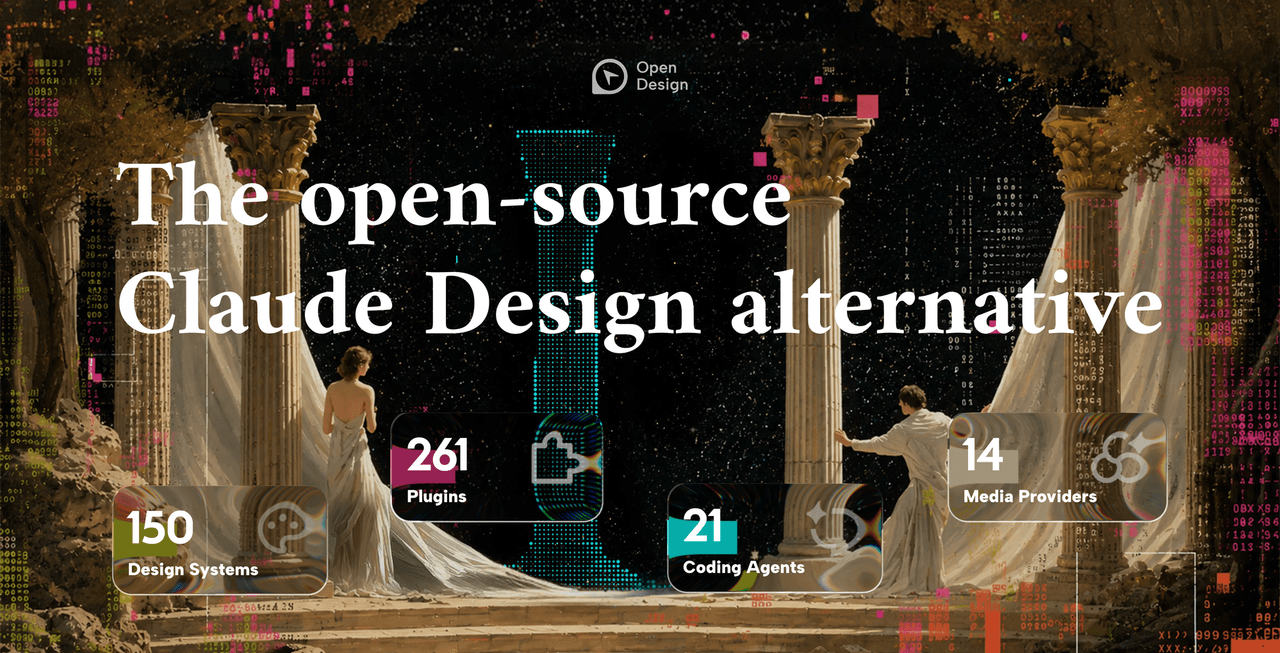 nexu-io/open-design
🎨 Best DeepSeek Harness Design Plugin. The open-source Claude Design alternative. 🖥️ Local-first desktop app. 🖼️ Your…
nexu-io/open-design
🎨 Best DeepSeek Harness Design Plugin. The open-source Claude Design alternative. 🖥️ Local-first desktop app. 🖼️ Your…
-
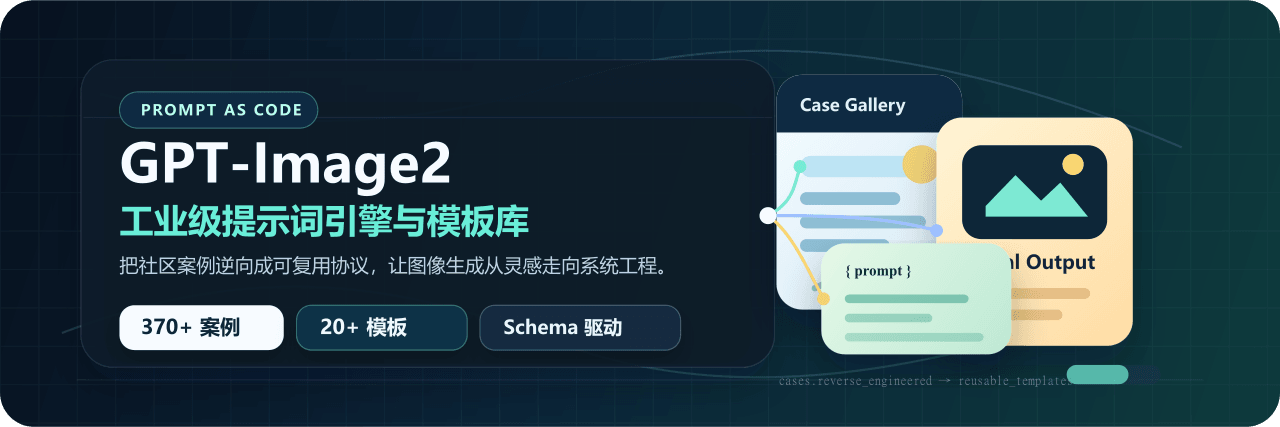 freestylefly/awesome-gpt-image-2
Prompt as Code | GPT-Image2 工业级提示词引擎与模板库,530+ 个案例逆向工程,20+ 套工业级模板,并提炼出Skills,持续更新中
freestylefly/awesome-gpt-image-2
Prompt as Code | GPT-Image2 工业级提示词引擎与模板库,530+ 个案例逆向工程,20+ 套工业级模板,并提炼出Skills,持续更新中
-
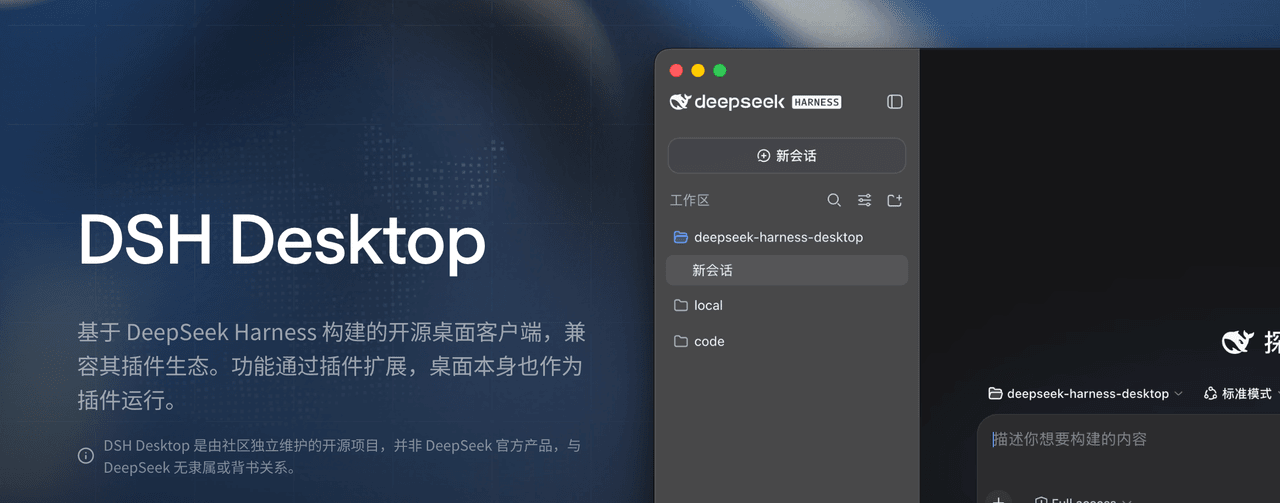 anywhere-labs/dsh-desktop
为 DeepSeek Harness (DSH) 插件生态打造的现代化桌面端解决方案。万物皆「插件」,桌面本身也是「插件」。
anywhere-labs/dsh-desktop
为 DeepSeek Harness (DSH) 插件生态打造的现代化桌面端解决方案。万物皆「插件」,桌面本身也是「插件」。
- Nagi-ovo/voyager Enhancement suite for Gemini, AI Studio, Claude & ChatGPT — plus a prompt manager for any web UI, DeepSeek Harness inclu…
-
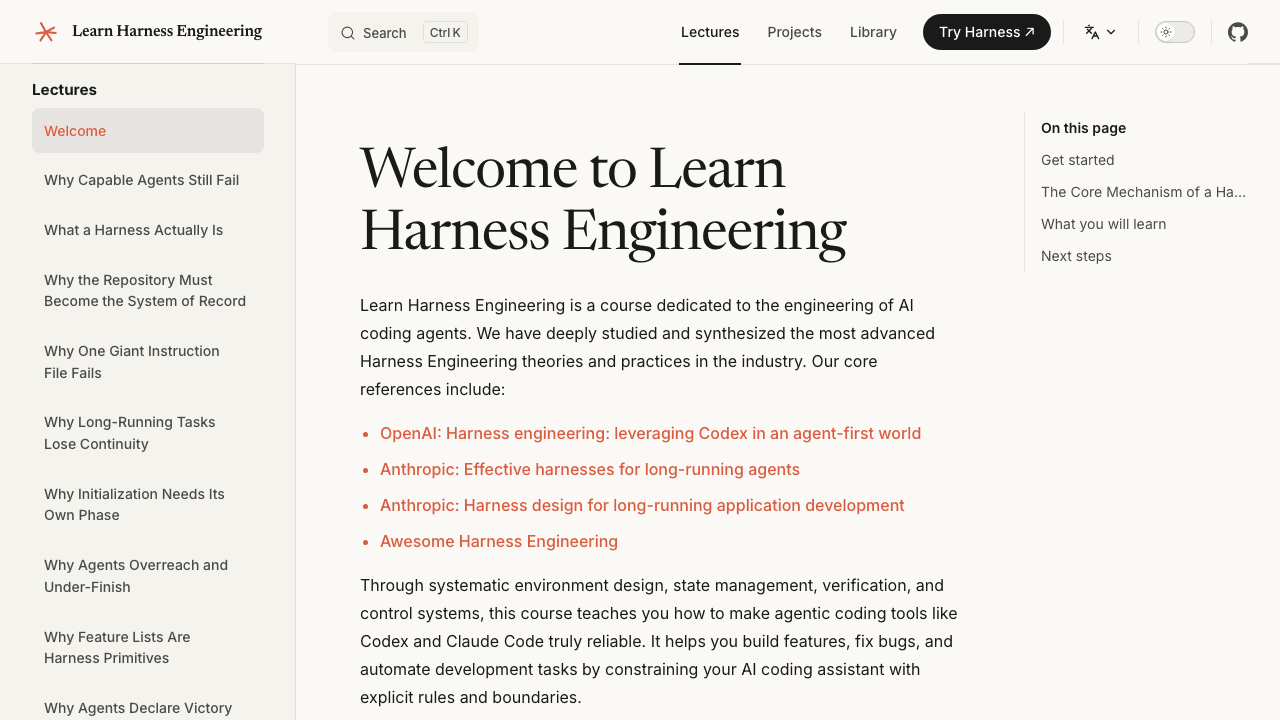 walkinglabs/learn-harness-engineering
Harness engineering beginner tutorial, from 0 to 1
walkinglabs/learn-harness-engineering
Harness engineering beginner tutorial, from 0 to 1
-
 awesome-dsh-plugin/awesome-dsh-plugin
A curated list of plugins for DeepSeek Harness (dsh) · DeepSeek Harness 插件精选列表
awesome-dsh-plugin/awesome-dsh-plugin
A curated list of plugins for DeepSeek Harness (dsh) · DeepSeek Harness 插件精选列表
-
 MemTensor/MemOS
Self-evolving memory OS for LLM & AI Agents: ultra-persistent memory, hybrid-retrieval, and cross-task skill reuse, with…
MemTensor/MemOS
Self-evolving memory OS for LLM & AI Agents: ultra-persistent memory, hybrid-retrieval, and cross-task skill reuse, with…
- yjh051108/dsh-routing-suite dsh-routing-suite — injector + router-standard kit: install the runtime injector first, then the task-aware reasoning-mo…