loongsuite/dsh-plugin
为DeepSeek Harness(dsh)提供OpenTelemetry追踪:将每个智能体交互转化为GenAI跨度树——包括步骤、带TTFT的LLM调用、工具执行和令牌使用情况——通过标准OTLP导出至Jaeger、Grafana Tempo、SigNoz、Langfuse或任何兼容的后端。
Project Overview项目介绍
This is a native open-source observability plugin built exclusively for DeepSeek Harness (DSH). It is the official DSH integration for the LoongSuite OpenTelemetry-based observability ecosystem. The plugin monitors DSH’s core runtime events including native sessions, agent loops, LLM streams, and tool lifecycles. It converts these events into standard OpenTelemetry GenAI traces and metrics, then exports them via OTLP/HTTP protobuf to any OpenTelemetry-compatible backend. It does not require a sidecar, local tap, or any specific vendor backend to work properly.
To install the plugin, you can add it to any DSH profile (web or headless) via the DSH CLI command dsh plugin --profile <profile-name> add @loongsuite/dsh-plugin. If you do not already have an OTLP backend set up, the repository includes a quickstart example that spins up a local Jaeger backend in three simple commands. After installation, you configure the plugin via standard OpenTelemetry environment variables or DSH’s own profile configuration file. Common configuration options include endpoint settings, service name, content capture toggle, and export batch size limits.
Content capture is disabled by default to protect user privacy. When enabled, it can export prompts, responses, tool definitions, and call results to your configured backend, which may include sensitive data like source code or user credentials, so you should review your backend access and retention policies before turning it on. The plugin requires Node.js 22.19.0 or newer, and only supports DSH versions from 0.1.0-rc.6 up to 0.2.0. It is released under the permissive Apache 2.0 open-source license, and the stable 0.1.x release is ready for production use.
这是一款专为DeepSeek Harness (DSH) 打造的原生可观测性插件,属于LoongSuite开源可观测性生态的一部分。它可以监听DSH原生会话、代理循环、LLM流和工具生命周期,将这些数据转换为OpenTelemetry GenAI标准格式的追踪数据和指标,再通过OTLP/HTTP协议导出到任意兼容后端。它不依赖第三方边车或特定厂商后端。
插件遵循清晰的分层数据模型,每个DSH交互轮次生成单个结构化追踪,包含ENTRY、AGENT、STEP、LLM、TOOL层级Span,重试、错误、异常终止、子会话都能正确关联记录,同时还会导出LLM调用延迟和token用量指标。用户可以从npm或DSH插件市场直接安装,支持通过环境变量或配置文件调整参数。
默认关闭内容捕获,仅导出结构元数据和用量统计,开启后可导出提示词、响应、工具内容,需注意敏感数据隐私。要求Node.js版本不低于22.19.0,仅支持DSH 0.1.0-rc.6及以上版本,采用Apache 2.0开源协议,提供快速启动示例方便新手上手。
请帮我安装这个 DSH 插件。安装前先完成【兼容性检查 + 安全性检查】,检查通过再动手。

插件:dsh-plugin(loongsuite/dsh-plugin)
仓库:https://github.com/loongsuite/dsh-plugin
本站详情页:https://www.yhbd.top/plugins/loongsuite-dsh-plugin/
本站登记:类型 plugin · 归类 原生 DSH 插件 · 许可证 Apache-2.0 · ⭐ 25 · 最近提交 2026-08-25 · 主语言 TypeScript

按下面顺序执行,每步先把结论告诉我,再进入下一步:

【1 兼容性检查】
① 我这边:DSH 版本、Node 版本、操作系统、当前 profile(web / desktop)。
② 读它的 README、package.json、插件 manifest,列出它要求的 DSH 版本 / Node 版本 / 操作系统 / 外部依赖 / 需要另外先装的运行时。
③ 逐条比对,结论只写「满足 / 不满足 / 未知」三种;不满足的给出可行替代方案。
④ 检查是否和我已装的插件冲突:命令名重复、skill / tool 重名、端口占用、重复注册的 MCP server。

【2 安全性检查】
① 仓库可信度:和上面「本站登记」是否一致;star / fork 数、创建时间、最近提交,是否归档或长期停更。
② 安装脚本:逐行看 package.json 的 preinstall / install / postinstall,以及 install.sh、setup.ps1 之类脚本。出现 curl|bash、下载后直接执行、混淆代码、访问与插件功能无关的域名,立刻停下来告诉我,不要继续装。
③ 依赖:列出新增依赖,标出无人维护、或与知名包拼写近似的可疑包(typosquatting)。
④ 权限与副作用:它会读写哪些目录、访问哪些域名、需要哪些 DSH 权限(filesystem / network / shell / clipboard 等),以及怎么卸载和回滚。
⑤ 如果它要求 sudo / 管理员权限,或权限明显超出功能所需,先停下来问我。

【3 安装】
上面两步没有「不满足」和「高危项」时才执行;用官方推荐方式安装,不要自行提权。

【4 汇报】
用表格输出:检查项 / 结论 / 依据 / 是否需要我决策。拿不准的一律写「未知」并说明要我怎么确认——不要猜,也不要替我决定。
Send this message to DSH in your current session: it verifies compatibility and security first (answering met / not met / unknown item by item) and only installs once everything checks out — it will stop and ask you if it finds a high-risk item. The box scrolls; the copy is the full prompt. CLI install commands may not be accurate across systems, so DSH is the safer route.把上面这条消息直接发给当前会话里的 DSH:它会先核对兼容性与安全性(逐条给「满足 / 不满足 / 未知」),确认没问题再安装,有高危项会停下来问你。框内可滚动,复制到的是完整提示词;安装命令不一定准确,发给 DSH 更稳。
- 25 stars - an early-stage project星标 25,属于早期项目
DSH walks through these 9 checksDSH 会逐条核对这 9 项
Compatibility兼容性
- DSH, Node, OS and profile requirementsDSH 版本 / Node 版本 / 操作系统 / profile 是否满足要求
- External dependencies and runtimes (Electron / Python / Docker, ...)外部依赖与运行时(Electron / Python / Docker 等)是否齐备
- Conflicts with installed plugins: command names, skill / tool names, ports, duplicate MCP registration与已装插件是否冲突:命令名、skill / tool 重名、端口占用、重复 MCP 注册
Security安全性
- Repo matches the facts registered here; archived or abandoned?仓库是否与页面登记一致,是否归档或长期停更
- Safety of preinstall / install / postinstall and install.sh / setup.ps1preinstall / install / postinstall 与 install.sh、setup.ps1 是否安全
- curl|bash, download-then-execute, obfuscation, unrelated domains → stop immediatelycurl|bash、下载即执行、混淆代码、无关域名 → 立刻停止
- Typosquatting or unmaintained packages among the new dependencies新增依赖里有没有 typosquatting 或无人维护的包
- Requested permissions vs. what the feature actually needs申请了哪些权限、是否超出功能所需(filesystem / network / shell / clipboard)
- Any sudo / admin requirement, plus uninstall and rollback是否要求 sudo / 管理员权限,以及卸载与回滚方式
Anything uncertain must be marked unknown with a note on how to confirm it. This site's signal screen is a static snapshot, not a security audit.拿不准的必须标「未知」并说明要我怎么确认。本站的信号筛查是静态快照,不能替代安全审计。
Or use CLI install (for developers)或使用命令行安装(适合开发者)
CLI Install命令行安装
dsh plugin --profile web add @loongsuite/dsh-plugin把 loongsuite/dsh-plugin 加入你的 DSH 配置(web profile)即可启用。
READMEREADME
LoongSuite observability for DeepSeek Harness
English | 简体中文
@loongsuite/dsh-plugin is a standalone, open-source observability plugin for
DeepSeek Harness (dsh). It observes DSH's native
session, agent loop, LLM stream, and tool lifecycle, converts them into OpenTelemetry GenAI traces
and metrics, and exports standard OTLP/HTTP protobuf to any compatible backend.
LoongSuite is an open-source observability collection ecosystem built on OpenTelemetry. This repository is its native DSH integration. The plugin does not depend on or require LoongSuite Pilot, a sidecar, a local JSONL tap, or any particular vendor's backend.
Status: stable
0.1.xrelease. Install@loongsuite/dsh-pluginfrom npm or the DSH plugin market.
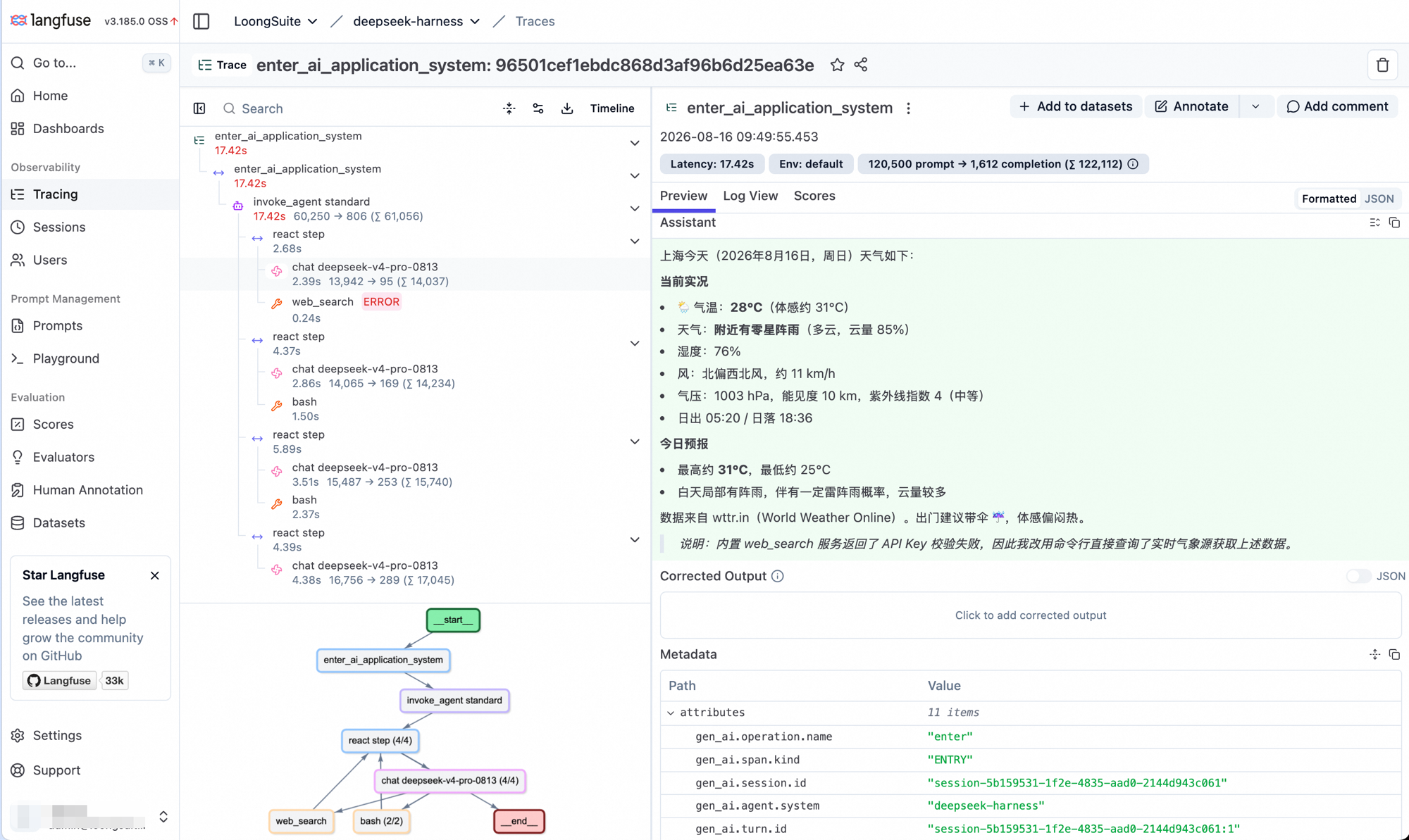
One DSH turn exported over OTLP into self-hosted Langfuse: four react steps, per-call latency
and token counts, a failed web_search followed by bash fallbacks, and the
ENTRY span's GenAI attributes. Content capture was enabled for this capture; it is off by
default.
Data model
DSH session/event + llm/stream
                │
                ▼
      lifecycle coordinator
                │
                ▼
   LoongSuite GenAI OTel utility
                │
                ▼
 private TracerProvider + MeterProvider
                │  OTLP/HTTP protobuf
                ▼
  any OpenTelemetry-compatible backend
One DSH turn produces a single trace with this shape:
ENTRY
└── AGENT
    └── STEP
        ├── LLM
        └── TOOL
Each real LLM attempt gets its own LLM span, so retries remain visible under the same step. Tool
calls are correlated with their results by DSH call ID. Errors, aborts, incomplete streams, and
plugin shutdown close live spans with an error status instead of leaving them open. Subagent
sessions create their own trace and carry DSH parent-session and delegation attributes.
When content capture is enabled, ENTRY and AGENT input messages contain only the turn's direct
source.kind=user input. Synthetic DSH context such as runtime snapshots, agent instructions,
skill catalogs, goals, and coordinator relays remains visible on the LLM span, but prior-turn
conversation history is excluded so every trace contains only its own turn context. Later LLM
spans in a tool loop retain assistant tool calls and tool results produced earlier in the same
turn. ENTRY and AGENT output messages contain only the final stop response; a turn that never
reaches stop falls back to its last available assistant message.
Showing the opening section of the README — the full document lives in the repository以上为 README 开头摘要,完整文档在仓库内 · View the full README on GitHub →在 GitHub 查看完整 README →
Related相关推荐
-
 kc0ed/dsh-bottom-bar
用于提供更丰富的DeepSeek Harness底栏信息显示插件
kc0ed/dsh-bottom-bar
用于提供更丰富的DeepSeek Harness底栏信息显示插件
- Zenjibad/llmtrim-stats-plugin Live llmtrim savings dashboard inside the DeepSeek Harness (DSH) Web UI: a settings dashboard plus a rotating carousel s…
-
 nocobase/nocobase
NocoBase is an open-source AI + no-code platform for building business systems fast. Instead of generating everything fr…
nocobase/nocobase
NocoBase is an open-source AI + no-code platform for building business systems fast. Instead of generating everything fr…
-
 TencentCloudBase/CloudBase-AI-Toolkit
Backend for AI coding agents on CloudBase — database, auth, functions via Plugin, Skills & MCP.
TencentCloudBase/CloudBase-AI-Toolkit
Backend for AI coding agents on CloudBase — database, auth, functions via Plugin, Skills & MCP.
-
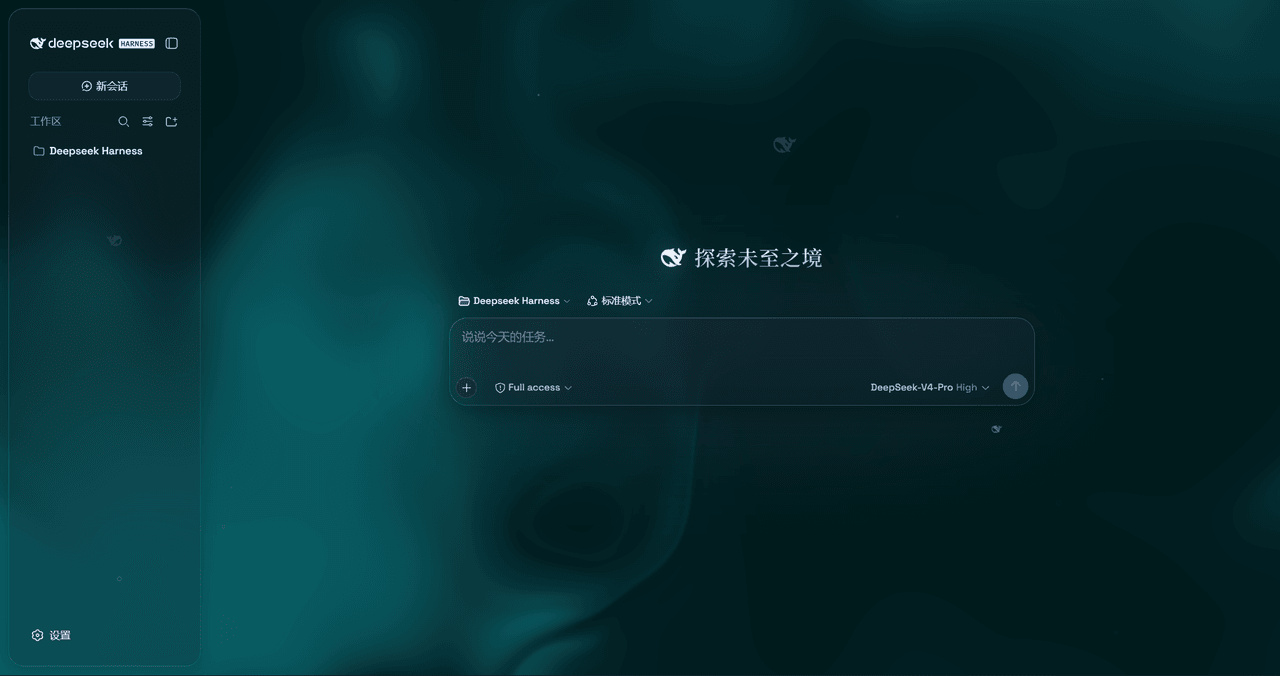 WYH66666666/DSH-Transparent-UI-Plugin
是一层高自由度的玻璃质感主题,套在 DeepSeek Harness 网页端。顶栏、侧边栏、输入框、统计行、轨迹视图都成了磨砂玻璃片。玻璃模糊度、磨砂度、背景(流体或自定义壁纸,壁纸还能单独调模糊和磨砂)全都能在设置卡片里自由调节。关掉开关…
WYH66666666/DSH-Transparent-UI-Plugin
是一层高自由度的玻璃质感主题,套在 DeepSeek Harness 网页端。顶栏、侧边栏、输入框、统计行、轨迹视图都成了磨砂玻璃片。玻璃模糊度、磨砂度、背景(流体或自定义壁纸,壁纸还能单独调模糊和磨砂)全都能在设置卡片里自由调节。关掉开关…
-
 Nagi-ovo/dsh-visualize
在 DSH 对话中生成交互式可视化|Render model-generated interactive cards inside DSH conversations
Nagi-ovo/dsh-visualize
在 DSH 对话中生成交互式可视化|Render model-generated interactive cards inside DSH conversations
-
 SepineTam/mcp-for-stata
Stata-MCP: A MCP server for integrating Stata into your agent loop with a safety-first design.
SepineTam/mcp-for-stata
Stata-MCP: A MCP server for integrating Stata into your agent loop with a safety-first design.
-
 omdsh-dev/dsh-data-agent
Connect DSH to your database for conversational data analysis and actionable business insights.
omdsh-dev/dsh-data-agent
Connect DSH to your database for conversational data analysis and actionable business insights.