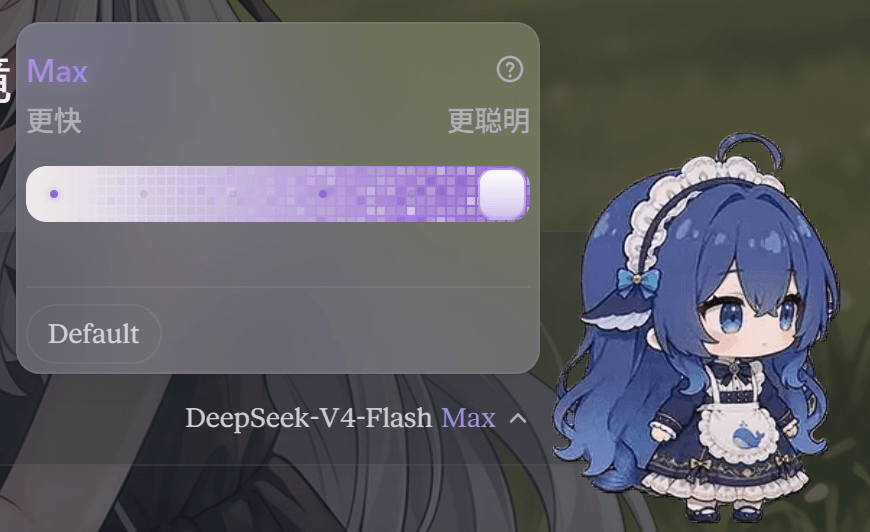
MEMZ-JZY/DSH-Claude-Style-Reasoning-Slider
DSH Claude Style Reasoning Slider 是一个 DeepSeek Harness(DSH)客户端 UI 插件,它将原生模型选择器替换为带 Claude 风格动画的推理等级滑块与模型选择器。
项目介绍Project Overview
DSH Claude 风格推理滑块是一款 DeepSeek Harness 插件,用 Claude 风格动画滑块替换原生模型选择器的 reasoningEffort 槽位,提供 Off 到 Max 六档规范化刻度、别名容错、降级提示及模型切换时保留档位等能力。适用于希望统一不同供应商推理强度交互、获得可视化调节体验的场景。注意:未声明推理元数据的模型仅显示 Default 与提示,Max 像素场与梁祖立绘等特效需 WebP 资源正常加载。
DSH Claude Style Reasoning Slider is a DeepSeek Harness plugin that replaces the native model selector's reasoningEffort slot with a Claude-style animated slider, offering six canonical stops from Off to Max, tolerant name matching, automatic downgrade with toast feedback, and effort preservation when switching models. Use it when you want a unified, visual reasoning-effort control across providers. Note: models without reasoning metadata show only a Default pill and notice, and the Liang portrait plus Max pixel field require the bundled WebP and sprite assets to load.
请帮我了解并安装插件:【DSH-Claude-Style-Reasoning-Slider】【https://github.com/MEMZ-JZY/DSH-Claude-Style-Reasoning-Slider】把上面这条消息直接发给当前会话里的 DSH,让它帮你了解并安装。安装命令不一定准确,发给 DSH 更稳。Send this message to DSH in your current session. CLI install commands may not be accurate across systems — DSH will figure it out for you.
或使用命令行安装(适合开发者)Or use CLI install (for developers)
命令行安装CLI Install
dsh plugin --profile web add github:MEMZ-JZY/DSH-Claude-Style-Reasoning-Slider把 MEMZ-JZY/DSH-Claude-Style-Reasoning-Slider 加入你的 DSH 配置(web profile)即可启用。
READMEREADME
DSH Claude Style Reasoning Slider
An animated reasoning-effort slider and model picker for DeepSeek Harness (DSH).
It replaces the native model selector's conversation.input.model slot with a
compatible selector whose reasoning pane is a Claude-style animated slider.
🇨🇳 中文版说明请见 README.zh.md
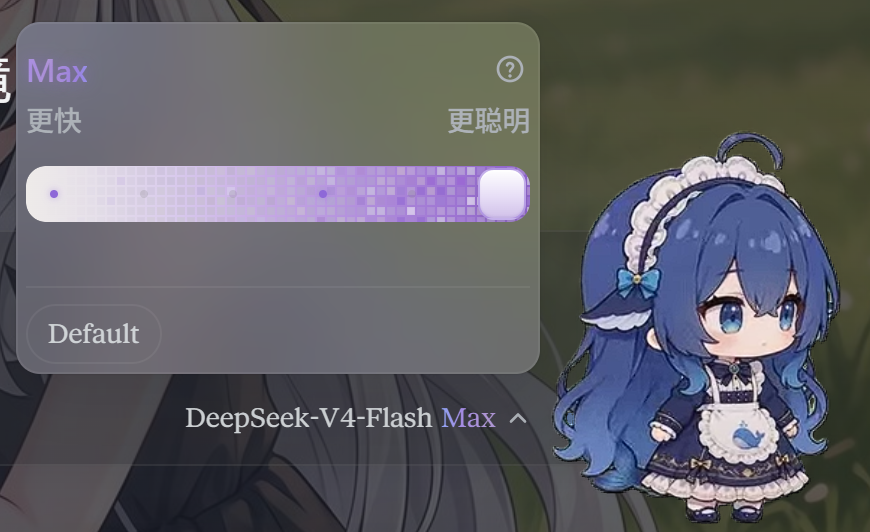
Preview
Features
- Drop-in model selector — replaces only the
conversation.input.modelslot; the rest of the chat input stays untouched. - Canonical effort slider — always shows
Off | Low | Medium | High | Extra | Maxpositions, regardless of how the provider names its levels. - Tolerant name matching — aliases such as
off,none,disabled,ultracode→max,med→medium,extreme→extra, and similar display names are mapped to canonical slider positions. - Unsupported levels stay visible — a level the current model does not support is dimmed but remains clickable. Clicking it keeps the thumb on the chosen slot and applies the nearest supported level below it, with a toast explaining the downgrade.
- Model switching preserves effort — when you switch models, the current effort is kept when possible, or automatically downgraded to the nearest supported level below it (with a toast).
- Default and adapter-specific strengths —
Defaultis offered as a pill below the slider and submits withoutreasoningEffort(the provider's own default applies). Other provider strengths that do not map to a canonical slider position are also shown as selectable pills. - Models without reasoning metadata stay manageable — when DSH does not
expose
reasoning/effortsfor the selected model (for example some OpenRouter or hand-declared custom entries), the Effort menu still appears: it shows a short “no effort levels” notice plus the safeDefaultpill, instead of hiding every thinking-strength control. - Liang Calibrator (滑动变祖器) — optional, off by default. Binds the six
canonical levels to stage names:
Off → 小难梁,Low → 牢梁,Medium → 梁子,High → 梁圣,Extra → 梁神,Max → 梁祖. When enabled, a 31-frame portrait (frame-00…frame-30) appears above the slider and follows the thumb continuously while dragging, then snaps to the segment's first frame on release. Labels and the trigger showMax 梁祖-style suffixes. The setting persists inlocalStorage. - Big Fat Fish thumb — optional, off by default. Replaces the slider thumb
with an 8-frame running chibi fish sprite. The idle animation loops at
720ms, speeds up to420mswhile dragging, and freezes underprefers-reduced-motion. Toggle it in DSH Settings → General → Big Fat Fish slider; changes apply immediately and persist inlocalStorage. - High / Extra ripple field —
HighandExtranow show a sparse blue / purple dot-matrix field with random flicker and radial water ripples around the thumb, as a lighter prelude to theMaxpixel field. - Max / Ultracode treatment — the model's
max/ultracodelevel turns the slider into an animated purple pixel field, and theMaxlabel becomes a flowing multi-color gradient text. - Localized and theme-aware — ships with English and Simplified Chinese dictionaries and follows DSH light/dark design tokens.
- Accessible — keyboard-operable slider (arrows, Home/End, PageUp/PageDown),
ARIA labels, focus management, and
prefers-reduced-motionsupport.
Install
Install the bundle from the Git repository:
dsh plugin --profile web add github:MEMZ-JZY/DSH-Claude-Style-Reasoning-Slider
dsh --profile web
Or use a local checkout:
dsh plugin --profile web add ./dsh-client-ui-effort-slider
Restart the web profile after installing or removing the bundle.
Usage
- Click the model/effort trigger chip in the conversation input.
- In the popup menu, choose Model to switch models, or Effort to adjust the reasoning level of the current model.
- In the effort pane:
- Drag or click the slider to pick
Off,Low,Medium,High,Extra, orMax. - If a position is unsupported, the thumb stays where you clicked and the nearest supported level below is applied; a toast tells you what happened.
- Click Default to remove
reasoningEffortand let the provider decide. - Click any extra pill to apply a provider-specific strength that does not map to a slider position.
- If the model has no declared reasoning levels, the pane shows a notice
and only the Default pill. For providers that do support effort but
are configured without
reasoningEfforts(common with custom OpenRouter routes), add the levels in DSH'sllm-pi-aisettings to get the full slider back.
- Drag or click the slider to pick
- When switching models, the plugin preserves the current effort level where
supported; otherwise it downgrades to the nearest supported level below or
falls back to
Default, always with a toast. - To enable the Liang Calibrator, click the
滑动变祖器switch below the track. The portrait and stage-name suffixes turn on immediately; the state is remembered across sessions. - To enable the Big Fat Fish thumb, open DSH Settings → General and turn on Big Fat Fish slider. The thumb changes immediately without a restart.
UI effects
- Trigger chip — shows the current model and effort label, six rising
signal bars that fill with the current level, and a chevron. At
Maxthe effort label flows as a purple gradient. With the Liang Calibrator enabled it also shows stage suffixes such asMax 梁祖. - Two-level popup menu — a compact menu with a model list (grouped by provider) and an effort pane; loading/error/retry states are included.
- Glass track — inner bevel shadows and a subtle fractal-noise layer break up flat-color banding.
- Light field — the track responds to the pointer like a light source: an
interior light pool and a glass-edge highlight follow the cursor, brightening
as the pointer approaches and fading with distance. The light is suppressed
at
Maxso the pixel field stays clean. - Level labels — faint tick labels; the current level is always shown, hovering near a slot highlights it, and others stay barely visible.
- Liang portrait — when the Liang Calibrator is enabled, a
224pxsquare portrait appears above the track. It uses 31 WebP frames (frame-00…frame-30) that change continuously while dragging and keep the original scanline + light-spot texture. - Liang toggle indicator — the
滑动变祖器switch below the track uses a dot indicator: a gray dot when off, a glowing purple dot when on. - High / Extra dot-matrix ripple —
High(blue) andExtra(purple) show a sparse particle field that expands from the thumb, flickers randomly, and animates bright/dark water ripples radiating outward. - Max pixel field — at
Maxthe track becomes an animated purple pixel field with a reveal sweep and flowing cell flicker; theMaxlabel uses a flowing multi-color gradient. - Big Fat Fish thumb — when enabled, the thumb becomes an 8-frame running
chibi fish sprite. It loops at
720mswhen idle,420mswhile dragging, and freezes under reduced motion. The left edge stays aligned and the right edge is clamped so the fish never overflows. - Motion safety — effects use CSS transitions/animations or lightweight
event handlers, and
prefers-reduced-motionis respected.
Development
Build the client bundle from source:
npm install
npm run build
lib/client.js is generated from src/client.js plus src/ds-effort-slider.js
by scripts/build-client.mjs.
Run the standalone component demo:
# open demo/index.html in a browser
The demo page exercises panel mode, inline mode, supported-level combinations, theme switching, the Max pixel field, the Liang Calibrator, and the Big Fat Fish thumb.
Package contract
This is a DSH bundle, not a dynamic cordis_define snippet. The package uses:
dsh.bundle.patch(cordis.patch.yml) for self-registration.dsh.client.platform: webfor the browser half.lib/client.jsas a prebuilt ModuleLoader artifact, generated fromsrc/.index.jsas the host half: it mounts an/effort-slider-assets/static route that servesassets/liang-frames/*.webpandassets/chibi-runner-strip.pngto the browser half.
Files
index.js— host half; serves the Liang portrait frames and chibi sprite.src/ds-effort-slider.js— standalone Web Component (shadow DOM, no framework).src/client.js— React wrapper + forked model selector plugin logic.scripts/build-client.mjs— bundle generator.demo/index.html— standalone UI demo.assets/—liang-frames/(31 WebP frames) andchibi-runner-strip.png.
相关推荐Related
-
 vibeinging/dsh-desktop
DeepSeek Harness Desktop App: a local AI desktop workspace for DSH Sessions, projects, files, web research, plugins, and…
vibeinging/dsh-desktop
DeepSeek Harness Desktop App: a local AI desktop workspace for DSH Sessions, projects, files, web research, plugins, and…
-
 EthanYoQ/AI-Novel-Writer
AI 小说创作软件:把灵感、角色、世界观、大纲、章节写作、审稿和修稿组织成可控流程;提供 Windows/macOS 桌面版、Ollama 与 DSH 插件预览。
EthanYoQ/AI-Novel-Writer
AI 小说创作软件:把灵感、角色、世界观、大纲、章节写作、审稿和修稿组织成可控流程;提供 Windows/macOS 桌面版、Ollama 与 DSH 插件预览。
-
 zuorn/Tydora
Let Your Ideas Flow — Tydora is a modern desktop Markdown editor combining WYSIWYG editing, bidirectional links, mind ma…
zuorn/Tydora
Let Your Ideas Flow — Tydora is a modern desktop Markdown editor combining WYSIWYG editing, bidirectional links, mind ma…
-
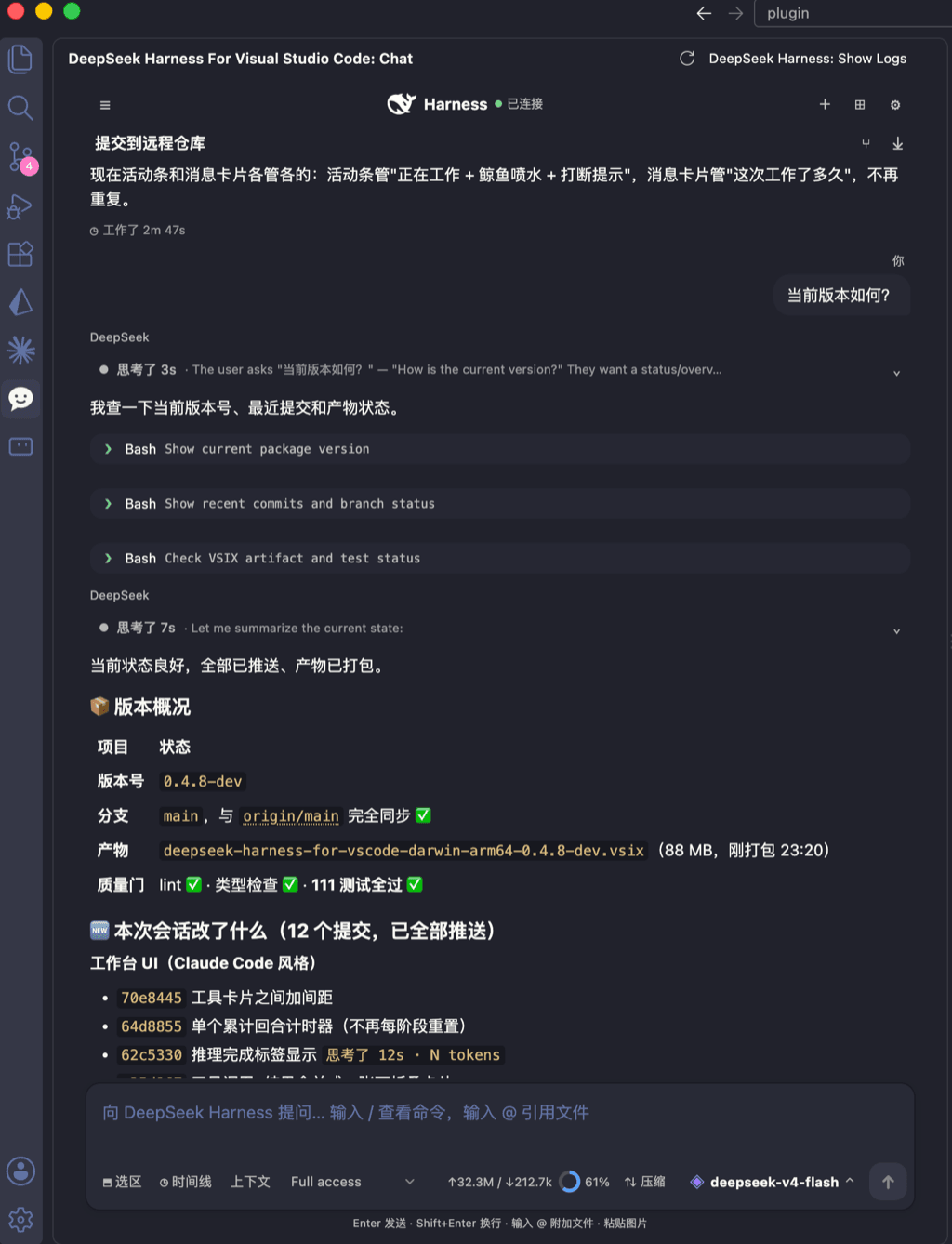 skymecode/deepseek-harness-for-vscode
deepseek-harness for vscode .A native VS Code coding-agent extension for DeepSeek Harness. Streamlined workbench with se…
skymecode/deepseek-harness-for-vscode
deepseek-harness for vscode .A native VS Code coding-agent extension for DeepSeek Harness. Streamlined workbench with se…
- ExElectron/dsh-tool-hongtou DeepSeek Harness 红头公文插件:两阶段解耦流水线(LLM 结构化提纲 + 确定性 Word 2003 XML 版式渲染)生成标准红头公文
- c-ling/dsh-plugin-newsboard DeepSeek Harness 网页端的 AI 与科技快讯看板:内置 RSS/JSON 源驱动的可拖拽浮窗,支持双语翻译、关键词过滤和设置页。
- bwndlct/dsh-session-export Export DeepSeek Harness (DSH) sessions to portable Markdown and JSON — dsh plugin
- Lisk809/dsh-dream-incubator 让 DeepSeek Harness 拥有潜意识:后台异步做梦,把日常对话与工具日志酿成梦境报告,呈现在沉浸式 WebUI 中