Nexus-Aethra/DSHBox
Manage DeepSeek Harness locally: run multiple DSH versions in isolated containers, open the UI in an embedded WebView, import plugins/skills with one click, share extension bundles, and let a queued task system handle installs with live logs. Zero-dependency installer.
安装Install
dsh plugin --profile web add github:Nexus-Aethra/DSHBox把 Nexus-Aethra/DSHBox 加入你的 DSH 配置(web profile)即可启用。
READMEREADME
DSH Box
Managed DeepSeek Harness desktop runtime — run, isolate, and extend multiple DeepSeek Harness environments on your own machine, no browser tab required.
DSH Box is a lightweight desktop shell built with Tauri 2 that installs, launches, and manages independent DSH Containers — each with its own DSH version, profile, plugins, skills, workspace, and logs — and renders them in an embedded WebView.
Highlights
- Isolated DSH Containers — install multiple DSH versions side by side and create independent Containers per project. Every Container gets its own profile (
web/headless/ custom), workspace, plugin set, and host process, so experiments never cross-contaminate. - Embedded WebView, no browser needed — the DSH frontend opens in a native WebView window managed by DSH Box. No port-forwarding, no copy-pasting URLs, no tab clutter.
- Zero-dependency install — a private Node, npm, pnpm, and Git (Windows) runtime is bundled with every release. No system Node, no manual toolchain setup, no PATH hacking. Git-backed Boxfile sources (
github.com/owner/repo:tag) resolve through the managed binary in DSH Box's clean-room environment — host~/.gitconfignever leaks into builds. On Linux, DSH Box uses your system Git (apt install git) while still isolating its configuration under the runtime directory. - Version manager built in — browse DSH releases from
deepseek-ai/deepseek-harness, install or uninstall any tag with one click, and pin a version per Container. - Boxfile / sealed-template pipeline — describe a Container with a small declarative
.dshscript (FROM+PROFILE+ADD plugin|skill|data);dshbox buildproduces a reusable source recipe anddshbox run <template>prepares it once in the final Container directory. See Architecture → Boxfile. - Portable built templates — building a Boxfile materialises its plugin, skill, and data payloads into the template. Containers receive their own copied payloads, so they do not depend on workspace paths, pnpm links, or a mutable extension repository.
- Windows-first runtime recovery — on Windows, DSH Box recovers from a first-run pnpm junction-validation failure after dependencies were materialised, and allocates a fresh loopback port immediately before Host launch. Transient loopback bind failures are retried without rebuilding the frontend.
- In-container agent awareness — DSH Box injects a
dsh-box-contextplugin into every Container so the in-session agent seespaths.dshboxHomeandpaths.dshboxCliand can manage DSH Boxes (containers, templates, plugins) even when it does not inherit a sanePATH. - Extension & Skill repository — import plugins and skills from a GitHub URL, a local directory, or a tarball, then install them into any Container's profile with a single click. Skills are auto-sorted into the Container's skill root.
- Bundle (整合包) workflow — group any mix of plugins and skills into a named bundle, then export it two ways:
- Quick export: GitHub-sourced entries are kept as URLs, keeping the archive tiny.
- Full export: everything is packed into one portable
.tar.gz. - Bundles can be re-imported (with your choice of overwrite or keep on name clashes) and installed into any Container — plugins land in the profile, skills are sorted automatically.
- Smart background tasks — every long operation (install, start, rebuild, import, export) runs as a visible queued task with real-time scrolling logs, cancel/retry/delete, and history paging. Nothing feels like it "just froze".
- Dual-mode RPC + live event stream — the daemon owns all state changes and exposes them through a single
POST /rpc(sync or async — the daemon decides) and a long-livedGET /events?token=…SSE stream. CLI, UI, and external agents talk to the same endpoints; UI pages contain zero business logic. - Network-friendly — automatic proxy detection for GitHub clones, configurable GitHub mirror, and npm registry mirror for installs inside DSH.
- Background service & tray — a small
dshboxdsidecar keeps things tidy, and a system tray icon lets you control it without keeping the main window open. - Lightweight by design — Tauri-based, so the installer is small and the memory footprint stays far below Electron alternatives.
- Bilingual UI — English and 简体中文, switchable in Settings.
Install
Download the installer for your platform from the Releases page of this repository:
| Platform | Artifact | Notes |
|---|---|---|
| Windows (x64) | dshbox_<version>_x64_<locale>.msi |
MSI installer with bundled runtime and sidecar |
| Linux (x64) | dshbox-<version>-amd64.deb |
Debian/Ubuntu package |
| macOS (arm64) | dshbox-<version>-arm64.dmg |
Apple Silicon |
Grab the latest version from the Releases page — artifact names follow the
<product>-<version>-<arch>convention and may differ per release. Other formats (.msi,.rpm,.AppImage) are produced per release where supported.
No runtime prerequisites on Windows — the bundled Node/npm/pnpm/Git runtime travels inside the installer. Linux needs a system Git (apt install git or your distro equivalent); its configuration is isolated per-runtime-directory, so your host ~/.gitconfig is never read by DSH Box builds.
Quick start
- Launch DSH Box and pick a writable runtime directory when prompted (all DSH data lives there).
- Open Resources → DSH Versions → Load versions, then install the DSH tag you want.
- Open Resources → Templates, then pull an official DSH template or build a reusable template from a Boxfile.
- Open Container → create a Container from that template (name and profile).
- The first create prepares the Container in its final directory (offline dependency install, local plugins, frontend build). Press Start — DSH Box launches that prepared copy and opens the DSH UI in the embedded WebView.
- Use Resources to import plugins/skills, assemble bundles, or create Boxfiles for reusable plugin-enabled templates.
Tray
The app minimizes to the system tray on close. Use the tray menu to open the window or start/stop/restart the dshboxd background service.
Architecture
DSH Box separates a Tauri desktop shell, a framework-free Rust workspace, a background daemon (dshboxd), and a small React frontend. The split exists so all business logic — plugin fetching, container lifecycle, template resolution, background tasks — is testable without a UI, and so a CLI or external agent can drive the same flows the UI does.
Layered components
| Layer | What lives here | Why |
|---|---|---|
Frontend (React 18 + Vite, src/) |
Pages, components, useTaskQueue/useContainers/useResources/useSettings hooks. No business logic — pages fire RPC requests and react to daemon SSE events. |
Keeps the Box UI thin and lets any client (UI/CLI/agent) share the same code path. |
Desktop shell (Tauri 2, src-tauri/src/) |
Browser window, tray, Tauri IPC adapters. Listens on 127.0.0.1 to the daemon's loopback HTTP server. All real work is delegated to dshboxd over HTTP RPC. |
One source of truth for state changes — UI and CLI cannot drift. |
Daemon (src-tauri/crates/dshboxd) |
Long-lived background service. Owns the queue, the data store, the template index, container registry, and the SSE event bus. Single HTTP entry point (POST /rpc) plus GET /events?token=…. |
Background work (installs, rebuilds, uninstalls) survives the desktop window closing. |
Crate workspace (src-tauri/crates/) |
Framework-free Rust crates: box-foundation, box-runtime, box-scheduler, box-state, box-toolchains, box-dsh-versions, box-containers, box-extensions, box-image, box-template-core, box-data-scheduler, box-logger, box-dsh-context, box-server-core, box-api, box-client. |
Pure functions + unit tests; only the top-level dshbox binary and dshboxd link Tauri/HTTP. |
The dependency direction is one-way: foundation / runtime / scheduler / state → functional crates → Tauri/desktop adapters. Feature crates do not depend on Tauri or one another's mutable state.
Daemon — dual-mode RPC + SSE event stream
Every UI / CLI action lands on POST /rpc with a JSON body of {"method": "...", "params": {...}, "token": "..."}. The daemon's dispatch table decides for each handler whether to synchronously return JSON (List templates, Read settings, …) or asynchronously enqueue a worker (Install, Build, Start container, Rebuild, Uninstall, …). Async handlers return a TaskRecord immediately; the client subscribes to GET /events?token=… for task:stage / task:log / task:finished / resource:added|updated|removed events.
This means the same HTTP surface serves every consumer — the desktop app's Tauri IPC handlers, the CLI (dshbox rpc …), and external agents calling curl -d '…' http://127.0.0.1:7923/rpc. There is no "client fallback" or local-state divergence: the daemon's resource map and task queue are the only sources of truth.
Boxfile and the built-template pipeline
A boxfile (.dsh) is the declarative script that describes a Container you want to instantiate. dshbox build resolves it into a sealed template recipe: physical Harness source without node_modules, plus the profile, local plugin artifacts, skills, and data needed by its ADD directives. dshbox run <template> copies it to the final Container directory, performs offline install, adds local artifacts, and builds once; later starts do none of those steps.
The full grammar is in docs/template-system.md; the canonical reference example (every source shape) is in examples/boxfile-plugin-chains.dsh. Here is the minimal form:
FROM github.com/deepseek-ai/deepseek-harness:latest
PROFILE web
NAME my-team

ADD plugin github.com/owner/cordis-plugin-foo:1.2.3
ADD plugin npm:@linxin666/dsh-web-ui-all
ADD plugin ./plugins/secret
ADD skill team-conventions
| Directive | Required | Notes |
|---|---|---|
FROM <ref> |
yes (exactly once) | GitHub short form (`github.com/owner/repo[:tag |
PROFILE <name> |
yes (exactly once) | Target DSH profile (web, headless, …). |
NAME <image-name> |
no | Defaults to the script file's stem. |
VERSION <image-version> |
no | Defaults to latest. |
LABEL key=value |
repeatable | Free-form metadata attached to the built template. |
DEF <name> @<path> |
repeatable | Defines a path alias usable as @<name> in subsequent ADD lines. |
ADD plugin|skill|data <src> [@<dest>] |
one or more | Resource you want baked into every Container made from this template. |
CP <src> [@<dest>] |
alias for ADD plugin |
Kept for backward compatibility. |
<src> accepts four shapes:
- GitHub short form —
github.com/owner/repo[:tag|@ref]. The GitHub branch resolves throughpnpm packand the same fetching/import pipeline as npm; a tagged release becomes aref_onParsedSource::Github. - Tarball —
https://…/pkg.tgz,./relative.tgz,/abs/path.tgz. Anything fetched and unpacked as a tarball. - Local directory —
./plugins/foo//abs/path/foo. Imported directly (no archive round-trip) — useful for plugins in progress. - Bare name —
name[@version]or@scope/name[@version]for plugins already in the Repository. - Explicit prefixes —
git:…(clones via libgit2, no guessing) andnpm:…(registry spec forwarded to pnpm).
The :latest tag and the explicit latest keyword are interchangeable; both pin the harness repository's main branch.
How each ADD is stored matters:
ADD plugin— the source is imported into the shared Repository as an immutable localartifact.tgz, recorded by the sealed recipe, then added only while preparing a Container at its final path. No running Container has an absolute repository path or runs a plugin dependency install.ADD skillandADD data— snapshotted into the data store (<runtime>/data/<digest>/), materialised in the built template, and copied into the Container profile.- The bundled
dsh-box-contextplugin (@deepseek-ai/dsh-box-context) is copied automatically — you do not need toADDit.
dshbox build writes a digest-addressed sealed template. dshbox run <name> then:
- Resolves the template's
FROMchain (max depth 4), - Creates
<runtime>/instances/<id>/{profile,workspace,state,logs}, - Copies the template's materialised plugins/skills/data into the profile,
- Allocates a loopback port immediately before host spawn,
- Launches bundled
pnpm dsh webfrom the Container's Harness copy and waits for readiness, - Writes
paths.dshboxHome+paths.dshboxCliinto the snapshot so the in-container agent can find the CLI.
The full storage, transaction, and migration contract is in docs/specs/prepared-template-runtime.md. This is a schema break: legacy shared runtimes/<version>/source layouts are not used by new builds.
Data scheduler and reference counts
Containers, templates, plugins, and skill packs all share a single resource-map.json indexed by id. Deletion is soft-delete → fast queue → permanent delete; references between Container ↔ template ↔ plugin are kept in lockstep so an entity still in use is never garbage-collected. Full design in docs/specs/data-scheduler.md.
Logging
tracing + tracing-subscriber ship structured logs to <runtime>/logs/<component>.log (daily rolled) and mirror to stderr. Filter with RUST_LOG, e.g. RUST_LOG=info,dshboxd=debug,box_template_core=debug.
Technology
| Layer | Stack |
|---|---|
| Desktop shell | Tauri 2, Rust (Cargo workspace under src-tauri/) |
| UI | React 18, TypeScript, Vite |
| Background service | dshboxd sidecar (single HTTP entry: POST /rpc + GET /events) |
| Bundled runtime | Node / npm / pnpm / Git-Windows-only (per-platform archive, SHA-256-pinned in runtime-lock.json) |
| Targets | Windows x64/arm64, Linux x64/arm64, macOS x64/arm64 |
Building from source
Prerequisites: Node.js 20+ with pnpm, the Tauri 2 prerequisites for your platform, and 7-Zip (needed once by runtime:prepare to unpack the Windows PortableGit archive — install from 7-zip.org or apt install p7zip-full, and make sure 7z is on PATH). 7-Zip is a build-time-only tool; it never ships in the installer.
pnpm install
pnpm runtime:prepare    # fetch + verify + extract the bundled Node/pnpm/Git runtime
pnpm server:prepare     # build the dshboxd sidecar
pnpm tauri dev          # run in development
runtime:prepare verifies every archive against the SHA-256 pins in runtime-lock.json before extraction and aborts on mismatch. If 7-Zip is missing the Git step is skipped with a warning (Node/pnpm still prepare); re-run after installing it.
Release bundles (per platform):
pnpm bundle:windows     # Windows MSI installer
pnpm bundle:linux       # Linux .deb
pnpm bundle:macos       # macOS .dmg
Run the test suite:
cd src-tauri && cargo test --workspace
Repository layout
src/                       React/TypeScript management UI
src-tauri/                 Rust workspace + Tauri shell
  crates/                  focused, framework-free crates
    box-foundation         config, paths, JSON persistence
    box-runtime            absolute-path process exec
    box-scheduler          persisted task queue + locks
    box-state              ResourceStateManager (read model)
    box-toolchains         bundled Node/pnpm resolver
    box-dsh-versions       DSH GitHub catalogue (harness tag + installs)
    box-containers         Container metadata + active Host registry
    box-extensions         repository plugin/skill scan + transfer
    box-image              .dsh parser, manifest v6, gzip tar I/O
    box-template-core      root/common template install/uninstall core
    box-data-scheduler     soft-delete + dual-queue async hard-delete
    box-logger             tracing init + daily-rolled log files
    box-dsh-context        dsh-box-context plugin (paths.dshboxHome/dshboxCli)
  src/desktop/app/         domain modules (containers, extensions, tasks, …)
examples/                  boxfile.dsh + plugin-chains example
docs/                      HANDOFF.md, architecture.md, template-system.md,
                           specs/, design/, notes/
The canonical reference for the boxfile grammar is docs/template-system.md; image/built-template design lives in docs/specs/image-build.md; the full RPC + event-stream surface in docs/design/rpc-and-events.md.
License
Proprietary — see repository owner for licensing terms.
© Nexus-Aethra
相关推荐Related
- Nagi-ovo/voyager Enhancement suite for Gemini, AI Studio, Claude & ChatGPT — plus a prompt manager for any web UI, DeepSeek Harness inclu…
-
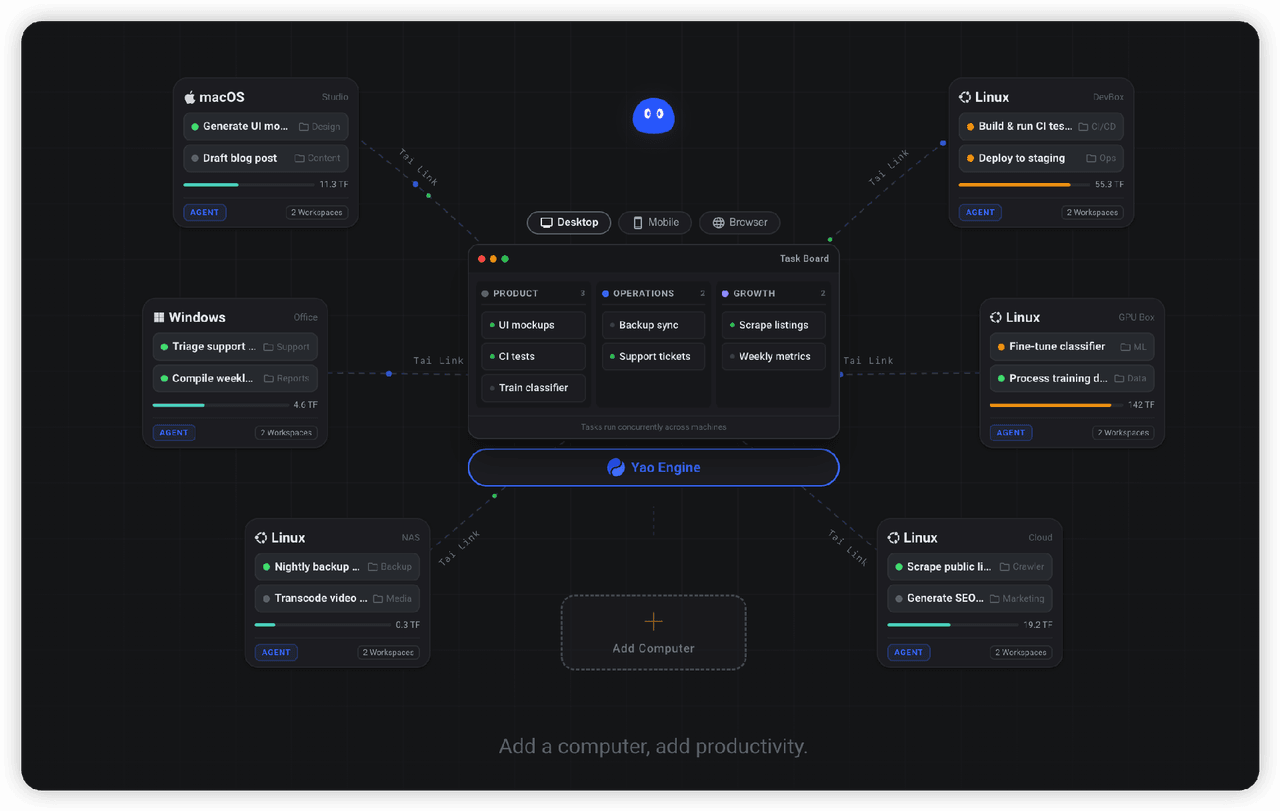 YaoApp/yao
✨ All your agents and workspaces in one place, on every device you own. Track tasks on a board, accessible from desktop,…
YaoApp/yao
✨ All your agents and workspaces in one place, on every device you own. Track tasks on a board, accessible from desktop,…
-
 zhu1090093659/dsh-web-ui
Plugin and skin collection for DeepSeek Harness (DSH) Web UI - task board, git graph, right-side panel, remote mobile UI…
zhu1090093659/dsh-web-ui
Plugin and skin collection for DeepSeek Harness (DSH) Web UI - task board, git graph, right-side panel, remote mobile UI…
-
 omdsh-dev/DSH-better-sidebar
开放的侧边栏底座,支持三方拓展注册新侧边栏页面。内置文件渲染编辑/终端/侧边对话/Git/子代理页面 | Open sidebar foundation, supports third-party extensions to registe…
omdsh-dev/DSH-better-sidebar
开放的侧边栏底座,支持三方拓展注册新侧边栏页面。内置文件渲染编辑/终端/侧边对话/Git/子代理页面 | Open sidebar foundation, supports third-party extensions to registe…
-
 Tencent/BrowserSkill
Let AI agents use your real, logged-in browser without interrupting your work. CLI + extension for browser automation ac…
Tencent/BrowserSkill
Let AI agents use your real, logged-in browser without interrupting your work. CLI + extension for browser automation ac…
-
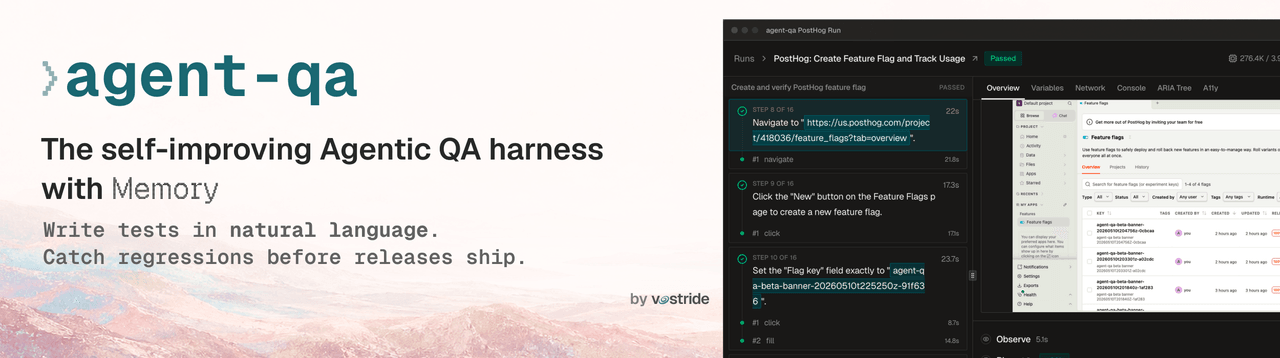 vostride/agent-qa
Open-source self-improving QA agent for software teams. A test harness with memory. Write tests in natural language for …
vostride/agent-qa
Open-source self-improving QA agent for software teams. A test harness with memory. Write tests in natural language for …
-
 MemTensor/memmy-agent
🍙 A personal AI agent & local memory hub for all AI agents, gives every AI one shared, fully controlled memory and per…
MemTensor/memmy-agent
🍙 A personal AI agent & local memory hub for all AI agents, gives every AI one shared, fully controlled memory and per…
-
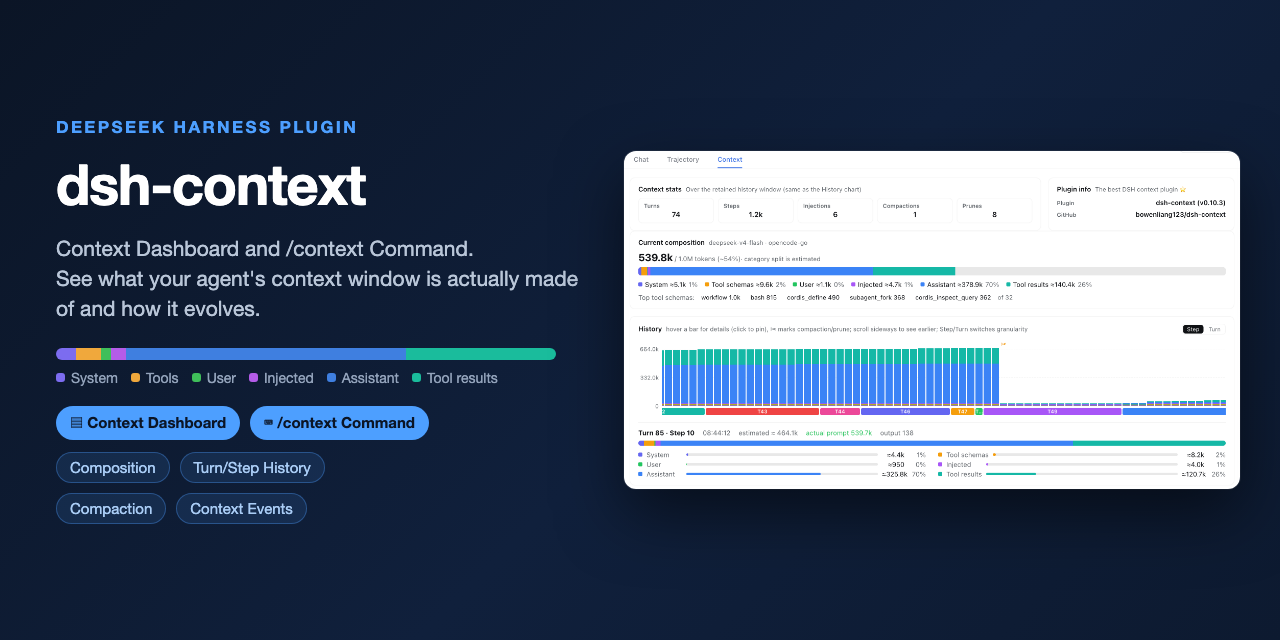 bowenliang123/dsh-context
The best DeepSeek Harness plugin for context insight and management, with context dashboard / browser and context comman…
bowenliang123/dsh-context
The best DeepSeek Harness plugin for context insight and management, with context dashboard / browser and context comman…